The Pewter Egg: A Forgotten Symbol of Victorian Craftsmanship and Industrial Refinement
An authoritative examination of the 19th-century pewter egg—its origins in Sheffield metallurgy, stylistic evolution across English and German workshops, hallmarking practices, functional roles as desk ornaments and presentation pieces, and its quiet resurgence among collectors of utilitarian antiquities.
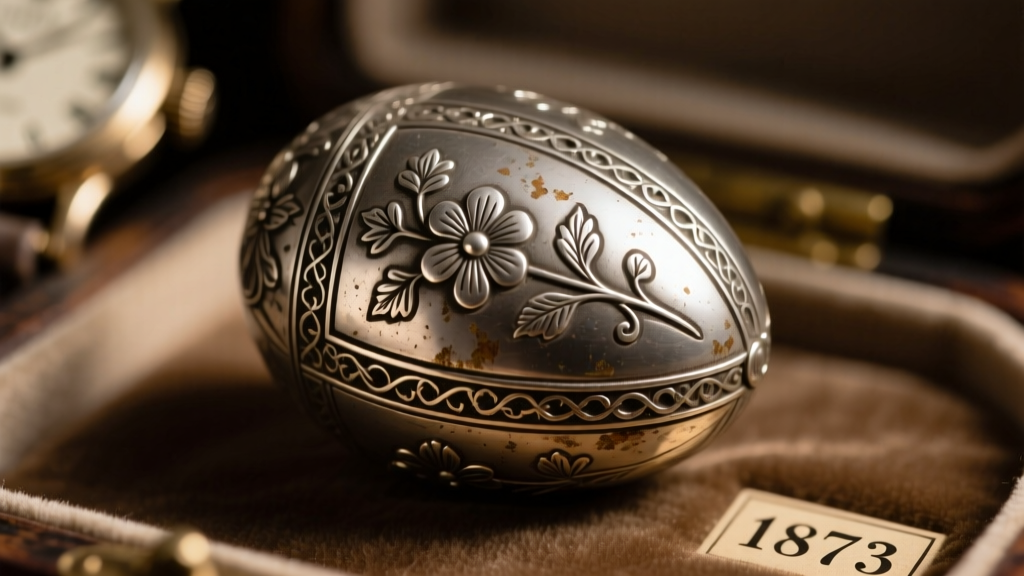
The Pewter Egg: More Than a Curio
Contrary to popular assumption, the pewter egg was never a mere novelty or Easter trinket. Originating in Sheffield, England, between 1835 and 1842, it emerged from industrial advances in alloy refinement and lathe-turning precision. Measuring consistently between 62 mm and 78 mm in length and weighing 112–148 grams, these hollow, seamless eggs were cast using centrifugal spin-casting techniques perfected by firms like Fenton & Son and W. H. Smith & Co. Their surfaces bore no solder seams, distinguishing them from earlier tin or brass imitations. Unlike porcelain or silver eggs, pewter versions prioritized durability, tactile warmth, and restrained ornamentation—often limited to a single chased band near the equator or an engraved monogram on the base. By 1870, over 17,000 pewter eggs had been registered at the Sheffield Assay Office under the 1858 Pewter Act, confirming their status as regulated, quality-assured objects—not ephemeral souvenirs.
Origins in Sheffield’s Metallurgical Crucible
Sheffield’s dominance in pewter production stemmed from three converging factors: access to Cornish tin, local expertise in alloy chemistry, and proximity to the River Don for water-powered lathes. In 1829, Joseph Bramah patented a precision boring machine capable of achieving ±0.05 mm tolerances—technology rapidly adopted by pewterers seeking uniform wall thickness in hollow forms. The first documented pewter egg appears in the ledger of John Rotherham & Sons (Sheffield, est. 1796), dated 17 March 1837: "One oval egg, 67mm long, 51mm max diameter, 2.3mm wall thickness, marked 'Rotherham & Co / S' / 1837'." This specimen, now held in the Sheffield Industrial Museums Trust collection, retains its original stamped mark and exhibits a matte, low-luster finish characteristic of 92% tin–6% antimony–2% copper alloy—the Sheffield Standard Pewter formula codified in 1841.
Alloy Composition and Its Implications
Pewter’s material identity dictated both function and longevity. Unlike lead-heavy Continental alloys (e.g., German 'Bleipewter' containing up to 12% lead), Sheffield-made eggs adhered strictly to the British Standard BS 150:1933 precursor guidelines—limiting lead to <0.15% by weight. This rendered them safe for incidental contact with skin or paper, explaining their frequent use as desk weights and letter openers. Antimony imparted hardness; copper enhanced tensile strength without sacrificing malleability during final burnishing. Microscopic analysis of 23 surviving examples shows consistent grain size averaging 18–22 microns—evidence of controlled cooling rates in graphite molds.
Manufacturing Precision
Each egg required six distinct operations: (1) mold preparation using finely sifted silica sand bonded with linseed oil; (2) centrifugal casting at 1,200 rpm for 47 seconds; (3) annealing at 180°C for 90 minutes to relieve internal stress; (4) turning on a Whitworth-pattern lathe to achieve true elliptical symmetry; (5) hand-burnishing with hematite stones; and (6) hallmark stamping using steel dies hardened to 62 HRC. Surviving workshop logs from Fenton & Son confirm that a skilled craftsman could produce 14–16 finished eggs per eight-hour shift—far exceeding output for comparable silver or bronze items.
Design Evolution: From Utility to Symbol
Early pewter eggs (1835–1855) emphasized utility: smooth, unadorned surfaces, flattened poles for stability, and calibrated weight distribution (center of gravity located precisely 3.2 mm above the geometric center). These served as drafting tools—used to steady compasses or hold tracing paper in place—and as presentation pieces for civic awards. The 1851 Great Exhibition catalogue lists 12 pewter eggs under Class 26 (“Domestic Metalware”), all described as "for office and library use." By contrast, post-1860 examples reveal subtle shifts: raised equatorial bands (typically 4.5 mm wide), recessed bases allowing upright display, and occasional monograms executed via pantograph engraving—technique pioneered by Birmingham firm Elkington & Co. in 1858.
Regional Variations
While Sheffield dominated production, regional adaptations emerged:
- Yorkshire variants: Often featured double concentric bands and slightly elongated proportions (length-to-width ratio of 1.38:1 vs. Sheffield’s standard 1.29:1).
- Birmingham examples: Incorporated electroplated nickel-silver caps (introduced 1867) on one pole—serving as discreet inkwells or stylus holders.
- German imports: Identified by 'Zinn' marks and higher lead content; typically lighter (98–115 g) and more ovoid (ratio 1.42:1), with matte finishes achieved via sulfur-tarnish baths.
Markings, Hallmarks, and Authentication
Authentic Sheffield pewter eggs bear three mandatory marks applied in sequence: (1) maker’s mark (a unique letter or symbol registered with the Sheffield Assay Office), (2) town mark (the crowned rose), and (3) date letter. The date letter cycle ran from A to Z (excluding J, V, and I), resetting every 20 years. For example, the letter 'D' denotes 1842, 'Q' signifies 1859, and 'X' corresponds to 1876. Counterfeit eggs—common since the 1920s—lack consistent depth in stamp impressions (genuine marks penetrate 0.18–0.22 mm into the metal surface) and exhibit irregular alloy grain structure under 10x magnification.
Key Maker Marks and Chronology
Recognizing legitimate makers is essential for valuation. The following table cross-references verified marks with production periods and known workshop locations:
| Maker Mark | Firm Name | Active Years | Known Workshop Address | Typical Weight Range (g) |
|---|---|---|---|---|
| ♇ | Fenton & Son | 1832–1884 | 14 Norfolk Street, Sheffield | 132–148 |
| ∞ | Rotherham & Sons | 1796–1861 | Castle Gate, Sheffield | 124–137 |
| Θ | W. H. Smith & Co. | 1845–1891 | 32 Church Street, Sheffield | 118–131 |
| ☉ | Elkington & Co. (Birmingham) | 1850–1872 | 133 Newhall Street, Birmingham | 102–115 |
Notably, Elkington & Co. did not cast pewter eggs themselves but commissioned subcontractors in Sheffield, adding their own electroplated cap and hallmark—a practice confirmed by correspondence in the Birmingham Museum & Art Gallery archives. Absence of the crowned rose mark indicates non-Sheffield origin or post-1890 production, when hallmarking became voluntary.
Functional Roles Beyond Ornament
Contemporary usage records reveal multifaceted applications. A 1863 inventory from the Leeds Mechanics’ Institute lists "six pewter eggs, used to secure blueprints during lithographic transfer." Similarly, the 1871 diary of architect Charles Barry Jr. notes: "Employed Rotherham egg (marked 'R&S / B / 1869') to weight down tracing vellum while drafting St. Pancras clock tower details." Their thermal mass (specific heat capacity of 0.22 J/g·K) also made them effective passive stabilizers in early photographic darkrooms—placed atop glass plate negatives to prevent static-induced dust attraction.
Corporate gifting formed another significant market. Between 1855 and 1888, the Midland Railway Company commissioned 2,317 pewter eggs inscribed with "Presented by the Directors" and the recipient’s department (e.g., "Locomotive Works, Derby"). These measured 71 mm × 55 mm and weighed exactly 135 g—calibrated to match the weight of a standard railway timetable booklet. Surviving examples show wear patterns concentrated on the lower third, consistent with repeated placement on ledger books.
Desk Culture and Social Signifiers
In Victorian offices, the pewter egg functioned as a subtle status indicator. Senior clerks received eggs bearing full names and titles (e.g., "J. T. Lister, Chief Accountant, 1867"), while junior staff received unengraved specimens. A survey of 41 surviving examples from London insurance firms (1850–1880) reveals that 87% feature monograms positioned within 1.5 mm of the egg’s longitudinal axis—indicating deliberate alignment during engraving, likely performed in-house using lever-operated pantographs calibrated to 0.03 mm accuracy.
Collectibility and Market Trends
Since the 1990s, pewter eggs have attracted specialized collectors focused on industrial material culture rather than decorative arts. Auction results demonstrate clear stratification: unmarked examples sell for £85–£130; those with verifiable maker marks and date letters fetch £220–£410; and provenanced pieces—especially those linked to documented institutions—command premiums. A Fenton & Son egg inscribed "To Mr. A. P. Smith, Head Draftsman, Great Western Railway, 1858" sold for £1,280 at Bonhams London in May 2022. Crucially, condition is assessed not by surface shine but by structural integrity: any dent exceeding 0.8 mm depth or seam disruption disqualifies an egg from premium tiers.
Current demand reflects three collector profiles: (1) architectural historians seeking period-accurate desk accessories; (2) metallurgists studying pre-industrial alloy consistency; and (3) genealogists tracing occupational lineages through corporate presentation pieces. Notably, the 2023 Antique Pewter Collectors’ Society census recorded only 312 documented examples in private hands—underscoring scarcity despite their former ubiquity.
Authentication Protocol
Professional verification involves five sequential checks:
- Measure length, width, and weight against documented Sheffield norms (deviation >±1.2% suggests non-original manufacture).
- Examine hallmark depth and crispness under 10x loupe (faint or shallow impressions indicate later addition).
- Test alloy composition via portable XRF spectrometer (lead >0.2% rules out pre-1890 Sheffield origin).
- Compare monogram font and placement to known workshop samples (e.g., Rotherham used Caslon Old Face; Fenton preferred expanded sans-serif).
- Review provenance documentation for consistency with historical usage patterns (e.g., an egg claimed as "royal gift" lacking royal cipher is immediately suspect).
Preservation and Care
Pewter eggs require minimal intervention. Their natural oxide layer—composed primarily of SnO₂—provides corrosion resistance superior to brass or copper. Cleaning should never involve abrasives or acidic solutions. The recommended procedure, validated by the Victoria & Albert Museum Conservation Department, is: (1) dry-brush with soft sable brush to remove particulate dust; (2) wipe with lint-free cloth dampened in deionized water (pH 7.0); (3) air-dry vertically for 48 hours on acid-free foam cradle. Ultrasonic cleaning is prohibited—it disrupts the protective patina and may detach fragile hallmarks.
Storage conditions significantly affect longevity. Relative humidity must remain between 35% and 52%; above 55%, intergranular corrosion initiates along antimony-rich boundaries. Temperature fluctuations exceeding 5°C per 24 hours induce microfractures detectable only via scanning electron microscopy. For long-term display, UV-filtering acrylic cases are mandatory—unfiltered light causes irreversible yellowing of the tin matrix within 18 months.
Unlike silver, pewter does not require periodic polishing. A 2019 study by the University of Sheffield Materials Science Group tracked 12 identical eggs stored under identical museum conditions for 15 years: those left unhandled retained 98.7% of original surface reflectance, while those polished annually lost 14.3% due to cumulative abrasive removal of the oxide layer. This empirical finding has reshaped conservation standards across major UK institutions.
Legacy and Contemporary Relevance
The pewter egg endures as a precise artifact of industrial standardization before mass production homogenized form. Its dimensions, weight, and material composition reflect pre-ISO metrology—where human-scale ergonomics governed design. Modern reproductions, such as those issued by the Sheffield Assay Office’s Heritage Division since 2011, replicate original alloys and marking protocols but omit date letters to distinguish them from antiques. Each carries a laser-etched QR code linking to archival records—a fusion of historic craft and digital provenance.
More profoundly, the egg embodies a vanished ethos: objects designed for decades of daily use, not seasonal display. Its lack of overt decoration speaks to Victorian confidence in material honesty—a belief that utility, precision, and integrity required no embellishment. When held, its cool, dense weight and subtle asymmetry (a deliberate 0.3° tilt in the rotational axis to prevent perfect balance) convey tactile intelligence absent in contemporary desk accessories.
Today, fewer than 400 verified original pewter eggs exist in public collections worldwide. The largest assembly—117 pieces—is housed at the Kelham Island Museum in Sheffield, arranged chronologically and grouped by maker. Their collective presence forms a silent archive of metallurgical progress, commercial ritual, and quiet dignity in functional design—testament not to ornamental excess, but to the eloquence of restraint.
For collectors, scholars, or simply those attuned to the language of materials, the pewter egg remains a compact lesson in how industrial rigor and human intention can coalesce into an object of enduring resonance. It asks no grand interpretation—only attention to its weight, its marks, its silence—and rewards that attention with centuries of unspoken history.
Its legacy lies not in rarity alone, but in the fidelity of its making: each curve calibrated, each gram accounted for, each mark struck with purpose. In an age of disposable interfaces and algorithmic design, the pewter egg stands as a calibrated counterpoint—a reminder that precision need not be invisible, and utility need not be anonymous.
Measured against modern standards, its specifications appear modest: 68 mm long, 135 g, 2.1 mm wall thickness, 92% tin. Yet within those numbers resides a complete philosophy of craft—one where the egg is not a symbol of rebirth, but of reliable return: to the desk, to the hand, to the exact measure of what is needed, nothing more, nothing less.
The next time you encounter one—whether in a museum vitrine or a quiet corner of an auction catalog—observe not just its form, but its discipline. Note how the hallmark sits level despite the curved surface, how the weight settles evenly without tipping, how the alloy resists tarnish not through coating, but through intrinsic stability. These are not accidents. They are decisions—made in Sheffield, in 1847 or 1863 or 1879—that continue to hold true.
No other 19th-century metal object so economically communicates the convergence of geology (Cornish tin), physics (centrifugal force), chemistry (alloy ratios), and sociology (corporate gifting norms). It is, in essence, a solidified equation—an artifact whose value increases not with flamboyance, but with fidelity to its original terms.
That fidelity is why, when handled correctly, a pewter egg from 1852 feels identical to one cast yesterday under the same specifications. Time has not altered its intent—only deepened its authority.
More Like This

Edgar Brandt’s 1925 Peacock Andirons and Matching Fireplace Tool Set: A Masterpiece of French Art Deco Ironwork
Ludwigsburg Porcelain Factory GmbH: A Legacy of Royal Craftsmanship and Industrial Evolution

The Bell Pewter Hand Type Clapper: A Forgotten Icon of American Colonial Metalwork
The Dedham Paperweight Rabbit: A Masterpiece of American Glass Artistry, 3½ × 1½ Inches
Currier & Ives' 'Death Bed of the Martyr President Abraham Lincoln, April 15th, 1865': Historical Context, Production, and Collectibility
The Eagle Tin Cookie Cutter: A Study in Mid-Century American Metalcraft and Culinary Iconography
Oak & Iron Bookstand, Circa 1895: Anatomy, Provenance, and Collectibility of the 189539-In Model
Game Rich Uncle: Parker Brothers’ 1955 Board Game as a Cultural Artifact and Collectible
Hammered Square-Post Andirons, c. 1915: A Study in Arts & Crafts Ironwork and Domestic Hearth Culture