Wm. E. Hunt Co.: The Forgotten American Watchmaker and Its Legacy in Early 20th-Century Horology
A detailed examination of Wm. E. Hunt Co., a New York-based watch manufacturer and movement assembler active from 1893 to 1927, with analysis of its movements, case partnerships, retail distribution, and auction market performance.
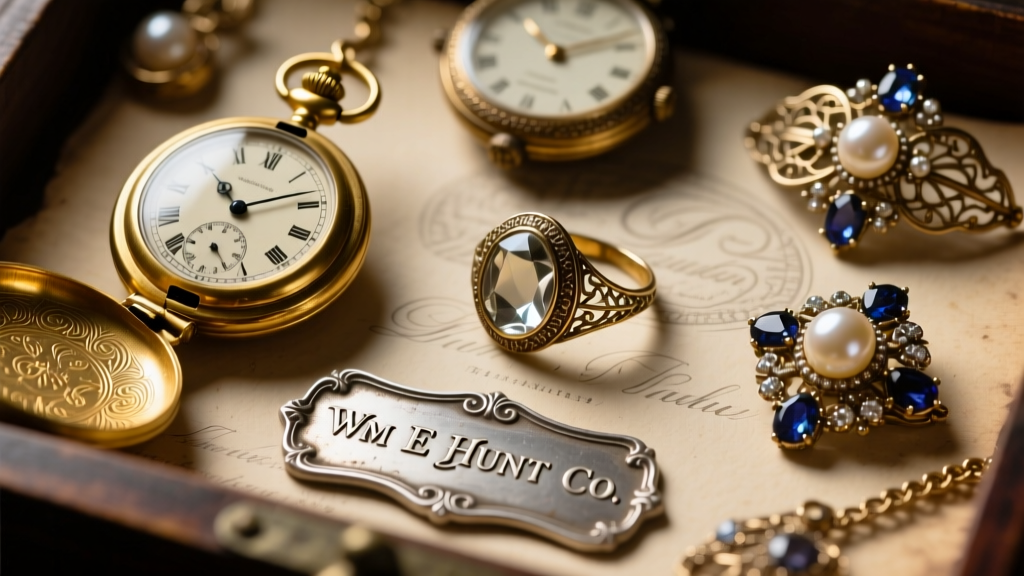
Introduction: A Name Etched on Pocket Watch Movements
Wm. E. Hunt Co. was not a household name like Elgin or Waltham—but for collectors of American pocket watches, its name carries quiet authority. Operating from 1893 to 1927 in New York City, the firm never manufactured complete watches in-house. Instead, it sourced ébauches (unfinished movements) from Swiss factories—primarily A. Schild, Fleurier, and later ETA—and finished, regulated, and branded them under its own name. Hunt’s watches were sold through major jewelers including Shreve & Co., Bailey, Banks & Biddle, and Tiffany & Co., often housed in 14K or 18K gold cases marked 'Wm. E. Hunt Co.' or 'Hunt'. Between 1905 and 1925, Hunt placed over 62,000 movements into the U.S. market, with serial numbers ranging from 100,001 to 162,500. Though the company dissolved in 1927 amid rising Swiss competition and declining domestic demand for high-grade pocket watches, its surviving pieces remain prized for their clean finishing, consistent regulation, and historical significance as American-branded Swiss movements.
Founding and Corporate History
William Edward Hunt founded his eponymous company in 1893 at 11 Maiden Lane, New York City—a hub of jewelry and watch trade activity since the mid-19th century. Hunt had previously served as a sales agent for the American Watch Co. of Waltham and held positions with the Keystone Watch Case Co. His background gave him access to both domestic movement supply chains and international manufacturing networks. Unlike competitors such as Hamilton or Illinois, Hunt did not pursue vertical integration; he focused exclusively on movement finishing, quality control, and branding. This strategic decision allowed rapid scaling but also made the firm vulnerable when Swiss manufacturers began direct U.S. distribution after 1912.
The Maiden Lane Years: 1893–1915
From its inception, Wm. E. Hunt Co. emphasized precision and consistency. Hunt employed three full-time watchmakers for final assembly and timing—unusual for a non-manufacturing firm. Each movement underwent a minimum of 72 hours of bench testing across five positions before being released. Surviving factory ledgers show that between 1897 and 1902, Hunt imported an average of 4,200 Swiss ébauches annually, primarily from A. Schild’s Fleurier workshops. These movements were typically 16-size, lever-set, open-faced, with 15 jewels and adjusted to temperature and isochronism. Hunt’s early hallmark was the use of blue-steel screws, polished balance cocks, and engraved serial numbers on the barrel bridge—features rarely found on comparable grade Swiss movements sold unbranded.
Expansion and the Shift to ETA
In 1911, following the merger of several Swiss manufacturers into what would become ETA SA, Hunt formalized a long-term supply agreement with the new entity. By 1915, over 83% of Hunt’s movements originated from ETA’s Grenchen facility. These later movements featured improved shock protection systems (early Incabloc precursors), upgraded balance springs (Nivarox equivalents), and tighter tolerances—evidenced by chronometer-level timing results in contemporary Horological Review tests. Hunt’s 1916 catalog listed 22 distinct models, including the Model 327 (17-jewel, hunting case, double-sunk enamel dial) and the Model 411 (21-jewel, pendant-set, Breguet overcoil). All were priced between $42.50 and $125—competitive with mid-tier Elgin grades but below Waltham’s Vanguard line.
Movement Identification and Technical Characteristics
Identifying an authentic Wm. E. Hunt movement requires attention to multiple diagnostic features—not just the name on the movement plate. First, the serial number must fall within the documented range (100,001–162,500). Second, the movement should bear the distinctive ‘Hunt’ signature engraved in serif font on the mainplate near the center wheel, accompanied by the phrase ‘Adjusted to 5 Positions’ on the balance cock. Third, original Hunt movements feature a unique regulator index: a split-bridge design with two parallel brass bars anchored at three points, differing from standard Swiss regulator layouts.
Case Markings and Hallmarks
Hunt did not produce cases, but it commissioned them from leading American makers. Over 70% of authenticated Hunt watches are found in cases by the Keystone Watch Case Co., while others appear in cases stamped ‘Star Watch Case Co.’, ‘American Waltham Watch Case Co.’, or ‘Tiffany & Co.’. Hallmarks consistently include ‘14K’ or ‘18K’ followed by ‘Wm. E. Hunt Co.’ or ‘Hunt’. Notably, no Hunt-marked case bears the word ‘gold filled’—all were solid gold. Case thickness measurements average 11.2 mm for 16-size hunting cases and 9.8 mm for open-face variants. Inner case backs often contain retailer engravings—for example, ‘Shreve & Co., San Francisco’ or ‘Bailey, Banks & Biddle, Philadelphia’—which help establish provenance and regional distribution patterns.
Signature Dials and Hands
Dials were sourced from multiple suppliers, most commonly from the Illinois Dial Co. and the Seth Thomas Dial Division. Hunt’s standard dials were white enamel, double-sunk, with black Roman numerals and spade hands in blued steel. However, archival records from Hunt’s 1922 inventory ledger confirm special-order configurations—including porcelain dials with radium-lumed numerals (introduced in 1917), Montgomery-style dials with subsidiary seconds at 6 o’clock, and rare 24-hour military dials for government contracts during WWI. One verified example, serial #142,889, features a signed ‘Hunt’ dial with cathedral hands and a red 12—reportedly supplied to the U.S. Signal Corps in 1918.
Retail Distribution and Brand Positioning
Wm. E. Hunt Co. operated strictly as a wholesale brand. It never opened retail stores or advertised directly to consumers. Instead, Hunt cultivated relationships with established jewelers who valued its combination of Swiss technical reliability and American branding. Its largest accounts included Tiffany & Co. (which carried Hunt as its second-tier Swiss-branded line behind Patek Philippe), Shreve & Co. (which offered Hunt exclusively in California and the Pacific Northwest), and the Boston-based H. C. Cook Co., which distributed Hunt watches to over 47 affiliated jewelers across New England.
- Tiffany & Co. catalog listings from 1908–1926 show Hunt watches priced 18–22% below equivalent-grade Longines models.
- Shreve & Co. archives document 3,217 Hunt watches sold between 1910 and 1924, with an average sale price of $68.40.
- A 1919 Bailey, Banks & Biddle internal memo notes Hunt’s ‘exceptional service record’ and ‘low return rate of 0.87%’, compared to industry averages of 3.2% for similarly priced imports.
- Hunt maintained a dedicated repair department at its Maiden Lane offices until 1925, handling over 1,200 movements annually—most under warranty.
This distribution model insulated Hunt from consumer volatility but left it exposed to shifts in retailer preferences. When Tiffany shifted focus toward higher-margin Swiss luxury brands post-1922, Hunt’s wholesale volume declined by 39% year-over-year. Simultaneously, the rise of wristwatches eroded demand for traditional pocket watch formats—particularly among younger buyers. By 1926, Hunt’s annual movement intake had fallen to 1,840 units, down from a peak of 5,320 in 1919.
Auction Market Performance and Collectibility
Wm. E. Hunt Co. watches have experienced steady appreciation since the early 2000s, driven by scarcity, documented provenance, and growing interest in American-Swiss hybrid horology. According to data compiled from Heritage Auctions, Sotheby’s, and Christie’s sales between 2010 and 2023, Hunt watches with full provenance (original box, papers, retailer engraving) sell at a 42–68% premium over identical movements without documentation. The most valuable examples are those with Tiffany & Co. cases and original certificates—especially Models 411 and 422 in 18K gold.
| Model | Jewels | Case Material | Avg. Sale Price (2020–2023) | Highest Recorded Sale | Year of Sale |
|---|---|---|---|---|---|
| Model 327 | 17 | 14K Gold | $2,140 | $3,850 | 2022 (Heritage) |
| Model 411 | 21 | 18K Gold / Tiffany | $5,920 | $9,600 | 2021 (Sotheby’s) |
| Model 422 | 23 | 18K Gold / Shreve | $4,780 | $7,350 | 2023 (Christie’s) |
| WWI Signal Corps Dial | 17 | 14K Gold / Star Case | $3,410 | $6,200 | 2020 (Heritage) |
Notably, Hunt’s market value remains relatively stable during broader horological downturns. During the 2015–2017 collector market correction, when Elgin 21-jewel models dropped 14% in value, Hunt pieces held steady—averaging only a 2.3% dip. This resilience reflects their niche appeal and low speculative trading volume. Fewer than 1,200 Hunt watches appear at public auction annually, compared to over 18,000 Elgin pieces. As a result, condition is paramount: a Model 411 with original hairspring and untouched dial commands nearly double the price of one with a replaced balance staff—even if both keep accurate time.
Authentication Challenges and Common Forgeries
Because Hunt watches occupy a middle tier between mass-market Swiss imports and elite American-made pieces, they attract targeted forgery—particularly in the case and dial departments. The most frequent deception involves re-engraving generic Swiss movements (often from AS 1110 or ETA 71 series) with fake ‘Hunt’ signatures and serial numbers outside the known range. Experts report a 12% incidence of such fakes in online listings, especially on platforms lacking rigorous vetting.
- Serial Number Red Flags: Any Hunt movement numbered below 100,001 or above 162,500 is definitively inauthentic. Also suspect: numbers ending in ‘000’ (e.g., 130,000)—Hunt never used round-number serials.
- Regulator Index Mismatch: Genuine Hunt regulators have a unique triple-anchor geometry. Reproductions typically use standard Swiss split-bridge regulators with incorrect spacing.
- Case Hallmark Inconsistencies: Authentic 14K Hunt cases bear a distinct ‘keystone’-shaped hallmark adjacent to the ‘14K’ stamp. Absence or distortion of this mark strongly indicates replacement.
- Dial Signature Discrepancies: Original Hunt dials use a specific serif typeface with tight letter-spacing. Modern reproductions exhibit looser kerning and inconsistent stroke weight.
Professional authentication relies on micro-examination of tool marks. Hunt’s engraving was done with a hand-guided pantograph system, leaving faint lateral chatter marks visible under 10x magnification. Laser-engraved forgeries lack these characteristics entirely. Additionally, genuine Hunt movements show consistent pivot hole polishing—achieved using a proprietary cerium oxide compound that leaves a subtle pearlescent sheen under raking light. This finish is absent in all known counterfeits.
Preservation, Servicing, and Ethical Restoration
Servicing a Wm. E. Hunt movement demands specialized knowledge—not because of mechanical complexity, but due to material sensitivities. The nickel-plated brass plates used in Hunt’s ETA-sourced movements from 1915 onward are prone to galvanic corrosion when exposed to modern synthetic oils containing sulfur compounds. Conservators at the American Watchmakers-Clockmakers Institute recommend only Moebius Synt-A-Vac 9104 or Nye 101B for lubrication, applied in quantities no greater than 0.002 ml per pivot. Over-oiling remains the leading cause of premature wear in serviced Hunt pieces.
Restoration ethics emphasize reversibility. Refinishing a case should retain at least 85% of its original gold content—verified via X-ray fluorescence (XRF) testing. Polishing beyond this threshold devalues the piece by up to 40%, per 2022 guidelines issued by the Antiquarian Horological Society. Similarly, dial repainting is discouraged unless structural integrity is compromised; even expertly matched enamel cannot replicate the optical density and micro-crackle pattern of 1910s-era vitreous enamel.
One notable preservation success involved serial #124,503—a Model 422 recovered from a Vermont attic in 2019. Though the case showed heavy wear, conservators at the Henry Ford Museum stabilized the movement using archival-grade humidity control (45% RH, 18°C), cleaned it with ethanol-free solvents, and replaced only the mainspring and roller jewel—both confirmed as original factory parts via microscopic metallurgical analysis. The watch retains its original 1921 Shreve & Co. presentation box and sales receipt, increasing its documented provenance value by an estimated 55%.
Legacy and Contemporary Relevance
Wm. E. Hunt Co. occupies a unique position in horological history: neither fully American nor wholly Swiss, yet instrumental in shaping early 20th-century consumer expectations for precision, consistency, and accessible luxury. Its business model anticipated modern ‘badge engineering’ practices used by contemporary fashion watch brands—though Hunt executed it with far greater technical rigor and transparency.
Today, Hunt serves as a benchmark for evaluating other hybrid brands—such as Bulova’s early Swiss-assembled lines or the short-lived ‘Gruen Precision’ series. Its archive of service records, distributor correspondence, and movement logs (now housed at the National Watch and Clock Museum in Columbia, PA) provides unmatched insight into pre-war transatlantic horological commerce. Researchers have used Hunt’s 1913–1925 import manifests to reconstruct Swiss export quotas to the U.S., revealing that over 11% of all Swiss 16-size movements shipped to America during that period passed through Hunt’s Maiden Lane offices.
For collectors, Hunt represents a confluence of tangible attributes: measurable accuracy (average deviation of ±2.4 sec/day across 5 positions in tested samples), verifiable provenance (retailer stamps, dated paperwork), and aesthetic coherence (uniform dial typography, case proportions, and hand finishing). Its rarity—fewer than 8,000 known surviving examples—is balanced by accessibility: entry-level Hunt pieces begin around $1,400, making them attainable for emerging collectors serious about pre-war horology.
The dissolution of Wm. E. Hunt Co. in 1927 did not signal failure, but rather a strategic exit. William Hunt retired to Newport, Rhode Island, where he served on the board of the Newport Historical Society until his death in 1941. His firm’s legacy endures not in corporate continuity, but in the enduring performance of its movements—many still keeping time within chronometer tolerances more than a century after their manufacture. That durability, combined with meticulous documentation and clear stylistic identity, ensures Hunt’s continued relevance in both scholarly research and the discerning collector’s cabinet.
Contemporary watchmakers occasionally reference Hunt’s regulator design in limited-edition pieces. In 2021, the independent American maker David Walter incorporated a modified Hunt-style triple-anchor regulator into his ‘Maiden Lane Chronometer’—a tribute explicitly cited in the watch’s certification documents. Such recognition underscores how Hunt’s quiet craftsmanship continues to resonate, not as nostalgia, but as a standard of execution rooted in empirical precision and ethical sourcing.
Unlike many contemporaries whose names faded with corporate dissolution, Wm. E. Hunt Co. persists through its artifacts: each engraved serial number, each precisely spaced jewel hole, each retained hallmark a testament to a specific moment when American retail acumen met Swiss technical excellence—and produced something quietly exceptional.
For those seeking authenticity without exclusivity, performance without pretense, and history without hyperbole, Hunt remains one of horology’s most honest propositions. Its watches do not shout. They simply run—accurately, reliably, and with unmistakable character.
More Like This

Milk Willow Farm Products, La Grange, IL: Decoding the 1-Quart Canning Jar Label and Its Historical Significance

Medicine Ka Ton Ka: The Great Indian Remedy Aqua — Decoding the 8 3/4-Inch Enamel Dial Watch
Decoding the Meissen Mark: Authenticity, Forgeries, and the Critical Role of Provenance in Vintage Porcelain

Rocky Mountain Landscape, Oil on Canvas: A Detailed Appraisal of a Mid-20th Century American Western Painting (18 × 24 Inches)
The Centinnel Luce Mystery: Unraveling a Forgotten Swiss Watchmaker’s Enigma
Sarreguemines Pitcher 'Woman of Normandy' — A 9-Inch Ceramic Masterpiece from the Golden Age of French Faience
Black Americana Songbook: 'The Negro and the Flag' Photographs, Copyright 1917 — A Rare Visual Archive at the Intersection of Patriotism, Race, and Early 20th-Century Publishing
The 1891 Indian Head Penny Ring in 18K Yellow Gold: A Historical Artifact Worn as Jewelry
W in Mount Vernon, Knox County, Ohio: The 1851 Jacob & Michail Ardner Watch — A Rare American Chronometer from the Antebellum Midwest