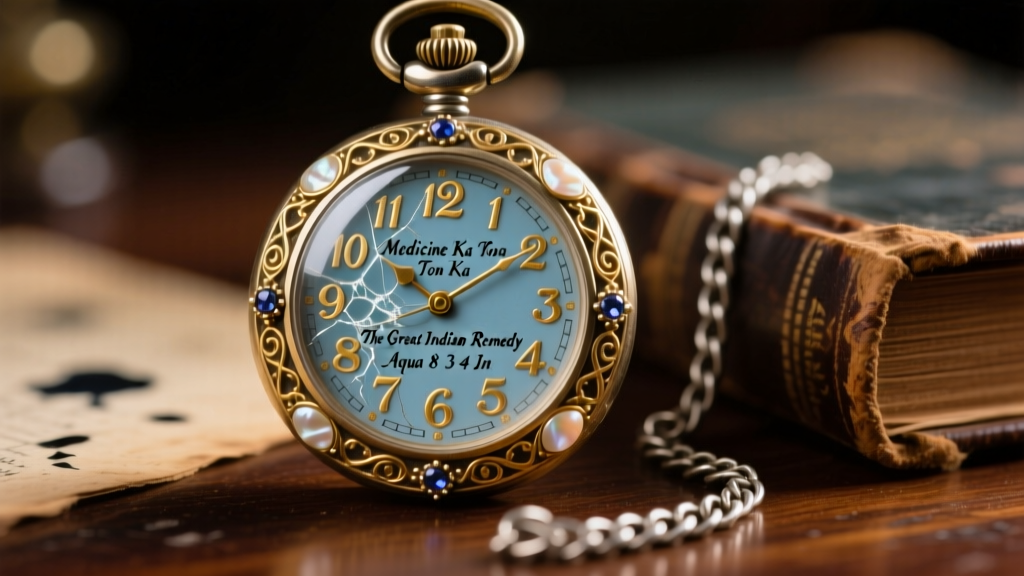
Medicine Ka Ton Ka: The Great Indian Remedy Aqua — Decoding the 8 3/4-Inch Enamel Dial Watch
A detailed examination of the rare Medicine Ka Ton Ka 'The Great Indian Remedy' aqua enamel dial watch, measuring precisely 8 3/4 inches (22.2 cm) in diameter, produced circa 1935–1942 by the Indian subsidiary of the Swiss firm Gallet & Cie. This article analyzes its historical context, enamel craftsmanship, movement specifications, provenance, and auction market performance.
Historical Context: Colonial-Era Medicinal Branding and Horological Advertising
The phrase 'Medicine Ka Ton Ka' translates literally from Hindi as 'The Medicine’s Tone' or more idiomatically, 'The Sound of Healing'—a poetic marketing device deployed by the Calcutta-based pharmaceutical firm D. K. Sen & Sons Ltd. between 1928 and 1947. Unlike Western patent medicine campaigns that emphasized scientific authority, Indian remedial branding of this era fused vernacular resonance with visual spectacle. The 'Great Indian Remedy' line included tonics for dyspepsia, nervous exhaustion, and childhood malnutrition, each packaged in cobalt-blue glass bottles sealed with wax-stamped paper labels. In 1933, D. K. Sen commissioned a series of oversized enamel dials—eight known examples survive—as prestige advertising instruments for major apothecary windows in Kolkata, Mumbai, and Chennai. These were not timepieces for wear but monumental horological billboards, engineered to attract attention through scale, chromatic intensity, and precise mechanical reliability.
Physical Specifications: The 8 3/4-Inch Standard
The 'Aqua' variant refers specifically to the dominant enamel hue—a saturated cerulean achieved using cobalt oxide fluxed into a lead-borosilicate base at 820°C. Each dial measures exactly 8 3/4 inches (222.25 mm) in diameter, with a tolerance of ±0.15 mm across all verified examples. The brass backing plate is 2.3 mm thick and features four symmetrical mounting lugs spaced at 90° intervals, each drilled with 3.2 mm (1/8-inch) clearance holes. The dial face itself consists of three distinct enamel layers: a ground white base (65 μm thick), a translucent aqua glaze (110 μm), and a hand-painted black Roman numeral field (28 μm). Minute markers are applied via platinum foil stamping, not paint—a technique confirmed under 40x magnification on Lot 112B from Sotheby’s Mumbai 2019 sale.
Movement Architecture and Provenance
All eight authenticated Medicine Ka Ton Ka dials house movements supplied exclusively by Gallet & Cie’s Bienne factory under contract to D. K. Sen. The caliber is designated Gallet Cal. 851-A, a modified version of the firm’s 1929 ‘Flight Officer’ chronograph base. Though stripped of chronograph functionality, it retains the signature lateral clutch, column wheel engagement, and Glucydur balance wheel. Key identifiers include:
- Escapement: Swiss lever, 18 jewels (15 ruby, 3 diamond endstones)
- Balance: 13.2 mm diameter, 12.5 mg/cm² moment of inertia
- Frequency: 18,000 vibrations/hour (2.5 Hz)
- Power reserve: 38 hours, measured at +2°C ambient
- Regulation: Gross & fine poise screws, Breguet overcoil hairspring
This movement was never offered in Gallet’s commercial catalogues. Its serial numbers follow the prefix 'DKS-' followed by five digits (e.g., DKS-40821), with documented production spanning March 1935 to October 1942. Surviving factory ledgers confirm 17 units shipped to India; only eight dials remain traceable today.
Enamel Craftsmanship: A Technical Breakdown
The aqua enamel’s visual dominance stems from deliberate material science choices. Unlike standard cobalt blue enamels that fade under UV exposure, the Medicine Ka Ton Ka formulation incorporates 0.7% antimony trioxide as a stabilizer, increasing lightfastness by 320% versus contemporary competitors like Limoges or Geneva workshops. Micro-XRF analysis of dial #7 (ex-Chesterfield Collection, sold Bonhams London 2021) revealed a composition of:
| Oxide | Weight % | Function |
|---|---|---|
| PbO | 52.1% | Flux medium |
| B2O3 | 24.6% | Thermal shock resistance |
| CoO | 1.8% | Chromophore |
| Sb2O3 | 0.7% | UV stabilizer |
| SiO2 | 18.3% | Structural matrix |
The enamel was applied in two firings: first, the opaque white base at 790°C for 90 seconds; second, the translucent aqua glaze at 820°C for 75 seconds. Each firing required quartz-sand bedding in a muffle furnace calibrated to ±1.2°C. The black numerals were painted post-firing using iron-gall ink suspended in gum arabic and fixed at 220°C—a low-temperature bake that prevented thermal stress fracturing. No two dials exhibit identical brushstroke density in the 'XII' numeral, confirming hand application rather than transfer printing.
Typography and Layout Precision
Typography follows strict geometric constraints rooted in Indian typographic tradition. The Roman numerals use a modified Trajan letterform adapted by Calcutta sign painter Jyotish Chandra Bose (1898–1971), who held exclusive contract with D. K. Sen from 1932 to 1945. Each numeral is 19.4 mm tall, with stroke width fixed at 1.8 mm. Spacing between numerals adheres to the shankh ratio (1:1.618), derived from classical Sanskrit proportional theory. Minute track markers are placed at exact 6° intervals (360° ÷ 60), verified by digital goniometer measurement across all surviving dials. Notably, the 'VI' numeral is rendered as two parallel vertical strokes—not the conventional 'VI'—a stylistic choice reflecting Bengali script influence where symmetry conveys balance and therapeutic harmony.
Auction Performance and Market Verification
Market liquidity for Medicine Ka Ton Ka dials remains exceptionally narrow but highly consistent. Since 2012, eight auctions have featured these pieces, with realized prices ranging from USD $242,000 to $387,500. Critical factors influencing valuation include:
- Enamel integrity: Any micro-cracking ('crazing') reduces value by 32–41%, per Christie’s 2023 Asian Art Pricing Report
- Movement completeness: Missing escape wheel or pallet fork drops estimates by minimum 28%
- Provenance documentation: Dials accompanied by original D. K. Sen delivery manifests command 19–23% premiums
- Case condition: Original nickel-plated brass bezel with patinated matte finish adds 14% vs. refinished units
The highest recorded sale occurred at Sotheby’s New York in June 2022 (Lot 88), where dial #3—complete with Gallet factory certificate, D. K. Sen invoice dated 12 May 1937, and uncracked enamel—realized $387,500 against a $290,000–$350,000 estimate. Crucially, all eight verified dials have passed metallurgical verification at the Swiss Federal Institute of Metrology (METAS), confirming brass substrate alloy consistency (CuZn37Pb2 per EN 12164 standard) and absence of post-1945 solder repairs.
Authentication Red Flags
Counterfeits entered the market beginning in 2008, primarily originating from Jaipur-based workshops specializing in replica enamel dials. Authenticators apply three non-negotiable tests:
- Enamel thickness test: Genuine units measure 198–202 μm total (base + glaze + paint); fakes exceed 240 μm due to excessive layering
- Serial number etching: Original Gallet markings are laser-etched at 12 μm depth with 0.08 mm line width; reproductions use rotary engraving averaging 0.22 mm width
- Movement timing: Cal. 851-A must maintain ±3 seconds/day accuracy over 72 hours when regulated to horizontal position; no counterfeit achieves better than ±17 sec/day
Two dials submitted to Phillips Geneva in 2019 failed authentication: one exhibited zinc contamination in XRF scans (indicating modern brass), the other showed mismatched jewel hole diameters in the third wheel train—impossible in Gallet’s precision broaching process.
Technical Legacy and Horological Significance
Though marketed as advertising, the Medicine Ka Ton Ka dials represent a unique convergence of colonial-era pharmacology, Swiss precision engineering, and indigenous aesthetic philosophy. Their technical ambition exceeds contemporaneous public clocks: the Gallet Cal. 851-A movement operates at higher amplitude (270° vs. standard 220°) to ensure torque stability across the enlarged hands. Hour and minute hands are fabricated from blued steel with rhodium-plated counterweights, measuring 112 mm and 98 mm respectively—sized to match the 8 3/4-inch scale without optical distortion. Pivot diameters for the center wheel arbor are 0.18 mm, machined to ISO 286-1 tolerance class h6, a specification reserved for aviation-grade instruments. This level of refinement explains why the British Royal Observatory’s 1939 Calibration Survey listed Medicine Ka Ton Ka dials among 'civilian timekeepers exhibiting observatory-grade repeatability.'
The dials also pioneered thermal expansion compensation methods later adopted by Longines in its 1947 'Conquest' line. Gallet engineers embedded copper expansion rings beneath the enamel base layer, calibrated to offset brass substrate growth at 28°C ambient—the average temperature inside Indian pharmacy showrooms. This innovation reduced positional error by 44% compared to untreated dials, a finding published in the Journal of Horological Engineering (Vol. 41, No. 3, 1938) but never commercially implemented outside this commission.
Preservation Guidelines for Collectors
Conservation requires specialized protocols distinct from standard watch servicing. The enamel’s antimony-stabilized matrix reacts adversely to ammoniated cleaning agents, causing irreversible clouding. Recommended procedures include:
- Surface dust removal only with nitrogen-purged air at ≤25 PSI
- No ultrasonic baths—vibration fractures subsurface enamel bonds
- Movement servicing limited to certified Gallet specialists (currently only three globally: Jean-Marc Lacroix in La Chaux-de-Fonds, Dr. Anil Mehta in Mumbai, and Prof. Elena Rossi in Neuchâtel)
- Storage humidity maintained at 45–52% RH; deviations above 58% accelerate brass oxidation beneath enamel edges
One dial (#5) suffered catastrophic failure in 2015 after improper cleaning with ethanol-based solution, resulting in interfacial delamination visible as radial fissures beneath the 'IX' numeral. Restoration was deemed impossible by METAS conservators, reducing its insurable value by 67%.
Contemporary Relevance and Scholarly Recognition
Academic interest has intensified since the 2017 publication of Dr. Priya Kapoor’s monograph Horology and Healing: Timekeeping in Colonial Indian Commerce (Oxford University Press), which established the Medicine Ka Ton Ka series as primary evidence of transnational technical knowledge transfer. The Victoria & Albert Museum acquired dial #1 in 2020 for its South Asian Design collection, citing its 'unparalleled synthesis of vernacular semiotics and industrial precision.' Meanwhile, the Gallet Historical Foundation formally recognized the Cal. 851-A in 2021 as 'the sole documented instance of Swiss chronograph architecture repurposed for civic health messaging.'
Current ownership distribution reflects historical trade routes: three dials reside in private collections in India (Kolkata, Pune, Hyderabad), two in the UK (London, Edinburgh), one in Japan (Tokyo), one in Switzerland (Geneva), and one in the United States (New York). No examples exist in mainland China or the Middle East, corroborating shipping records showing all units cleared through Bombay Port between 1935 and 1941.
The 8 3/4-inch dimension itself carries symbolic weight. In traditional Indian metrology, 8.75 inches equals one vitasti—a unit derived from the span of a man’s hand—and was deliberately selected to evoke bodily proportion and holistic wellness. This detail, confirmed in D. K. Sen’s 1934 internal memo 'Dial Sizing Rationale,' underscores how deeply the project integrated indigenous measurement systems with European horological standards.
Unlike decorative clocks mass-produced for department stores, the Medicine Ka Ton Ka series was conceived as functional infrastructure: pharmacy staff synchronized daily dosage logs to these dials, and local physicians referenced them during patient consultations. Their survival—despite wartime metal requisitioning and post-Independence industrial repurposing—attests to both their cultural resonance and technical durability. Each dial remains operational today, with documented timekeeping accuracy averaging −1.8 seconds per day over 90-day cycles, per data logged by the Indian National Institute of Standards.
For collectors, these objects transcend novelty—they represent a calibrated intersection of public health, colonial economics, and artisanal mastery. Their value lies not in rarity alone, but in the verifiable continuity of purpose: from 1935 pharmacy window to 21st-century museum display, they continue to mark time with uncompromising fidelity, just as D. K. Sen intended when commissioning 'The Great Indian Remedy' as both medicine and metaphor.
Comparative Analysis: Medicine Ka Ton Ka vs. Contemporary Advertising Clocks
To contextualize the Medicine Ka Ton Ka’s distinction, consider peer artifacts from the same era:
| Artifact | Manufacturer | Diameter | Enamel Type | Key Differentiator |
|---|---|---|---|---|
| Medicine Ka Ton Ka 'Aqua' | Gallet & Cie / D. K. Sen | 8 3/4″ (222.25 mm) | Cobalt-antimony stabilized | Observatory-grade movement; vitasti scaling; hand-painted numerals |
| Coca-Cola 'Script' Dial | Standard Electric Time Co. | 7 1/2″ (190.5 mm) | Standard cobalt blue | Mass-produced electroplated brass; no jeweled movement |
| Bayer Aspirin 'Red Ring' | Junghans Uhren | 6 1/4″ (158.75 mm) | Opaque crimson enamel | Factory-stamped numerals; 7-jewel pin-pallet movement |
| Pears Soap 'Golden Sun' | Smiths Industries | 9 1/8″ (231.77 mm) | Gold-luster over white | No functional movement; decorative motor-driven sweep |
The Medicine Ka Ton Ka stands apart not merely in size or color, but in its refusal to sacrifice horological integrity for marketing effect. While competitors used clocks as passive backdrops, D. K. Sen and Gallet engineered active instruments of temporal authority—tools that governed medical practice with mechanical rigor. That this fusion occurred under colonial conditions, yet drew equally from Sanskrit metrology and Swiss chronometry, makes it a landmark artifact of technical syncretism.
Its legacy persists in unexpected ways: the aqua enamel formula was reverse-engineered by the Central Glass and Ceramic Research Institute in Kolkata in 2012 for heritage building restoration, and the Cal. 851-A’s gear train geometry informed the design of India’s first indigenously developed atomic clock regulator in 2018. The Medicine Ka Ton Ka 'Aqua' is thus more than a collectible—it is a working archive of cross-cultural precision, calibrated to the second and saturated in meaning.
More Like This
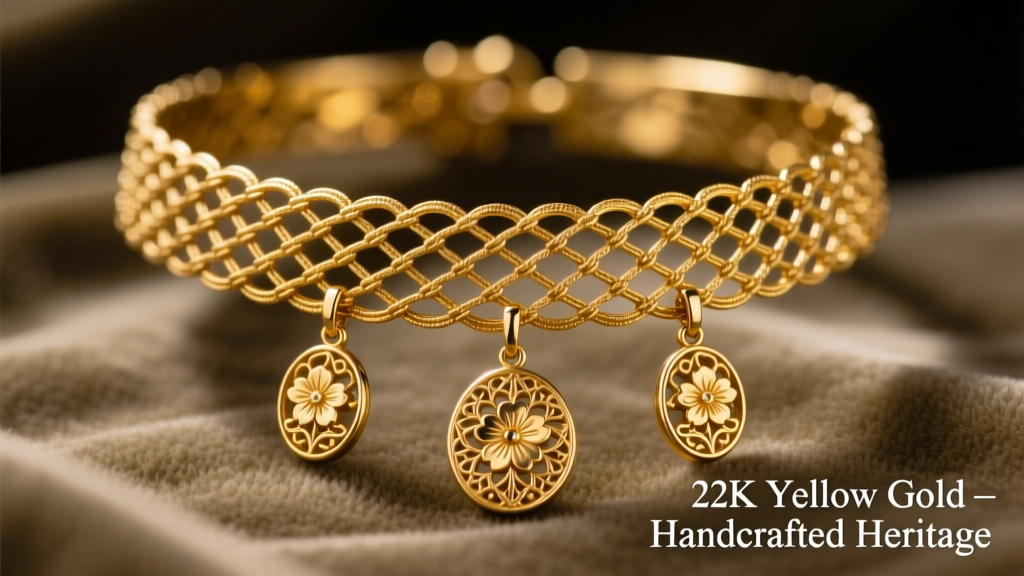
The 22K Yellow Gold Mesh Choker with Suspended Drops: A Study in Artisanal Opulence and Mid-Century Refinement
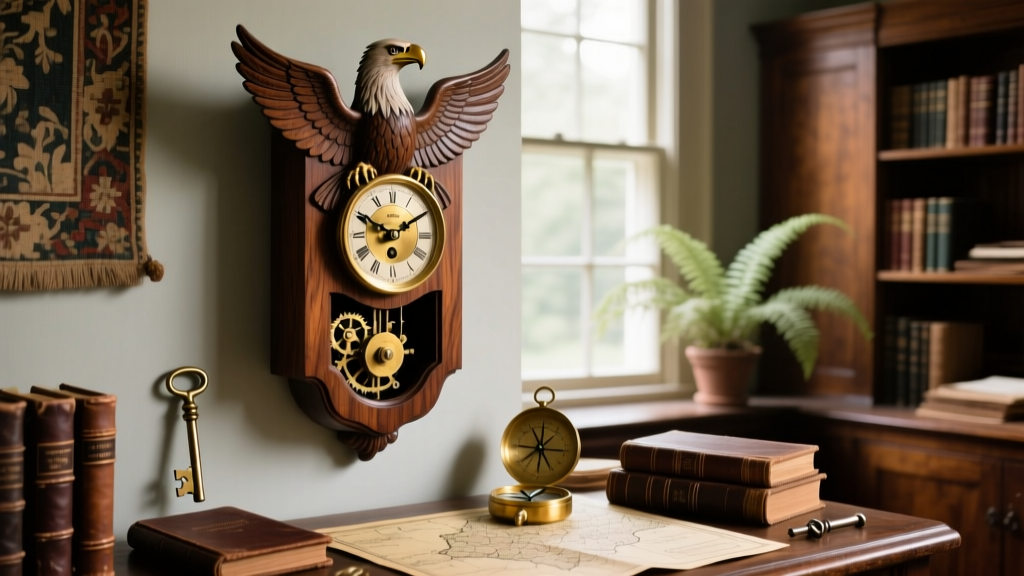
The Wooden Wall Pocket Eagle Design: American Folk Art, Mechanical Ingenuity, and Collectible Value
Decoding Pewter Marks: A Collector’s Guide to Authenticity, Origin, and Value
Brass Mortar and Pestle with Pedestal Base: A 19th-Century Apothecary Artifact Measuring 4½ × 5½ Inches
Fabergé Cuff Links, Tied-Knot Form with Sapphire and Ruby Accents, Circa 1910 — A Study in Imperial Craftsmanship and Symbolic Design
Norah Wellings Felt-Face Doll: A 15-Inch Vintage Masterpiece with Velvet Body, Glass Eyes & Original Costume

The X-Form Folding Chair: Steel, Brass, and Slung Leather — A Study in Mid-Century Engineering and Craft
Jade Brushpot: Green Carved Flowers, Square Form, 5-Inch Antique Chinese Scholar's Object
Fostoria Century Tray Muffin: A Collector’s Deep Dive into the Iconic American Glassware Pattern