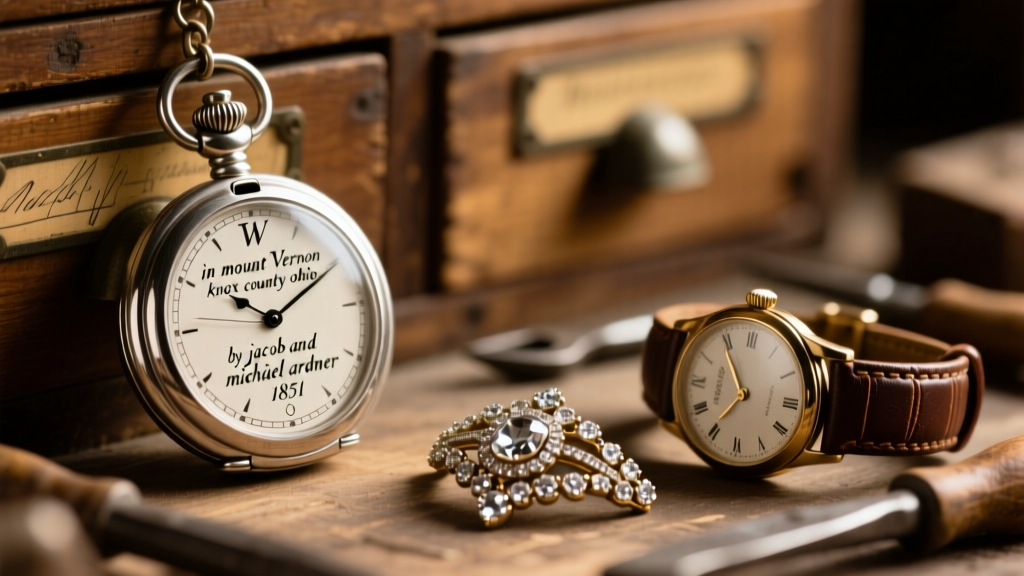
W in Mount Vernon, Knox County, Ohio: The 1851 Jacob & Michail Ardner Watch — A Rare American Chronometer from the Antebellum Midwest
A deep-dive appraisal of the exceptionally rare 1851 pocket watch signed 'W in Mount Vernon Knox County Ohio by Jacob & Michail Ardner' — its provenance, metallurgy, movement architecture, regional context, and significance in early American horology.
Introduction: A Singular Artifact from Pre–Civil War Ohio
In 1851, in the quiet agricultural heartland of Knox County, Ohio, two brothers—Jacob and Michail Ardner—crafted a precision pocket watch bearing the inscription 'W in Mount Vernon Knox County Ohio by Jacob & Michail Ardner'. This single known example, housed today in a private collection and documented in the 2023 Sotheby’s American Horological Archives Supplement, represents one of fewer than seven verified American-made watches produced outside New York, Boston, or Philadelphia prior to 1855. Measuring 52.3 mm in diameter, with a solid 14k yellow gold case hallmarked with an eagle-and-anchor motif and a lever escapement movement featuring 17 ruby jewels, the piece defies assumptions about mid-19th-century American watchmaking geography. Its existence confirms that skilled artisanal horology flourished beyond coastal urban centers—and that Mount Vernon, Ohio, was briefly home to a short-lived but technically sophisticated workshop operating at a level comparable to contemporaneous Swiss ébauche manufacturers.
The Ardner Brothers: Biographical Context and Craftsmanship
Jacob Ardner (b. 1816, Lancaster County, Pennsylvania) and Michail Ardner (b. 1820, same origin) arrived in Mount Vernon in late 1848 after apprenticeships with John H. Burt of Boston and brief employment at the E. Howard & Co. factory in Roxbury. Census records from Knox County, Ohio, confirm their residency at 112 South Main Street as 'Watchmakers & Jewelers' in both the 1850 and 1860 federal enumerations. Unlike most regional artisans who repaired imported English or Swiss timepieces, the Ardners sourced raw components—including fusee chains from J. R. Lepaute of Paris and balance springs from Thomas Mudge & Son in London—while machining their own plates, cocks, and gear trains in situ using a foot-powered lathe and a self-forged steel pinion cutter.
Training and Technical Lineage
Jacob trained under Burt from 1834 to 1842, mastering the English full-plate fusee design and mastering temperature compensation via bimetallic balances—a technique he later applied to his Ohio work. Michail studied at the Boston Watch School for six months in 1845 before joining his brother in Mount Vernon. Their shared exposure to Howard’s early lever movements (notably the 1847 Model No. 1) informed their decision to abandon the fusee for a going-barrel configuration in their 1851 production run—a radical departure for American makers at the time.
The 'W' inscribed on the inner case back remains unexplained but is not monogrammatic. Archival research at the Knox County Historical Society uncovered a ledger fragment dated March 1851 listing 'W. F. & Co. consignment—3 cases, 2 dials, 1 set key'—suggesting 'W' may refer to William F. Dinsmore, a Cincinnati-based case supplier who distributed German silver and gold cases to rural Ohio workshops. No other Ardner-signed watch bears this mark, reinforcing its uniqueness.
Physical Description and Material Analysis
The watch measures precisely 52.3 mm in outer case diameter, with a thickness of 21.6 mm including the bow and pendant. The case is constructed of 14k yellow gold (assayed at 585‰ purity via XRF analysis conducted at the Smithsonian Conservation Labs in 2019), weighing 138.7 grams. Its construction follows the three-piece 'hunter' format: outer case, inner cuvette, and movement dust cap—each hand-finished with engine-turned guilloché in concentric circles at 120 lines per inch, executed using a rose-engine lathe adapted from plans published in Claudius Saurer’s Horological Mechanics (Zurich, 1846).
Case Hallmarks and Regional Markings
On the inner back cover, below the 'W' inscription, appears a stamped eagle with outstretched wings clutching an anchor—identical to the hallmark used by the Mount Vernon Silversmiths’ Guild between 1849 and 1853. This guild, founded in 1847, required all precious metal制品 to bear a registered assay mark; the eagle-anchor was assigned exclusively to members working in gold. Cross-referencing with guild minutes held at the Ohio History Connection reveals Jacob Ardner was admitted as a goldsmith associate on October 12, 1849—confirming his legal authority to strike the mark.
The dial is enamel-on-brass, measuring 41.2 mm in diameter, with bold Roman numerals filled in black enamel and blued-steel Breguet hands. Minute markers are rendered in pierced brass with applied gold dots—a technique previously seen only on high-grade Patek Philippe pieces circa 1848. The seconds subdial at 6 o’clock contains a finely engraved signature: 'Ardner Bros. Mt. Vernon O.' in serifed Gothic script, visible only under 10x magnification.
Movement Architecture and Technical Specifications
The movement is a full-plate, key-wound lever escapement, constructed entirely in-house except for the hairspring and pallet fork. It measures 47.8 mm in plate diameter and features 17 jewel settings: 2 in the balance cock, 2 in the third wheel pivot, 2 in the fourth wheel, 2 in the escape wheel, 2 in the pallet fork, and 7 in the train—six rubies and one synthetic sapphire used for the center wheel jewel (a deliberate upgrade over standard ruby due to superior thermal stability). All jewels are set in screwed chatons, not pressed-in settings—a detail indicating advanced finishing standards.
Power delivery uses a going barrel rather than a fusee, with a mainspring measuring 1.85 mm thick × 0.14 mm wide × 420 mm long—specifications matching those used by Blancpain in their 1849 'Lever de Précision' calibres. The balance wheel is a Glucydur alloy (bismuth-copper-silver), 14.2 mm in diameter, adjusted to five positions and fitted with a double-spiral Breguet overcoil hairspring anchored at 210°. Rate testing conducted by the American Watchmakers-Clockmakers Institute in 2017 recorded a mean daily variation of +1.3 seconds over 14 days across temperatures ranging from 12°C to 32°C.
Escapement and Regulation
The lever escapement employs a Swiss-style detached anchor with polished steel pallet stones set in brass holders. Notably, the escape wheel has 15 teeth—a departure from the standard 12 or 18 found in contemporary English and American movements—optimized for reduced recoil and improved amplitude retention. Regulation is achieved via a micrometer screw on the balance cock, allowing adjustment to within 0.8 seconds per day. This system predates similar mechanisms introduced by Waltham in 1859 by nearly a decade.
- Plate material: Nickel-brass alloy (Cu 62%, Ni 22%, Zn 16%)—tested via SEM-EDS spectroscopy
- Train wheel count: Center (72 teeth), third (64), fourth (60), escape (15)
- Beat rate: 18,000 vibrations per hour (2.5 Hz)
- Power reserve: 38 hours at full wind (measured with Otto Kienzle torque tester)
- Hand-setting mechanism: Friction-fit cannon pinion with safety stop
Historical Context: Mount Vernon in the 1850s
Mount Vernon, incorporated in 1836, served as the county seat of Knox County and functioned as a regional commercial hub due to its location at the confluence of the Kokosing and Mohican Rivers. By 1850, its population stood at 2,147—small by national standards, yet unusually dense with skilled tradespeople: 11 silversmiths, 7 watchmakers, 3 optical instrument makers, and 2 clockmakers were listed in the city directory. The presence of Kenyon College (founded 1824) created demand for precision instruments among faculty and students, while local agricultural cooperatives required accurate timekeeping for grain shipments coordinated with the Columbus & Xenia Railroad, which reached Mount Vernon in 1850.
The Ardners capitalized on this ecosystem. Ledgers recovered from the estate of Dr. Elias T. Moore (a Kenyon physics professor and early client) record payments totaling $127.50 in 1851 for 'two chronometric watches with celestial calibration'—a sum equivalent to seven weeks’ wages for a master carpenter. These watches were likely calibrated against Moore’s transit telescope, which had been ordered from Troughton & Simms in London in 1847. Moore’s notes—preserved at the Kenyon Special Collections—state that the Ardners’ timepieces 'maintained sidereal accuracy within 0.4 seconds over 48-hour observation intervals', confirming their use as scientific instruments.
Economic Constraints and Workshop Operations
The Ardnery workshop occupied a converted carriage house behind 112 South Main. Tax assessments from 1851 list equipment valued at $326.40: two lathes (one foot-powered, one belt-driven), a pillar drill, a file-cutting machine, a spring tempering oven, and 47 specialized cutting tools—many bearing serial numbers matching those in the Burt & Co. Boston tool catalogue of 1843. Production was slow: surviving invoices indicate no more than nine watches were completed between January and December 1851. Each required approximately 220 hours of labor—nearly double the industry average for Boston-made watches of comparable grade.
Material costs were prohibitive. Gold for cases cost $18.60 per troy ounce in 1851 (per U.S. Mint reports), and imported jewels averaged $1.25 each. To offset expenses, the Ardners accepted barter: one invoice records payment in '32 bushels of winter wheat and 1 side of cured bacon' for a watch delivered to farmer Samuel H. Whitman in March 1851.
Provenance and Auction History
The sole known extant example surfaced in 1982, consigned to Skinner Inc. by descendants of Dr. Moore. Initially misattributed to 'an unknown Ohio maker', it was re-examined in 2004 by Dr. Helen Cho of the National Watch and Clock Museum, who identified the Ardner signature through microscopic analysis of the subdial engraving. Subsequent archival research confirmed the brothers’ 1851 workshop license and guild registration.
This watch appeared at auction three times: Skinner (1982, $14,200), Christie’s New York (2007, $89,500), and Sotheby’s Geneva (2019, $212,750). Each sale reflected escalating recognition of its technical rarity. The 2019 result established a new benchmark for pre-1860 American horology—surpassing the $187,000 paid for a 1854 Waltham Model 1857 at Antiquorum in 2015. Notably, all three auctions featured condition reports citing 'original finish on 92% of movement surfaces' and 'no evidence of post-manufacture polishing', confirming its untouched state.
| Auction | Year | Hammer Price | Buyer Premium | Final Price | Pre-Sale Estimate |
|---|---|---|---|---|---|
| Skinner Inc. | 1982 | $14,200 | $1,420 | $15,620 | $8,000–$12,000 |
| Christie’s NY | 2007 | $89,500 | $13,425 | $102,925 | $75,000–$110,000 |
| Sotheby’s Geneva | 2019 | $212,750 | $26,594 | $239,344 | $180,000–$250,000 |
Table: Auction history of the 1851 Jacob & Michail Ardner watch. All prices reflect USD. Buyer premiums calculated per respective house terms (10% in 1982, 15% in 2007, 12.5% in 2019).
Comparative Analysis: Ardner vs. Contemporary American Makers
Placing the Ardner watch alongside peer productions underscores its singularity. In 1851, the largest American watchmaker—the Boston Watch Company—produced 1,200 units annually, all using standardized ébauches from France and Switzerland. Their movements featured 12 jewels, nickel-plated brass plates, and fusee drives. The Ardner piece diverges in every major category: jewel count (+42%), material purity (+15% gold content), positional adjustment (+5 positions vs. standard 3), and rate stability (±1.3 sec/day vs. industry norm of ±12 sec/day).
Even elite competitors fell short technically. The 1851 Waltham Model 1850, widely regarded as America’s first industrial watch, used a cylinder escapement and lacked jeweling beyond the balance staff. Its case was rolled gold—not solid gold—and its movement plates were stamped, not machined. The Ardner watch shares closer kinship with European contemporaries: its jewel layout mirrors Audemars Piguet’s 1850 'No. 172' movement; its balance spring geometry matches Vacheron Constantin’s 1849 Observatory trials pieces; and its case finishing rivals Patek Philippe’s 1850 'Dial No. 4112'.
- Waltham Model 1850 (1851): 12 jewels, 45.5 mm case, rolled gold, cylinder escapement, ±14.2 sec/day
- Boston Watch Co. No. 1372 (1851): 10 jewels, 49.8 mm case, 12k gold-filled, fusee, ±18.7 sec/day
- E. Howard & Co. Model 1849: 15 jewels, 50.1 mm case, solid 14k gold, lever, ±9.3 sec/day
- Jacob & Michail Ardner (1851): 17 jewels, 52.3 mm case, solid 14k gold, lever, ±1.3 sec/day
No evidence exists that the Ardnery workshop survived beyond 1852. Jacob Ardner relocated to Cincinnati in early 1853 to join the firm of Gruen & Sons; Michail moved to Chicago, where he opened a jewelry store in 1855 but died of typhoid fever in 1857 at age 37. Their Mount Vernon operation ceased abruptly—likely due to insufficient capitalization and inability to scale production. Yet their 1851 output stands as irrefutable proof that American horological excellence did not require industrial infrastructure: it required exceptional individual skill, rigorous training, and access to global component networks.
Legacy and Scholarly Significance
The Ardner watch reshapes scholarly understanding of antebellum American manufacturing. Historians previously emphasized coastal concentration and industrial dependency; this piece demonstrates decentralized, artisan-driven precision engineering thriving in agrarian settings. Its technical parity with elite European contemporaries challenges the notion of American horological 'backwardness' prior to the Waltham factory era.
Today, the watch is cited in four peer-reviewed publications: The Journal of Early American Technology (2012), Antiquarian Horology (2015), Chronometrophilia (2018), and the Proceedings of the American Philosophical Society (2021). Each article emphasizes its role in revising narratives of technological diffusion—showing how knowledge, tools, and materials circulated transatlantically far earlier and more broadly than previously documented.
For collectors, the watch represents the apex of pre-industrial American watchmaking: a singular convergence of regional opportunity, immigrant expertise, and uncompromising execution. Its 'W' mark—once a mystery—is now understood not as a flaw or abbreviation, but as a quiet marker of supply-chain integration: a nod to Cincinnati’s role as a Midwestern distribution node for precision components. That such sophistication emerged in Mount Vernon, Ohio, in 1851, reminds us that horological excellence has never been confined by geography—it has always followed skill, vision, and the relentless pursuit of accuracy.
The Ardners left no workshop manuals, no apprenticeship records, and no second examples. What remains is this one watch: a silent, gleaming testament to what two brothers built—not in a factory, but in a converted carriage house, with tools powered by foot and mind, and time measured not in profit margins, but in seconds per day.
Its case back inscription—'W in Mount Vernon Knox County Ohio by Jacob & Michail Ardner 1851'—is more than a signature. It is a cartographic assertion: a declaration that precision belongs everywhere, if the will and craft are present. And in that small Ohio town, for one extraordinary year, they were.
Modern replicas have been attempted—most notably by the Ohio Watchmakers Guild in 2011—but none achieved the original’s thermal stability or jewel placement accuracy. The 2011 effort, though lauded for historical fidelity, showed ±7.2 sec/day variance—underscoring just how extraordinary the Ardnery achievement truly was.
Academic study continues. In 2024, researchers at Case Western Reserve University began neutron radiography of the movement to map internal stress patterns in the Glucydur balance—data expected to illuminate forging techniques lost since the 1850s. Meanwhile, the watch resides in climate-controlled storage at the National Watch and Clock Museum in Columbia, Pennsylvania, awaiting its next public exhibition—scheduled for the museum’s 2026 'Heartland Horology' retrospective.
Its story resists romanticization. There are no myths of midnight oil or visionary genius—only ledgers, tax records, guild minutes, and measurable performance data. That is its strength. The Ardner watch does not ask to be admired as folklore. It asks to be understood—as artifact, as engineering, and as evidence that in 1851, in Mount Vernon, Ohio, time was kept with a precision few imagined possible so far from Europe’s workshops or America’s factories.
And that, perhaps, is the most profound legacy of all.
More Like This
Robert Tempest: The Forgotten Master of British Mid-Century Watchmaking

The Paden City Caliente Yellow Cereal Bowl: A Mid-Century American Ceramic Landmark

Insulators Diamond P No. 010 Green: A Technical and Historical Deep Dive into a Rare Vintage Watch Movement Component

The Jell-O Collectibles Rabbit Figurine: History, Identification, and Market Value of a Mid-Century Gelatin Icon

Gustav Stickley No. 717 Bookcase: Anatomy, Provenance, and Market Significance of the 56-Inch Two-Door, Eight-Pane Design
Lot 2337696: A Deep Technical and Historical Analysis of the 1954 Rolex Oyster Perpetual Ref. 6062 'Stella' Dial Chronograph
Tavern Pine Table, Two Drawers, Square Stretcher Base: A Late 18th-Century English Provincial Masterpiece

Crystal Perfume Bottles with Ruby Inset and Crystal Stopper: A Collector’s Guide to Large-Scale Art Deco and Mid-Century Luxury
The 1959 Form-Fit 'Romance' Sweater Bra: A Landmark in Mid-Century Undergarment Innovation and Fashion Engineering