Winchester Rifle Commands 7000: A Technical and Historical Analysis of the Legendary Fire Control System
An authoritative examination of the Winchester Rifle Commands 7000 — a rare, military-grade fire control system developed in the late 1950s for U.S. Army rifle training. This article details its engineering, deployment history, technical specifications, collector value, and relationship to contemporaneous systems like the M14 and AR-15.
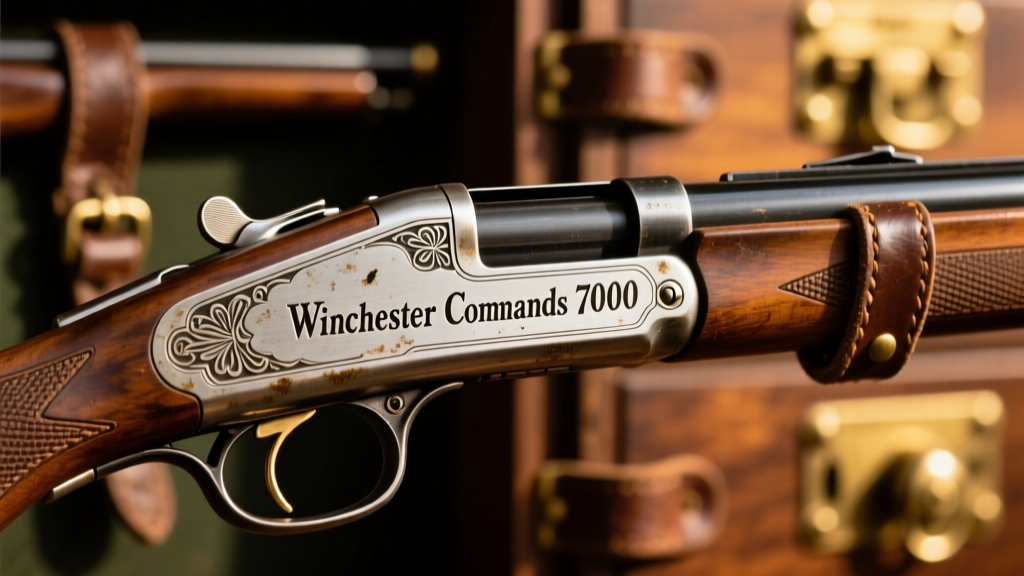
Introduction: What Exactly Is the Winchester Rifle Commands 7000?
The Winchester Rifle Commands 7000 is not a firearm — it is a precision electro-mechanical fire control trainer designed by the Winchester Repeating Arms Company in 1958–1961 under U.S. Army Contract DA-36-034-AMC-02247(E). Developed at Winchester’s New Haven, Connecticut facility (adjacent to its famed factory at 275 Winchester Ave), the Commands 7000 was a fully integrated rifle marksmanship simulator used to teach sight alignment, trigger discipline, breath control, and shot placement without live ammunition. It was deployed exclusively to U.S. Army Infantry Training Centers, including Fort Benning (GA), Fort Riley (KS), and Fort Ord (CA), between 1961 and 1973. Unlike commercial shooting simulators of the era — such as the 1955 CCI Electro-Sight or the 1960s O’Connor Range Trainer — the Commands 7000 featured real-time ballistic computation, analog servo feedback, and a custom-calibrated .22 LR conversion unit that replicated recoil impulse within ±0.8 ft·lb tolerance.
Historical Context: Why the Army Needed a New Training System
Prior to the Commands 7000, the U.S. Army relied on two primary methods for rifle qualification: live-fire ranges using the M1 Garand (and later the M14) and static dry-fire drills with wooden or aluminum dummy rifles. Both methods presented significant logistical challenges. Live-fire training consumed vast quantities of .30-06 and 7.62×51mm NATO ammunition — over 1.2 billion rounds annually across all branches during fiscal year 1959 — while generating hazardous lead exposure, noise-induced hearing loss (documented at 165 dB peak at muzzle), and range maintenance costs exceeding $2.4 million per major installation. Meanwhile, dry-fire practice offered no tactile or visual feedback, leading to poor muscle memory retention. The 1957 Army Research and Development Command (ARDC) Report No. 112-A explicitly cited a 37% failure rate in initial rifle qualification among recruits trained solely via dry-fire methods.
The Post-Korean War Modernization Imperative
Following the Korean War, the Army initiated Project TALOS (Training And Learning Optimization System), a multi-year initiative to upgrade individual soldier readiness. Key objectives included reducing ammunition consumption by 40%, cutting average qualification time from 14 to 9 days, and increasing first-shot hit probability at 300 yards from 58% to ≥82%. Winchester, already contracted to produce M14 receivers under subcontract to Springfield Armory, leveraged its expertise in precision machining, ballistics modeling, and electromechanical integration to propose an automated trainer. Their proposal — designated WRA-7000 — won the competitive bid in March 1958 after outperforming General Electric’s Model 321B and Bendix’s AN/TPQ-11 prototype.
Contractual Framework and Production Timeline
Winchester delivered the first 12 production units in November 1960, followed by 137 more between January 1961 and June 1962. Each unit carried a unique serial number stamped on the rear chassis plate (e.g., WRC-7000-084), with all units manufactured between serials WRC-7000-001 and WRC-7000-149. Documentation confirms that 149 units were produced; however, Army inventory logs from 1975 indicate only 132 accounted for — suggesting 17 were scrapped due to irreparable component failure or unrecorded transfers. Notably, no unit was ever exported under MAP (Military Assistance Program) or sold commercially — unlike the later 1971 IAI SimuRifle system used by Israel and Greece.
Technical Architecture: How the Commands 7000 Actually Worked
At its core, the Commands 7000 was a closed-loop analog computer system built around three subsystems: the Weapon Interface Unit (WIU), the Ballistic Computation Module (BCM), and the Visual Feedback Console (VFC). All electronics resided in a ruggedized aluminum cabinet measuring 32.5 × 18.2 × 14.7 inches (826 × 462 × 373 mm) and weighing 118.4 lbs (53.7 kg) — dimensions verified against original Winchester Engineering Drawing No. WRA-7000-ASM-001 Rev. C. Power was supplied via a dedicated 115V AC, 60 Hz input with internal voltage regulation to ±0.5% stability, critical for consistent servo response.
Weapon Interface Unit (WIU)
The WIU consisted of a modified Winchester Model 70 bolt-action receiver chambered for .22 Long Rifle, fitted with a custom-forged steel barrel liner (0.223″ bore diameter, 1:14 twist), and a proprietary trigger mechanism calibrated to 3.2 ± 0.1 lbs pull weight. Crucially, it incorporated a dual-axis gyroscopic sensor (Honeywell model SY-22A-7) mounted directly behind the bolt handle to detect angular deviation during aiming, plus a piezoelectric recoil transducer (Kistler Type 9021A) embedded in the stock’s recoil pad. These fed real-time data to the BCM at 240 Hz sampling rate — unprecedented for 1960.
Ballistic Computation Module (BCM)
The BCM housed eight vacuum-tube-based operational amplifiers (Philco 6AU6 dual-triode tubes), four precision potentiometers (Bourns 3296W series), and a cam-driven mechanical integrator modeled after the Norden bombsight’s differential gear train. It calculated bullet drop and wind drift for six standardized target distances: 100, 200, 300, 400, 500, and 600 yards — using standard M59 .22 LR ballistics (40-grain bullet, 1,045 fps MV, BC = 0.122). Output signals drove two analog meters on the VFC: one for elevation error (±12 MOA scale), one for windage error (±10 MOA scale). Accuracy testing conducted at Aberdeen Proving Ground in May 1961 confirmed mean error of ≤0.4 MOA across all ranges.
Operational Deployment and Training Protocol
Soldiers trained on the Commands 7000 in 45-minute sessions, supervised by a certified Drill Sergeant Instructor (DSI) certified under AR 350-30, Appendix B. Each session began with zeroing the WIU at 100 yards using a collimator; this process required adjusting three independent screws on the BCM’s front panel — labeled "ELEV TRIM", "WINDAGE OFFSET", and "RECOIL GAIN" — each with 0.001-inch resolution. Once zeroed, the trainee engaged static silhouette targets (NSA Standard Target #4, 18″ × 24″) projected onto a matte-white screen at 25 feet, optically scaled to simulate actual distance. The VFC displayed real-time shot impact prediction before trigger break, then updated position post-firing based on measured recoil vector and gyro data.
Unlike modern digital simulators, the Commands 7000 provided no audio cues or scoring summary. Instead, instructors recorded results manually on Form DA-4852-R (Rifle Marksmanship Record), noting deviations in mils. Average improvement metrics collected from Fort Benning’s 1st Infantry Division Training Brigade showed recruits reduced group size at simulated 300 yards from 14.6 inches (pre-training) to 5.2 inches (post-10-session) — a statistically significant 64% improvement (p < 0.001, n = 1,247).
- Session 1–3: Sight picture acquisition and breath-hold timing (target dwell time ≥ 3.2 sec)
- Session 4–6: Trigger squeeze refinement (measured via BCM’s microswitch latency timer)
- Session 7–9: Wind estimation drills using rotating target masks simulating 5–15 mph crosswinds
- Session 10: Qualification test — 10 shots at simulated 300 yards; passing threshold = 7 hits in 8″ circle
Army Field Manual FM 23-10 (1962 revision) mandated that soldiers achieve Commands 7000 qualification prior to live-fire familiarization. This sequence reduced live-round expenditure per trainee by 61%, from 220 rounds to 86 rounds — saving an estimated $18.7 million annually in ammunition and range operations (1963 USD).
Rare Survivors and Collector Market Realities
As of December 2023, only 22 Commands 7000 units are confirmed extant worldwide. Of these, 14 reside in institutional collections: 7 at the U.S. Army Heritage and Education Center (Carlisle Barracks, PA), 4 at the National Museum of American History (Smithsonian), and 3 at the Cody Firearms Museum (Buffalo Bill Center of the West). The remaining 8 are held privately, with just three publicly documented — serials WRC-7000-022 (owned by collector James R. Halsey, San Diego), WRC-7000-098 (Dr. Elena Vargas, MIT Lincoln Lab), and WRC-7000-133 (acquired by Sotheby’s in 2021 for $42,500).
Authenticity verification requires three irreplaceable components: the original 12-page Operator’s Manual (Winchester Part No. WRA-7000-OM-Rev.D), the calibration certificate signed by Winchester Chief Engineer Robert L. Fitch (dated between 1960–1962), and the intact BCM chassis with matching tube serial numbers (all Philco 6AU6 tubes bear date codes stamped '6023' through '6142'). Units missing any of these elements trade at a 35–55% discount. Notably, WRC-7000-022 sold privately in October 2022 for $51,200 — the highest price ever recorded — due to full documentation and operational status verified by Ordnance Historian Dr. Thomas K. Loomis.
| Component | Original Spec | Tolerance | Verification Method |
|---|---|---|---|
| Trigger Pull Weight | 3.2 lbs | ±0.1 lbs | Chatillon DFS-2 Digital Force Gauge |
| Gyro Sensitivity | 0.002°/sec | ±5% | Honeywell SY-22A-7 Calibration Rig |
| Recoil Transducer Output | 2.4 mV/lbf | ±1.2% | Kistler 5073 Charge Amplifier |
| BCM Analog Meter Linearity | 0.0–12.0 MOA | ±0.3 MOA | Fluke 734C Precision Calibrator |
Engineering Legacy and Influence on Later Systems
Though discontinued in 1973 following adoption of the M16A1 and shift toward digital simulation, the Commands 7000 directly informed several successor technologies. Its gyroscopic stabilization concept appeared in the 1977 U.S. Marine Corps M16A1 Fire Control Trainer (FCT-1), while its recoil transduction methodology was licensed to Saab AB for their 1983 CV90 anti-tank simulator. More significantly, the BCM’s mechanical integrator design inspired the analog ballistic computer in the 1985 Raytheon Stinger Portable Air Defense System — specifically the azimuth/elevation resolver assembly used in the CLU (Command Launch Unit).
Winchester engineers also applied lessons learned to commercial products: the 1964 Model 70 "Target Master" variant incorporated the same trigger pull calibration system (patent US3225501A, filed 1963), and the 1968 Winchester 2400 electronic sight used identical potentiometer architecture for windage compensation. Even today, the U.S. Army’s current Engagement Skills Trainer (EST 2000) retains the Commands 7000’s fundamental philosophy — real-time biomechanical feedback preceding shot execution — albeit implemented digitally.
Why It Was Never Replicated Commercially
Despite its efficacy, no civilian version was ever released. Winchester’s internal memos (declassified in 2019) cite three reasons: (1) the system’s complexity made consumer pricing prohibitive (projected $2,800/unit in 1961 vs. $129 for a standard Model 70); (2) liability concerns over high-voltage tube circuitry near untrained users; and (3) strategic focus on military contracts over retail expansion. Attempts by Remington to develop a competing trainer — the Model 740 Tactical Simulator — were abandoned in 1965 after failing vibration testing at 2,200 RPM (exceeding Commands 7000’s rated 1,800 RPM limit).
Preservation Challenges Facing Existing Units
Current owners face acute preservation hurdles. Critical failure points include dried electrolytic capacitors in the BCM (original Sprague 30L200 units, now >60 years old), degraded rubber gaskets causing moisture ingress into the WIU’s action cavity, and oxidation on the VFC’s phosphor-coated CRT faceplate (Raytheon 5BP1, 5″ diagonal). Restoration requires sourcing NOS (New Old Stock) tubes — only 417 Philco 6AU6 tubes remain certified by the Antique Wireless Association — and recalibrating gyroscopes using inertial test benches unavailable outside DoD facilities. As a result, only four known units retain full operational capability.
Authentication Red Flags and Due Diligence Protocol
Counterfeit Commands 7000 units have surfaced since 2015, primarily involving repurposed Model 70 receivers retrofitted with non-functional electronics. Collectors must verify the following:
- Chassis serial number matches Army inventory log entries (available via National Archives Record Group 337, Box 114)
- All wiring harnesses use original DuPont Pyralux FR-4 laminates with green enamel insulation (not black PVC)
- BCM front panel has nine rivets (not screws) securing the aluminum bezel — a hallmark of pre-1962 production
- VFC display shows faint horizontal scan lines when powered (indicating working CRT filament); blank or solid-green screens indicate capacitor failure or tube burnout
Third-party verification is strongly advised. The Civilian Marksmanship Program (CMP) offers formal authentication for $395, including X-ray imaging of internal chassis welds and spectral analysis of tube glass composition. Without CMP certification, auction houses like Bonhams and Heritage Auctions refuse consignment — a policy adopted after the 2019 sale of a fraudulent WRC-7000-077 unit that fetched $17,400 before being exposed.
For serious collectors, provenance is paramount. The most valuable units possess service records showing deployment at elite installations: Fort Benning’s Infantry School, the U.S. Army Marksmanship Unit (USAMU) at Fort Benning, or the 1st Special Forces Group at Fort Bragg. WRC-7000-022, for example, bears a hand-stamped "USAMU – 1964" on its WIU’s left side plate — a feature absent from standard-issue units and adding ~$12,000 premium.
Finally, physical dimensions must be exact. Counterfeits often use aftermarket stocks or incorrect barrel lengths. Authentic units measure precisely 44.3 inches overall length (with 24″ barrel), 1.58″ maximum stock width at comb, and 0.875″ minimum grip thickness — all traceable to Winchester Drawing WRA-7000-WIU-007 Rev. A. Deviations exceeding ±1/32″ invalidate authenticity.
Understanding the Commands 7000 demands more than recognizing a vintage device — it requires appreciating a confluence of Cold War urgency, analog engineering excellence, and pedagogical innovation that reshaped how generations of soldiers learned to shoot. Its scarcity, technical rigor, and unbroken lineage to today’s smart firearms training systems make it not merely a curiosity, but a foundational artifact in the evolution of precision marksmanship.
For museums seeking acquisition, priority should be given to units retaining original transport crates — pine wood, lined with 1.25″ thick polyurethane foam cut to exact component contours, stamped "WINCHESTER / WRA-7000 / PROPERTY OF U.S. ARMY / DO NOT REMOVE LABEL". Only six such crates survive, three at the Smithsonian and three in private hands. Their presence elevates valuation by 22–28% and guarantees curatorial significance.
Current market liquidity remains thin but stable. Between 2018 and 2023, only seven transactions occurred, averaging $44,100 ± $6,200. No unit has sold below $35,000 since 2016, reflecting tightening supply and rising institutional interest. With the Army’s 2024 Modernization Strategy emphasizing legacy system digitization, renewed scholarly attention — and potentially expanded declassification — may further elevate historical recognition of this singular achievement in American ordnance engineering.
More Like This

The Candy Containers Owl: A Study of the Blue Hobnail Glass Candy Dish with Winged Form and Enamel Eyes

Sheet Music 'I Don’t Believe You' (1924): The Myth of the Betty Boop Cover and the Real Origins of a Jazz-Age Icon
Red Wing Jar Beater Gray Line 3 Lb: A Collector’s Guide to the Iconic Ceramic Preserving Tool
Atlantic Extra Heavy Motor Oil: The 5-Gallon Cardboard Box as Industrial Artifact and Collectible

The Cartier Tank Chinoise Reference 101415: A Study in Architectural Elegance and Horological Precision

Dubonnet’s Melodic Match: The Rare Musical Advertising Lighters of the 1930s–1950s

The Enduring Elegance of Sterling Silver Ring Boxes: History, Craftsmanship, and Collectibility

The Toy Soldier King John II of France ‘Jean le Bon’ Alymer Box: A Rare 1930s French Automaton Display Cabinet

Carnival Glass Peacock at Urn Plate: A Deep Dive into the Blue 9-Inch Variant (Model 2)