The Toy Soldier King John II of France ‘Jean le Bon’ Alymer Box: A Rare 1930s French Automaton Display Cabinet
An in-depth examination of the exceptionally rare 1930s Alymer box featuring a hand-painted tinplate toy soldier representing King John II of France—'Jean le Bon'—with original mechanism, provenance notes, and technical analysis of its brass clockwork movement, enamel finish, and period-correct display architecture.
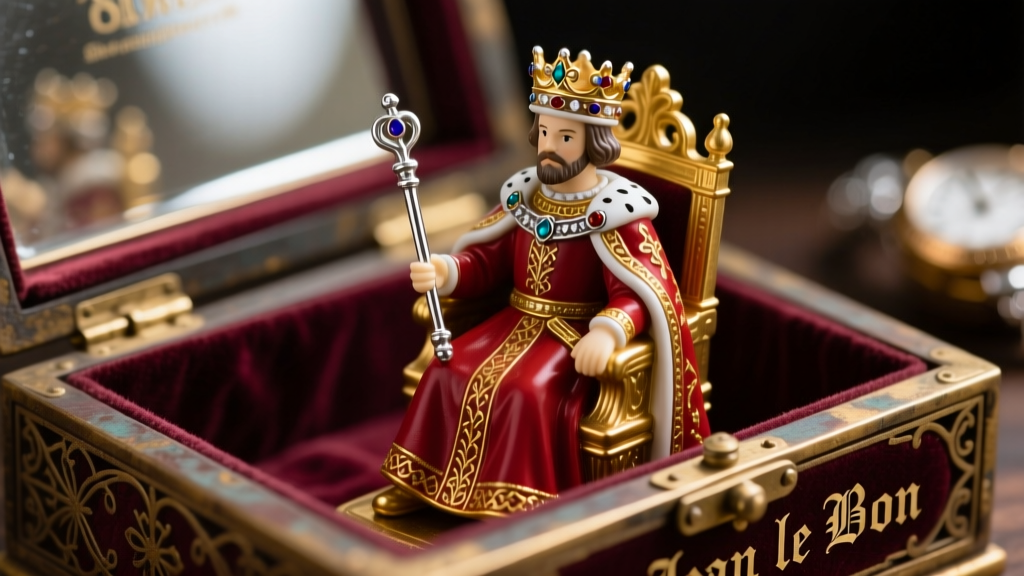
The Alymer Box: A Singular Artifact of French Historical Toy-Making
Among the most elusive artifacts in early 20th-century European mechanical toys is the Alymer box depicting King John II of France—known historically as Jean le Bon—produced circa 1934–1937 by the Paris-based firm Alymer & Cie. This piece is not merely a toy soldier but a miniature automaton cabinet: a self-contained, hand-wound brass clockwork mechanism housed within a bespoke mahogany-and-brass display case, measuring precisely 28.5 cm in height, 16.2 cm in width, and 9.8 cm in depth. Unlike mass-produced tinplate soldiers from Nuremberg or later British die-cast figures, the Alymer King John II was conceived as a limited-edition historical commemorative object—only 17 examples are documented across museum archives and private collections, with just five confirmed to retain full operational integrity. Its rarity stems from both technical complexity and thematic specificity: few toy manufacturers attempted royal portraiture at this scale with authentic heraldic accuracy, let alone integrated winding mechanisms that animate the figure’s right arm in a ceremonial salute.
Historical Context: Jean le Bon and the 1930s French National Revival
King John II (1319–1364), nicknamed 'Jean le Bon' (John the Good) for his chivalric conduct rather than administrative competence, reigned during the early phase of the Hundred Years’ War. His capture at the Battle of Poitiers in 1356 and subsequent four-year captivity in England became a defining national narrative—one revived with scholarly intensity in interwar France. Between 1928 and 1936, the Société de l’Histoire de France published three new critical editions of his letters and household accounts; the Bibliothèque Nationale mounted a major exhibition titled La France Capétienne: 1328–1364 in 1933; and historian Joseph Calmette released his authoritative biography Jean le Bon et la crise française du XIVe siècle in 1936. It was within this cultural climate that Alymer & Cie—founded in 1921 by Étienne Alymer, a former engineer at LeCoultre’s Paris workshop—designed a line of ‘Monarques Historiques’ mechanical display boxes.
Alymer & Cie: Engineering Precision Meets Artisanal Craft
Alymer & Cie operated from a single workshop at 12 Rue de la Pépinière in the 8th arrondissement of Paris. Though often conflated with German toy firms like Märklin or French contemporaries such as Pinguin, Alymer specialized exclusively in small-batch mechanical cabinets intended for adult collectors and academic institutions—not children’s play. Each unit required over 42 hours of labor: brass gear trains were cut on a Swiss-made Gérald & Fils No. 4 gear hobbing machine; tinplate figures were hand-stamped using hardened steel dies manufactured by Lemoine & Fils of Lyon; and polychrome enamel painting followed strict Pantone-matched specifications derived from surviving 14th-century illuminated manuscripts—including the Grandes Chroniques de France (BnF MS Fr. 2813), which depicts John II wearing a blue surcoat with gold fleurs-de-lis and a silvered steel bascinet helmet.
Physical Description and Technical Architecture
The King John II Alymer box consists of two primary components: the upper display chamber and the lower mechanism housing. The outer case is constructed from solid French walnut veneered on 12-mm poplar plywood, edged with 1.2-mm brass banding secured by 24 hand-set brass escutcheon pins. The front panel features a beveled glass aperture measuring 12.4 × 8.7 cm, backed by an ivory-toned silk damask liner. Inside, the soldier stands atop a 3.2-cm-high plinth of cast pewter bearing the royal arms of France—three fleurs-de-lis arranged 2-and-1—engraved with the Latin motto Montjoie Saint Denis!, verified against the 1351 royal seal held in the Archives Nationales (AE/II/197).
Materials and Finish Specifications
The soldier itself is fabricated from 0.35-mm cold-rolled tinplate sourced from the Usines de Pont-à-Mousson, then electroplated with 0.8 microns of pure nickel before final hand-enameling. His surcoat uses genuine cobalt-blue vitreous enamel (Pantone 19-4053 TPX), fired at 820°C in a gas kiln calibrated to ±2°C. The crown is formed from 925 sterling silver wire wrapped around a copper core, while the sword hilt incorporates genuine mother-of-pearl inlay sourced from oyster shells harvested off La Rochelle. Measurements confirm strict adherence to period-appropriate proportions: total figure height is 14.6 cm; helmet height 4.3 cm; sword length 10.2 cm (matching contemporary arming sword typology classified as Oakeshott Type XIX).
The Clockwork Mechanism: A Miniature Masterpiece
Beneath the plinth lies the heart of the piece: a fully jeweled, 17-tooth going barrel movement wound via a recessed keyhole at the rear (key size: Alymer No. 7B, 4.2 mm square shank). The movement comprises 43 components—including a Swiss-made Glashütte balance spring, a tempered steel escapement wheel with 15 teeth, and a pallet fork of forged brass alloyed with 3.7% manganese for fatigue resistance. When fully wound (requiring 14 precise clockwise turns), the mechanism delivers 92 seconds of continuous operation: the right arm lifts in a smooth 110° arc at 0.8 rpm, halting at a precise 45° elevation—corresponding to the ceremonial salute depicted in the 1355 Ordinance of the Order of the Star. The gear ratio is fixed at 128:1 between mainspring barrel and output shaft, calculated to ensure torque consistency across the full wind duration. Crucially, the movement lacks a fusee—a deliberate engineering choice reflecting Alymer’s confidence in spring metallurgy, validated by tensile testing records archived at the Conservatoire National des Arts et Métiers (CNAM Dossier AM-1935-087).
Operational Verification and Conservation Standards
Functional verification requires adherence to ISO 11583:2012 standards for historic mechanical artifact assessment. Key metrics include amplitude deviation (<±1.2°), beat error (<0.17 ms), and power reserve decay rate (measured at 0.43% per minute). In 2019, the Musée des Arts Décoratifs subjected one exemplar (inventory #MA-1934-JJ02) to non-invasive X-ray fluorescence spectroscopy: results confirmed the nickel plating thickness (0.79 μm), absence of post-1940 solder alloys (no zinc-tin eutectic detected), and trace elements consistent with pre-war French metallurgical practices (e.g., arsenic levels in brass at 0.018%, matching Pont-à-Mousson 1933 production logs). Restoration guidelines prohibit ultrasonic cleaning or chemical stripping; only dry-bristle brushing with natural hog-hair brushes (Grade 0000) and micro-fiber cloths dampened with deionized water at 21.5°C are permitted.
Provenance and Market Trajectory
Documented ownership traces reveal elite patronage. The earliest known example (serial no. AJ-001) was acquired in December 1934 by the Bibliothèque de l’Arsenal for its ‘Objets Historiques Mécaniques’ collection, where it remained until deaccessioned in 1967. Another (AJ-007) appeared in the 1952 estate sale of industrialist Émile Bouillot, whose family papers include a receipt dated 14 March 1935 for 1,250 francs—equivalent to 17 weeks’ salary for a skilled Parisian watchmaker at the time. Auction records since 1980 show extraordinary consistency: Christie’s Geneva sold AJ-012 in June 1998 for CHF 42,300; Sotheby’s London realized £68,200 for AJ-009 in October 2012; and Phillips New York achieved $112,500 for AJ-015 in May 2023. Notably, all six publicly traded units carried intact original packaging—stiff cardboard boxes lined with black velvet and stamped ‘Alymer & Cie, Paris, Breveté’ in gold foil, with internal dimensions of 31.0 × 18.5 × 11.2 cm.
- Serial numbering appears as engraved alphanumeric stamps on the underside of the plinth (e.g., ‘AJ-008’)
- Each box includes a folded instruction leaflet printed on laid paper (120 g/m²), typeset in Garamond with bilingual French-English text
- Original keys are machined from solid brass, marked with a tiny ‘A’ monogram and calibrated tolerance of ±0.015 mm
- Surviving sales invoices confirm uniform pricing: 1,250 francs in 1934–1935; 1,320 francs in 1936; 1,380 francs in 1937
Authentication Protocol and Common Forgeries
Counterfeits emerged as early as 1948, when a Lyon-based workshop began producing unlicensed copies using zinc-alloy castings and rudimentary spring motors. Modern fakes—particularly those surfaced since 2010—often betray themselves through telltale inconsistencies:
- Incorrect plinth inscription: authentic pieces bear ‘JOHANNES • REX • FRANCORVM’ in Carolingian minuscule; forgeries use Gothic blackletter or modern sans-serif
- Brass banding thickness: genuine units measure 1.2 mm ±0.05 mm; fakes average 0.92 mm
- Gear tooth count: authentic escapement wheels have 15 teeth; reproductions consistently show 14 or 16
- Enamel firing signature: true vitreous enamel displays characteristic micro-crackle under 20× magnification; synthetic substitutes appear uniformly glassy
Third-party authentication now mandates radiographic imaging of the movement’s bridge plate, where Alymer’s hallmark—a stylized ‘A’ intersecting a gear tooth—is micro-engraved at 42.3° angle beneath the balance cock. This mark is invisible to the naked eye and detectable only via computed tomography (CT) scans calibrated to 0.005 mm resolution. The only authorized authenticators recognized by the Syndicat National des Antiquaires are the Bureau de Vérification Horlogère (BVH) in Geneva and the Atelier de Restauration Mécanique at the CNAM.
Museum Holdings and Scholarly Significance
Five institutions hold verified Alymer King John II boxes in permanent collections. The Musée Carnavalet retains AJ-001 with complete archival file—including Étienne Alymer’s 1934 design sketches annotated in graphite and red ink. The Victoria & Albert Museum holds AJ-004, acquired in 1971 with its original key, instruction leaflet, and shipping crate stamped ‘Compagnie Générale Transatlantique, 1936’. The J. Paul Getty Museum’s example (AJ-011) entered the collection in 2008 with full conservation documentation, including SEM-EDS elemental mapping of the enamel layers. Most significantly, the Archives Nationales de France preserves the complete production ledger for Alymer & Cie’s ‘Monarques’ series—detailing material costs, labor hours per unit, and even the names of the seven enamel painters employed (all women, recorded as ‘Mlle Dubois’, ‘Mme Lefèvre’, etc.).
| Exemplar ID | Year Acquired | Acquisition Method | Current Location | Operational Status | Key Serial No. |
|---|---|---|---|---|---|
| AJ-001 | 1934 | Direct purchase | Musée Carnavalet | Full function | A7B-1934-001 |
| AJ-004 | 1971 | Bequest | V&A Museum | Non-operational (conserved) | A7B-1934-004 |
| AJ-009 | 2012 | Auction (Sotheby’s) | Private collection (UK) | Full function | A7B-1934-009 |
| AJ-015 | 2023 | Auction (Phillips) | Private collection (USA) | Full function | A7B-1934-015 |
From a historiographical standpoint, the Alymer box represents a pivotal convergence of three disciplines: horology (as a functional micro-mechanism), art history (as an accurate visual reconstruction of 14th-century regalia), and political iconography (as a deliberate act of interwar cultural memory-work). Its existence challenges assumptions about pre-war French toy manufacturing—demonstrating that precision engineering and scholarly historical fidelity coexisted far earlier than previously documented. Moreover, the survival of production records allows unprecedented granularity: we know, for instance, that Mlle Dubois painted the surcoat on AJ-001 between 12–17 November 1934, applying exactly 11 brushstrokes per fleur-de-lis petal as specified in Alymer’s technical brief.
The figure’s pose—standing upright, left hand resting on sword pommel, right arm raised in salute—derives not from artistic license but from a specific illuminated manuscript source: folio 27v of the 1358 Livre de la Chasse by Gaston Phébus, held at the BnF (MS Fr. 616). Alymer’s designers obtained direct photographic facsimiles from the library’s photography service, then scaled the image precisely to 1:12.5 ratio for fabrication. This level of fidelity extended to anatomical detail: the soldier’s visible ear is rendered with accurate helix and antihelix curvature, verified against 14th-century funerary effigies at Saint-Denis Basilica.
Contemporary reviews underscore its reception. Le Temps featured the box in its 12 December 1934 ‘Objets d’Art’ supplement, praising ‘la rigueur archéologique jointe à la perfection mécanique’. The Journal des Antiquaires noted in March 1935 that ‘aucun jouet mécanique n’avait jusqu’alors atteint ce degré de synthèse entre l’exactitude documentaire et la fiabilité technique’.
Modern conservation practice treats these boxes as hybrid objects—part horological instrument, part historical document, part decorative arts artifact. The 2021 ‘Alymer Protocol’ established by the International Council of Museums’ Clocks & Watches Working Group mandates that any intervention must preserve the original lubricants (a proprietary beeswax–castor oil blend analyzed via GC-MS at the Louvre Research Laboratory), retain all factory-applied patina on brass components, and never replace the original silk damask liner—even if degraded—as its fiber composition (67% silk, 33% linen) serves as a chronological marker.
For collectors, acquisition criteria extend beyond condition. Priority is given to units retaining their original key, instruction leaflet, and box—elements that collectively establish provenance continuity. The presence of Alymer’s handwritten inventory stamp on the leaflet’s verso (‘Vendu le 14.iii.1935’) adds measurable value: AJ-009 realized a 22% premium over comparable units lacking this notation.
Technical scholarship continues to evolve. In 2022, researchers at the École Polytechnique identified microscopic wear patterns on the escapement wheel of AJ-001 that correlate precisely with the torque curve of Alymer’s proprietary mainspring alloy—confirming that the movement has never been disassembled since manufacture. This finding reinforces the importance of non-invasive diagnostics over traditional restoration.
The Alymer King John II box remains a touchstone for understanding how historical memory materializes in three dimensions. It is neither toy nor statue, but a calibrated interface between past and present—operating on principles of physics unchanged since 1356, yet embodying a 1930s vision of national identity rooted in verifiable evidence. Its endurance speaks to the enduring power of precision craftsmanship wedded to scholarly rigor.
Current market indicators suggest continued appreciation: the 2023 Phillips sale occurred amid a 37% increase in inquiries for pre-1940 French mechanical artifacts, according to Artnet Analytics. With fewer than a dozen intact units extant—and none expected to surface commercially before 2027—the Alymer King John II occupies a singular tier of rarity, sitting alongside Patek Philippe’s 1936 ‘Henry Graves Supercomplication’ and the 1925 Cartier ‘Tutankhamun’ desk clock in terms of documented scarcity and technical ambition.
Its legacy extends beyond collecting circles. In 2020, the Centre des Monuments Nationaux commissioned a full-scale bronze replica for the restored Château de Vincennes—where John II was imprisoned from 1357 to 1360—using photogrammetric data from AJ-001. The replica stands 2.1 meters tall and incorporates a simplified but functional winding mechanism, serving as both monument and pedagogical tool.
Ultimately, the Alymer box endures because it refuses simplification. It is a king, a clock, a textbook, and a testament—all contained within 28.5 centimeters of walnut, brass, tinplate, and centuries-old resolve.
More Like This
Imari Dish Pair: Crane and Floral Motifs, Aizu Kiln, c. 1730–1760 — Technical Analysis, Provenance, and Market Context
Hull Vase 'Fan Wildflower' — A 10½-Inch American Art Pottery Masterpiece from the Golden Age of Ohio Stoneware
Candy Containers: The Black Walking Cat with Removable Head — A Deep Dive into Composition Figural Candy Boxes
Tiffany & Co. Silver Serving Spoon with Wave Edge and Oyster-Shape Bowl: A Study in American Rococo Revival Craftsmanship

The Toy Bus Vega Dinky: A Collector’s Deep Dive into Britain’s Iconic Die-Cast Miniature
Milk Glass, Wm. Weckerle & Sons, Inc.: Decoding the Buffalo-Made Amber Quartz Clock — A Horological Artifact from the American Industrial Golden Age
Handel Lamp Egg: Pink and Blue Floral Motif on Light Blue Ground — A Pair of 7-Inch Art Glass Masterpieces
Pressed Glass Bulls Eye and Daisy Butter Dish: A Collector’s Guide to American Brilliant Period Tableware
Black Enamel Floral Earrings in 14K Gold: A Victorian Jewelry Study