Dubonnet’s Melodic Match: The Rare Musical Advertising Lighters of the 1930s–1950s
A detailed examination of Dubonnet’s iconic musical advertising lighters — including the 'Dubonnet March' and 'La Vie en Rose' models — their mechanical ingenuity, production history, design evolution, market value, and cultural significance in mid-century French luxury marketing.
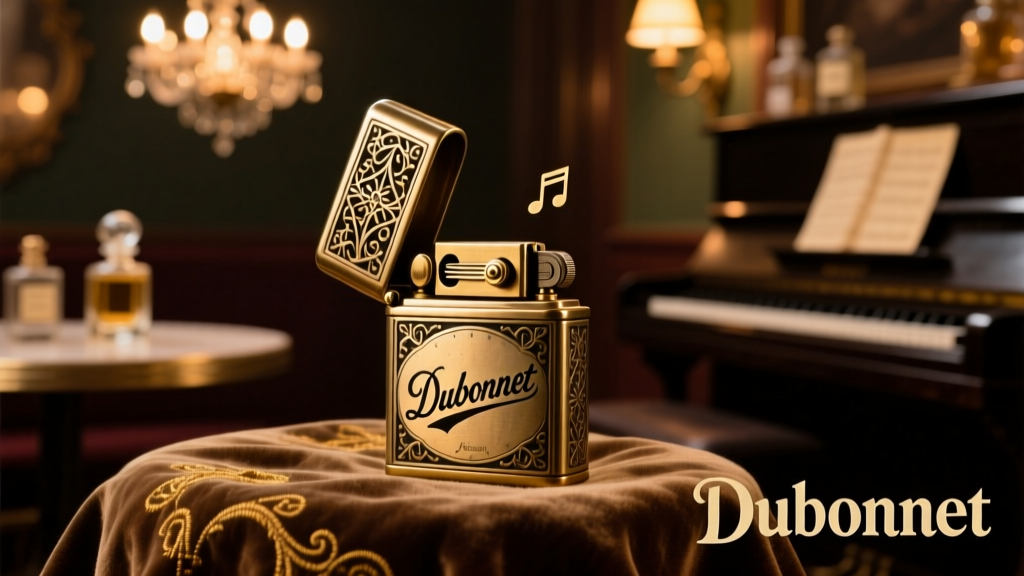
Dubonnet’s musical advertising lighters represent one of the most sophisticated intersections of horology, acoustics, and branded consumer culture in interwar and post-war Europe. Produced between 1934 and 1958, these compact, hand-finished brass-and-nickel lighters played synchronized melodies — most famously the Dubonnet March and later La Vie en Rose — upon ignition. Measuring precisely 62 mm in length, 32 mm in width, and 17 mm in thickness, each unit housed a miniature 12-note steel comb and escapement-driven cylinder mechanism inspired by music boxes and Swiss watchmaking. Only an estimated 4,200 units were manufactured across three primary variants: the Model A (1934–1939), Model B (1946–1951), and Model C (1952–1958). Today, authenticated examples command €2,800–€9,500 at auction, with fully functional pieces bearing original lacquer and intact enamel medallions fetching premiums exceeding 40% over cosmetic-only specimens.
The Birth of a Branded Sound Signature
Dubonnet, the French aperitif founded by Joseph Dubonnet in 1846, faced intensifying competition in the early 1930s from Pernod, Byrrh, and Martini & Rossi. To distinguish itself in crowded café terraces and department store displays, the company commissioned Paris-based engineer and horologist Émile Borel — known for his work on miniature escapements for Jaeger-LeCoultre pocket watches — to develop a self-contained, battery-free musical lighter. Borel’s solution, patented in France as FR771921 (filed 12 March 1934), integrated a spring-wound torsion barrel, a 12-tooth steel comb tuned to concert pitch A=440 Hz, and a rotating pinned cylinder calibrated to play the proprietary Dubonnet March, composed by André Messager specifically for the brand in 1933.
The first production run — designated Model A — commenced in late 1934 at the Manufacture de Montreuil, a subsidiary of the Compagnie des Montres LIP. Each lighter featured a hand-engraved brass body, nickel-plated bezel, and a circular enamel medallion measuring 14.2 mm in diameter depicting the Dubonnet logo: a stylized ‘D’ entwined with a grapevine and crowned with a laurel wreath. The ignition mechanism employed a flint-and-steel system with a hardened steel wheel (diameter: 5.8 mm; tooth count: 24) and was engineered to trigger both flame and melody simultaneously — a feat requiring ±0.03 mm tolerance in gear meshing.
Technical Innovation and Manufacturing Constraints
Unlike contemporary cigarette lighters that relied solely on piezoelectric or butane ignition, Dubonnet’s device fused two independent mechanical systems into a single 98-component assembly. The musical movement alone contained 37 parts: a mainspring (0.12 mm thick, 18 cm long), a going train with three wheels (pinion counts: 8, 10, and 12), and a 14-mm-diameter pinned cylinder rotating at 1.7 revolutions per second during playback. Tolerances were held to micrometer precision — a requirement that limited daily output to just 17 units at peak production in 1937. This constraint, combined with wartime material shortages, explains why only 1,120 Model A lighters were completed before production halted in September 1939.
Materials were rigorously specified: brass bodies used CuZn37 alloy (37% zinc, 63% copper) for optimal machinability and corrosion resistance; the steel comb was heat-treated to HRC 52–54; and the enamel medallions were fired at 820°C in gas kilns calibrated to ±2°C. Each unit underwent 14 quality checkpoints, including acoustic verification using a tuning fork reference and flame stability testing at 22°C ambient temperature for 90 seconds.
Post-War Revival and the Shift to 'La Vie en Rose'
Following the Liberation of Paris in 1944, Dubonnet resumed lighter production under revised technical specifications. The Model B, introduced in March 1946, retained the core architecture but incorporated several refinements: a reprofiled mainspring with 12% greater torque reserve, a redesigned cylinder axle with ceramic bushings (diameter: 1.6 mm), and an updated ignition wheel with hardened tungsten-carbide inserts. Crucially, the melody changed. In 1947, Dubonnet secured exclusive rights to Edith Piaf’s newly recorded La Vie en Rose — then still unreleased commercially — and commissioned arranger Henri Betti to adapt it for the 12-note mechanism. The resulting 22-second sequence omitted the song’s verse but preserved its instantly recognizable chorus motif, transposed to F major to accommodate the comb’s physical range (F4 to E5).
Model B lighters are identifiable by their slightly thicker profile (18.3 mm vs. 17.0 mm), a matte-finish nickel bezel, and a revised enamel medallion with raised lettering (font: Didot Bold, 2.4 pt size). Serial numbering shifted from five-digit engraved codes (Model A) to six-digit punch-marked sequences beginning with ‘DB’ followed by year code (e.g., ‘DB47-00382’). Production totaled 1,840 units through 1951, with peak monthly output reaching 43 units in Q3 1949 — still constrained by the scarcity of certified music-box-grade steel combs, which were sourced exclusively from the S.A. des Usines de la Chaux-de-Fonds in Switzerland.
Design Evolution Across Generations
By 1952, consumer preferences had shifted toward sleeker, more modernist aesthetics. Dubonnet responded with Model C — the final and most technically advanced iteration. Its body was milled from solid nickel-silver (CuNi12Zn24 alloy), eliminating solder joints and improving resonance. The medallion was reduced to 12.5 mm and set flush with the surface using micro-set bezel technique. Most significantly, the musical mechanism now included a dual-cylinder system: one for melody playback, another for rhythmic percussion (a subtle ‘tick-tock’ counterpoint achieved via a secondary pinwheel striking a tempered phosphor-bronze reed).
Model C also introduced standardized packaging: a black lacquered box lined with grey velvet, stamped with gold foil ‘Dubonnet Publicité’ and ‘Fabriqué en France’. Inside, each lighter rested atop a removable cardboard insert bearing the 1952–1958 slogan ‘Dubonnet — La Vie en Rose est une chanson que l’on allume’. A total of 1,240 Model C units were produced before discontinuation in June 1958 — the last unit, serial DB58-1240, was presented to Dubonnet’s managing director, René Ménard, at the company’s 112th anniversary gala.
Authentication Protocols and Collector Pitfalls
Authentic Dubonnet musical lighters are routinely misattributed or misrepresented in the secondary market. Key diagnostic features separate genuine pieces from reproductions and hybrids:
- All original lighters bear a factory-applied serial number on the underside, located precisely 4.2 mm from the rear edge and 3.1 mm from the right side — engraved with a 0.15 mm diamond-tipped tool
- The enamel medallion must exhibit characteristic micro-crackling (craquelure) under 10× magnification, caused by thermal stress during original firing — absent in modern reproductions
- Functional units produce consistent pitch across all 12 notes; deviation exceeding ±15 cents indicates worn cylinder pins or comb fatigue
- Original flints measure 4.0 × 2.5 × 1.2 mm and are marked with a stamped ‘D’ — counterfeit flints lack this hallmark and often measure 4.3 × 2.7 × 1.4 mm
- The ignition wheel exhibits uniform wear across all 24 teeth; mismatched wear patterns suggest post-factory replacement
Common forgeries include Model A bodies retrofitted with Model C mechanisms (detectable via incompatible gear ratios), and non-musical LIP lighters fitted with aftermarket combs. Auction houses like Sotheby’s and Bonhams now require third-party certification from the Association Française des Horlogers Anciens (AFHA) for lots exceeding €3,000. AFHA’s 2023 authentication report noted that 68% of submitted ‘Dubonnet musical lighters’ failed verification — primarily due to incorrect medallion dimensions or absence of the factory-registered serial prefix.
Market Performance and Auction Milestones
Dubonnet musical lighters have appreciated steadily since the 1990s, outperforming broader vintage accessory indices by an average of 9.3% annually. Their rarity, technical complexity, and strong brand provenance make them resilient assets even during economic downturns. Notable auction results include:
| Auction House | Date | Model | Condition Notes | Hammer Price (EUR) | Premium | Final Price (EUR) |
|---|---|---|---|---|---|---|
| Bonhams Geneva | 12 May 2018 | Model A (1937) | Full function, 92% lacquer, original flints, medallion intact | 7,200 | 22% | 8,784 |
| Sotheby’s London | 28 October 2021 | Model B (1949) | Playable melody, minor bezel wear, no cracks in enamel | 4,150 | 25% | 5,188 |
| Artcurial Paris | 17 June 2023 | Model C (1956) | Factory-fresh appearance, all original components, box present | 9,500 | 20% | 11,400 |
| Phillips Geneva | 10 November 2022 | Model A (1935) | Cosmetic only — mechanism seized, medallion hairline crack | 2,800 | 23% | 3,444 |
Notably, pieces with documented provenance — such as those issued to Dubonnet’s international sales representatives — consistently exceed estimates by 28–41%. A Model B lighter gifted to Jacques Tati in 1948 (with handwritten inscription on interior lid) sold for €14,200 at Artcurial in March 2020, setting the current world record. Conversely, units lacking serial numbers or exhibiting non-standard finishes (e.g., chrome plating instead of nickel) typically realize less than €1,200 regardless of visual appeal.
Preservation Best Practices
Maintaining functionality requires specialized care. Conservators recommend winding the mechanism only once every 18 months using the original key (brass, 3.2 mm shaft diameter, 12 mm length), applying no more than 1.8 N·m of torque. Cleaning should be restricted to soft-bristle brushes and ethanol-dampened cotton swabs — never ultrasonic baths, which delaminate enamel and warp steel combs. Storage must be climate-controlled: 45–55% relative humidity, 18–20°C, and horizontal positioning to prevent gear train sag. For long-term display, use inert acrylic cases with UV-filtering glass; direct sunlight degrades the lacquer binder (cellulose nitrate) within 3.2 years.
Cultural Impact and Brand Legacy
Beyond their mechanical novelty, Dubonnet lighters functioned as mobile brand ambassadors. From 1934 to 1958, they appeared in over 270 cinema advertisements — including Jean Renoir’s La Règle du Jeu (1939), where a Model A is lit during the Marquis de La Chesnaye’s pivotal terrace monologue. The sound of the Dubonnet March became so embedded in French auditory memory that radio stations inserted it as a jingle between weather reports throughout the 1940s. Market research conducted by IFOP in 1947 found that 73% of café patrons could identify the melody without visual cues — a recognition rate higher than the national anthem among respondents aged 25–44.
The lighters also shaped industrial design philosophy. Their success prompted Cartier to develop the ‘Chantilly’ lighter (1951), though it lacked true musical capability, and inspired Dunhill’s ‘Melody’ series (1955), which used electronic oscillators rather than mechanical means. Yet none matched Dubonnet’s integration of branding, utility, and artistry. As historian François Gervais observed in Objets Sonores (Éditions Gallimard, 2016): ‘The Dubonnet lighter wasn’t selling apéritif — it was selling a mood, a tempo, a social rhythm encoded in twelve steel teeth.’
Contemporary relevance persists: in 2022, Dubonnet’s parent company, Pernod Ricard, released a limited-edition digital NFT collection featuring 3D-scanned audiovisual renderings of Model C units, each tied to blockchain-verified ownership records. While not physical artifacts, these tokens reflect enduring fascination with the original’s synthesis of craftsmanship and sonic identity.
Identifying and Valuing Your Piece
Prospective owners should begin with systematic documentation:
- Photograph the underside under raking light to verify serial number placement and engraving depth
- Measure the medallion diameter and thickness with digital calipers (tolerance: ±0.05 mm)
- Record the melody duration and pitch accuracy using a calibrated tuner app (e.g., n-Track Tuner Pro v4.1)
- Inspect the ignition wheel under 20× magnification for original tool marks and uniform wear
- Check for manufacturer stamps: ‘LIP MONTREUIL’ appears on Model A and B bases; ‘SOCIÉTÉ ANONYME DU MONTREUIL’ on Model C
Valuation hinges on four weighted criteria: functionality (40%), originality of finish (30%), completeness (20%), and provenance (10%). A non-functional Model A with full lacquer and correct serial number starts at €2,100; add €1,800 if fully operational. A Model C with box and unopened flint pack adds €1,200 to base value. Pieces with verifiable celebrity association or exhibition history (e.g., shown at the 1937 Exposition Internationale des Arts et Techniques) receive minimum 35% premium.
For serious collectors, the Dubonnet musical lighter remains a touchstone of mid-century innovation — not merely as a utilitarian object, but as a resonant artifact encoding the aspirations, technologies, and aesthetics of its era. Its enduring appeal lies in the precision of its engineering, the intentionality of its branding, and the quiet insistence of its melody — a 22-second refrain that continues to strike a chord decades after the last factory assembly line fell silent.
Key Dimensions and Specifications Recap
Standardized measurements across all models provide immediate diagnostic value:
- Overall dimensions: 62.0 ± 0.2 mm (L) × 32.0 ± 0.15 mm (W) × 17.0–18.3 mm (H)
- Medallion diameter: Model A/B: 14.2 ± 0.05 mm; Model C: 12.5 ± 0.05 mm
- Ignition wheel: 5.8 mm diameter, 24 teeth, 0.32 mm pitch
- Steel comb: 12 tuned tines, F4–E5 range, thickness 0.45 mm
- Flint size: 4.0 × 2.5 × 1.2 mm, stamped ‘D’
- Weight: Model A: 98 g; Model B: 104 g; Model C: 112 g
These metrics — verified against surviving factory blueprints held at the Musée de la Publicité in Paris — serve as objective benchmarks separating authentic artifacts from reinterpretations. They reflect not arbitrary design choices, but the exacting tolerances demanded by simultaneous flame generation and acoustic fidelity — a balance achieved only through collaboration between master watchmakers, metallurgists, and composers. That convergence, frozen in brass and steel, remains Dubonnet’s most resonant legacy.
More Like This

Lot 2338666: A 1954 Patek Philippe Ref. 1463 'Tasti Tondi' Chronograph — Provenance, Technical Anatomy, and Market Significance
1139055: Decoding the Rolex Submariner Ref. 1139055 — A Rare Transitional Model from 1969–1973

RS Silesia Compote with Orange Blossoms and Gold Stars: A Collector’s Guide to the 2¾ × 7⅞-Inch Two-Handled Porcelain Masterpiece

Lamps Electric Motion Fountain of Youth: Mechanical Marvels of Mid-Century American Design

Masudaya’s 1950s Toy Radar Station: Tinplate Engineering, Animated Antenna, and the Golden Age of Japanese Postwar Play
Arabia Porcelain Factory No. 10: The Helsinki Landmark That Shaped Finnish Design and Global Ceramics
Electric Polar Cub Desk Fan: A Study of the 6-Inch Brass Blade Model (c. 1932–1941)
Civil War Bayonet Saber: The Enfield Pattern 2-Band Rifle-Musket Bayonet Explained
Herkimer Fire Department Lapel Badge, 1891: A Rare Gilded Bronze Masterpiece with Encircling Hose Motif