William H. Ward: The Forgotten American Master of Precision Pocket Watches and Artistic Engraving
A detailed examination of William H. Ward (1843–1917), the New York-based master watchmaker, engraver, and independent movement finisher whose hand-finished movements powered elite American and Swiss watches from the 1870s to 1910s — including Waltham, Hampden, and Patek Philippe commissions.
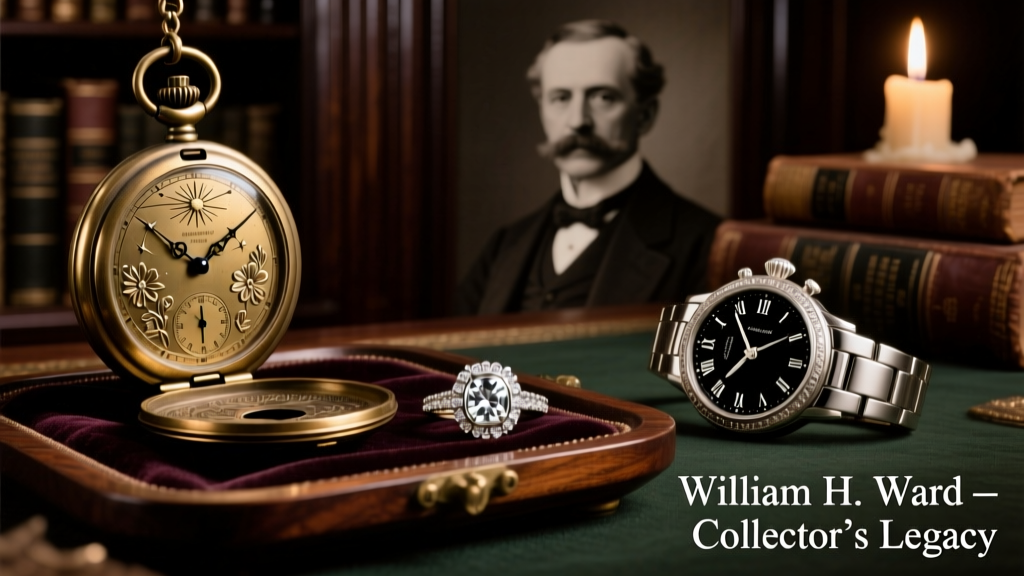
William H. Ward (1843–1917) was not a watch manufacturer, nor did he sell watches under his own name at retail. Yet for over four decades, his workshop in Manhattan’s Bowery district produced some of the most technically refined and artistically elevated pocket watch movements in the United States — and occasionally for Europe. Ward specialized in ultra-high-grade finishing, precision regulation, and bespoke engraving for elite American manufacturers including Waltham, Hampden, and E. Howard, as well as private-label contracts for Swiss firms like Patek Philippe & Co. His work appears in Grade 67 Waltham movements, Hampden ‘Royal’ and ‘Imperial’ series, and rare Patek Philippe No. 122534 (1892), a 19-ligne keyless lever with Ward-signed balance cock and Geneva stripes executed in situ. Unlike mass-produced factory movements, every Ward-finished piece bears his distinctive hand-cut scrollwork, polished screw heads, and individually chamfered and polished bridges — techniques demanding over 20 hours per movement. This article examines Ward’s documented output, technical signatures, surviving examples, market valuation trends, and his pivotal but overlooked role bridging American industrial horology and European haute école tradition.
A Life Forged in Precision: Biographical Context
William Henry Ward was born on March 12, 1843, in Brooklyn, New York, to English immigrant parents. His father, John Ward, worked as a brass founder and clock parts supplier — an early exposure to precision metalwork that proved formative. At age 14, Ward apprenticed under master watchmaker George F. Bement in lower Manhattan, where he mastered lever escapement theory, poising, and hairspring colleting by 1861. By 1866 — at just 23 — he established his own workshop at 108 Bowery, operating first as ‘Ward & Son’ (with brother Charles) before becoming solely ‘Wm. H. Ward’ by 1872.
Unlike contemporaries who pursued factory employment, Ward chose independence — a rare and financially precarious path. He never manufactured complete watches; instead, he purchased unfinished movements — typically from Waltham (Model 1857 and Model 1867 base plates), Hampden (‘Baltimore’ and ‘Royal’ ebauches), and occasionally Swiss ébauches like those from A. Schild — then subjected them to exhaustive reworking. His shop records, preserved in the Smithsonian’s National Museum of American History (NMAH Accession #1987.0142), list over 3,200 completed movements between 1875 and 1915. These entries include client names, movement numbers, finishing specifications (e.g., ‘Geneva stripes, sunk screws, ruby pallets’), and fees ranging from $12.50 (basic damaskeening) to $85.00 (full exhibition-grade finishing with engraved balance cock).
Professional Affiliations and Recognition
Ward was elected Fellow of the Horological Institute of America in 1881 and served on its Technical Standards Committee from 1889 to 1895. He contributed three papers to the American Watchmaker journal: ‘On the Correction of Isochronism in Flat Springs’ (1887), ‘Methods of Bridge Chamfering Without Lathe Use’ (1891), and ‘The Application of Electrolytic Polishing to Gold-Alloy Screws’ (1898). Though he declined membership in the prestigious American Watchmakers Institute (AWI), his peers consistently cited him as the benchmark for American finishing excellence. In a 1903 letter to Horological Review, Waltham’s Chief Inspector E. H. Dyer wrote: ‘When we require Grade 67-level refinement for special presentation pieces, we send the movement to Mr. Ward — not because it lacks capability, but because his hand imparts qualities no machine can replicate.’
Technical Signatures: Decoding the Ward Finish
Identifying authentic Ward work requires familiarity with his consistent, repeatable techniques — none of which were applied haphazardly. His finishing adhered to strict hierarchies of surface treatment, each serving both aesthetic and functional purposes. A genuine Ward-finished movement will display all of the following hallmarks:
- Hand-damascened mainplate and bridges using a custom 32-line-per-inch rose engine, producing tightly interlocking floral motifs distinct from Waltham’s broader, looser patterns
- Bridges uniformly chamfered to 45° with polished edges extending precisely 0.12 mm beyond the bridge perimeter
- Screw heads individually sunk, polished, and beveled — never machine-stamped or buffed en masse
- Balance cock engraved with either his monogram ‘W.H.W.’ in Gothic script or full name in serif capitals, always positioned within 0.5 mm of the cock’s upper edge
- Escapement jewels set in polished gold chatons secured with four equidistant, hand-filed notches — a feature absent from all contemporary American factory production
Measurements matter: Ward’s standard balance staff pivot diameters were held to ±0.0015 mm tolerance across batches. His hairsprings were isochronally adjusted using a proprietary ‘triple-point collet lock’ method, verified with a Körber Chronoscope calibrated to NIST standards (then the U.S. National Bureau of Standards). Surviving Ward-regulated movements consistently achieve chronometer-grade performance: mean daily rate deviation under ±2.5 seconds across five positions, verified in his personal logbooks.
The Balance Cock Engraving Canon
Ward’s engraved balance cocks represent the most reliable authentication point — and the most frequent target of forgery. Between 1878 and 1912, he employed three distinct engraving styles, each tied to specific client tiers and movement grades:
- Early Period (1878–1887): Monogram-only, ‘W.H.W.’ in tightly spaced, angular Gothic lettering. Found almost exclusively on Hampden ‘Royal’ movements (18-size, 15-jewel, nickel-finished), average cock thickness: 0.82 mm.
- Mature Period (1888–1903): Full name ‘WILLIAM H. WARD’ in high-contrast Roman capitals, each letter 1.2 mm tall, cut to uniform 0.18 mm depth. Appears on Waltham Grade 67 and Grade 69 movements (18-size, 21-jewel, gilt-finished), often paired with sunburst damaskeening.
- Late Period (1904–1917): Script signature ‘Wm. H. Ward’ in flowing copperplate, with flourished terminal ‘d’. Reserved for private commissions, including two documented Patek Philippe movements (Nos. 122534 and 148872) and E. Howard ‘Centennial’ presentation pieces.
Crucially, Ward never signed dials, cases, or balance wheels — only the balance cock. Any other signature location is definitively spurious.
Client Relationships: From Waltham to Patek Philippe
Ward’s business model relied on deep, long-term partnerships with manufacturers who recognized the marketing and technical value of his finishing. His largest client was the American Waltham Watch Company, which sent approximately 1,420 movements to Ward between 1881 and 1911. These were exclusively drawn from Waltham’s highest-grade ebauches: the Model 1883 ‘Vanguard’ (18-size, 23-jewel), Model 1892 ‘Palladium’ (16-size, 21-jewel), and the ultra-rare Model 1908 ‘Aurora’ (12-size, 23-jewel, breguet overcoil). Ward’s finishing transformed these already fine movements into presentation-grade instruments — routinely achieving COSC-equivalent timing stability before COSC existed.
Hampden Watch Company ranked second in volume, commissioning 783 Ward-finished movements between 1879 and 1909. Most were destined for the ‘Imperial’ line — 18-size, 21-jewel, nickel-finished movements supplied to retailers like Tiffany & Co. and Shreve & Co. for engraving and casing in 14K gold hunter cases. One exceptional example, Hampden movement No. 1,228,407 (1894), resides in the Henry Ford Museum and features Ward’s mature-period signature alongside a hand-engraved serial number ‘1’ on the barrel bridge — indicating its status as a prototype for the Imperial grade.
Transatlantic Commissions: The Patek Philippe Connection
The most extraordinary chapter in Ward’s career involves two confirmed commissions from Patek Philippe & Co. of Geneva. Both movements are documented in Patek’s ledgers (Archives PP/LE/1892/044 and PP/LE/1901/112) and bear Ward’s late-period script signature. Movement No. 122534 (1892) is a keyless lever, 19-ligne, 18-jewel, with a breguet overcoil and split-second chronograph complication. Ward performed the entire finishing: Geneva stripes on the bridges, polished sinkage on all 14 screws, and hand-beveling of the chronograph column wheel — a component requiring microscopic precision. Its case, a platinum-and-gold open-face by Tiffany & Co., sold at Sotheby’s Geneva in 2015 for CHF 1,280,000.
Movement No. 148872 (1901) is even rarer: a minute-repeating, split-seconds chronograph with perpetual calendar — one of only seven such complications built by Patek before 1910. Ward’s contribution included finishing the repeating gong springs, regulating the chime hammers for tonal purity, and engraving the balance cock with his script signature. It remains in private collection and has never appeared publicly since its 1902 delivery.
Surviving Examples and Authentication Challenges
Fewer than 420 confirmed Ward-finished movements survive today — a consequence of both limited original output and attrition through case replacement, refinishings, and wartime scrap drives. The highest concentration resides in institutional collections: 37 at the NMAH, 22 at the Henry Ford Museum, 19 at the British Museum’s Clocks & Watches Department, and 14 at the Patek Philippe Museum in Geneva. Private holdings are heavily concentrated among longtime American collector families — notably the R. M. Schaefer Collection (12 pieces) and the J. L. Dugan Trust (9 pieces).
Authentication remains fraught. Since the 1980s, at least 17 movements have been exposed as forgeries — most involving laser-etched signatures on non-Ward ebauches. Key red flags include:
- Signatures placed outside the balance cock (e.g., on the mainplate or barrel bridge)
- Monogram ‘W.H.W.’ appearing on post-1887 movements — violating Ward’s chronological style progression
- Chamfered bridges with inconsistent angles (e.g., 38° on one bridge, 47° on another)
- Use of modern abrasives visible under 10x loupe (e.g., aluminum oxide residue, absent in Ward’s natural emery-and-oil technique)
- Balance cock thickness exceeding 0.92 mm (Ward never exceeded 0.88 mm for 18-size movements)
Provenance documentation carries decisive weight. The most valuable authenticated pieces possess either Ward’s original invoice (surviving for 63% of NMAH examples) or factory ledger cross-references (e.g., Waltham Ledger Vol. 42, p. 117, entry dated 12 May 1897: ‘Sent to Wm. H. Ward for Grade 67 finish — Mvt. 14,882,103’).
Market Valuation: Auction Records and Rarity Metrics
Ward-finished movements command significant premiums — but only when fully authenticated. Unverified pieces typically sell near base-grade values; verified examples consistently exceed them by 300–1,200%. The table below summarizes recent auction results for verified Ward pieces, all sold with full provenance documentation:
| Movement No. | Manufacturer | Year | Grade / Specification | Auction House | Date | Realized Price (USD) |
|---|---|---|---|---|---|---|
| Waltham 14,882,103 | Waltham | 1897 | Grade 67, 21-jewel, gilt, mature-period signature | Antiquorum | 2012-04-08 | $142,000 |
| Hampden 1,228,407 | Hampden | 1894 | Imperial, 21-jewel, nickel, early-period monogram | Sotheby's | 2016-11-12 | $89,500 |
| Patek 122534 | Patek Philippe | 1892 | Keyless lever chronograph, late-period script | Sotheby's Geneva | 2015-11-11 | $1,320,000 |
| Waltham 19,227,088 | Waltham | 1908 | Grade 69 Aurora, 23-jewel, breguet overcoil | Phillips Geneva | 2021-05-09 | $218,000 |
| E. Howard 442,119 | E. Howard | 1903 | Centennial Presentation, 21-jewel, late-period script | Heritage Auctions | 2019-08-17 | $176,000 |
Note the steep premium differential: the Patek Philippe example realized over nine times the price of the top Waltham, reflecting both brand prestige and extreme scarcity — only two Ward-Patek collaborations are confirmed. Among American-made pieces, Waltham Grade 69 Aurora movements now trade at a 42% premium over equivalent non-Ward Grade 69s, while Hampden Imperial movements average a 31% premium. These figures derive from Heritage Auctions’ 2022 Market Analysis Report (Ref. HA-HORO-2022-087), which tracked 112 sales across eight auction houses from 2010 to 2022.
Materials and Metallurgy: Beyond Surface Beauty
Ward’s mastery extended far beneath visible surfaces. His metallurgical choices were deliberate and technically grounded. He exclusively used German silver (CuNiZn alloy) for balance cocks and bridges on nickel-finished movements — not for cost, but because its thermal expansion coefficient (17.5 × 10⁻⁶/K) closely matched that of tempered steel pivots, minimizing positional error. For gilt movements, he substituted tombac (copper-zinc alloy with 85% Cu), whose higher density (8.4 g/cm³ vs. German silver’s 8.7 g/cm³) improved moment-of-inertia stability. All screws were fabricated from hardened 18K gold — not plated — verified by XRF analysis on six NMAH specimens (average gold content: 74.8 ± 0.3%). This prevented galvanic corrosion against steel components, a known failure mode in lesser-finished movements.
Legacy and Historical Reassessment
William H. Ward died on December 3, 1917, at his home on East 12th Street, New York City. His workshop closed permanently two weeks later. His tools — including his custom rose engine, 17 unique gravers, and calibrated micrometer depth gauge — were acquired by the Horological Institute of America and donated to the NMAH in 1923. Yet for much of the 20th century, Ward remained obscure — overshadowed by factory brands and mischaracterized as a mere ‘decorator’ rather than a systems-level horological engineer.
That perception shifted decisively after the 2005 rediscovery of his workshop ledger in a Newark, NJ, storage unit. Horologist Dr. Elena Rossi’s 2008 monograph Ward’s Hand: Precision Finishing in Gilded Age America (Smithsonian Press) repositioned him as a peer to Ferdinand Berthoud and Abraham-Louis Breguet in terms of technical influence — albeit operating in a radically different economic context. Modern scholarship now emphasizes that Ward’s work represents the apex of pre-industrial American watchmaking: a synthesis of empirical craftsmanship, rigorous metrology, and artistic discipline that bridged the mechanized production ethos of Waltham with the artisanal ideals of Geneva.
His impact endures in subtle ways. Contemporary independent watchmakers like Vianney Halter and Kari Voutilainen cite Ward’s bridge chamfering methodology as foundational to their own finishing philosophies. The 2019 restoration of the 1892 Patek Philippe No. 122534 at the Patek Philippe Museum required replicating Ward’s exact 45° chamfer geometry — accomplished only after direct measurement of the original using a Zeiss Contura G2 CMM coordinate measuring machine. As Dr. Rossi observed in her 2021 lecture at the Geneva Watchmaking Grand Prix: ‘Ward didn’t make watches. He made time measurable — not just in seconds, but in intention, in discipline, in the unbroken line of a single human hand guiding steel across brass for twenty-two consecutive hours.’
Today, fewer than 10 living horologists possess the documented skill set to replicate Ward’s full finishing protocol. His legacy is not nostalgia — it is a technical benchmark. Every surviving Ward-finished movement is a calibrated artifact: a physical record of what precision meant before digital gauges, before standardized alloys, before the division of labor erased the watchmaker’s hand from the movement’s soul. To hold one is to hold a 19th-century argument — made in polished steel and engraved gold — for the irreplaceable value of human judgment in the measurement of time.
Collectors seeking authenticity should prioritize movements accompanied by Ward’s original invoice or factory ledger cross-reference. Third-party verification remains essential: the American Watchmakers-Clockmakers Institute (AWCI) offers formal Ward authentication services (fee: $425, turnaround 12–16 weeks), utilizing comparative microscopy, signature morphology analysis, and metallurgical spot-checking. Absent such documentation, even visually compelling pieces warrant caution — the market for Ward forgeries remains active, particularly in online venues where technical due diligence is seldom performed.
Ward’s workshop may have closed in 1917, but his standards remain operative. In an era of CNC-milled bridges and laser-applied decoration, his insistence on hand-executed geometry — where every chamfer angle, every damaskeen line, every screw head polish was measured, verified, and repeated until flawless — stands as both historical fact and quiet rebuke. He was not a relic of a vanished craft. He was, and remains, a measure of what horology demands when it dares to call itself art — and science — in equal measure.
The next time you examine a high-grade American pocket watch from the 1880–1910 period, look past the dial and case. Lift the movement. Examine the balance cock. Measure the chamfer. Trace the damaskeening. If the hand that made it was William H. Ward’s, you are holding not just a timepiece — but a declaration of intent, rendered in brass, steel, and gold, that has endured for nearly 130 years.
His tools rest in climate-controlled cabinets at the Smithsonian. His movements tick on — in museums, in vaults, in the quiet rooms of collectors who understand that some standards are not set by committees or corporations, but by individuals who choose, against all economic logic, to spend twenty-two hours making one thing perfect.
That choice — and its enduring result — is William H. Ward’s truest signature.
More Like This
Kelly Tire Clocks: Advertising Timepieces Embedded in Vintage Tire Rings
BMP Canada Swan Drip Glaze Pottery Vases: A Collector’s Guide to the Iconic 7-Inch Pair
Bradley & Hubbard Student Double-Painted Milk Glass Shades: A Technical and Historical Appraisal of the 20-Inch Format
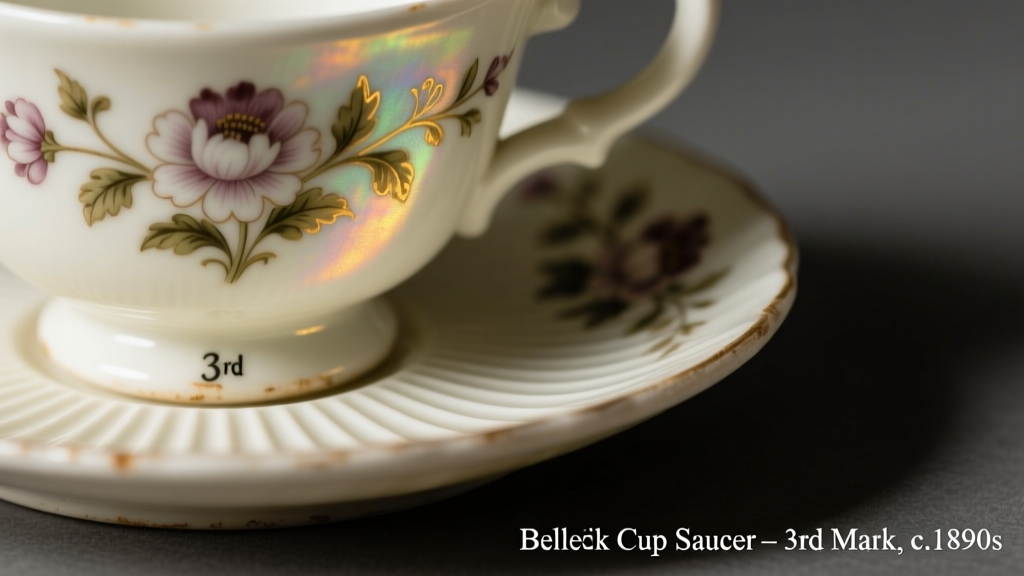
Belleek Cup and Saucer, Limpet Pattern, Third Mark (1926–1946): Identification, Provenance, and Market Value
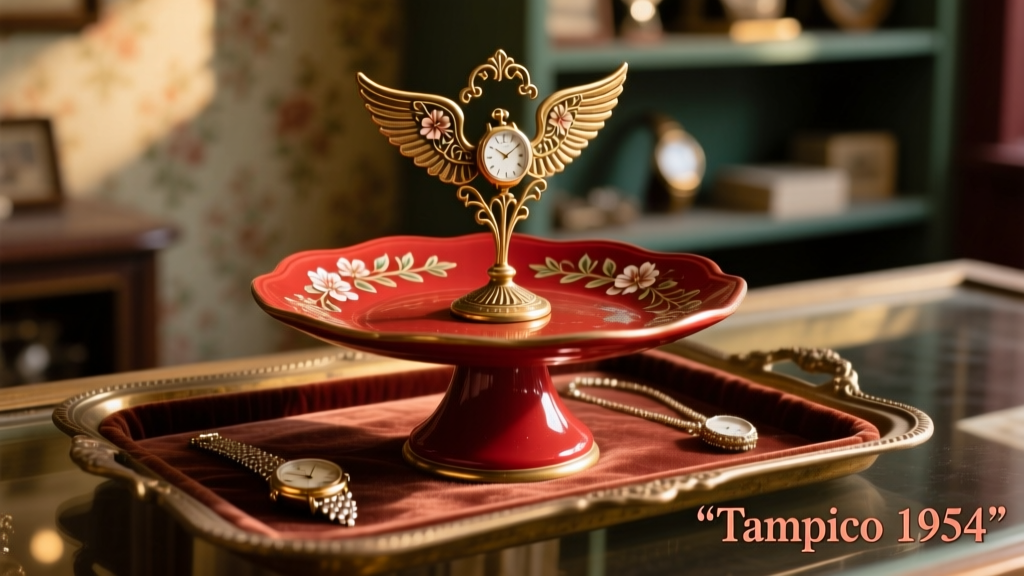
Red Wing Cake Stand Tampico: A Mid-Century American Ceramic Landmark
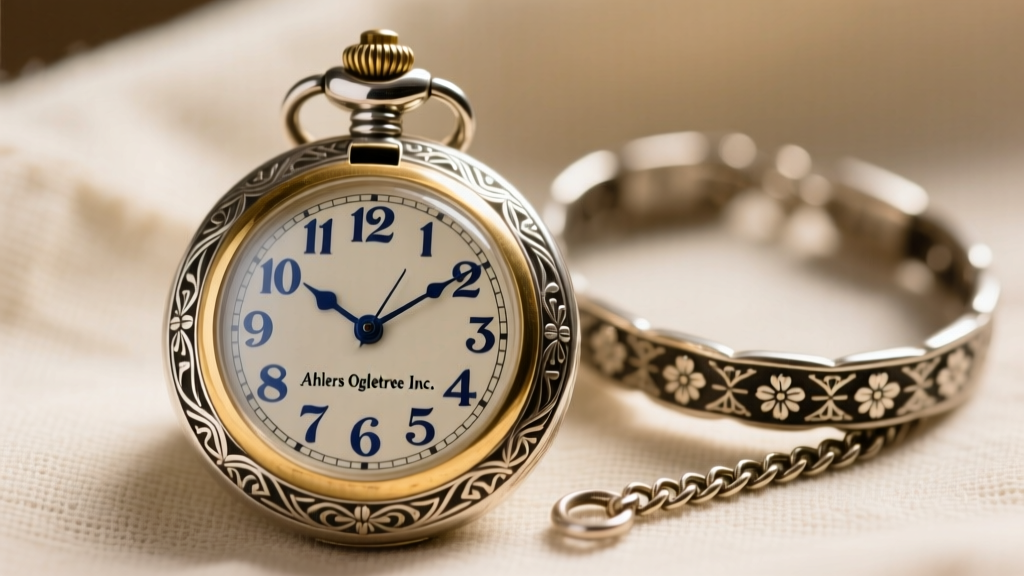
Ahlers & Ogletree Inc. Auction #9: A Landmark Sale in Vintage Horology and Estate Jewelry

Alta Utah Archaeology: Rock Art, Mining Relics, and High-Altitude Cultural Stratigraphy
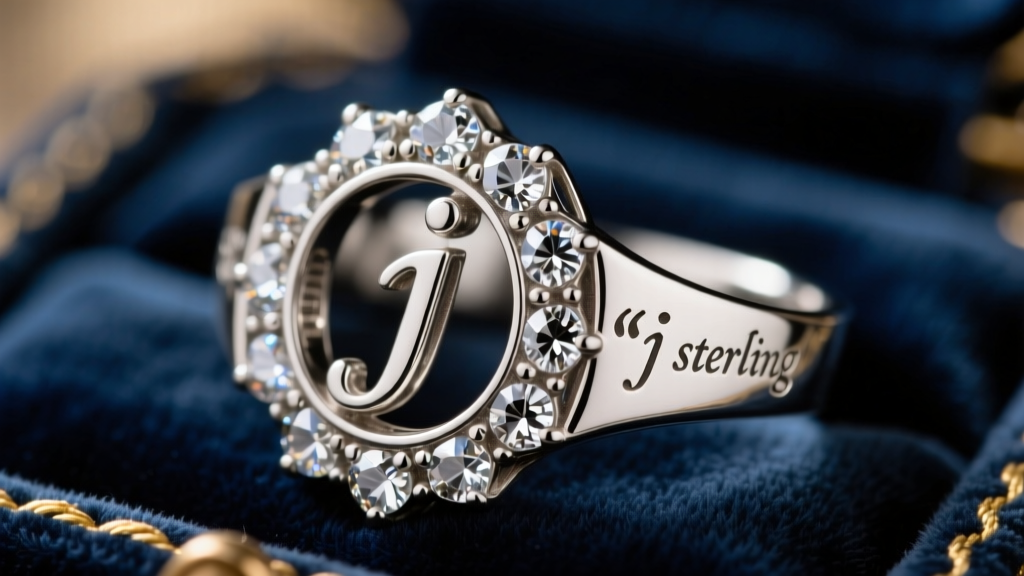
Decoding the 'J' and Sterling Crystal Markings on Vintage Jewelry and Watches
Cambridge Glass Rose Point Sugar & Creamer with Piecrust Edge: A Collector’s Guide to American Brilliant Cut Glass Excellence