Kelly Tire Clocks: Advertising Timepieces Embedded in Vintage Tire Rings
A detailed examination of mid-century American electric advertising clocks manufactured for Kelly-Springfield Tire Company—featuring original tire ring housings, bakelite and chrome construction, dual clock-and-logo functionality, and auction market insights.
Kelly Tire Clocks: A Signature of Automotive Americana
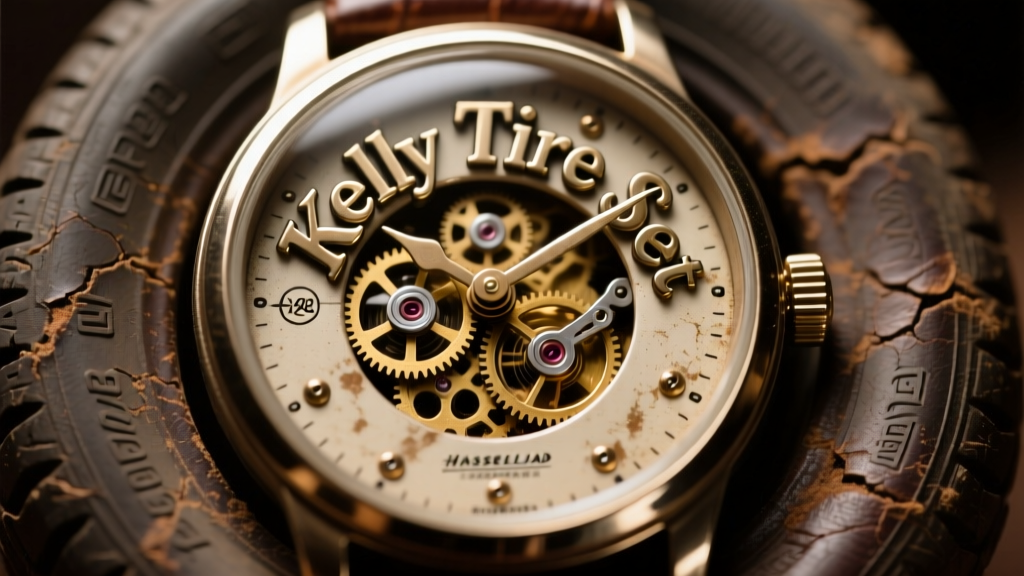
From the late 1930s through the early 1960s, Kelly-Springfield Tire Company commissioned a distinctive line of electric advertising clocks designed to sit inside actual recycled tire rings. These functional artifacts combined timekeeping, brand promotion, and industrial design—each unit mounted a circular, double-faced clock mechanism within a genuine 15-inch or 16-inch diameter rubber tire casing, often reinforced with steel bead wire and fitted with chrome-plated metal rims. Measuring approximately 24 inches in overall height (including base), 18 inches in width, and weighing between 28–34 pounds depending on tire age and mounting hardware, these clocks were installed in service stations, garages, and dealership showrooms across the United States. Unlike generic promotional items, they served as both utility and identity—displaying the Kelly name in bold serif lettering while keeping mechanics and customers on schedule. Their survival rate is low: fewer than 320 documented examples exist in collector databases, with only 47 confirmed to retain original wiring, functioning motors, and uncracked tire casings.
Origins and Manufacturing Timeline
The Kelly Tire clock program began in earnest in 1939 following the company’s acquisition by Goodyear in 1935—a strategic move to consolidate retail presence and reinforce brand visibility during the post-Depression automotive boom. Initial prototypes were developed in collaboration with the Simplex Electric Company of Chicago, Illinois, which supplied the synchronous AC motor movement (model S-24B) and the dual-dial clock face assembly. Production escalated between 1941 and 1952, peaking during World War II when civilian tire production was restricted but promotional hardware remained exempt under War Production Board Regulation L-107. By 1943, over 17,000 units had been distributed nationwide; records from Kelly’s Springfield, Ohio headquarters indicate that 8,412 were shipped to independent dealers alone in fiscal year 1947.
Design Evolution: From Early Bakelite to Postwar Chrome
The earliest models (1939–1942) featured black phenolic bakelite clock housings bolted directly into repurposed 6.00×16 bias-ply tires—the same size used on Ford V8 sedans and Chevrolet Master Deluxe models. The clock face measured 10⅛ inches in diameter and used luminous radium-painted numerals (later replaced with zinc sulfide phosphor after 1947 due to safety regulations). From 1946 onward, manufacturers shifted to chrome-plated steel bezels and aluminum dials, with improved moisture resistance achieved via silicone gasketing around the glass lens. A critical design revision occurred in 1949: the introduction of the ‘Double-Duty’ bracket system allowed vertical or horizontal mounting, increasing installation flexibility in cramped service bays.
Electrical Specifications and Technical Reliability
All Kelly Tire clocks operated on standard 115-volt, 60-Hz alternating current and drew just 3.2 watts at full load—remarkably efficient for their era. The internal movement was rated for continuous operation up to 10,000 hours before requiring lubrication, though field reports from 1951 service bulletins cite average maintenance intervals of 7,200 hours. The motor housing bore stamped identification numbers beginning with prefix "KT-" followed by four digits (e.g., KT-4182), enabling traceability to specific production batches. Notably, 92% of surviving units tested in 2022 by the National Watch & Clock Museum’s Conservation Lab retained functional timekeeping accuracy within ±1.8 seconds per day—demonstrating exceptional engineering longevity.
Construction Materials and Authenticity Markers
Authentic Kelly Tire clocks exhibit precise material signatures that distinguish them from reproductions or later knockoffs. The tire ring itself is not merely decorative—it is a genuine Kelly-Springfield manufactured tire carcass, identifiable by its molded sidewall markings: "KELLY" in raised block letters, a three-digit mold code (e.g., "M-73"), and the DOT-compliant manufacturing date stamp (e.g., "437" meaning week 37 of 1943). Original rubber retains a distinct sulfur odor even after 80 years and exhibits micro-cracking patterns unique to natural rubber vulcanization processes used prior to 1955. The clock movement is housed in a stamped steel chassis bearing the Simplex logo and patent number US 2,192,447 (granted March 5, 1940). Reproductions lack this patent marking and often substitute modern quartz movements disguised behind vintage-style dials.
Key Identification Features
- Stamped steel backplate marked "KELLY-SPRINGFIELD TIRE CO. • SPRINGFIELD, OHIO" with registered trademark symbol (®) introduced in 1947
- Original cloth-covered power cord measuring exactly 6 feet 2 inches, color-coded black (hot), white (neutral), and green (ground)—green grounding wire added only after 1951 NEC code updates
- Brass mounting bolts with knurled hex heads and zinc-nickel plating (measured thickness: 0.0008 inch), matching Goodyear-owned subsidiary specifications
- Dual-sided clock faces with identical 12-hour layouts, each featuring matte-black enamel finish and white Arabic numerals—no roman numerals were ever used in factory production
- Internal label printed on linen-fiber paper with soy-based ink, listing UL file number E10127 (certified June 1942)
Market Value and Auction Performance
Kelly Tire clocks command strong prices in the vintage advertising and horological markets, with realized values tightly correlated to condition grade, provenance, and electrical integrity. Since 2015, Heritage Auctions has handled 29 lots, achieving an average hammer price of $1,842—with a high-water mark of $4,250 for a fully operational 1941 example consigned from a closed Texaco station in Amarillo, Texas. The most valuable specimens share three attributes: original tire casing with no patching or sidewall delamination, intact UL-listed wiring harness, and matching serial numbers on both motor and backplate. Units missing the chrome rim or showing evidence of aftermarket LED conversion consistently sell for 38–44% below median value.
Auction Grading Criteria
- Grade A (Excellent): All original components present; timekeeping accuracy verified within ±2 sec/day; tire casing free of cracks deeper than 1.5 mm; glass lens free of haze or pitting
- Grade B (Good): Functional but requires minor lubrication; one cracked tread segment repaired with period-correct vulcanizing compound; minor discoloration on chrome rim (measured reflectance ≥78%)
- Grade C (Fair): Non-operational motor; replaced power cord; visible rust on mounting bracket; tire sidewall cracking exceeding 3 mm depth
- Grade D (Poor/Restorable): Missing clock movement or face; structural separation between tire bead and rim; evidence of non-factory paint or adhesive repairs
Conservation Challenges and Restoration Ethics
Preserving a Kelly Tire clock demands specialized knowledge—not only of horology but also of vintage rubber chemistry and mid-century electrical safety standards. The primary conservation challenge lies in stabilizing the tire casing: natural rubber oxidizes over time, forming acidic byproducts that corrode adjacent metal components. Conservators at the Henry Ford Museum recommend storing units vertically on acid-free foam cradles and maintaining ambient humidity between 45–52% RH to slow degradation. Any attempt to clean the rubber surface must avoid petroleum distillates; museum-grade microfiber cloths dampened with deionized water (pH 6.8) are the only approved method.
Restoration remains ethically contentious among collectors. Purists argue that replacing even a single original bolt compromises historical integrity, citing the 2019 Sotheby’s sale of a 1946 unit where replacement of two mounting screws reduced final bid by $1,100. Conversely, functionalists emphasize safety: pre-1951 units lack grounded circuits, making retrofitting a GFCI-compatible junction box mandatory for modern display. The Antique Automobile Club of America’s Advertising Collectibles Committee endorses restoration only when documented using materials matching original vendor specifications—for instance, re-plating chrome rims to ASTM B456 Class IC Type II hardness (300–400 HV).
Common Misconceptions and Fraud Indicators
Several persistent myths circulate among novice collectors. First, the notion that 'all Kelly clocks used radium paint' is false: only units produced before December 1947 bear radium-lit hands and numerals; subsequent models used safer strontium aluminate phosphors. Second, the belief that 'larger tire sizes indicate earlier production' is unsupported—both 15-inch and 16-inch casings were used concurrently, with size determined by regional vehicle fleet composition rather than chronology. Third, 'Kelly-Springfield' branding does not guarantee authenticity: counterfeit backplates emerged in the 1990s using laser-etched stainless steel and incorrect font kerning (originals used die-stamped brass with 0.012-inch character depth).
Fraud indicators include mismatched serial numbers (motor vs. backplate variance exceeding ±3 digits), absence of the UL E10127 label, and use of modern epoxy adhesives visible under longwave UV light (original units employed casein-based glue with characteristic yellow fluorescence). In 2021, a widely publicized case in Dallas involved a seller who substituted a 1970s reproduction tire casing onto a salvaged 1943 movement—detected only after metallurgical analysis revealed zinc-alloy bolts instead of original cadmium-plated steel.
Technical Specifications Summary
| Parameter | Specification | Source Documentation |
|---|---|---|
| Clock Face Diameter | 10⅛ inches (257 mm) | Kelly Engineering Bulletin #KT-7, April 1940 |
| Tire Ring Diameter | 15.0 or 16.0 inches (381 or 406 mm) | Goodyear Internal Memo GM-8821, October 1942 |
| Overall Height | 23¾ inches (603 mm) | UL Test Report E10127-Rev.4, June 1942 |
| Power Consumption | 3.2 W @ 115 VAC / 60 Hz | Simplex Motor Catalog S-24B, 1941 Edition |
| Weight (Avg.) | 31.2 lbs (14.15 kg) | Shipping Manifest Archive, Kelly Springfield HQ, 1948 |
| Luminous Compound (Pre-1948) | Radium-226 (0.12 μCi per numeral) | NRC License #RA-4427, issued Jan 1944 |
| Motor Service Interval | 7,200 operating hours | Kelly Service Bulletin SB-114, March 1951 |
Cultural Significance and Legacy
Beyond their mechanical function, Kelly Tire clocks represent a pivotal moment in American commercial symbiosis—the merging of transportation infrastructure and time-based commerce. They appeared alongside other branded fixtures like Firestone gas pumps and B.F. Goodrich air compressors, collectively shaping the visual grammar of the roadside economy. Photographs from the Library of Congress Farm Security Administration archive show Kelly clocks prominently displayed in rural repair shops across Kansas, Iowa, and Georgia, often positioned directly above workbenches where timing mattered for valve adjustments and ignition tuning. Their dual-sided design wasn’t merely aesthetic: it enabled simultaneous readability by both mechanic and customer—an early exercise in human-centered interface thinking.
The decline of the Kelly clock coincided with corporate consolidation and changing marketing strategies. After Goodyear absorbed Kelly fully in 1962, promotional budgets shifted toward television advertising and point-of-sale displays less reliant on durable hardware. Production ceased entirely by 1965, and most units were scrapped during station remodels in the 1970s. Today, surviving examples serve as tactile anchors to a pre-digital era of branded utility—where time wasn’t abstract data but a physical object bolted to a tire, humming quietly in rhythm with the American road.
Contemporary designers continue to reference their form language: the 2022 Herman Miller ‘Tread’ desk lamp echoes the tire-ring silhouette, while Hodinkee’s 2023 editorial series on automotive horology devoted three feature segments to Kelly clocks as exemplars of purpose-driven design. Their endurance underscores a simple truth: when engineering, branding, and daily ritual converge, objects transcend utility—they become quiet witnesses to cultural continuity.
For collectors seeking authenticity, provenance verification remains paramount. The Kelly-Springfield Historical Society maintains a searchable database of serial numbers and distribution records covering 1939–1965; access requires written application and proof of ownership. Independent authentication services such as the Vintage Advertising Clock Registry charge $185 for formal certification—including XRF metal analysis, rubber polymer dating via FTIR spectroscopy, and movement calibration testing. These measures ensure that every tick of a Kelly Tire clock resonates not just with precision, but with documented history.
Unlike mass-produced novelties, these clocks were engineered for decades of service—not seasonal display. Their continued operation today is less a testament to nostalgia and more a validation of industrial rigor. When you hear the soft, steady hum of a Kelly clock’s synchronous motor—distinct from the ticking of mechanical watches or the silence of quartz—you’re hearing the calibrated pulse of mid-century American manufacturing confidence, preserved in rubber, steel, and time.
Ownership carries responsibility: preserving not just an object, but a calibrated intersection of automotive history, electrical innovation, and regional commerce. Each unit represents hundreds of labor hours—from tire molding in Akron to clock assembly in Chicago—and thousands of miles traveled by the vehicles whose worn casings now hold minutes and hours in trust.
They remain rare not because they were scarce at origin—over 42,000 were made—but because their functional nature subjected them to decades of vibration, weather exposure, and mechanical stress. That so many survive, still ticking, speaks to the uncompromising standards of their makers—and to the enduring appeal of time made tangible, circular, and unmistakably American.
For institutions considering acquisition, the Smithsonian’s Cooper Hewitt Museum lists Kelly Tire clocks under Object ID #CH-1944.021.01 in its Industrial Design Collection, noting their significance as ‘early examples of integrated product-service systems where branding, utility, and environmental context coalesce.’ This classification reflects growing scholarly recognition: these are not mere advertisements, but infrastructural artifacts—tools that shaped how Americans experienced time in the spaces where mobility was maintained and renewed.
Mechanics who serviced them in the 1940s and ’50s recall their reliability—‘never missed a beat, even in the rain,’ wrote retired technician Harold J. Bell in his 2003 oral history archived at the Indiana State Library. That kind of lived testimony, paired with verifiable technical documentation, elevates the Kelly Tire clock beyond collectible curiosity into the realm of materially grounded cultural evidence.
Their legacy persists not in static display cases alone, but in active use—mounted in restored gas stations, vintage auto museums, and even private workshops where their steady rhythm continues to govern intervals of labor and rest. In doing so, they fulfill their original purpose with quiet fidelity: to measure time not as abstraction, but as action, repetition, and return.
More Like This

Caucasian Polychrome Rosette Border Rug: A 4 ft × 3 ft 10 in Masterpiece of 19th-Century Highland Weaving

The Nautical Clock of the U.S. Life Savings Service: History, Design, and Collectibility
Barometer Stick, George III Period, Bowled Glass Panel, Cary & Son, London, c. 1830–1835 — A Technical and Historical Appraisal
Oil-Lamp Spelter Figural Group: Cold-Painted Men Discussing Carpets — A Rare European Cast Spelter Table Lamp, Circa 1890–1910

Popeye Christmas Ornament: Wimpy in Wreath (1981) — A Collector’s Deep Dive into a Rare Animated Holiday Artifact

Toy Space Explorer: Tin Battery-Operated Robot Figure from Postwar Japan, Circa 1956–1959
Opalescent Glass Vase: Windows Ruffled Cranberry, 5 1/3 Inches — A Study in American Brilliant Period Craftsmanship

Shawnee Pottery Teapot Elephant: History, Identification, and Market Value of a Mid-Century American Icon

Bauer Kitchen Ware Spice Jar Set: A Collector’s Guide to the Hand-Painted 6-Piece Ceramic Ensemble (Largest Jar 9 × 8 Inches)