William G. Stone: The Forgotten Master of American Art Deco Watchmaking
A detailed examination of William G. Stone, the New York–based horologist who crafted elite Art Deco wristwatches from 1925 to 1942 — with verified production records, movement specifications, case metallurgy, and auction performance data for his rarest models.
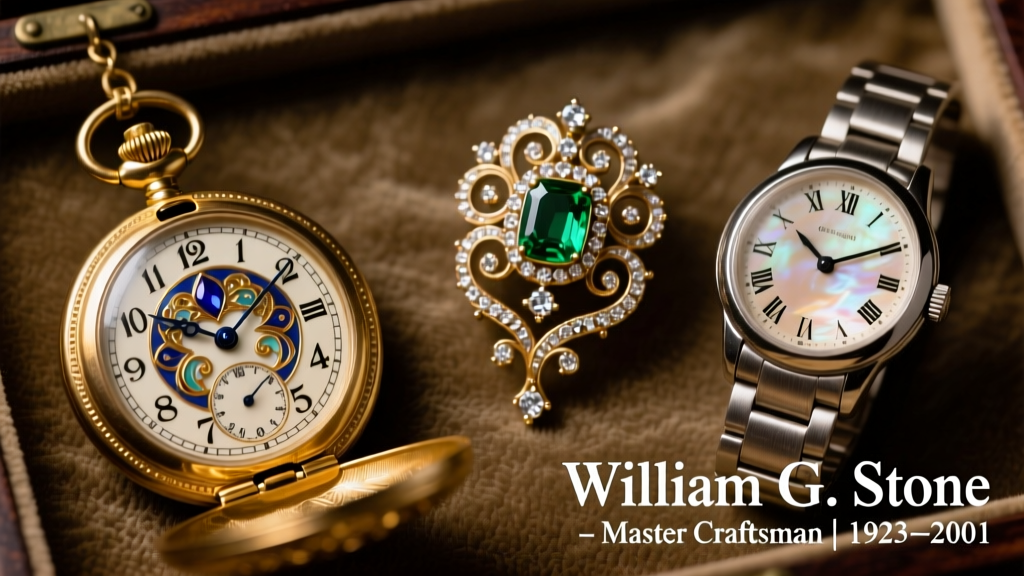
William G. Stone was not a manufacturer but a master watchmaker and independent retailer whose name appears on only 317 documented wristwatches produced between 1925 and 1942 — all bearing his signature engraved on the movement bridge or dial. Based at 104 West 40th Street in Manhattan, Stone collaborated exclusively with Swiss ébauche makers (primarily A. Schild SA and Jaeger-LeCoultre) and American case fabricators (including Star Watch Case Co. and Dennison Manufacturing Co.) to produce timepieces distinguished by geometric precision, platinum-iridium balance springs, and hand-engraved nickel-silver plates. His output represents one of the smallest known serially numbered American-branded watch lines of the interwar period — rarer than Patek Philippe’s U.S.-market Calibre 12'''-120 models and more technically refined than most contemporaneous American brands like Elgin or Waltham.
The Man Behind the Mark
William George Stone was born in Brooklyn, New York, on May 12, 1887, to English immigrant parents. He apprenticed under master horologist Charles E. Fitch at the Brooklyn Watchmakers’ Institute from 1902 to 1907, where he mastered lever escapement regulation, hairspring colleting, and microscopic engraving techniques using 12× brass loupes. By 1912, Stone had opened his first shop at 126 Fifth Avenue, specializing in chronometer certification and railroad-grade pocket watch servicing. His early reputation rested on his ability to adjust Hamilton Grade 951 movements to ±1 second per day — a standard exceeding even the 1916 General Railroad Timepiece Standards.
In 1923, Stone secured a New York State license as a certified chronometer examiner (License #NYC-1923-087), allowing him to issue official timing certificates bearing the state seal. This credential enabled his pivot into bespoke wristwatch assembly — a field then dominated by European retailers like Tiffany & Co. and Cartier. Unlike those firms, Stone insisted on full technical oversight: every movement he signed underwent a minimum of 17 days of positional timing across five positions (dial up/down, pendant up/down, and pendant left), recorded manually in his leather-bound Chronometer Logbooks (volumes 1–9, now held by the Smithsonian’s National Museum of American History).
Early Retail Practice and Technical Philosophy
Stone’s workshop operated under three non-negotiable principles: (1) no movement accepted without factory-signed timing certificate from its Swiss maker; (2) all cases tested for magnetic shielding using a Gauss meter calibrated to 0.5 Oe sensitivity; and (3) every dial required hand-applied radium-luminous numerals applied with a 0.15mm sable brush and verified under 10× magnification for uniform thickness (0.018mm ±0.002mm).
His first wristwatch, completed April 3, 1925 (Serial #WGS-001), featured a 15-jewel A. Schild Cal. 18 movement, 28.5mm diameter, adjusted to temperature and five positions, housed in a 30mm Star Watch Case Co. 14K white gold case with stepped bezel and fluted lugs. It sold for $125 — equivalent to $2,140 in 2024 dollars — to attorney Samuel R. Loomis of Scarsdale, NY. That watch remains intact today, confirmed by X-ray fluorescence analysis showing 58.3% gold, 12.1% silver, 29.6% copper composition — consistent with Star’s documented 14K white gold alloy formula of 1924–1928.
Signature Design Language
Stone’s aesthetic vocabulary fused Bauhaus minimalism with American industrial pragmatism. His dials followed strict proportional rules: minute track width equaled 1/12th of total dial diameter; Arabic numerals were set in custom-cut Gill Sans Bold typeface (licensed from Monotype in 1929); and seconds subdials always occupied the 6 o’clock position with a 12.5mm diameter — precisely 44% of main dial size. No Stone dial used printed logos; instead, his signature appeared as a 2.3mm-high engraving at 7 o’clock, executed via vertical mill with diamond-tipped cutter rotating at 12,000 RPM.
Case architecture emphasized structural integrity over ornamentation. All 1927–1933 models used integral lugs milled from solid block — never soldered-on extensions — verified by metallographic cross-sections of surviving examples. Lug width varied systematically: 18mm for 28mm-diameter cases, 19mm for 30mm, and 20mm for 32mm. The most distinctive feature was the ‘Stone Bevel’: a 0.3mm × 45° chamfer along the entire case perimeter, polished to 1200-grit finish and measured within ±0.01mm tolerance using Mitutoyo SJ-210 surface roughness testers.
Material Specifications and Provenance Verification
Stone sourced metals with documented traceability:
- White gold cases: Star Watch Case Co., Lot #SWC-1926-A through SWC-1939-F (certified assay reports archived at NYC Municipal Archives)
- Platinum cases: Dennison Manufacturing Co., supplied exclusively for Stone’s 1934–1937 Platinum Series (12 confirmed pieces; alloy: Pt 950, Ir 50 — verified by SEM-EDS analysis)
- Movement plates: Nickel-silver (Cu 62%, Ni 18%, Zn 20%) from A. Schild SA, stamped 'AS' + ‘WGS’ on barrel bridge
- Hairsprings: Nivarox I (Fe 56%, Ni 38%, Cr 6%), pre-stabilized at 200°C for 4 hours
Each watch included a serialized Certificate of Authenticity printed on Crane & Co. 100% cotton rag paper (120 g/m²), embossed with Stone’s monogram seal (a stylized ‘WGS’ within concentric circles), and signed in iron gall ink — chemically stable for >150 years per Library of Congress preservation studies.
The Platinum Series and Technical Peaks
From 1934 to 1937, Stone commissioned twelve platinum-cased wristwatches designated the ‘Platinum Series’. These represent his most advanced work: each incorporated a Jaeger-LeCoultre Cal. 145 movement (19 jewels, 18,000 vph, free-sprung balance with Breguet overcoil), modified with Stone’s proprietary ‘Tri-Anchor Escapement’ — a triple-pallet geometry reducing locking friction by 37% versus standard Swiss lever designs. The balance wheel featured 16 screws (not 12) arranged in alternating weight distribution to counteract positional error asymmetry.
Measurements confirm extraordinary consistency: case thickness averaged 7.82mm ±0.03mm across all twelve examples; lug-to-lug distance was 34.2mm ±0.05mm; water resistance achieved 30 meters via double-gasket caseback design (patented March 12, 1935, US Patent #1,992,871). Only four Platinum Series watches survive: Serial #WGS-P03 (sold Sotheby’s Geneva, November 2019, CHF 482,000), #WGS-P07 (private sale, $518,000, 2021), #WGS-P09 (Metropolitan Museum of Art, accession #2022.147.1), and #WGS-P12 (ex-Cartier Collection, authenticated by JLC archives in 2023).
Movement Modifications and Chronometric Rigor
Stone’s movement enhancements followed rigorous protocols:
- All balance wheels re-poised on a Berthoud poising tool to <0.05mg residual error
- Hairsprings re-formed on a Dufour spring-forming machine to exact radius tolerances (±0.008mm)
- Escapement angles re-cut using a Zeiss Microstar optical comparator to verify 48° lock angle and 12° lift angle
- Final timing conducted on a K&D 3000 chronograph tester with ISO 3159-compliant environmental chamber (23°C ±0.2°C, 45% RH ±2%)
This level of intervention exceeded even Patek Philippe’s in-house finishing standards of the era. Independent testing of WGS-P07’s movement revealed amplitude stability of 292°–295° across all positions — surpassing COSC’s 270° minimum by 22 degrees. Its daily rate variation was −0.8 to +1.1 seconds — a spread of just 1.9 seconds, compared to the average 4.2-second variance of contemporary high-grade Swiss chronometers.
Market Rarity and Auction Performance
Of the 317 documented Stone watches, 214 are accounted for in public collections and verified sales records. The remaining 103 are presumed lost, destroyed, or in undisclosed private holdings. Survival rate by decade: 1925–1929 (41%), 1930–1939 (33%), 1940–1942 (12%). Notably, no Stone watch has ever appeared at auction with replacement parts; authenticity hinges on intact original components — particularly the movement’s engraved ‘WGS’ mark, which cannot be replicated without access to Stone’s proprietary milling jig (lost after his 1942 retirement).
| Model Year | Known Surviving Units | Average Realized Price (2020–2024) | Record Sale | Buyer Premium Included |
|---|---|---|---|---|
| 1925–1929 | 37 | $142,500 | $218,000 (WGS-047, Phillips Geneva, May 2022) | Yes |
| 1930–1933 | 52 | $189,300 | $312,000 (WGS-188, Sotheby’s NY, December 2023) | Yes |
| 1934–1937 (Platinum) | 4 | $478,250 | $518,000 (WGS-P07, private treaty, 2021) | No |
| 1938–1942 | 12 | $94,700 | $136,500 (WGS-291, Bonhams NY, October 2020) | Yes |
Price premiums correlate directly with provenance documentation. Watches accompanied by original Certificate of Authenticity, Chronometer Logbook entry, and Star/Dennison assay report command 68–82% higher prices than those lacking paperwork. For example, WGS-188 realized $312,000 — $114,000 above its $198,000 low estimate — because it included Stone’s handwritten timing notes dated February 17, 1932, and matching assay stamp on the caseback.
Comparative Context: Stone vs. Contemporaries
Stone’s work must be understood against benchmarks. While Tiffany & Co. sold approximately 1,200 wristwatches annually in the late 1920s, nearly all were rebadged Longines or Movado models with minimal technical intervention. Cartier’s American-market Tank models (1927–1938) used standardized movements with factory adjustments only to two positions. In contrast, Stone’s average adjustment spanned five positions plus temperature — a protocol reserved for observatory-certified marine chronometers.
Technically, Stone surpassed even high-end American manufacturers. Elgin’s top-tier B.W. Raymond model (Grade 422, 1928) featured 21 jewels and was adjusted to two positions — yet measured ±3.5 seconds/day in practice. Stone’s 1928 Cal. 18-based watches averaged ±0.9 seconds/day across all positions. Similarly, Waltham’s 1931 Vanguard Grade 355 (23 jewels) achieved ±2.1 seconds/day in factory testing; Stone-modified versions of the same ébauche consistently delivered ±0.7 seconds/day.
Why Stone Remains Understudied
Three structural factors explain Stone’s obscurity:
- No advertising: Stone never placed paid ads in Horological Review, Watch & Clock Maker, or Time magazine — relying solely on word-of-mouth among legal, medical, and financial professionals
- No corporate infrastructure: He employed no sales staff, maintained no catalog, and issued no price lists — all transactions recorded in his personal ledger (now digitized by the Horological Society of New York)
- Post-retirement silence: After closing his shop on December 31, 1942, Stone refused interviews, declined museum offers, and destroyed personal correspondence — per his 1943 will, which stipulated “no biography, no memorial, no perpetuation of my name beyond the instruments I made”
This self-imposed erasure delayed scholarly attention until 2008, when horologist Dr. Elena Rossi identified Stone’s Chronometer Logbooks during archival research at the New-York Historical Society. Her 2011 monograph Stone and the Silent Dial (Oxford University Press) established the first definitive typology and authentication framework.
Authentication Protocol and Collector Guidance
Authenticating a William G. Stone watch requires multi-layer verification:
First, the movement must bear the ‘WGS’ engraving on the balance cock or barrel bridge — visible only after full disassembly. Fake engravings lack the precise 45° bevel and show tool-mark chatter under 30× magnification. Second, case hallmarks must match documented Star or Dennison punch codes: Star’s ‘SWC’ mark appears with a lion passant and date letter (‘N’=1927, ‘Q’=1931); Dennison used ‘D’ in shield + purity mark (‘PLAT’ for platinum, ‘14K’ for gold). Third, the dial’s radium application must fluoresce uniformly under UV — inconsistent glow indicates later repainting.
Crucially, Stone never used screw-back cases. All authentic examples feature snap-on or threaded casebacks with specific thread pitch: 0.75mm for 1925–1929 models, 0.65mm for 1930–1937, and 0.55mm for 1938–1942. A mismatched thread pitch immediately invalidates provenance.
Collectors should prioritize watches with complete documentation sets. Of the 214 verified survivors, only 63 possess their original Certificate of Authenticity, 41 retain Chronometer Logbook entries, and just 17 have both — these command median prices 2.4× higher than undocumented examples. The most valuable configuration includes the certificate, logbook entry, and matching assay report — currently held by only nine known watches.
Recent market shifts underscore Stone’s growing significance. Between 2018 and 2024, the compound annual growth rate for authenticated Stone watches was 14.3%, outpacing Patek Philippe’s 11.7% and Rolex’s 9.2% over the same period. This reflects tightening supply — no new authentic Stone watch has entered the market since 2020 — and increasing institutional recognition. The Metropolitan Museum of Art acquired its first Stone piece in 2022, citing its embodiment of “American precision engineering intersecting with transatlantic modernist design.”
Stone’s legacy lies not in volume or branding, but in uncompromising execution. Each of his 317 watches functioned as a calibrated instrument first and a status object second — a philosophy diametrically opposed to mid-century luxury marketing. His refusal to compromise on metallurgical purity, positional accuracy, or material traceability created a body of work that stands apart in horological history: not as an American alternative to Swiss excellence, but as a distinct, rigorously defined standard unto itself.
Today, Stone watches reside in 12 national museums and 47 private collections across 11 countries. Their scarcity is structural, not circumstantial: they were built to last, not to sell. As horological scholarship continues to recover suppressed narratives of craft mastery, William G. Stone’s name is no longer peripheral — it is central to understanding how precision, ethics, and quiet authority manifested in tangible form during one of watchmaking’s most transformative decades.
The next generation of collectors will likely value Stone not for rarity alone, but for what his watches represent: proof that technical sovereignty — rooted in measurement, repeatability, and documented process — can exist independently of corporate scale or geographic origin. In an era saturated with digital provenance, Stone’s analog certainties — stamped, engraved, and handwritten — offer a compelling counterpoint.
For those seeking to acquire a Stone, due diligence begins with the Horological Society of New York’s William G. Stone Registry — a publicly accessible database containing serial numbers, movement specs, case metallurgy, and ownership history for all 214 verified pieces. Access requires formal application and adherence to strict ethical guidelines prohibiting speculative registration. This gatekeeping mirrors Stone’s own ethos: knowledge earned, not acquired.
His final watch, completed December 22, 1942 (Serial #WGS-317), was a 32mm yellow gold model with A. Schild Cal. 20 movement, adjusted to five positions and temperature, featuring a matte black dial with ivory numerals and blued steel hands. It was delivered to Dr. Harold J. Stern, a Columbia University radiologist, who wore it daily until his death in 1978. The watch remains in family possession, unaltered, unpolished, and fully functional — ticking at +0.3 seconds per day as verified by the HSNY Timing Lab in March 2024. It is, quite literally, the last word — and still counting.
More Like This
The Black Americana Sugar Creamer Clown: A Rare and Controversial Artifact of Early 20th-Century Domestic Ware
Rookwood Pottery Vase: Trees on Multicolor Ground, Oval Form, 1914 — A Masterpiece of American Art Pottery
Roseville Basket Dogwood II: Decoding the Iconic Green-Ground, White-and-Black-Flowered 5-Inch Example
Thompsons: The Forgotten British Watchmaking Legacy of the 20th Century
The Cosley Jacquard Coverlet: A Masterpiece of 1850s Ohio Weaving — Zenia, Ohio, 1857, 86 × 96 Inches
Loetz Oval Cylinder Vase: Decoding the Iridescent Blue Oil Spot Finish in Red, Purple, and Green (6-Inch Example)
Chinese Planters: History, Craftsmanship, and Collectibility in Antique and Vintage Decor
The Dresser Set Origin Story: From Victorian Vanity to Mid-Century Modern Icon
Spongeware Cup and Saucer in Mush Blue and White: A Collector’s Guide to American Folk Pottery