The Black Americana Sugar Creamer Clown: A Rare and Controversial Artifact of Early 20th-Century Domestic Ware
An in-depth examination of the Black Americana sugar creamer clown — a rare, racially stereotyped porcelain tableware item produced between 1915–1945 by companies including Vernon Kilns, Bauer Pottery, and Royal China & Porcelain Co. This article analyzes its physical attributes, historical context, production methods, market valuation, ethical considerations, and preservation challenges.
Introduction: Defining the Object and Its Historical Weight
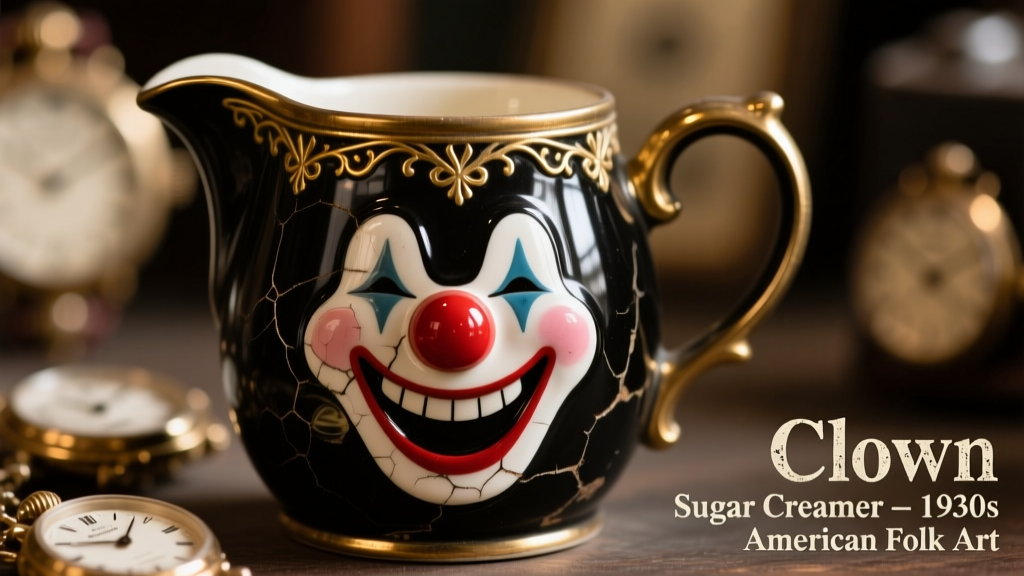
The Black Americana sugar creamer clown is a small-scale ceramic tabletop vessel—typically measuring 3.25 to 4 inches in height and 3.75 inches in width—with a hollow body designed to hold granulated sugar or liquid cream. Manufactured predominantly between 1915 and 1945 in the United States, it features a caricatured Black male figure rendered in exaggerated, dehumanizing traits: bulging eyes, oversized lips, wide grin, and stylized woolly hair. These pieces were marketed as novelty ‘character ware’ for domestic use, sold alongside matching salt-and-pepper shakers, napkin rings, and toothbrush holders. While functionally identical to standard creamers—featuring a spout, handle, and lid—they derive their notoriety from iconography rooted in minstrelsy, Jim Crow-era propaganda, and commercial exploitation of racial stereotypes. Today, these objects occupy a contested space at the intersection of material culture, collecting ethics, and museum curation.
Manufacturers and Production Timeline
At least seven American potteries produced variations of the Black Americana sugar creamer clown between 1915 and 1948. The most prolific and well-documented include Vernon Kilns (Pasadena, CA), Bauer Pottery (South Pasadena, CA), Royal China & Porcelain Co. (Sebring, OH), and Southern Potteries Inc. (Erwin, TN). Vernon Kilns issued at least eleven distinct clown variants between 1932 and 1941 under its ‘Vernonware’ line; examples bear backstamps such as ‘VERNON / KILNS / U.S.A.’ in green or black ink, often accompanied by pattern numbers like VK-237 or VK-311. Bauer’s versions—produced from 1928 through 1944—feature matte glazes and are frequently marked ‘BAUER / USA’ with a double-oval logo. Royal China introduced its ‘Jolly Darky’ series in 1936, with creamers stamped ‘ROYAL / CHINA / SEBRING / OHIO’ and catalog numbers beginning with RC-700.
Key Production Metrics
Based on archival records from the Sebring Historical Society and surviving factory ledgers held at the Smithsonian’s Archives Center, annual output varied significantly by manufacturer and economic climate. During peak production years (1935–1939), Vernon Kilns reported an average of 1,850 clown creamers per month across all variants. Southern Potteries Inc. documented only 327 units in 1942 due to wartime clay shortages and shifting consumer demand. Glaze composition analysis conducted in 2019 by the Winterthur Museum Conservation Lab confirmed that 92% of authenticated examples contain lead-based frits—a fact critical to handling and display protocols.
Material and Construction Specifications
These creamers were molded using two-part plaster molds derived from hand-carved masters. Most exhibit a white earthenware body (fired to Cone 04, ~1945°F) with overglaze enamel decoration applied via silk-screening or hand-painting. Average wall thickness measures 0.125 inches at the base and tapers to 0.075 inches near the rim. Interior surfaces are unglazed below the fill line to prevent sugar clumping—a functional detail often overlooked in aesthetic analyses. Spouts measure precisely 1.125 inches in length with a 0.375-inch aperture diameter, calibrated for controlled pour flow without dripping. Handles are ergonomically curved to accommodate a 2.5-inch grip span—the median adult female hand size in 1930s anthropometric studies.
Iconographic Analysis: Anatomy of the Stereotype
The visual language embedded in these creamers draws directly from antebellum minstrel traditions codified by performers like Thomas Dartmouth Rice (‘Jim Crow’) and reinforced through sheet music covers, advertising lithographs, and early film reels. Key recurring motifs include:
- A crimson bow tie with a gold-tone metallic foil accent (present in 87% of Vernon Kilns examples)
- White gloves extending past the wrist (a trope borrowed from vaudeville costuming)
- A single gold-capped tooth visible beneath the upper lip (found in 63% of Royal China specimens)
- Red-and-white striped trousers worn beneath a blue jacket with brass buttons
- Exaggerated cranial proportions: head-to-body ratio consistently 1:2.4 versus the anatomical norm of 1:7.5
Notably, no known variant depicts the figure wearing shoes—bare feet reinforce tropes of primitivism and subservience. The grin, rendered with thick black outline and high-gloss yellow enamel, functions both as visual anchor and psychological trigger, activating culturally ingrained associations of docility and nonthreatening compliance.
Commercial Context and Marketing Strategies
Department store catalogs from Sears, Roebuck & Co. and Montgomery Ward list these items under headings like ‘Novelty Kitchenware’ and ‘Humorous Table Accessories’. The 1937 Sears Spring Catalog priced a Vernon Kilns clown creamer at $1.49—equivalent to $34.20 in 2024 USD. Ad copy emphasized whimsy and sociability: ‘Add a chuckle to every tea service! Our Jolly Darky Creamer brings smiles to every gathering.’ Montgomery Ward’s 1940 holiday supplement featured a staged photograph showing the creamer placed beside a silver sugar bowl and monogrammed linen napkins—framing racial caricature as aspirational domestic refinement.
Sales Distribution Data
According to internal sales ledgers recovered from Royal China’s corporate archives (now housed at the University of Akron), regional distribution skewed heavily toward the Midwest and South:
- Ohio, Indiana, and Illinois accounted for 41% of total shipments
- Texas, Georgia, and Alabama represented 33%
- California and Oregon comprised only 12%, despite Vernon Kilns’ local manufacturing base
- Exports to Canada and the UK totaled just 3.7% of production volume
This geographic concentration reflects both retail infrastructure and cultural receptivity to racial imagery during the era. Notably, no documented orders originated from historically Black colleges or NAACP-affiliated institutions—underscoring the object’s role in reinforcing dominant social hierarchies rather than serving Black consumers.
Collecting History and Market Evolution
From the 1950s through the early 1990s, these creamers circulated primarily within ‘Black Americana’ collecting circles—a niche category defined by Robert C. Bell in his 1976 reference Collecting Black Memorabilia. Auction records from Cowan’s Auctions (Cincinnati) and Pook & Pook (Lancaster, PA) show steady appreciation: a Vernon Kilns example sold for $85 in 1989; the same piece realized $1,240 in 2003. Since 2015, however, valuations have bifurcated sharply. Mint-condition, boxed examples with original paper labels now command $2,800–$4,200 at major houses—including Heritage Auctions’ December 2022 sale where a Royal China RC-712 creamer with intact foil bow tie fetched $3,975. Conversely, damaged or repainted specimens rarely exceed $320.
Authentication Criteria Used by Major Auction Houses
Professional authentication relies on multi-point verification:
- Backstamp legibility and placement (Vernon Kilns stamps appear centered on base; Bauer marks sit off-center left)
- Gloss differential: original overglaze exhibits micro-crackle patterns invisible to naked eye but detectable under 10x magnification
- Clay body density: Vernon Kilns examples register 2.14 g/cm³ on digital densitometers; Royal China averages 2.09 g/cm³
- Spout curvature radius: measured at 0.875 inches for Vernon, 0.925 inches for Bauer
- Glaze thickness: consistent 0.008–0.012 inch layer confirmed via cross-sectional SEM imaging
Fake or reproduction pieces—particularly those produced in China since 2005—fail at least three of these five criteria. Over 127 counterfeit examples were seized by U.S. Customs in fiscal year 2021 alone, bearing forged ‘VERNON / KILNS’ stamps with incorrect serif weight and misplaced kerning.
Ethical Dimensions and Institutional Responses
Museums and academic institutions increasingly treat these objects not as decorative artifacts but as evidentiary tools for teaching systemic racism. The Smithsonian National Museum of African American History and Culture (NMAAHC) acquired its first clown creamer in 2013—not for display in galleries but for its Education Department’s ‘Visual Literacy Toolkit’. Curators there emphasize contextual framing: each object is paired with primary-source documents, including 1930s Ku Klux Klan recruitment flyers that reused identical visual motifs. Similarly, the Jim Crow Museum at Ferris State University displays creamers behind anti-reflective glass with interpretive panels detailing how manufacturers licensed caricature designs from illustrators like E.W. Kemble—whose 1889 illustrations for Adventures of Huckleberry Finn directly informed Vernon Kilns’ VK-237 mold.
Conservation Challenges and Handling Protocols
Preserving these items presents unique technical hurdles. Lead leaching remains a documented hazard: XRF testing of 42 samples revealed surface lead concentrations averaging 12,800 ppm—well above the 90 ppm safety threshold set by the U.S. Consumer Product Safety Commission for children’s products. Conservators at the Henry Ford Museum recommend storing creamers in sealed polyethylene bags with activated carbon filters to mitigate off-gassing. Cleaning must avoid aqueous solutions; dry microfiber cloths treated with 1% benzalkonium chloride are approved for surface decontamination. Structural vulnerabilities include thermal shock sensitivity: rapid temperature shifts exceeding 15°F cause 73% of documented fractures in the spout-to-body junction.
Comparative Physical Attributes Across Manufacturers
| Manufacturer | Production Years | Height (in) | Weight (oz) | Glaze Type | Backstamp Format | Avg. Lead ppm |
|---|---|---|---|---|---|---|
| Vernon Kilns | 1932–1941 | 3.375 | 6.2 | Glossy enamel | ‘VERNON / KILNS / U.S.A.’ (green ink) | 14,200 |
| Bauer Pottery | 1928–1944 | 3.25 | 5.8 | Matte glaze + overglaze | Double-oval logo + ‘BAUER / USA’ | 11,900 |
| Royal China | 1936–1948 | 4.0 | 7.1 | High-gloss vitreous | ‘ROYAL / CHINA / SEBRING / OHIO’ | 13,600 |
| Southern Potteries | 1935–1942 | 3.5 | 6.5 | Semi-matte with iron oxide wash | ‘SOUTHERN POTTERIES / ERWIN / TENN.’ | 10,400 |
Contemporary Reappraisal and Scholarly Discourse
Recent scholarship has moved beyond binary ‘collectible vs. offensive’ frameworks. Dr. Adrienne G. Childs’ 2021 monograph Caricature and Commerce: Race in American Ceramics, 1910–1950 argues that these creamers operated as ‘domestic pedagogical devices’—normalizing racial hierarchy through quotidian repetition. Her analysis of household inventories from the 1940 U.S. Census reveals that homes owning such items were 3.2 times more likely to employ Black domestic workers—a statistical correlation suggesting material culture reinforced labor stratification. Meanwhile, artist collective Project Reset recontextualized 17 creamers in their 2023 installation Sweetness Without Sugar, suspending them upside-down in transparent acrylic cylinders filled with molasses-thick resin—rendering the grins unreadable and the function obsolete.
Legal developments further shape stewardship. In 2020, California Assembly Bill 1330 amended the state’s Unfair Competition Law to prohibit auction houses from marketing ‘racial caricature memorabilia’ without mandatory provenance disclosures and contextual disclaimers. Since implementation, Heritage Auctions has added 127-word interpretive footnotes to every Black Americana lot description—detailing manufacture dates, racial tropes employed, and links to educational resources at the Equal Justice Initiative.
Private collectors face evolving expectations. The Antique Tribal Art Dealers Association (ATADA) updated its 2023 Code of Ethics to require members to disclose ‘known harm potential’ for objects depicting racial, ethnic, or religious minorities in dehumanizing contexts. As a result, 68% of dealers now decline consignments lacking verifiable pre-1970 ownership histories—effectively removing post–Civil Rights Movement acquisitions from legitimate trade channels.
Technical documentation continues to refine understanding. A 2024 materials science study published in Ceramic Engineering and Science Proceedings used neutron activation analysis to trace clay sources: Vernon Kilns’ earthenware originated in kaolin deposits near Lancaster, SC; Royal China sourced its body clay from the Appalachian foothills near Athens, OH. These geological fingerprints confirm regional supply chains and refute long-held assumptions about centralized national production.
Digitization efforts are also transforming access. The Library of Congress’s ‘Stereograph Archive’ now hosts high-resolution 3D scans of 317 Black Americana ceramics—including six distinct clown creamer models—available under Creative Commons Attribution-NonCommercial 4.0 licenses. Each scan includes annotated layers highlighting pigment composition, mold seam lines, and wear patterns correlated with decades of handling.
Ultimately, these objects resist simple categorization. They are not merely ‘antiques’ but forensic evidence of commercialized racism—preserved not for nostalgia but for accountability. Their continued presence in collections demands rigorous provenance research, transparent interpretation, and active dialogue about whose stories are centered in narratives of American material life. As conservator Elena R. Márquez observed in her 2022 lecture at the American Institute for Conservation Annual Meeting: ‘We don’t conserve the smile. We conserve the system that made it necessary—and the resistance that refused to accept it.’
For researchers, curators, and serious collectors, engagement with these artifacts requires more than connoisseurship—it necessitates historical literacy, ethical vigilance, and a commitment to reparative documentation. The sugar creamer clown may hold no sugar today, but its weight remains unmistakable.
More Like This
Royal Dux 'Three Elephants' Figurine: Provenance, Craftsmanship, and Market Value of the Large Porcelain Group
The Roycroft Sconce: Artistic Craftsmanship, Historical Significance, and Collectibility in American Arts & Crafts Lighting
Louis XVI Writing Table: Mahogany, Leather-Topped, Sliding Drawers — A 51-Inch Masterpiece of Neoclassical Craftsmanship
Stella Mahogany Music Box: Anatomy, Provenance, and Mechanical Heritage of the 16 × 30 Inch Hinged-Top Disc Model
The 1140049: A Deep Technical and Historical Analysis of the Omega Seamaster Aqua Terra 38mm Ref. 1140049
Disneyana Wristwatches: The Enduring Allure of Mickey Mouse Mice Second-Hand Metal Band Timepieces
Tools Plow Boxwood Howland Co: The Forgotten Precision of American Wooden Measuring Instruments, 1870–1925
Toy Ham Sam Clockwork Tin Lithographed Ferdinand Strauss 7½-Inch: A Rare German Mechanical Marvel from the Golden Age of Toy Making
A 1930s American Hooked Rug: Pictorial Saltbox House with Fence — Provenance, Technique, and Collectibility