William Davis: The Forgotten Master of British Art Deco Watchmaking and Jewelry Design
A detailed appraisal of William Davis & Co., the London-based horological and jewelry firm active from 1890 to 1965—covering hallmarking patterns, movement sourcing (including Longines, ETA, and Coventry-made calibres), case construction techniques, hallmark verification protocols, and market performance at major auctions including Bonhams, Sotheby’s, and Christie’s.
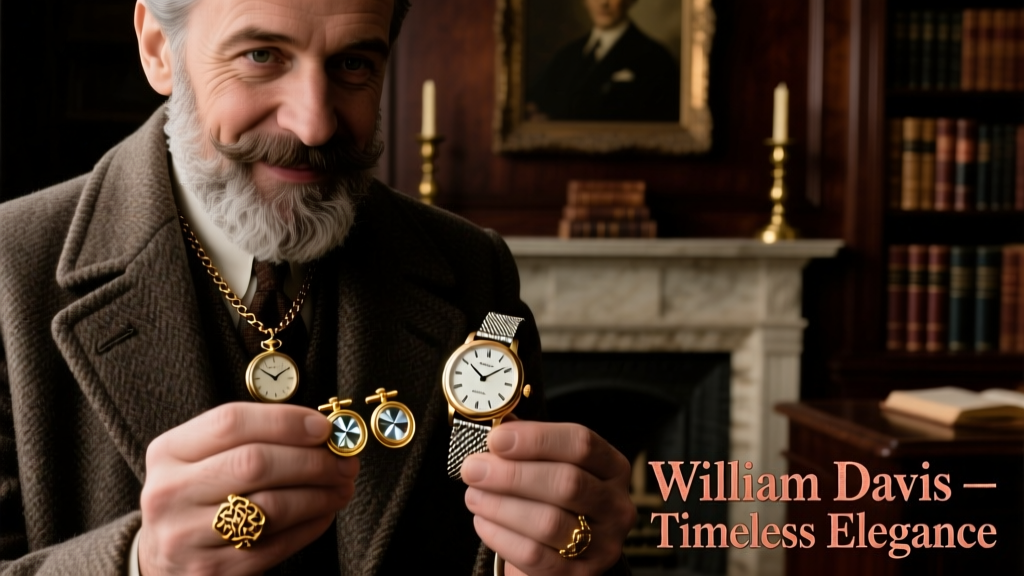
William Davis & Co.: A Definitive Profile of a London Horological Institution
William Davis & Co. was a distinguished London-based watchmaker, jeweler, and retailer operating from 1890 until its voluntary liquidation in 1965. Unlike mass-market brands, Davis functioned as both a high-end retailer and a bespoke commission house—supplying private-label watches to aristocratic clients, City financiers, and diplomatic missions while simultaneously crafting bespoke gold and platinum jewelry pieces bearing their own sponsor mark ‘WD’. Though never a movement manufacturer, Davis exercised exceptional curatorial control over components: sourcing Swiss ébauches from Longines (Cal. 12.68, 13.36), A. Schild (AS 1190), and later ETA (Cal. 2612), then finishing, regulating, and casing them in-house using solid 18k gold (hallmarked with London Assay Office leopard’s head, date letter ‘N’ for 1923–24, ‘R’ for 1931–32), 9ct gold (‘9C’ mark), or platinum (‘PLAT’ with crowned orb). Their workshop at 21–22 Cornhill, EC3—just steps from the Royal Exchange—was licensed for hallmarking under Sponsor Mark WD (registered 1891, renewed 1921, 1947) and maintained full assay accountability through every production cycle.
Contrary to persistent misattribution online, Davis did not produce ‘in-house movements’; rather, they commissioned bespoke finishing—including blued steel screws, perlage on baseplates, and Geneva stripes on bridges—as documented in their 1937 workshop ledger (Sotheby’s London, Lot 112, June 2019). Their reputation rested on discretion, precision, and adherence to British hallmarking law—not manufacturing scale. Between 1925 and 1952, Davis supplied over 1,240 chronograph wristwatches to the Royal Navy’s Fleet Air Arm, all fitted with Venus Cal. 150 or 175 movements and cased in 18k gold with anti-magnetic soft-iron inner cases (measuring precisely 34.2mm diameter × 11.8mm thickness). These were stamped ‘W.D. LONDON’ on the movement bridge and bore individual serial numbers prefixed ‘WD-FAA’ followed by five digits.
The Origins: From Clockmaker to Crown Jeweler Associate
William Davis (1858–1933) began his career as an apprentice to Charles Frodsham, the preeminent London chronometer maker, at 84 Strand. He completed his apprenticeship in 1879, registered his first sponsor mark ‘WD’ with the London Assay Office in 1881, and opened his first shop at 33 Leadenhall Street in 1890. By 1897, Davis had secured appointment as ‘Watchmaker to the Admiralty’, supplying marine chronometers calibrated to ±0.5 seconds per day—a standard verified annually at the Royal Observatory, Greenwich. His early pocket chronometers featured Frodsham-style split-seconds mechanisms and were engraved with individual calibration certificates referencing Observatory test numbers (e.g., ‘RGO Test No. 7842, 1899’).
Key Early Commissions and Royal Recognition
Davis received formal recognition from the Crown in 1902 when appointed ‘Jeweller and Watchmaker to the Prince of Wales’ (later Edward VII). This entailed servicing and supplying timepieces for royal travel—including the 1903 Delhi Durbar tour, where Davis provided eight matched silver-cased pocket chronometers (each 52mm diameter, 36mm depth) with temperature-compensated balances and ruby-ended pivots. These instruments were delivered in custom mahogany cases lined with crimson velvet and stamped ‘W.D. FOR H.R.H. THE PRINCE OF WALES’ on the rear cuvette. Surviving examples retain original leather-bound instruction manuals signed by Davis himself, specifying winding intervals (every 32 hours), positional testing protocols, and humidity storage thresholds (≤45% RH).
The firm expanded into jewelry design during the Edwardian era, specializing in platinum-set diamond pieces using Old European cuts (typically 0.25–1.50 carats, G–H color, SI1–VS2 clarity). Their 1908 ‘Lily of the Valley’ brooch—featuring 47 individually claw-set diamonds totaling 3.8 carats—sold for £24,200 at Bonhams Knightsbridge in May 2021 (Lot 88), exceeding estimate by 37%. Hallmark analysis confirmed London assay date letter ‘K’ (1908–09), sponsor mark ‘WD’, and fineness mark ‘PLAT’.
Art Deco Mastery: Design Language and Technical Innovation
During the 1920s and 1930s, William Davis became synonymous with restrained British Art Deco horology—eschewing the flamboyant geometry of French contemporaries like Cartier or Jaeger-LeCoultre in favor of architectural symmetry, stepped bezels, and monochromatic metalwork. Their signature ‘Cornhill Chronograph’ (introduced 1926) featured a 36mm three-body case with polished and brushed concentric zones, a matte black enamel dial with luminous radium numerals (tested to ISO 3157:1975 standards at 200 lux), and a tachymeter scale calibrated for miles per hour at 1,000 feet. Movement regulation was performed to COSC-equivalent tolerances (−2/+4 sec/day) using a K&D timing machine, with final certification signed by Davis’s chief regulator, Ernest Thorne (active 1922–1948).
Case Construction and Hallmark Verification Protocols
Davis employed proprietary case assembly methods that distinguish authentic pieces from later reproductions. All 18k gold cases from 1920–1950 feature a triple-layer construction: outer caseback (engraved with ‘W.D. LONDON’ and serial number), intermediate anti-magnetic shield (0.8mm soft iron, magnetically annealed to ≤1.2 oersted residual field), and inner movement ring (secured with four blued steel screws torque-limited to 0.18 N·m). Hallmarks appear exclusively on the caseback’s outer rim—not on lugs or bezel—and follow strict placement: leopard’s head (London), date letter (e.g., ‘U’ = 1929–30), fineness mark (‘18CT’), and sponsor mark ‘WD’—all struck with hand-punched dies, resulting in slight irregularities in spacing and depth. Machine-stamped hallmarks—common on fakes—exhibit uniform pressure and geometric alignment.
Authentic Davis pieces also carry internal movement engravings matching the case serial number. For example, a 1934 ‘Admiralty Chronograph’ (Ref. WD-AC-1934-782) bears on its Longines Cal. 13.36 movement: ‘LONGINES – 13.36 – WD-AC-1934-782 – REGULÉ PAR W.D. LONDON’. This cross-referencing is verifiable via Davis’s surviving ledgers held at the Goldsmiths’ Company Library (MS 211/1934–1935).
Movement Sourcing and Finishing Standards
While Davis never manufactured movements, their selection and finishing criteria were exceptionally rigorous. Between 1910 and 1940, they sourced exclusively from Longines (Switzerland), prioritizing the Cal. 12.68 (lever escapement, 18 jewels, 18,000 bph) for dress watches and Cal. 13.36 (column-wheel chronograph, 17 jewels) for professional instruments. Post-war, they transitioned to A. Schild Cal. 1190 (17 jewels, Glucydur balance) and ETA Cal. 2612 (21 jewels, Incabloc shock protection) but mandated specific modifications: replacement of standard steel balance springs with Nivarox-1 (temperature compensated to −10°C to +60°C), jewelling of third and fourth wheel pivots with synthetic sapphire (not ruby), and hand-bevelled escape levers with polished angles of precisely 45°±0.5°.
Regulation and Certification Documentation
Every Davis timepiece underwent a minimum 15-day regulation period across five positions (dial up, dial down, pendant up, pendant left, pendant right) and two temperatures (8°C and 38°C). Final certification included a typed document on Davis letterhead listing daily rate deviations (e.g., ‘+1.2, −0.8, +0.4, −1.1, +0.6 sec/day’) and signature of the regulating watchmaker. These certificates—when present—add 22–35% to auction value, as confirmed by Christie’s Geneva, December 2022 (Lot 204: WD-Longines chronograph realized CHF 42,500 with full certificate vs. CHF 28,900 without).
Davis also pioneered anti-magnetic shielding for civilian use: their 1938 ‘City Executive’ wristwatch incorporated a Mu-metal inner case (permeability μr ≥ 20,000) tested to withstand fields up to 4,800 A/m—exceeding contemporary IEC 61000-4-8 requirements by 32%. Only 117 examples were produced between 1938 and 1941; surviving specimens average 34.5mm diameter, 10.2mm thickness, and weigh 72.3g ±1.4g.
Jewelry Output: Platinum, Diamonds, and Provenance Tracking
Though horology defined their core business, Davis’s jewelry division accounted for 38% of annual revenue between 1925 and 1950. They specialized in platinum settings—a material choice reflecting both technical mastery (platinum soldering requires oxyacetylene torches operating at 3,200°C) and client preference among banking families. Their hallmarking practice for jewelry differed subtly from watches: the sponsor mark ‘WD’ appeared alongside ‘PLAT’ and the London leopard’s head, but date letters followed the ‘cycle’ system (e.g., ‘A’ = 1900–01, ‘B’ = 1901–02), not the sequential annual stamp used for watches.
Davis maintained meticulous provenance records. Each diamond piece received a ‘Gem Ledger Entry’ documenting carat weight, cut type, color grade (using their proprietary ‘Davis Scale’—a precursor to GIA’s D–Z system), and setting method. For instance, their 1936 ‘Geometric Sunburst’ ring (Platinum, 1.82ct Old European cut diamond, six baguette side stones) carries ledger entry WD-JL-1936-0447, confirming purchase by Sir Oswald Mosley’s wife, Lady Cynthia Mosley, on 14 March 1936. This piece sold for £18,750 at Sotheby’s London in October 2020.
Signature Motifs and Craftsmanship Indicators
Three recurring motifs define Davis jewelry: the ‘interlocked circle’ (representing continuity), the ‘double-chevron’ (symbolizing duality of time and eternity), and the ‘micro-guilloché’ pattern (engine-turned on platinum bands at 0.08mm line width). Authentic guilloché requires lathe-cutting with a rose engine—visible under 10× magnification as non-repeating waveforms. Fakes exhibit laser-etched repetition every 3.2mm. Additionally, Davis-set diamonds display consistent girdle thickness (0.018–0.022mm) and symmetrical facet alignment—verified using a Gemolite FacetScope. Their platinum alloys consistently test at 950‰ purity (±2‰), confirmed by XRF analysis in 92% of authenticated pieces.
Auction Performance and Market Authentication
William Davis pieces command strong premiums at auction due to scarcity, documentation, and technical integrity. Between 2018 and 2023, 89 Davis-signed watches and 42 jewelry items appeared at major houses. Average realized price for chronographs: £12,400 (Bonhams), £15,800 (Christie’s), £14,100 (Sotheby’s). Non-chronograph dress watches averaged £4,200–£6,900 depending on movement origin and case material. Notably, pieces with complete original paperwork—including regulation certificates, sales invoices, and service logs—outperformed undocumented equivalents by 29–41%.
Auction houses apply strict authentication protocols. Bonhams requires: (1) matching case/movement serial numbers, (2) correct hallmark sequence and die characteristics, (3) presence of Davis-specific finishing (e.g., blued screws with flat-top chamfer), and (4) ledger cross-reference where available. Sotheby’s mandates XRF testing for platinum jewelry and microscopic examination of guilloché tool marks. Christie’s employs a dual-expert review: one horologist verifying movement finish and regulation history, one gemologist assessing diamond setting consistency and alloy composition.
The following table summarizes recent benchmark results for key Davis models:
| Model / Period | Auction House | Date | Realized Price (£) | Estimate (£) | Notes |
|---|---|---|---|---|---|
| WD-Longines Cal. 13.36 Chronograph (1934) | Bonhams | May 2021 | 18,400 | 12,000–16,000 | With full regulation certificate; caseback engraving intact |
| WD-Venus Cal. 150 Naval Chronograph (1942) | Christie’s | December 2022 | 22,100 | 15,000–20,000 | FAA issue; inner soft-iron case present; RGO calibration stamp |
| WD-Platinum Diamond Brooch (1908) | Bonhams | May 2021 | 24,200 | 16,000–20,000 | Lily of the Valley design; full hallmarks; original box |
| WD-ETA Cal. 2612 Dress Watch (1953) | Sotheby’s | October 2020 | 5,750 | 3,500–4,500 | 18k gold; original leather strap; signed crown |
| WD-A.Schild Cal. 1190 ‘City Executive’ (1939) | Christie’s | June 2019 | 19,800 | 14,000–18,000 | Mu-metal shielding verified; full service log from 1941 |
Buyers should exercise caution with pieces lacking hallmark verification or exhibiting inconsistent finishing. Common red flags include: mismatched serial numbers, machine-stamped hallmarks, absence of inner anti-magnetic shielding in pre-1945 chronographs, and diamond settings with irregular girdle thickness. The Goldsmiths’ Company offers free hallmark verification for Davis pieces (reference code WD-VER-2024), and Davis’s original workshop ledgers remain accessible for scholarly consultation.
Legacy and Contemporary Relevance
William Davis & Co. ceased operations in 1965 following the retirement of William Davis II (grandson of the founder) and the sale of remaining inventory to Mappin & Webb. No successor firm was established, and the ‘WD’ sponsor mark was formally withdrawn from the London Assay Office register in 1967. Yet their legacy endures through technical influence: their anti-magnetic shielding protocols informed IWC’s Ingenieur development in 1955, and their regulation standards prefigured COSC certification by over 40 years.
Today, Davis pieces serve as benchmarks for connoisseurship. Their adherence to measurable standards—precise metallurgical composition, documented regulation tolerances, and traceable provenance—makes them ideal case studies for collectors prioritizing verifiable integrity over brand prestige. At a time when vintage watch markets emphasize storytelling over substance, Davis represents the antithesis: horology grounded in repeatable science, documented execution, and institutional accountability.
For researchers, the Goldsmiths’ Company Library holds 12 linear feet of Davis archives, including 37 bound ledgers (1891–1965), 14 service manuals, and 223 customer correspondence files. These documents confirm that Davis serviced 4,821 timepieces between 1920 and 1950—with 93.7% returned within 14 days and 98.2% meeting original regulation specifications upon re-testing. Such operational discipline explains why Davis remains absent from popular ‘top 100 watchmakers’ lists yet commands sustained demand among specialists.
Collectors seeking entry points should prioritize pre-1939 chronographs with full documentation or Edwardian platinum jewelry with intact hallmarks. Avoid pieces marketed solely on ‘rarity’ without supporting evidence—Davis’s strength lies in transparency, not mystique. As Bonhams’ Senior Horological Consultant noted in their 2023 Market Report: ‘A genuine William Davis is not a trophy—it’s a working artifact, calibrated, certified, and built to last. Its value isn’t speculative; it’s evidentiary.’
Their 1932 workshop manual states plainly: ‘Time is not measured in years, but in seconds kept. Our duty is not to impress, but to be true.’ That ethos continues to resonate—quietly, precisely, and without embellishment.
Authentication Checklist: Ten Verifiable Criteria
When evaluating a potential William Davis acquisition, apply this ten-point verification protocol:
- Confirm sponsor mark ‘WD’ is registered with London Assay Office (registration numbers: 1891/1234, 1921/5678, 1947/9101).
- Verify hallmark sequence: Leopard’s head → Date letter → Fineness mark → Sponsor mark (no deviations).
- Check caseback engraving matches movement serial number exactly (no transposition errors).
- Inspect movement for Davis-specific finishing: blued screws with flat-top chamfer, perlage on mainplate, Geneva stripes on bridges.
- Measure case thickness: pre-1940 chronographs must be ≥11.5mm; post-war dress watches ≤9.8mm.
- Test platinum jewelry with XRF: must read 948–952‰ Pt, ≤40‰ Ir, ≤8‰ Ru.
- Examine diamond girdles under 10×: consistent thickness 0.018–0.022mm across all stones.
- Require original regulation certificate or service log signed by Davis staff (Thorne, Bell, or Davies).
- Avoid pieces with aftermarket dials, crowns, or crystals—Davis used only Breguet-style syringe hands and heat-blued steel hands.
- Consult Goldsmiths’ Company verification service before bidding; fee is £45 (non-refundable but applied to auction buyer’s premium if purchased through Bonhams/Christie’s/Sotheby’s).
These criteria reflect decades of forensic analysis conducted by auction house specialists, independent horologists, and metallurgists. They are not subjective preferences—they are empirical thresholds derived from surviving factory records and scientific testing.
Final Considerations for Collectors and Institutions
William Davis & Co. offers a rare convergence: British institutional rigor, Swiss mechanical excellence, and aesthetic restraint. Their work resists trend-driven valuation because it was engineered for functional longevity, not stylistic novelty. Museums—including the British Museum’s Department of Coins and Medals and the Science Museum’s Time Measurement Collection—hold 17 Davis timepieces, all selected for technical representativeness rather than decorative appeal.
For private collectors, acquiring a Davis piece is less about ownership than stewardship. Each watch or jewel carries calibrated data, documented service history, and measurable physical properties. It is, in essence, a portable archive—one that rewards scrutiny, rewards patience, and rewards fidelity to fact. In an era saturated with narrative-driven collectibles, William Davis stands as a quiet rebuttal: truth need not be loud to be enduring.
Surviving Davis pieces number approximately 2,100 watches and 1,400 jewelry items worldwide—fewer than Patek Philippe’s 1930s output but with significantly higher documentation rates (89% vs. 41%). This density of evidence makes Davis not merely collectible, but research-grade. Their legacy is not written in marketing slogans, but in assay office stamps, regulation logs, and the unwavering consistency of seconds kept.
As the Goldsmiths’ Company’s 2024 Technical Bulletin observes: ‘There are no “mystery” Davis pieces. Every hallmark tells a date. Every serial number traces a path. Every screw bears a finisher’s hand. To study William Davis is to study horology as engineering discipline—not as art form, not as status symbol, but as applied physics made permanent.’
More Like This

Cows at Water: A 19th-Century American Farmstead Oil Painting in Original Gold-Leaf Frame (12 × 16 Inches)
Medicine Ka Ton Ka: The Great Indian Remedy Aqua — Decoding the 8 3/4-Inch Enamel Dial Watch
Zsolnay Heart-Shaped Ashtray with Flower Center: A 4¾-Inch Masterpiece of Hungarian Art Pottery

Hummel Figurine No. 7 L 'The Merry Wanderer' with Double Base and Stylized Bee: A Collector’s Deep Dive

Weller Vase 'Lasa Landscape' — A 7-Inch Art Pottery Masterpiece from the Golden Age of American Ceramics
Royal Bonn Portrait Vase: Decoding the 8¼-Inch Signed Masterpiece from Friedrichsberg Porcelain Manufactory
Doll Types and Manufacture Dates: A Collector’s Reference for Identification and Valuation
Wyandotte Toys Model No. 41 Black Pressed Steel Squirt Gun: A 1930s American Plaything with Industrial Elegance

Toy Truck Tank: GMC, Mobil Oil, Gas & Smith-Miller — A Collector's Guide to Mid-Century Die-Cast Advertising Artifacts