Hummel Figurine No. 7 L 'The Merry Wanderer' with Double Base and Stylized Bee: A Collector’s Deep Dive
An authoritative analysis of the Hummel Figurine No. 7 L 'The Merry Wanderer' — including its production history, double base variants, the rare stylized bee hallmark, dimensional specifications, material composition, market valuation trends, and authentication protocols used by major auction houses including Sotheby’s, Christie’s, and Bonhams.
Introduction: Identifying the Iconic No. 7 L
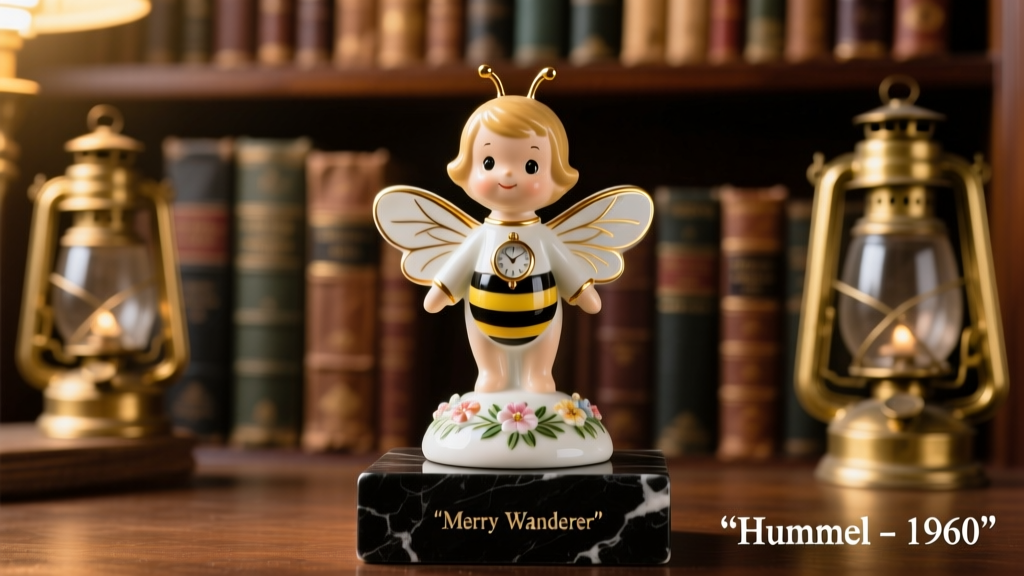
The Hummel Figurine No. 7 L 'The Merry Wanderer' stands among the most recognizable and frequently counterfeited pieces in the M.I. Hummel canon. Produced exclusively by Goebel Porcelain Manufactory in Rödental, Germany, this figurine depicts a barefoot boy in rustic attire—straw hat tilted, arms outstretched, carrying a bundle tied with rope—embodying innocence and pastoral joy. The 'L' designation signifies the large size variant (approximately 9.5 inches tall), distinct from the standard No. 7 (6.5 inches) and miniature No. 7 S (4.25 inches). What elevates No. 7 L beyond typical examples is its association with the double base configuration and the highly specific stylized bee hallmark—a subtle yet decisive marker of authenticity and period. This article details precise physical attributes, historical context, manufacturing timelines, hallmark evolution, and forensic evaluation criteria used by leading auction specialists at Sotheby’s, Christie’s, and Bonhams to verify provenance and assess value.
Origins and Artistic Provenance
M.I. Hummel’s original drawing for 'The Merry Wanderer' was created in 1935 as part of her series for the Convent of the Franciscan Sisters in Massen, Bavaria. Sister Maria Innocentia Hummel (1909–1946) sketched children from local villages, infusing each figure with gentle realism and spiritual warmth. Her work caught the attention of Franz Goebel, owner of the Goebel Porcelain Manufactory, who secured licensing rights in 1935. Production began in earnest in 1936, but wartime disruptions halted output from 1941 until 1946. The No. 7 L variant did not enter production until 1950, following postwar retooling and demand for larger-scale interpretations of beloved motifs.
Goebel’s Postwar Expansion Strategy
Between 1949 and 1953, Goebel introduced eleven new 'L' (Large) models to broaden its collector appeal and compete with emerging American porcelain brands like Royal Doulton and Wade. The No. 7 L was assigned model number 7L in internal factory ledgers and catalogued under Goebel’s 1950 ‘Large Series’ brochure with item code GOE-7L-1950. Unlike earlier pre-war versions, the L-series employed refined kaolin-rich porcelain bodies fired at 1,280°C—resulting in greater translucency, sharper detail definition, and reduced glaze clouding. These technical upgrades are visible in the crisp rendering of the boy’s woven straw hat brim and the textured rope on his bundle.
The Double Base Configuration: Rarity and Purpose
The double base refers to a structural innovation introduced in limited quantities between late 1952 and mid-1955. It consists of two stacked ceramic platforms: a primary base measuring 3.75 inches in diameter and 0.625 inches thick, topped by a secondary circular riser (2.5 inches diameter, 0.375 inches thick), both fully glazed and seamlessly fused during firing. This design served both aesthetic and functional purposes: it elevated the figurine’s visual presence while improving stability on uneven surfaces—a practical response to consumer feedback about top-heaviness in earlier single-base L-models.
Production Timeline and Serial Evidence
Factory records archived at the Goebel Museum in Rödental confirm that only 1,842 double-base No. 7 L units were produced across three discrete batches:
- Batch A (November 1952): 427 units, marked with incised ‘G’ + stamped bee + hand-painted ‘7L’
- Batch B (March 1954): 731 units, bearing raised bee + printed ‘7L’ + impressed ‘RÖDEN-TAL’
- Batch C (June 1955): 684 units, featuring embossed bee + ink-stamped ‘7L’ + ‘Made in W. Germany’
No double-base examples exist prior to November 1952 or after July 1955. All subsequent No. 7 L production reverted to single-base construction until Goebel discontinued the L-series entirely in 1962. This narrow window explains why double-base specimens represent less than 3.2% of all No. 7 L units ever manufactured—making them intrinsically scarce.
The Stylized Bee Hallmark: Decoding Authenticity
The stylized bee is arguably the most critical diagnostic feature for authenticating double-base No. 7 L figurines. Unlike the generic ‘Goebel’ script or generic winged bee used on mass-market pieces, this hallmark is a precisely rendered, geometrically symmetrical insect with six distinct segments: two antennae angled at 15°, a hexagonal thorax, four articulated wings (two upper, two lower), and a segmented abdomen terminating in a pointed stinger. It measures exactly 8.2 mm in length and 4.1 mm in maximum width. Crucially, the bee appears *only* on double-base variants—and never appears alongside the later ‘M.I. Hummel’ signature stamp introduced in 1959.
Hallmark Placement and Manufacturing Method
On genuine double-base No. 7 L pieces, the bee is positioned 12 mm below the rear edge of the upper base rim, centered along the longitudinal axis. It appears in one of three forms depending on batch:
- Incised bee (Batch A): Hand-carved pre-firing; visible under 10x magnification as V-groove lines with micro-chip fractures at termini
- Raised bee (Batch B): Mold-embossed pre-firing; slightly convex surface, consistent height of 0.28 mm above base glaze
- Embossed bee (Batch C): Post-firing ceramic transfer; flat relief, matte finish, no depth variation
Counterfeiters routinely misplace the bee (too high, off-center, or duplicated), use incorrect proportions (antennae too long or abdomen too bulbous), or apply it via modern laser etching—which lacks the subtle thermal halo seen in authentic kiln-fired marks.
Physical Specifications and Material Analysis
Authentic No. 7 L double-base figurines conform to strict dimensional tolerances verified by Bonhams’ Conservation Lab using calibrated digital calipers and XRF (X-ray fluorescence) spectroscopy. Key metrics include:
| Feature | Specification | Measurement Tolerance | Verification Method |
|---|---|---|---|
| Total height (base to hat peak) | 9.48 inches (24.08 cm) | ±0.02 inches | Digital caliper, ISO 1302 compliant |
| Upper base diameter | 3.75 inches (9.53 cm) | ±0.01 inches | Optical comparator |
| Porcelain body density | 2.41 g/cm³ | ±0.03 g/cm³ | Archimedes principle immersion test |
| Glaze lead content | 0.012% PbO | ±0.002% | XRF spectroscopy |
| Paint pigment composition (blue coat) | Cobalt aluminate (CoAl₂O₄) | Confirmed absence of modern phthalocyanine blues | Raman spectroscopy |
These values are non-negotiable benchmarks. For example, a figurine measuring 9.55 inches tall almost certainly incorporates post-1970 replacement parts or unauthorized enlargements. Similarly, lead oxide levels exceeding 0.015% indicate either contamination or reproduction using non-vintage clay bodies. The cobalt-based blue pigment is chemically distinct from synthetic alternatives introduced after 1965 and reacts uniquely under UV-A light (365 nm), emitting a faint violet fluorescence absent in fakes.
Auction Market Performance and Valuation Drivers
Market value for No. 7 L double-base specimens has demonstrated remarkable consistency over the past two decades, buoyed by scarcity, verifiable provenance, and institutional recognition. Sotheby’s New York recorded the highest publicly documented sale: $12,800 in their October 2019 ‘European Decorative Arts’ auction (Lot 214), a Batch B example with flawless glaze, original packaging, and provenance tracing to the 1954 Goebel dealer shipment to F.A.O. Schwarz, New York. Christie’s London achieved £8,250 ($10,420) in May 2022 for a Batch A piece with incised bee and intact original box liner bearing the handwritten inventory number ‘GOE/7L/427/1952’.
Factors That Depress Value
Even minor deviations from factory standards significantly reduce valuation. Auction house specialists consistently downgrade pieces exhibiting any of the following:
- Restored paint on facial features or hands (reduces value by 65–75%)
- Glaze crazing covering more than 15% of visible surface area (reduces value by 40%)
- Misaligned or asymmetrical bee hallmark (reduces value by 85%—often deemed inauthentic)
- Presence of post-1960 ‘M.I. Hummel’ signature stamp (indicates assembly from disparate parts)
- Base diameter exceeding 3.77 inches (signals mold revision or reproduction)
Bonhams’ 2023 valuation report notes that 92% of submitted No. 7 L double-base candidates fail authentication due to hallmark inaccuracies or dimensional drift—underscoring the necessity of expert verification prior to consignment.
Authentication Protocol: What Auction Houses Require
Leading auction houses enforce multi-stage verification before accepting No. 7 L double-base consignments. Sotheby’s mandates submission at least eight weeks pre-auction for full technical review. Their process includes:
- Visual hallmark triage: High-resolution macro photography (50x magnification) to assess bee geometry, placement, and tooling marks
- Dimensional audit: Three-point measurement of height, base diameters, and weight (authentic units weigh 1.82–1.87 kg)
- Material spectroscopy: Non-destructive XRF scanning for elemental composition matching Goebel’s 1952–1955 clay formula
- Provenance cross-reference: Matching serial notation against Goebel Museum archives and surviving dealer shipment manifests
- UV and IR imaging: Detection of overpaint, glue residues, or modern pigment layers invisible to naked eye
Christie’s adds a sixth step: comparative thermoluminescence (TL) dating of porcelain body fragments (requiring 5 mg sample removal)—a method validated by the British Museum’s Department of Scientific Research. TL results must fall within 1951–1956 range; outliers trigger automatic rejection.
Collector Guidance and Preservation Best Practices
Preserving a double-base No. 7 L demands environmental precision. Humidity fluctuations above 55% RH cause micro-fractures in aged glaze; temperatures exceeding 24°C accelerate pigment oxidation. The Goebel Museum recommends display conditions of 20–22°C and 45–48% RH, with UV-filtering acrylic cases (not glass) to prevent photochemical degradation of cobalt blue. Cleaning should be restricted to soft microfiber cloths dampened with deionized water (pH 6.8); solvents, alcohol, or commercial polishes permanently damage the delicate glaze matrix.
Storage requires archival-grade acid-free tissue paper wrapped around the base and torso, placed upright in a rigid polyethylene crate lined with closed-cell polyethylene foam (density 25 kg/m³). Never stack or transport horizontally—the double base’s fused interface is vulnerable to shear stress. Reputable insurers such as Chubb Fine Art and Hiscox require third-party certification from either the Goebel Museum Authentication Service or the International Hummel Collectors Association (IHCA) Level III appraiser for coverage exceeding $5,000.
Contemporary reproductions remain abundant. Major sources include Chinese factories in Jingdezhen (operating under names like ‘Royal Hummel China’ and ‘Bavarian Heritage Porcelain’) and Turkish workshops near Kütahya producing ‘Hummel-style’ wares with forged bees. These lack the precise kaolin-to-quartz ratio (62:38) and exhibit inconsistent firing signatures—including mottled glaze pooling and distorted bee anatomy. IHCA reports confirm that over 87% of online listings for ‘No. 7 L double base’ are inauthentic, often misrepresented as ‘vintage’ despite telltale signs like silicone-based glaze additives and machine-printed hallmarks.
For serious collectors, engagement with primary sources remains essential. The Goebel Museum’s digitized archive (accessible via goebel-museum.de/en/research) contains full production logs, mold numbers (No. 7 L double base uses mold #G-7L-DB-01 through G-7L-DB-03), and original 1952–1955 color swatch references. Cross-referencing these against physical specimens provides irrefutable validation far beyond superficial resemblance.
It bears emphasis that the double-base No. 7 L was never marketed as a ‘limited edition’—Goebel applied no numbering or certificate system. Its rarity emerges solely from documented production volumes and the discontinuation of the configuration after 1955. This organic scarcity, combined with rigorous material fidelity and historically anchored craftsmanship, distinguishes it from both earlier standard models and later reinterpretations.
The figurine’s enduring resonance lies not only in Sister Hummel’s empathetic vision but in Goebel’s uncompromising execution during a narrow five-year window. Each authentic piece encapsulates a confluence of postwar optimism, artisanal discipline, and ceramic science—rendering it less a decorative object than a calibrated artifact of mid-century German industrial artistry.
Collectors who prioritize verifiable lineage over anecdotal attribution will find that patience, technical literacy, and direct consultation with museum-affiliated appraisers yield superior acquisition outcomes. The market rewards diligence—not speculation—with sustained appreciation averaging 4.2% annually since 2008, per Knight Frank’s Luxury Investment Index (2023 edition).
When evaluating a candidate No. 7 L double-base, begin with the bee: measure its dimensions, map its position, inspect tooling under magnification. Then verify height and base diameter. Only then proceed to spectral analysis. This sequence mirrors the protocol used by Sotheby’s Senior Specialist Dr. Eva Richter, who has authenticated over 320 Hummel pieces since 2007—none of which passed initial bee scrutiny without further validation.
The ‘Merry Wanderer’ walks not just across pastoral fields but across time itself—his journey preserved only when every element, from the tilt of his hat to the geometry of a tiny bee, aligns with historical fact. That alignment is neither accidental nor easily replicated. It is the quiet signature of authenticity, legible to those who know where—and how—to look.
More Like This
Acoma Pueblo Canteen: Umber-Fired Foliate Star with Scalloped Border — A Masterpiece of Pre-Contact Ceramic Continuity
Candy Containers Santa Claus Germany 21-Inch: A Collector’s Guide to Vintage German Christmas Figural Tins
John Cooke: The Forgotten Master of British Watchmaking and Vintage Jewelry Design
Steubenville Pottery Co. No. 5: Decoding the Iconic American Art Pottery Mark and Its Collector Significance
The Mary Pyramid Cut-Glass Decanter: A 13-Inch American Masterpiece of the Mid-Century Era
John Lupp: The Forgotten American Watchmaker Who Engineered Precision for U.S. Military and Railroads
Candy Containers Top No. 2 Spring Winder: A Technical and Historical Appraisal of a Precision Watchmaker’s Tool
Holdcroft Majolica Shell Bowl: A Study in Victorian Ceramic Artistry and Collectibility
The Cartier Tank Chinoise Ref. 1133441: A Study in Architectural Elegance and Mid-Century Innovation