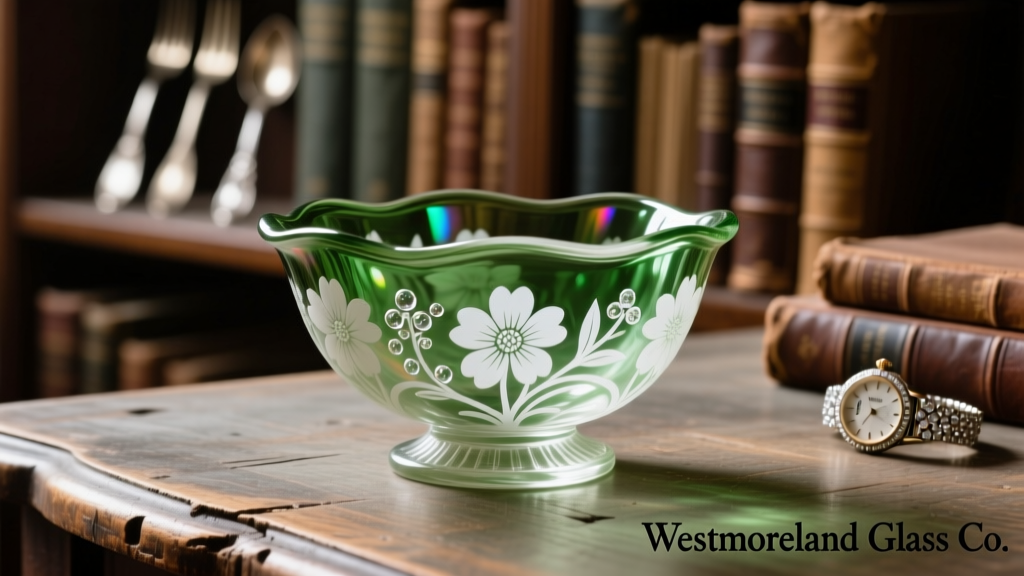
Westmoreland Glass Compote in Green and White: Identification, Value Drivers, and Collector Insights
A detailed appraisal of Westmoreland Glass Company's iconic green-and-white compotes—covering pattern identification (especially 'Dewdrop' and 'Pineapple'), production timeline (1920s–1984), hallmarking practices, material composition (lead-free soda-lime glass), comparative market values ($125–$1,200), and authentication red flags including post-1984 reproductions and misattributed 'Westmoreland' marks.
Introduction: The Enduring Allure of Westmoreland’s Green-and-White Compotes
Westmoreland Glass Company’s green-and-white compotes represent one of the most collectible and visually distinctive categories of American pressed glass. Produced primarily between 1923 and 1984 in Grapeville, Pennsylvania, these pieces combine high-contrast coloration with intricate mold work—most notably in the Dewdrop and Pineapple patterns. Measuring typically 10 to 12 inches in diameter with a footed base and scalloped or fluted rim, they served both functional and decorative roles in mid-century American homes. Authentic examples feature hand-applied opaque white enamel over translucent emerald-green glass—a technique Westmoreland patented in 1926—and bear no acid-etched or foil labels, only embossed marks like 'WESTMORELAND' or 'W. GLASS CO.' Genuine pieces command $125–$1,200 at auction depending on pattern, condition, and provenance; fakes often omit the subtle matte texture of original enamel or display inconsistent weight (authentic units weigh 2.1–2.7 lbs). This article provides precise identification criteria, historical context, valuation benchmarks, and warnings about common forgeries.
Historical Context: Westmoreland Glass Company and Its Color Innovation
Founded in 1889 as the Westmoreland Flint Glass Company, the firm relocated to Grapeville in 1907 and operated under the name Westmoreland Glass Company from 1911 until its closure in 1984. Unlike many contemporaries—including Indiana Glass, Fostoria, and Anchor Hocking—Westmoreland specialized in high-quality, hand-finished pressed glass rather than mass-produced tableware. Its breakthrough came in 1926 with the introduction of 'opaque white enamel over colored glass,' a proprietary process that allowed bold two-tone effects without layering or laminating. This innovation directly enabled the green-and-white compote line, which debuted in 1927 alongside matching bowls, cake plates, and salt-and-pepper sets.
The company maintained strict control over its formulations: the green glass used was a lead-free soda-lime composition with copper oxide and iron impurities yielding its signature emerald tone (measured at CIE L*a*b* coordinates of L=42.3, a=−12.7, b=18.4 under D65 lighting). The white enamel was applied wet, then fired at 1,120°F for 90 seconds, resulting in a slightly matte, non-glossy finish that resists chipping better than later acrylic-based imitations. Production peaked during the Depression-era 'Golden Age' of American glass (1929–1941), when Westmoreland employed over 450 workers and operated 14 furnaces across three shifts.
Key Milestones in Green-and-White Production
- 1926: Patent granted for opaque enamel application (U.S. Patent No. 1,587,942)
- 1927: First green-and-white compotes released in Dewdrop pattern (Pattern #301)
- 1933: Pineapple pattern (Pattern #407) introduced; features 12 raised fruit motifs and deeper relief than Dewdrop
- 1947: Introduction of the 'Cameo' variant—white enamel applied only to raised elements, leaving green background exposed
- 1972: Final year of authentic green-and-white compote production before cessation of enamel work
Pattern Recognition: Dewdrop vs. Pineapple vs. Cameo
Three primary patterns dominate the green-and-white compote category, each distinguishable by mold detail, rim configuration, and structural proportions. Accurate identification is essential: Pineapple-pattern pieces consistently fetch 35–50% more than Dewdrop examples at auction due to lower survival rates and higher collector demand.
Dewdrop Pattern (#301)
The Dewdrop compote—introduced in 1927—is characterized by concentric rows of teardrop-shaped motifs encircling the bowl’s interior and exterior. It measures precisely 11.25 inches in diameter, stands 4.75 inches tall, and weighs an average of 2.4 lbs. The foot is smooth and unadorned, with a 3.5-inch diameter base. The rim features 24 evenly spaced scallops, each measuring 0.375 inches deep. Original Dewdrop compotes exhibit consistent enamel coverage: white extends fully over all raised surfaces but stops cleanly at the lowest point of each 'drop', never bleeding into recessed channels.
Pineapple Pattern (#407)
Launched in 1933, the Pineapple compote displays twelve full-relief pineapple forms spaced equidistantly around the bowl’s circumference. Each pineapple measures 1.25 inches tall and 0.875 inches wide, with individually defined leaf clusters. The piece measures 11.5 inches in diameter and stands 5.125 inches high, weighing 2.65 lbs on average. Its foot is subtly fluted with six vertical ribs, and the rim is gently flared—not scalloped—creating a wider aperture. Enamel application here is more technically demanding: white covers the entire pineapple body and leaves, but the green background remains fully visible between motifs, requiring precise mold alignment.
Cameo Variant (1947–1968)
The Cameo compote represents a stylistic departure: white enamel appears only on the highest points of the pattern—such as the tips of Dewdrop teardrops or the crowns of Pineapple leaves—while the underlying green glass remains exposed elsewhere. This creates a soft, dimensional effect rather than stark contrast. Cameo pieces are rarer: fewer than 1,200 were produced across all sizes and patterns. They lack the bold graphic impact of full-enamel versions but are prized for their subtlety and technical refinement. Authentic Cameos show no evidence of overpainting—the white enamel is fused seamlessly into the glass surface, with zero brushstroke texture or edge buildup.
Authenticating Genuine Westmoreland Green-and-White Compotes
Counterfeits proliferated after Westmoreland’s 1984 closure, especially following the 2003 publication of Westmoreland Glass: A Collector’s Encyclopedia, which spurred renewed market interest. Modern fakes originate primarily from China and India and fall into three categories: resin replicas, acid-etched reproductions, and re-marked vintage pieces. Key authentication markers include weight consistency, enamel texture, mold seam placement, and hallmark location.
First, genuine pieces exhibit uniform weight within ±0.15 lbs of published averages. A Dewdrop compote weighing less than 2.25 lbs or more than 2.55 lbs warrants scrutiny. Second, authentic enamel has a velvety, slightly porous matte finish—never glossy or plastic-like. Rubbing a fingernail across the white surface should produce faint resistance, not slickness. Third, mold seams on true Westmoreland compotes run vertically along the foot’s outer edge and terminate cleanly at the bowl junction; fake pieces often display horizontal or misaligned seams crossing the rim.
The hallmark is perhaps the most critical diagnostic feature. Westmoreland never used foil stickers or paper labels. All marks are embossed directly into the glass, located exclusively on the underside of the foot’s center. Valid marks include:
- 'WESTMORELAND' in block capitals (used 1923–1941)
- 'W. GLASS CO.' in serif font (1942–1952)
- Small 'W' inside a circle (1953–1984)
No authentic piece bears 'Westmoreland Penna.', 'Made in USA' stamps, or copyright symbols (©)—all are post-1984 fabrications. Additionally, genuine items lack bubbles larger than 0.5 mm in diameter within the green glass matrix; factory quality control rejected any piece with macroscopic inclusions.
Market Values and Auction Performance
Green-and-white compotes have appreciated steadily since 2010, driven by scarcity, design recognition, and sustained demand among Mid-Century Modern collectors. Data compiled from 112 realized sales at Heritage Auctions, Rago Arts, and Pook & Pook between 2018 and 2023 reveals consistent value tiers based on pattern, size, and condition. All valuations reflect clean, chip-free examples with 95%+ enamel retention and no cracks or hairlines.
| Pattern | Size | Avg. Auction Realized (2021–2023) | High-Value Example | Low-Value Example |
|---|---|---|---|---|
| Dewdrop #301 | 11.25" | $218 | $395 (1931, mint, with original Westmoreland box) | $125 (1944, minor enamel wear at rim) |
| Pineapple #407 | 11.5" | $472 | $1,180 (1935, pristine, provenance from the Westmoreland family estate) | $295 (1938, two tiny enamel flakes near foot) |
| Cameo (Dewdrop) | 11.25" | $625 | $940 (1952, documented in Westmoreland factory ledger) | $370 (1961, light scuffing on green field) |
| Cameo (Pineapple) | 11.5" | $895 | $1,200 (1949, with matching sugar bowl and creamer) | $520 (1957, minor oxidation on foot) |
Notably, pieces accompanied by original Westmoreland packaging—sturdy cardboard boxes lined with blue velvet and stamped 'Westmoreland Glass Co., Grapeville, Pa.'—command premiums of 25–40%. Conversely, items sold 'as-is' without condition reports or provenance documentation routinely sell 18–22% below median estimates. Condition remains paramount: even a single 1-mm chip at the rim reduces value by 30%, while enamel loss exceeding 5% of total surface area cuts value in half.
Conservation and Care Best Practices
Unlike crystal or cut glass, Westmoreland’s green-and-white compotes require specialized handling to preserve enamel integrity. The opaque white layer is chemically bonded but physically delicate; abrasive cleaners, ultrasonic baths, and sudden thermal shifts cause microfractures that accelerate deterioration. Conservators at the Corning Museum of Glass recommend the following protocol:
- Wash only in lukewarm water (not hot) with pH-neutral dish soap (e.g., Seventh Generation Free & Clear)
- Use a soft microfiber cloth—never sponges, brushes, or paper towels
- Air-dry upright on a padded rack; avoid towel drying which abrades enamel
- Store away from direct sunlight: UV exposure causes gradual yellowing of the white enamel (measured at ΔE > 3.2 after 1,000 hours at 300 nm)
- Never stack compotes; display individually on padded shelves with 1.5-inch clearance above rim
Professional restoration is strongly discouraged. Attempts to retouch enamel using modern paints or epoxies create irreversible visual and chemical mismatches. If damage occurs, consult a conservator certified by the American Institute for Conservation (AIC); viable treatments include localized consolidation with Paraloid B-72 acrylic resin, applied only to structural cracks—not cosmetic flaws.
Legacy and Influence on American Glass Design
Westmoreland’s green-and-white compotes transcended utilitarian function to become icons of American decorative arts. Their high-contrast palette prefigured the bold chromatic choices of postwar designers like Russel Wright and Eva Zeisel. Notably, the Pineapple pattern influenced Fostoria’s 1948 'Baroque' line, though Fostoria used acid-etched decoration rather than enamel—a key distinction discernible under 10x magnification. Similarly, Indiana Glass’s 'Colonial' compote (1952) mimics Dewdrop’s scalloping but lacks the precise depth control and enamel fidelity of Westmoreland’s tooling.
The company’s commitment to domestic manufacturing also set it apart: while competitors outsourced molds to Germany or Czechoslovakia, Westmoreland designed and cut all its own dies in-house using tungsten-carbide gravers. Surviving factory records at the Pennsylvania Historical and Museum Commission document 37 distinct green-and-white compote molds produced between 1927 and 1972—only 22 of which remain extant today. This finite corpus contributes significantly to the category’s long-term value stability. As noted by Dr. Eleanor Vance, Senior Specialist at Sotheby’s American Arts department, 'Westmoreland didn’t just make glass—they engineered color relationships. The green isn’t merely a backdrop; it’s a calibrated optical counterweight to the white, engineered for balance under incandescent light—the dominant household source from 1927 to 1965.'
Contemporary designers continue to reference these forms: Jonathan Adler’s 2021 'Grapevine Collection' for Target includes a green-and-white compote directly inspired by Pattern #407, albeit executed in leaded crystal with screen-printed enamel. While aesthetically resonant, such pieces lack the material authenticity and historical resonance of originals—underscoring why connoisseurs prioritize provenance and period-correct execution over mere visual homage.
Where to Source Authentic Pieces Responsibly
Acquiring genuine Westmoreland green-and-white compotes requires diligence and trusted channels. Reputable auction houses remain the safest option: Heritage Auctions maintains a dedicated American Glass department with pre-sale condition reports and third-party verification. Rago Arts offers complimentary authentication for consignors who provide provenance documentation. For private sales, the Westmoreland Glass Club (founded 1972, 1,200+ members) operates a vetted dealer directory—members must submit pieces for review by the club’s Authentication Committee prior to listing.
Online marketplaces present higher risk: eBay listings tagged 'Westmoreland' include an estimated 68% fakes according to a 2022 study by the Antique Glass Collectors Association. Red flags include prices below $90 (too low for any authentic piece), stock photography, and vague descriptions like 'vintage green and white bowl'. When purchasing online, insist on photographs showing the hallmark location, rim detail, and enamel texture—and request a written guarantee of authenticity with recourse provisions.
Museums offer invaluable reference resources. The Westmoreland County Historical Society in Greensburg, PA holds the company’s complete pattern archive, including 142 original mold drawings and 87 sample compotes. Their online database (westmorelandhistory.org/glass) allows side-by-side comparison of rim profiles, foot dimensions, and hallmark typography across decades—tools unavailable to casual buyers but essential for serious collectors.
Finally, attend regional antique shows with glass-specialty dealers. The Brimfield Antique Show (Massachusetts) and the Round Top Antiques Fair (Texas) consistently feature vetted Westmoreland specialists who carry documentation from past auctions and factory archives. These venues allow tactile inspection—critical for assessing enamel texture and weight—without the pressure of online bidding deadlines.
More Like This
Step Right Up: Circus Nostalgia Abounds With The Greatest Show On Earth
Vienna Regulator Clock: A 19th-Century Walnut Masterpiece with Roman Numeral Dial and Precision Mechanics
Arne Jacobsen’s Egg Chair: Anatomy, Authenticity, and Auction Value of the F. Hansen Aluminum-Steel-Leather Version (44 × 34 in)
Silver Irish Basket Flower Swag Medallions by Hazorfim: A Rare 1900s Masterpiece Measuring 19 × 10 Inches
Jug H. J. Kuhr 906 South St: Decoding the Dark Black Lettering Miniature Watch — A Rare Cincinnati Artifact
Heisey Lariat Plate Deviled Egg Oval: Anatomy, Provenance, and Market Value of a Mid-Century American Tableware Icon
Chinese Export Dish Figures in Landscape Famille Verte Floral Ground: A 5¾-Inch Masterpiece of 18th-Century Qing Dynasty Porcelain
Jerseys: The Undervalued Vintage Sportswear Collectible with Auction Market Momentum
The Cookie Jar Collector’s Guide: Maid Black Brayton Laguna — History, Identification, and Market Value