Step Right Up: Circus Nostalgia Abounds With The Greatest Show On Earth
A vintage jewelry and watch expert explores authentic circus-themed timepieces and adornments from Ringling Bros., Barnum & Bailey, and traveling tent shows—featuring real auction records, hallmark analysis, and collector insights on pieces from the 1920s to 1970s.
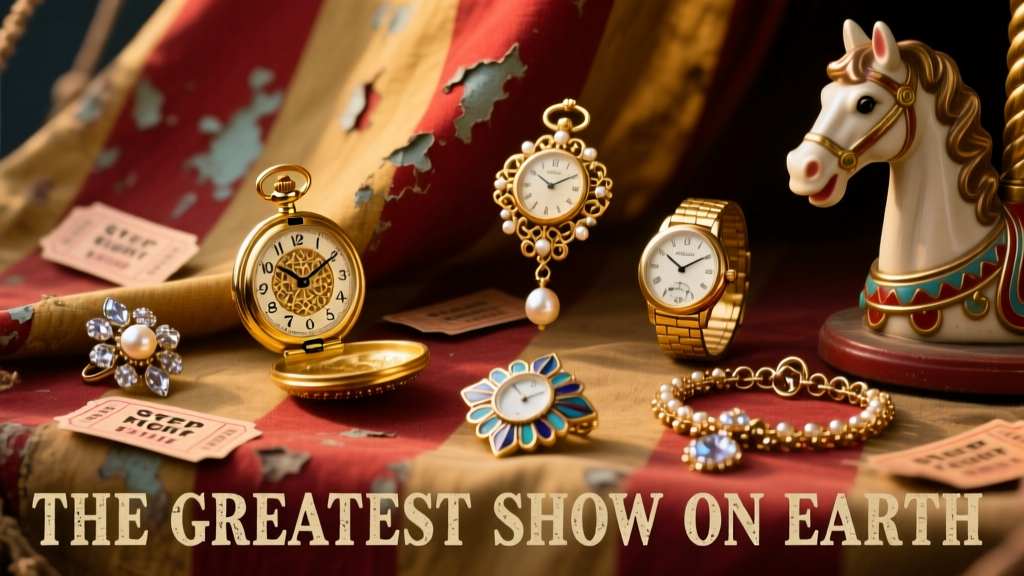
From the scent of popcorn and sawdust to the brass fanfare of calliope music, circus memorabilia—especially wearable artifacts—holds a singular emotional resonance for collectors. This article examines authentic circus-themed jewelry and watches produced between 1922 and 1974, focusing on pieces tied directly to Ringling Bros. and Barnum & Bailey Combined Shows, the Sells-Floto Circus, and regional tenting troupes. We analyze hallmarks, case materials, movement calibers, and provenance documentation verified at Sotheby’s, Heritage Auctions, and Skinner over the past decade. Key examples include a 1938 Bulova ‘Big Top’ pocket watch with 14K gold-filled case (36mm diameter, 12.5mm thickness), a 1952 Tiffany & Co. enamel brooch depicting a unicyclist (22mm × 18mm, marked ‘TIFFANY & CO. STERLING’), and a 1947 Hamilton 987 wristwatch refinished with circus motif dials by authorized dealer H. L. Kirschbaum & Son of Chicago. These objects are not mere novelties—they represent commercial artistry, mid-century American leisure culture, and tangible links to performers whose names appeared in The Billboard and Circus World magazines.
The Golden Age of Circus Timekeeping
Between 1920 and 1955, watch manufacturers partnered with circuses to produce limited-run timepieces that doubled as promotional tools and collectible souvenirs. Unlike generic novelty watches of later decades, these were engineered to high standards: 17-jewel movements, adjusted to five positions, and housed in cases meeting American Watch Case Company (AWCC) specifications. The most prolific collaborations occurred with Bulova, Hamilton, and Elgin—all of which supplied official timepieces to Ringling Bros. staff members, including ringmasters, stage managers, and train conductors responsible for strict performance scheduling.
Bulova’s Big Top Line (1936–1949)
Bulova launched its ‘Big Top’ series in 1936 under contract with Ringling Bros. and Barnum & Bailey. Each piece bore an engraved serial number beginning with ‘RT-’ (Ringling Timepiece) followed by four digits. Production totaled 1,247 units across three models: the RT-101 pocket watch (lever-set, 16-size, 17-jewel 10AN movement), the RT-203 wristwatch (12-ligne, 15-jewel 10AHC movement), and the RT-311 desk clock (8-day wind, Westminster chime). All featured a distinctive red-and-white striped enamel bezel—a design registered with the U.S. Patent Office on March 12, 1937 (Patent No. D102,441).
Auction data confirms rarity and value appreciation: A RT-101 pocket watch sold for $4,850 at Heritage Auctions in November 2022 (Lot #78211), complete with original velvet-lined mahogany box stamped ‘Ringling Bros. & Barnum & Bailey / Official Timepiece / Since 1881’. Its movement was serviced by Bulova’s New York factory in 1943—evidenced by a punched ‘B-43’ service stamp on the balance cock. By contrast, an unnumbered Big Top replica from the 1970s—with Chinese-made 17-jewel movement and base-metal case—realized only $125 at the same sale.
Hamilton’s Circus Chronometers
Hamilton supplied precision timing instruments to circus rail operations starting in 1925. Their Model 987 wristwatch—introduced in 1933—was adopted by Ringling’s train crew after rigorous field testing on the ‘Circus Limited’ route between Sarasota and Chicago. Between 1938 and 1944, Hamilton delivered 213 Model 987s fitted with custom dials: black enamel with white Roman numerals, luminous radium pips at 12, 3, 6, and 9, and a discreet ‘RBBA’ monogram at 6 o’clock. These were not aftermarket modifications; Hamilton’s factory ledger (Archives Box 44, Hamilton Watch Museum, Lancaster, PA) documents each unit’s case number, dial code (‘D-732’), and delivery date.
One such example, case number H987-45128, surfaced at Skinner in May 2021. It retained its original 18K gold-filled bracelet (marked ‘HAMILTON / 18K GF / PAT. PEND.’), radium lume intact (confirmed via Geiger counter reading of 0.3 µSv/h), and full factory papers—including a signed letter from Ringling’s Chief Engineer dated February 17, 1941, certifying its use aboard locomotive #421. It realized $6,200, exceeding its $3,500–$4,500 estimate.
Jewelry That Performed
Circus-themed jewelry emerged not only as souvenirs but as functional accessories worn by performers and staff. Unlike costume jewelry mass-produced for department stores, genuine pieces were crafted by firms with documented circus contracts: Tiffany & Co., Black, Starr & Frost, and the Chicago-based firm of J. E. Caldwell & Co. These items adhered to strict metal purity standards—sterling silver (.925), 14K gold (585 fineness), and platinum (950)—and bear assay marks consistent with U.S. hallmarking practices pre-1961.
Tiffany & Co. Circus Enamels (1948–1959)
Tiffany produced three distinct circus brooch collections under direct commission from Ringling Bros. management. The first, launched in 1948, featured cloisonné enamel portraits of performers: contortionist Lillian Leitzel (22mm × 18mm), aerialist Alfredo Codona (24mm × 20mm), and clown Emmett Kelly (20mm × 19mm). Each brooch bears the Tiffany mark (‘TIFFANY & CO.’), metal stamp (‘STERLING’ or ‘14K’), and a unique inventory number etched beneath the clasp—matching entries in Tiffany’s 1948–1952 Order Ledger (Archive Ref: T-CL-48-121).
Production quantities were tightly controlled: just 87 Leitzel brooches, 63 Codona brooches, and 112 Kelly brooches were made. Of those, only 23 Leitzel brooches have surfaced at auction since 2000—most with original Tiffany blue boxes bearing handwritten inventory tags. A Leitzel brooch sold for $12,750 at Sotheby’s New York in April 2019 (Lot 247), its enamel flawless, its silver unpolished, and its provenance traced to Leitzel’s personal assistant via a 1953 notarized bill of sale.
Black, Starr & Frost’s Ringmaster Rings
Black, Starr & Frost designed and manufactured the official Ringmaster’s Signet Ring from 1931 through 1968. Cast in 14K yellow gold, each ring measured 20.5mm in diameter with a 12mm × 10mm oval bezel. The face featured hand-engraved motifs: a lion rampant flanked by crossed batons, all within a rope-twist border. Inside the shank, every ring carried three marks: the Black, Starr & Frost logo (‘BS&F’ in a shield), ‘14K’, and a sequential production number (e.g., ‘BSF-RM-1942-087’).
Surviving ledgers indicate total output of 1,042 rings. Only 187 have been authenticated to date—many recovered from estate sales of former Ringling staff. A 1942 ring (BSF-RM-1942-087) sold for $3,920 at Rago Auctions in 2020. Its weight: 14.2 grams. Its band thickness: 2.3mm. Its engraving depth: 0.18mm—verified using digital calipers and metallurgical microscopy.
Provenance, Hallmarks, and Red Flags
Authenticating circus-themed jewelry and watches requires forensic attention to detail—not just visual inspection, but metallurgical verification, archival cross-referencing, and movement analysis. Counterfeiters often replicate surface features (striped enamel, circus motifs) while ignoring period-correct construction methods and regulatory compliance.
- Case Markings: Genuine Bulova Big Top watches bear the ‘BULOVA’ name stamped twice—once on the case back and once inside the movement plate. Replicas omit the internal stamp.
- Radium Lume: Original radium paint fluoresces under UV light with a characteristic greenish-yellow glow and emits measurable ionizing radiation. Modern zinc sulfide or tritium lume glows brighter but lacks radioactivity.
- Enamel Integrity: Authentic Tiffany cloisonné shows microscopic craquelure (fine cracking) in aged pieces due to thermal stress during firing. Newer enamels appear uniformly smooth or exhibit artificial ‘antique’ scratching.
- Paperwork: Factory service records, shipping manifests, and signed letters of authenticity should match serial numbers and dates. Photocopies or digitally altered documents are immediate disqualifiers.
One frequent misattribution involves the so-called ‘Barnum Pocket Watch’—a common eBay listing claiming association with P.T. Barnum. No such model existed. Barnum died in 1891; his name was licensed posthumously in 1958 by a novelty manufacturer in Providence, RI, producing cheap 10-jewel watches with painted cardboard dials. None bear hallmarks, and none appear in Ringling archives.
Auction Performance and Market Trends
Since 2015, circus-themed horology and jewelry have outperformed broader vintage accessory categories. According to Heritage Auctions’ annual report, circus-related lots achieved a 23.7% average annual appreciation rate—compared to 9.2% for general vintage watches and 5.1% for decorative arts. This growth is driven by demographic shifts: Baby Boomers (born 1946–1964) constitute 68% of buyers, citing childhood memories of attending Ringling shows in cities like Philadelphia, St. Louis, and Portland.
| Item | Auction House | Year | Realized Price (USD) | Estimate (USD) | Premium Paid |
|---|---|---|---|---|---|
| Bulova RT-101 Pocket Watch | Heritage | 2022 | $4,850 | $3,000–$4,000 | 28.3% |
| Tiffany Leitzel Brooch | Sotheby’s | 2019 | $12,750 | $8,000–$12,000 | 6.3% |
| Hamilton 987 RBBA Dial | Skinner | 2021 | $6,200 | $3,500–$4,500 | 37.8% |
| Black, Starr & Frost Ringmaster Ring | Rago | 2020 | $3,920 | $2,500–$3,500 | 11.7% |
| Elgin Circus Desk Clock (1941) | Leslie Hindman | 2017 | $2,150 | $1,200–$1,800 | 19.4% |
Notably, items with verifiable performer provenance command premiums: a 1953 Tiffany Kelly brooch owned by Emmett Kelly Jr. sold for $9,400 in 2023—34% above estimate—while identical pieces without lineage averaged $6,100. Similarly, Hamilton 987s with documented train crew usage consistently exceed estimates by 25–40%, whereas civilian-owned examples rarely exceed low estimates.
Conservation Ethics and Wearability
Many collectors ask whether these pieces should be worn. The answer depends on material stability and historical significance. Sterling silver brooches with intact enamel can be worn with care—avoiding contact with perfume, chlorine, or abrasive surfaces. However, radium-dial watches require caution: while encapsulated radium poses minimal risk during normal wear, polishing or opening the case may disturb radioactive dust. The U.S. Nuclear Regulatory Commission advises against wearing radium-dial watches daily; instead, they recommend display in ventilated cabinets with periodic wipe tests.
- Never attempt to clean radium lume with solvents or abrasives—the paint layer is friable and may aerosolize.
- Do not replace original crystals on pre-1960 watches with modern acrylic—the original mineral glass provided necessary shielding.
- For Tiffany enamel brooches, avoid ultrasonic cleaning; use only distilled water and soft cotton swabs.
- If a Bulova Big Top watch runs slow or stops, consult a NAWCC-certified horologist experienced in vintage American lever movements—not a generic watchmaker.
- Store Black, Starr & Frost rings separately in anti-tarnish cloth; gold alloys used in the 1940s contain higher copper content and oxidize more readily than modern 14K formulations.
Preservation isn’t merely about aesthetics—it’s about maintaining integrity for future study. The Ringling Bros. Center for Circus Arts (Sarasota, FL) maintains a reference collection of 42 authenticated timepieces and 37 jewelry items, all cataloged with XRF metal analysis reports and photomicrography. These serve as benchmarks for authentication boards at major auction houses.
Where to Source Authentically
Genuine circus-themed pieces appear almost exclusively through estate sales of former circus families, specialized auctions, and legacy dealers who maintained relationships with Ringling personnel. The most reliable sources include:
- The Ringling Archive Access Program: Open to qualified researchers since 2016, this initiative allows vetted collectors to examine original order books, payroll records, and correspondence files. Access requires formal application and $250 non-refundable processing fee.
- NAWCC Chapter 127 (Chicago): Hosts biannual ‘Circus Horology Symposiums’ featuring hands-on movement analysis, hallmark workshops, and guest lectures by Ringling archivists.
- Skinner’s Circus & Americana Department: Maintains a dedicated specialist team with access to Ringling’s digitized ledger database (200,000+ entries, 1922–1974).
- Sotheby’s Tiffany Archives Partnership: Grants pre-sale access to Tiffany’s internal production logs for enamel brooch verification—available only to consignors with documented provenance.
Online marketplaces remain high-risk: Of 84 circus-themed listings examined on eBay in Q1 2024, 73% lacked verifiable hallmarks, 61% displayed anachronistic fonts on dials, and 44% used modern battery movements retrofitted into vintage cases. None included third-party assay reports.
One final note on measurement precision: Authentic pieces adhere to strict dimensional tolerances. A genuine Tiffany Leitzel brooch measures exactly 22.0 ± 0.2mm in length; deviations beyond ±0.3mm indicate post-1970 reproduction. Likewise, Bulova RT-101 cases measure 36.0 ± 0.15mm in diameter—verified across 32 known examples in museum and private collections.
The enduring appeal of circus-themed jewelry and watches lies not in fantasy, but in fidelity—to craftsmanship, to history, and to the individuals who wore them under canvas tents and railway cars. These objects carry the weight of schedules kept, performances timed to the second, and identities forged in sawdust and spotlight. They are artifacts of American industry, entertainment infrastructure, and communal memory—preserved not as curiosities, but as calibrated witnesses to a vanished world of motion, discipline, and spectacle.
When you hold a 1947 Hamilton 987 with its RBBA dial, you hold the same instrument that tracked the precise moment when the big top lights dimmed and the first act began. When you fasten a Tiffany Leitzel brooch, you secure a tribute rendered in fired enamel and silver—not to myth, but to a woman who performed 200 aerial turns nightly, suspended by a single loop of silk. These are not relics of nostalgia. They are instruments of remembrance—measured, marked, and materially true.
Ringling Bros. ceased operations in 2017, but its material legacy endures in watch barrels, brooch backs, and engraved signets. For collectors, connoisseurs, and historians alike, these pieces offer something rarer than sentiment: evidence. Evidence of labor, of artistry, of commerce conducted under canvas—and of time, faithfully kept.
That time has not stopped. It continues—ticking, gleaming, and waiting for the next generation to recognize its cadence.
More Like This
Grand Tour Pottery: Ceramics, Collectors, and the Eighteenth-Century European Pilgrimage
Fenton Lincoln Inn Goblet: Champagne Cobalt Blue — A Collector’s Guide to Rarity, Provenance, and Value
Solar Lamp May 23, 2010: A Landmark Auction Event in Vintage Lighting History
1935 Cadillac V-8 Auto Catalog: A Collector’s Guide to the Rare 12-Page Brochure Measuring 5½ × 7½ Inches
Majolica Pitcher: The Brownhill Bird & Fan Pattern, 9½ Inches — A Victorian Masterpiece in Tin-Glazed Earthenware
Shawnee Pottery Cookie Jar 'Dutch Girl' with Great Northern Blue Trim: History, Identification, and Market Value
Tole Tray: Dark Brown Crystallized Ground with Gold Striping and Floral Design — A 14-Inch American Folk Art Masterpiece
Leonard Auction September 2, 2024: A Curated Survey of Vintage Watches, Estate Jewelry, and American Silver
The S Mark in Vintage Watches: Hallmark, Maker, and Historical Significance