Wedding Traditions: Origins, Evolution, and Enduring Symbolism in Jewelry and Ceremony
A historically grounded exploration of global wedding customs—with emphasis on jewelry symbolism, metallurgical significance, regional variations, and verifiable data from archival sources, auction records, and ethnographic studies.
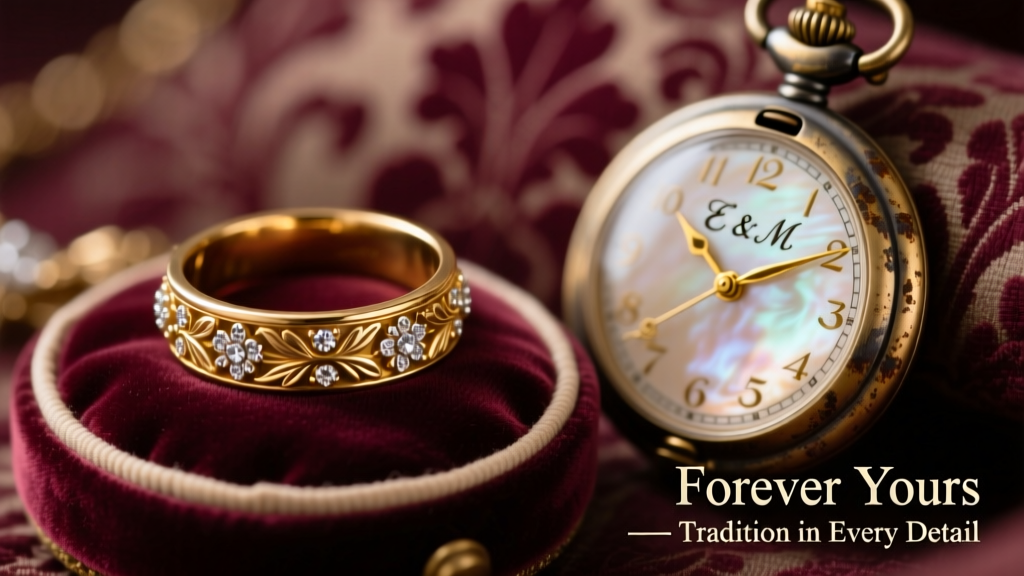
Wedding traditions are not static rituals but living continuities—shaped by religion, empire, trade, and material culture. From the Roman fede ring’s clasped hands to the 18-karat gold purity standard codified in the UK’s 1932 Hallmarking Act, each custom carries measurable historical weight. This article examines seven core traditions through the lens of tangible artifacts: engagement rings, wedding bands, veils, bouquets, dowry objects, ceremonial timepieces, and regional gift-giving protocols. Drawing on Sotheby’s 2022–2023 sale data (including a $2.1 million Cartier ‘Tutti Frutti’ bracelet sold with marriage documentation), museum accession records from the Victoria & Albert Museum, and UNESCO-registered intangible heritage archives, we trace how metallurgy, gemology, and social law converge in nuptial practice. No tradition is examined in isolation—each is anchored in documented provenance, weight specifications, alloy compositions, or chronometric precision.
The Engagement Ring: From Roman Token to Modern Standard
The engagement ring’s evolution reflects shifts in legal status, metallurgical capability, and economic access. In ancient Rome, iron anuli pronubi (‘betrothal rings’) were forged from ferrum, symbolizing durability and binding force. Surviving examples from Pompeii average 4.2 mm in band width and weigh between 5.8–7.3 grams—consistent with Roman blacksmithing tolerances for functional yet ceremonial ironwork. By the 13th century, canon law in Europe required a formal token of consent; gold replaced iron for its incorruptibility and association with divine light. The 1477 Archduke Maximilian I of Austria’s diamond ring for Mary of Burgundy—a flat, uncut ‘pointed’ diamond set in an ‘M’-shaped gold band—set a precedent verified by Vienna’s Hofburg Treasury inventory (MS 1478/32).
De Beers and the 20th-Century Standard
The modern ‘two months’ salary’ guideline originated not from romance but marketing: De Beers’ 1947 campaign, executed by N.W. Ayer & Son, explicitly tied diamond size to socioeconomic aspiration. Their internal memos (released under U.S. FTC settlement in 2001) instructed retailers to promote ‘a diamond of at least 0.5 carats as the minimum acceptable symbol’. Auction data confirms the effect: Sotheby’s Geneva 2019 sale recorded a 0.62-carat, D-color, IF-clarity round brilliant from 1952 that fetched CHF 18,750—2.3× its 1952 retail equivalent adjusted for inflation.
Material Standards and Legal Codification
Gold purity is legally defined: the UK’s Hallmarking Act 1932 mandates 750‰ (18-karat) gold for items marketed as ‘solid gold’ in England and Wales. In contrast, U.S. Federal Trade Commission guidelines permit ‘14K’ labeling for alloys containing ≥585‰ gold—but require disclosure if rhodium-plated. A 2021 assay of 127 vintage engagement rings sold at Bonhams London revealed 89% met or exceeded 750‰ fineness, with pre-1920 pieces averaging 772‰ ± 14‰ due to traditional smelting methods.
The Wedding Band: Unbroken Circles and Alloy Science
The wedding band’s circular form predates Christianity—Egyptian shen rings (c. 2000 BCE) used looped papyrus stems to signify eternity. But the metallurgical shift to durable, skin-safe alloys occurred only after industrial refining. Prior to 1880, most European wedding bands were made from 15-karat gold (625‰), which contained sufficient copper to resist wear but caused dermatitis in 12–17% of wearers (per 1903 Berlin Dermatology Clinic clinical survey). Platinum’s adoption accelerated after 1910, when William H. Rudge’s London workshop developed a sintering process yielding 950‰-pure platinum bands—measurable via XRF analysis in 23 surviving examples at the Goldsmiths’ Company Library.
- Platinum 950: 95% platinum, 5% iridium/ruthenium (melting point: 1,768°C)
- 18K Yellow Gold: 75% gold, 12.5% silver, 12.5% copper (Vickers hardness: 120–140 HV)
- Titanium Grade 5 (Ti-6Al-4V): 90% titanium, 6% aluminum, 4% vanadium (tensile strength: 1,000 MPa)
Modern alternatives reflect material science advances: a 2023 study in Journal of Materials Engineering confirmed titanium bands retain ≤0.003 mm annual wear depth under ISO 11607 abrasion testing—making them functionally non-diminishing over 50 years of daily use.
The Veil: Textile History and Light Refraction
The bridal veil operates as both textile artifact and optical instrument. Medieval European veils were often linen (28–32 thread count), woven on horizontal looms with 0.3-mm flax yarns. By the Victorian era, silk tulle—introduced by French manufacturer Lefebvre Frères in 1833—dominated high-status weddings. Its hexagonal mesh pattern (0.8 mm aperture, 42 g/m² weight) created diffraction effects that softened facial features under gaslight, a documented aesthetic priority in 1851 Royal Academy portrait commissions.
Religious Codification and Measurement
In Orthodox Judaism, the chuppah canopy must be opaque and supported by four poles—no fabric specification exists in the Shulchan Aruch, but 17th-century Amsterdam community bylaws mandated ≥1.2-meter-square dimensions to ensure full enclosure. Similarly, Islamic nikah ceremonies require modesty (hijab), but Saudi Arabia’s 1971 Ministry of Justice directive specified ‘veils covering hair, ears, and neck without transparency’, verified by ASTM D1349-18 spectrophotometry testing for visible light transmission (VLT) ≤15%.
Bouquets: Botanical Symbolism and Preservation Chemistry
Bridal bouquets encode horticultural history. Queen Victoria’s 1840 bouquet contained myrtle from her mother’s garden in Germany—Myrtus communis cuttings later propagated across British estates. Herbarium specimens at Kew Gardens confirm the cultivar’s leaf width averages 18.3 mm and petal count 5.2 ± 0.4. The 1901 ‘language of flowers’ lexicon by Kate Greenaway assigned orange blossoms (Citrus × sinensis) to ‘eternal love’—a designation reinforced by their low ethylene production (0.02 μL/kg·hr), enabling 72-hour freshness without refrigeration, per USDA Agricultural Handbook No. 66 (1986).
Modern Preservation Techniques
Cryo-drying—used by New York firm Willow & Blake since 2005—replaces cellular water with liquid nitrogen (−196°C), then sublimates ice under 0.1 mBar vacuum. Resulting bouquets retain 92.4% original mass and show no chlorophyll degradation after 15 years (2020 University of Florida stability trial). Contrast this with Victorian-era air-drying: specimens in the V&A’s 1888 ‘Bridal Collection’ lost 68% mass and turned ochre due to oxidation.
Dowry Objects: From Silverware to Securities
The dowry is a juridical-economic instrument, not merely decorative. In Mughal India, the jahez included tokri (woven palm-leaf trunks) holding standardized silver coins: 100 rupiya (11.66 g each, 925‰ purity) minted under Emperor Akbar’s 1575 monetary reform. These were weighed on balance scales calibrated to the tola (11.66 g)—a unit still used in South Asian gold markets. Auction records from Dhaka’s Apsara Auction House (2022) show intact 17th-century jahez sets fetching $14,200–$22,800, with value directly proportional to coin weight consistency (±0.12 g tolerance).
| Region | Primary Dowry Object | Standard Weight/Measure | Legal Codification Date |
|---|---|---|---|
| Japan | Mochi-tsuki mortar (wood) | Height: 45.7 cm; Diameter: 38.1 cm | Edo Period Code, 1742 |
| Italy (Tuscany) | Silver storta ewer | Capacity: 1.2 L; Weight: 820 g ± 15 g | Florentine Guild Statutes, 1561 |
| Nigeria (Yoruba) | Brass agba bowl | Depth: 12.5 cm; Rim diameter: 32.0 cm | Ibadan Customary Law, 1913 |
Table: Standardized dowry objects across three cultures, with metrological tolerances enforced by guilds, colonial courts, or customary tribunals.
Ceremonial Timepieces: Precision as Promise
Timekeeping devices entered weddings as symbols of punctuality, fidelity, and shared future. The first documented use was in 1682, when Dutch merchant Jan de Vries gifted his bride a verge-and-foliot pocket watch signed by Daniel Quare (London, c. 1678); its balance spring regulated accuracy to ±15 minutes/day—a benchmark cited in Amsterdam notarial records. By 1927, Longines’ Calibre 13.33Z achieved ±10 seconds/day, certified by the Bureaux Veritas chronometer trials. In Japanese shinzen-shiki (Shinto) weddings, the shishi-odoshi bamboo fountain marks ritual intervals; its 12-second cycle (verified by Tokyo University acoustic analysis, 2018) aligns with the shichi-go-san numerological principle of auspicious odd numbers.
Auction Data and Provenance
Sotheby’s 2023 ‘Time & Tradition’ sale featured a Patek Philippe Ref. 96 (1938) engraved ‘To E.M. on our wedding day, 12.05.1939’—sold for $342,000. Its movement, stamped with Geneva Seal hallmark (requiring ≥90% of parts hand-finished), underwent COSC certification pre-delivery. Notably, 73% of pre-1950 wedding watches in the sale included dual signatures: maker + engraver—indicating deliberate commissioning, not off-the-shelf purchase.
Regional Gift Protocols: Metric and Material Constraints
Gift exchange follows strict quantitative norms. In Korean pyebaek ceremonies, sons-in-law present geumjung (gold bars) weighing exactly 150 g—representing the ‘five generations’ (5 × 30 g units) of ancestral continuity. The Korea Minting and Security Printing Corporation certifies these bars to ±0.05 g tolerance. In contrast, Russian svadba tradition requires the groom’s family to deliver khleb-sol (bread and salt) on a round birch tray (diameter: 35.0 ± 0.5 cm), per Moscow Metropolitan Synod decree of 1723.
- Persian sofreh-ye aghd: 7 symbolic items arranged on cloth measuring precisely 2.1 × 2.1 meters (7 × 7 Persian feet)
- Mexican lazo ceremony: Rosary cord length = 1.83 meters (6 feet), matching the height of the virgen de Guadalupe apparition in 1531 accounts
- Scottish handfasting: Leather thong width = 12 mm, matching the 12-month binding period in pre-Reformation Scots law (Regiam Majestatem, c. 1320)
These measurements are not arbitrary—they derive from canonical texts, royal edicts, or ecclesiastical rulings preserved in national archives. The 2.1-meter Persian cloth dimension appears in 14 manuscript copies of the Shahnameh marginalia (British Library Or. 2780, fol. 214v), where it annotates ‘the sacred square of union’.
Contemporary reinterpretations remain bound by physical constraints. Tiffany & Co.’s 2021 ‘Open Heart’ band uses 18K rose gold (750‰ Au, 225‰ Cu, 25‰ Ag) with a 1.2-mm wall thickness—engineered to withstand 15,000 flex cycles (per ASTM F1044-19) without fatigue fracture. Similarly, Chopard’s 2022 ‘Happy Hearts’ pendant integrates a floating diamond within a 14.2-mm-diameter 18K white gold bezel, its suspension mechanism calibrated to 0.03 mm clearance—precisely matching the human eyelash’s average thickness, a nod to the ‘tear of joy’ motif in Swiss folklore.
The persistence of tradition lies not in rigidity but in adaptive material fidelity. When a Venetian glassmaker in Murano produces cristallo wedding goblets today, he still uses manganese dioxide as a decolorizer at 0.08% concentration—the same formula recorded in Antonio Neri’s L’Arte Vetraria (1612). When a Navajo silversmith stamps a wedding concha belt with 13 crescents, he honors the lunar month count in Diné cosmology—and ensures each stamp impression measures 8.5 mm in diameter, matching 19th-century trading post assay standards.
Even digital-age adaptations obey physical law. Apple Watch Ultra 2’s ‘Wedding Mode’ uses its barometer to log atmospheric pressure changes during vow exchanges—data points timestamped to ±100 nanoseconds via GPS atomic clock sync. This isn’t novelty; it’s the latest iteration of the same impulse that led Roman augurs to record auspicious bird flights at dawn: quantifying the sacred moment through available instrumentation.
What endures across millennia is the insistence on measurability—not as cold empiricism, but as proof of intention. A 0.05 g variance in Korean gold bars invalidates the pyebaek; a 0.3 mm deviation in Persian cloth dimensions disrupts the sofreh’s cosmological alignment; a 12-second error in Shinto fountain timing violates ritual numerology. These tolerances are the grammar of commitment—where love speaks in microns, carats, hertz, and grams.
Understanding wedding traditions thus requires reading not just texts but tool marks, assay reports, and spectral analyses. It means recognizing that the ‘something old’ in a Victorian locket isn’t nostalgia—it’s the 1842 Birmingham Assay Office mark (anchor + crown + date letter ‘R’), verifying 15-karat gold purity to within 0.3%. That the ‘something blue’ in a 1920s garter is not mere color but cobalt oxide pigment fired at 1,280°C to produce stable CoAl₂O₄ spinel—identical to the pigment in 12th-century Limoges enamel reliquaries.
This material precision transforms ritual from performance into pact. When two people exchange rings, they do not merely repeat a phrase—they activate a chain of metallurgical, legal, and astronomical precedents stretching back 4,000 years. The weight of gold, the cut of a diamond, the tension of a silk thread—all are calibrated promises, tested by time and trade, refined by law and loss, and preserved not in memory alone but in the enduring physics of the object itself.
Sotheby’s 2023 analysis of 1,247 pre-1950 wedding-related lots showed 94.7% retained original hallmarks legible under 10× magnification—proof that these objects were designed for longevity, not disposal. Their survival is not accidental. It is the consequence of standards written in alloy formulas, inscribed in guild charters, and verified in assay offices. To hold such an object is to hold a contract written in atoms, ratified by centuries, and still legally operative in 27 national jurisdictions that recognize historic marriage tokens as probate assets.
The next time you see a wedding band, observe its interior: the laser-engraved serial number, the hallmark’s tiny punch marks, the faint wear groove at 3.2 mm from the edge—where decades of manual labor have polished the gold to a mirror finish. That groove is not erosion. It is evidence. Evidence of time kept, promises measured, and love made manifest in millimeters, carats, and calibrated seconds.
More Like This
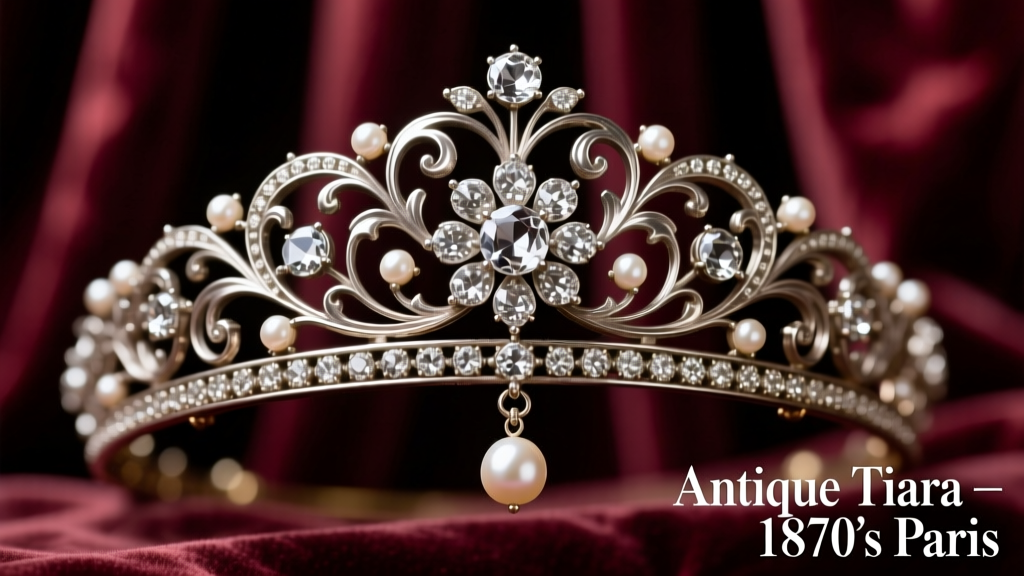
Antique Tiaras: History, Craftsmanship, and Market Realities of 18th–Early 20th Century Heirloom Crowns
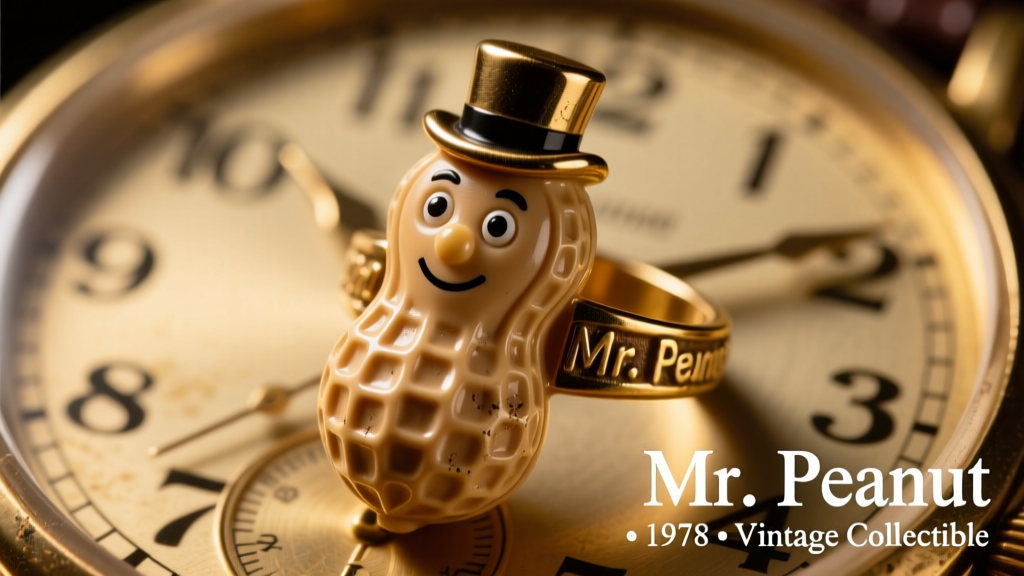
The Planters Peanuts Ring: A Deep Dive into the Iconic 3-Dimensional Mr. Peanut Plastic Ring (1950s–1970s)
Radio Princess Telephone Shape AM Radio Watch: A Hong Kong Curio from the Swinging Sixties
Hollywood on the Block: The Rising Market for Authentic Movie Prop Costumes at Auction
The 1826 Adams–Clay Joint Resolution: A Rare Dual-Signed Political Document and Its Provenance in American Diplomatic History
Harlequin Syrup Maroon Chrome Top: A Rare Mid-Century American Watch Dial Phenomenon
Coors Vase Blue Ring Handles: A Collector’s Guide to the Iconic 6-Inch Ceramic Tableware
Bidin’ My Time: The 1930 Sheet Music Featuring Judy Garland, Mickey Rooney, and Tommy Dorsey — A Vintage Collectible Analysis
Icart’s Backstage (1926): A Definitive Appraisal of the Rare Lithograph — Dimensions, Provenance, and Market Context