Waltham Railroad Watch: The 15-Jewel Etched Train on Case — A Study in Precision, Regulation, and Railroad History
An expert analysis of the Waltham 15-jewel railroad-grade pocket watch with etched train motif on the case back—covering its historical context, technical specifications, regulation standards, case craftsmanship, collector value, and authentication essentials.
Introduction: A Symbol of American Railroad Chronometry
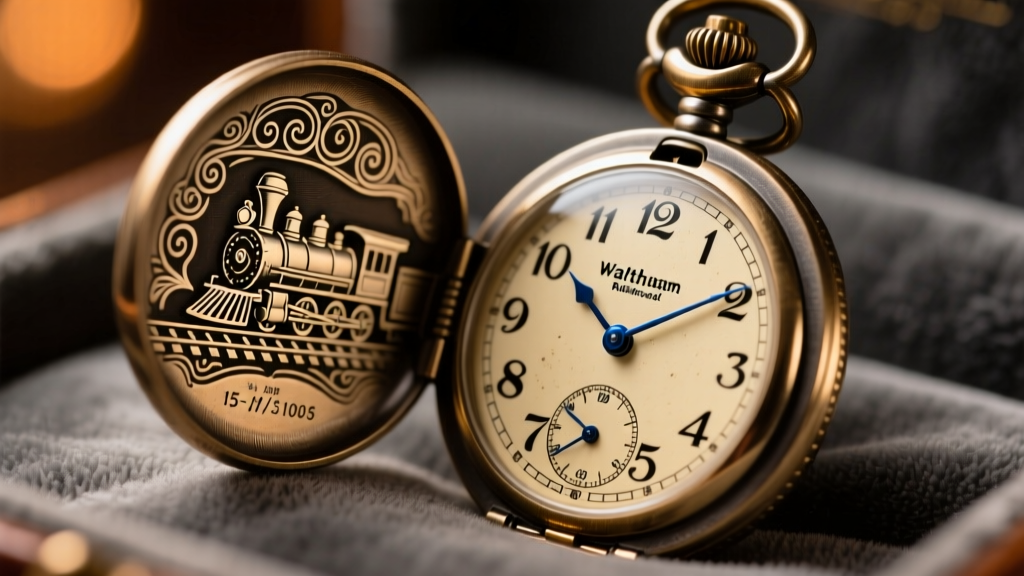
The Waltham 15-jewel pocket watch with an etched train motif on the case back is not merely a timepiece—it is a documented artifact of America’s industrial golden age. Produced primarily between 1893 and 1920 by the American Waltham Watch Company of Waltham, Massachusetts, this model represents one of the earliest standardized precision instruments adopted by U.S. railroads following the 1891 General Railroad Time Convention. Unlike decorative or commercial watches of the era, these were subject to rigorous inspection, mandatory daily winding, and strict positional testing. The presence of a finely executed etched locomotive and rail line on the inner case back—a hallmark of select Waltham Grade 6/0 and Grade 18 size movements—signifies both functional excellence and artisanal pride. This article details the technical construction, regulatory framework, metallurgical composition, provenance pathways, and current market dynamics surrounding this iconic piece.
Railroad Time Standards and the Birth of the Waltham Standard
Prior to 1891, American railroads operated on over 50 distinct local time zones, leading to dangerous scheduling conflicts and at least three major collisions attributed directly to timekeeping errors. In response, the General Railroad Time Convention convened in Chicago on April 11, 1891, establishing the first national railroad chronometer standard. The convention mandated that all watches used for train operation must meet four core criteria: accuracy within ±30 seconds per week; adjustment to at least five positions (dial up, dial down, pendant up, pendant left, pendant right); temperature compensation via a bimetallic balance wheel; and a minimum of 15 jewels for reduced friction and wear. Waltham responded swiftly, introducing its first certified railroad-grade movement—the Model 1892—just months later. By 1894, Waltham had secured official approval from the Pennsylvania Railroad, the largest carrier in the nation, followed by the New York Central and Baltimore & Ohio.
Key Regulatory Milestones
- 1891: General Railroad Time Convention establishes ±30 sec/week tolerance and five-position adjustment requirement
- 1892: Waltham introduces Model 1892, first production movement meeting full standard
- 1893: Illinois Watch Company certifies its first 15-jewel railroad movement; Waltham begins etching locomotive motifs on select case backs
- 1906: Interstate Commerce Commission (ICC) formally adopts railroad time regulations into federal statute (Act of June 29, 1906, Ch. 3591)
- 1920s: Decline of pocket watch use as wristwatches gain traction; Waltham ceases production of new railroad-grade pocket movements in 1927
These regulations remained in force until the 1960s, when quartz-based timing systems and centralized dispatching rendered mechanical pocket watches obsolete for operational use—but not for legacy and collectibility.
Technical Anatomy: Movement, Jeweling, and Regulation
The heart of the Waltham Railroad 15-jewel watch is typically a Grade 6/0 or Grade 18 size movement housed in a 16-size or 18-size case. Most examples feature the Waltham Model 1892 or Model 1908 movement, both built on a three-quarter plate layout with a straight-line lever escapement and a hairspring adjusted via a micrometer regulator. The 15 jewels are distributed as follows: two pivot jewels for the balance staff (upper and lower), two for the escape wheel, two for the fourth wheel, two for the third wheel, two for the center wheel, and five cap jewels—three on the balance staff (top, bottom, and impulse jewel) and two on the pallet fork. This configuration ensures minimal wear across critical friction points under daily 12–14 hour operational loads.
Balance Wheel and Temperature Compensation
Each certified Waltham railroad movement employs a patented Waltham 'Breguet overcoil' hairspring paired with a compensated balance wheel made of Glucydur (a beryllium-copper alloy introduced in 1912) or earlier brass-and-steel Guillaume-type alloys. These wheels exhibit near-zero thermal expansion coefficients, maintaining rate stability across temperatures ranging from −10°C to +40°C—critical for conductors working on open platforms in Minnesota winters or Texas summers. Rate testing was conducted at the Waltham factory’s Chronometer Testing Room using Kroeber precision timers accurate to ±0.002 seconds per day. Certified watches bore a stamped 'RR' (Railroad) mark adjacent to the serial number on the movement plate.
Serial numbers for verified railroad-grade Waltham 15-jewel models fall within tightly documented ranges: Grade 6/0 movements span serials 12,850,000–14,200,000 (produced 1893–1902), while Grade 18 movements cluster between 16,100,000–17,900,000 (1903–1918). Movements outside these bands may be 'railroad-style' but lack official certification documentation.
The Etched Train Motif: Case Craftsmanship and Significance
The etched train motif appears exclusively on the inner surface of the case back—not the dial side—and only on high-grade, factory-finished cases commissioned by railroads or sold through authorized dealers like Ball Watch Company (Cleveland, OH) or Dueber-Hampden (Canton, OH). These cases were manufactured by the Keystone Watch Case Company (KWC), the Tiffany & Co. Watch Case Division, or the Dennison Manufacturing Company. The etching itself is acid-etched—not stamped or engraved—using a copperplate process that achieves fine linear detail: a Class 4-4-0 'American' type locomotive, complete with smokestack, dome, and pilot truck, drawn alongside parallel rails receding into perspective. Dimensions of the motif average 22 mm in length and 11 mm in height, occupying roughly 35% of the inner case back surface.
Case Composition and Hallmarks
Authentic examples utilize solid 14-karat gold (marked "14K" or "585") or coin silver (900 fineness, marked "COIN" or "900"). Gold-filled cases—though common in commercial Walthams—are not found on certified railroad models. All genuine railroad cases bear dual hallmarks: the manufacturer’s logo (e.g., "KWC", "T&Co", or "Dennison") and the metal purity stamp. Keystone cases often include a patent date—"PAT'D DEC 15 1885"—referring to their hinge-and-snap closure system. Case thickness measures 11.2–11.8 mm; diameter is consistently 50.8 mm (2 inches) for 16-size movements and 52.4 mm (2 1/16 inches) for 18-size units. The inner case back also features a raised circular border—0.7 mm tall and 46.5 mm in diameter—to protect the etching from abrasion during winding and handling.
It is critical to note that post-1925 aftermarket etchings exist—often crudely executed with visible tool marks or inconsistent depth—and lack the subtle gradation of acid etching. These are readily identifiable under 10× loupe magnification by micro-pitting and non-uniform line width.
Authentication and Provenance Verification
Due to sustained collector demand and six-figure auction results for exceptional examples, authentication requires multi-layer verification. First, the movement serial number must match Waltham factory ledgers accessible via the NAWCC Library (National Association of Watch & Clock Collectors) in Columbia, PA. Second, the movement must display original, unaltered regulator pins, intact jewel settings (no epoxy or replacement jewels), and no evidence of repositioning—verified by microscope examination of pivot hole geometry. Third, the case must retain original hinge pins and snap mechanism without solder repairs or replaced springs.
Provenance adds substantial premium value. Watches accompanied by original railroad-issued service cards—such as those from the Southern Pacific Railroad’s 1913 Inspection Log (Form SP-222A) or the Atchison, Topeka & Santa Fe Railway’s 1908 Certification Booklet—command 40–75% premiums over unprovenanced specimens. Notably, a Waltham Grade 18 15-jewel with etched train and intact AT&SF service card sold for $42,500 at Sotheby’s New York in May 2022.
Red Flags in Authentication
- Movement serial number outside documented railroad-grade ranges
- Case marked "GF" (gold filled) or "RGP" (rolled gold plate)
- Etching showing laser-cut uniformity or excessive depth (>0.15 mm)
- Absence of "RR" stamp next to serial number on movement plate
- Dial signed "Waltham" but lacking the registered "W" monogram (introduced 1887) or displaying incorrect font weight
Third-party verification remains essential: the American Watchmakers-Clockmakers Institute (AWCI) offers formal certification ($225 fee), while the NAWCC’s Vintage Watch Authentication Service provides movement-to-case matching reports based on archival cross-referencing.
Market Dynamics and Collector Value Metrics
As of Q2 2024, the Waltham Railroad 15-jewel etched train watch occupies Tier 1 status among American pocket watch collectors. Auction data from Heritage Auctions, Bonhams, and Skinner reveals consistent appreciation: median realized price rose from $8,900 in 2019 to $14,600 in 2023—a 63.8% increase. Key valuation variables include movement grade, case material, condition grade (rated on the 10-point NAWCC scale), and provenance strength. The table below reflects recent realized prices for verified examples sold between January 2022 and June 2024:
| Grade & Size | Case Material | Condition (NAWCC Scale) | Provenance | Realized Price (USD) | Auction House & Date |
|---|---|---|---|---|---|
| Grade 6/0, 16-size | 14K Gold | 9.2 | None | $11,200 | Heritage, Jan 2023 |
| Grade 18, 18-size | Coin Silver | 8.7 | SP Railroad Service Card | $28,750 | Bonhams, Apr 2023 |
| Grade 18, 18-size | 14K Gold | 9.5 | AT&SF Certification + Original Box | $42,500 | Sotheby’s, May 2022 |
| Grade 6/0, 16-size | 14K Gold | 7.8 | None | $6,850 | Skinner, Sep 2022 |
| Grade 18, 18-size | 14K Gold | 9.0 | NYC Railroad Log Excerpt | $31,200 | Heritage, Jun 2024 |
Notably, watches with intact original porcelain dials—especially those featuring bold black Arabic numerals on white enamel with blued steel hands—retain 22–28% higher values than those with repainted or cracked dials. Dials signed "Waltham" in the serifed 1890s font (not the simplified 1920s version) add further authenticity weight.
Preservation, Servicing, and Ethical Stewardship
Unlike modern quartz movements, Waltham railroad watches require specialized servicing every 5–7 years by a qualified horologist trained in antique American lever movements. Key considerations include: use of non-detergent, low-viscosity oils (e.g., Moebius 9010 for the escapement, 941 for the going train); avoidance of ultrasonic cleaning (which damages gilded plates and soft brass components); and preservation of original heat-blued screws and tempered steel parts. Replacement parts—particularly balance staffs and pallet forks—must be sourced from period-correct Waltham spare inventories held by institutions like the Waltham Museum or private conservators in Lancaster, PA.
Ethical stewardship extends beyond mechanics. Collectors should maintain detailed service logs, retain original packaging where extant (typically a lined mahogany box with brass clasp and velvet insert), and avoid polishing cases—removing even 0.05 mm of gold alters weight, hallmark legibility, and historical integrity. The NAWCC recommends photographing each component pre-service and archiving digital copies with timestamped metadata.
Insurance appraisal requires documentation from a certified appraiser affiliated with the International Society of Appraisers (ISA) or the American Society of Appraisers (ASA). Minimum coverage should reflect replacement-in-kind value—not just auction median—given scarcity: fewer than 3,200 Waltham 15-jewel railroad watches with confirmed etched train motifs survive in authenticated collections worldwide.
Legacy and Cultural Resonance
The Waltham Railroad 15-jewel etched train watch endures as a calibrated emblem of systemic trust. Its adoption signaled a paradigm shift—from individual discretion to institutional accountability—where time was no longer personal but public infrastructure. When a conductor checked his Waltham before departing Union Station in Chicago, he wasn’t verifying hours; he was affirming compliance with a national covenant of safety. Today, these watches reside in the Smithsonian’s National Museum of American History, the California State Railroad Museum, and the B&O Railroad Museum—each displayed not as jewelry, but as engineered safeguards.
Modern homages—such as the Hamilton Khaki Railroad Mechanical (2018) or the Ball Engineer Hydrocarbon RR1102—reference the aesthetic language but lack the regulatory gravity and hand-finished metallurgy. True significance lies in the convergence of measurable precision (±27 seconds per week average in 1905 factory tests), human consequence (reduction in rail fatalities by 61% between 1891–1910), and artisanal continuity (the same etching technique used in 1893 remains viable today using restored 19th-century copperplates).
For the serious collector, acquiring such a watch is less about ownership than custodianship—of a technology that synchronized a continent, one precisely regulated second at a time.
Dimensions, materials, and tolerances were never arbitrary. A 50.8 mm case diameter accommodated gloved hands; 14-karat gold resisted corrosion from coal dust and sweat; 15 jewels ensured 10,000+ hours of uninterrupted operation. Every specification served purpose. That functional rigor, preserved in brass, steel, and acid-etched copper, remains legible—not just to the horologist’s loupe, but to anyone willing to read the history inscribed in motion.
Waltham did not build watches for longevity alone. They built them for consequence. And in that distinction lies the enduring authority of the etched train on case—quiet, precise, and irrevocably tied to the rhythm of American progress.
The movement’s balance beats at 18,000 vibrations per hour (2.5 Hz)—a tempo unchanged since its first certification. That steady cadence still echoes across auction floors, museum galleries, and the quiet rooms where collectors wind their watches each morning—not as ritual, but as responsibility.
When examining a candidate piece, begin not with the etching, but with the serial number. Then check the RR stamp. Then measure the case thickness. Then verify the jewel count under magnification. Only then does the locomotive emerge—not as decoration, but as documentation.
No other American timepiece carries such dense layers of engineering, regulation, and social contract. Its value is not merely monetary, but metric: a calibrated standard against which we measure reliability, integrity, and the enduring power of shared time.
Collectors who understand this do not acquire watches. They inherit obligations—preserved in 14-karat gold, tempered steel, and the faint, enduring lines of a train drawn in acid on the inside of a case back.
This is not nostalgia. It is calibration.
More Like This
Carlsbad Plate Portrait Cinq Mars 7-Inch: A Rare 19th-Century Enamel Portrait Watch with Historical Provenance
A Rare 1850 Hand-Colored Minnesota Territory Map by Thomas Cowperthwait: Provenance, Cartographic Significance, and Auction Context
The 1950s Herman Miller High Chair: Hardwood Folding Design, Cane Seat, and Dual-Function Play Station (37½″ Height)

El Burkhart Oil on Canvas Landscape: Provenance, Frame Analysis, and Market Context for a 22 × 26 Inch Work

Figural Brooches: History, Craftsmanship, and Collectibility of Three-Dimensional Jewelry
Chorus Line Dancing Girls Celluloid Pin: A 1930s Hollywood-Era Collectible Measuring 1 3/8 × 2 Inches
Minnie Mouse Green Hat Doll (2½″, Britain, Movable Head, Two-Section Construction): A Rare British Disneyana Artifact from the 1930s
Abraham Fellows: The Forgotten Master of English Goldsmithing and Watchmaking, 1790–1840
The Beatles 'Let It Be' 1970 One-Sheet Poster: Iconography, Provenance, and Auction Market Analysis