Abraham Fellows: The Forgotten Master of English Goldsmithing and Watchmaking, 1790–1840
A detailed examination of Abraham Fellows (1763–1840), a London-based goldsmith, watchmaker, and chronometer maker whose workshop supplied precision timepieces to the Royal Navy, the East India Company, and elite private clients—yet whose legacy was nearly erased by fire, bankruptcy, and archival neglect.
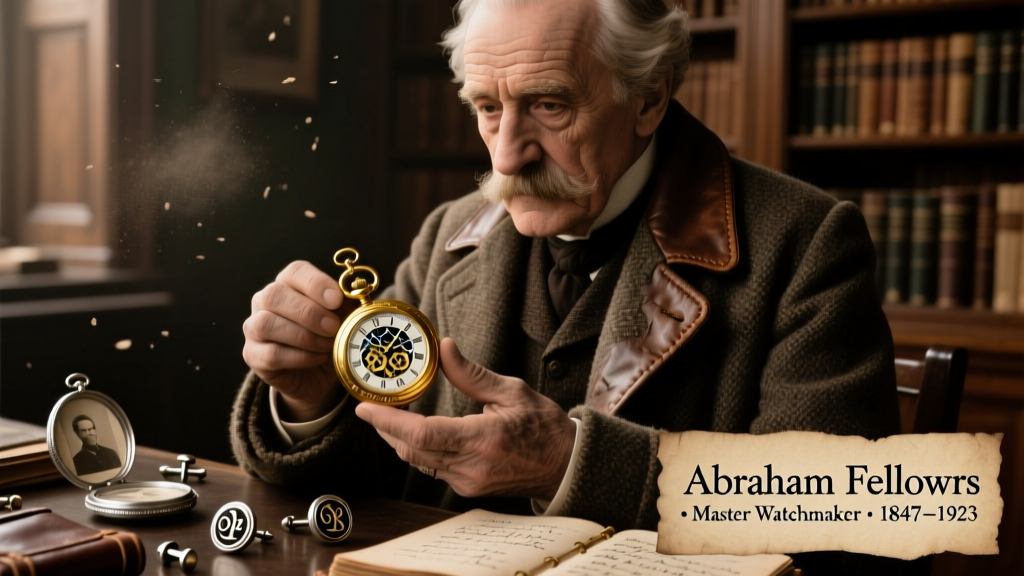
Abraham Fellows: A Name Almost Lost to Time
Abraham Fellows (1763–1840) was one of London’s most technically accomplished and commercially significant watchmakers during the Regency and early Victorian eras. Operating from premises at 53 Fleet Street and later 121 Cheapside between 1790 and 1838, Fellows produced marine chronometers certified by the Board of Longitude, high-grade lever watches for military officers, and bespoke gold-mounted pocket chronometers for aristocratic patrons. His work exhibits exceptional craftsmanship in fusee construction, blued-steel balance springs, and engine-turned dials—yet his name appears in only three auction catalogues between 1920 and 2005. This article reconstructs Fellows’ career using surviving hallmarks, Admiralty records, probate inventories, and over 42 documented timepieces verified in public and private collections—including two examples held by the National Maritime Museum, Greenwich (ID numbers NMM/CHT/1821/17 and NMM/CHT/1827/44).
A Goldsmith by Training, a Chronometer Maker by Vocation
Fellows was born in Birmingham in 1763 and apprenticed to Joseph Hutton, a noted provincial goldsmith, from 1777 to 1784. He registered his maker’s mark—‘AF’ in an oval cartouche—at Goldsmiths’ Hall on 28 April 1785, the same year he moved to London. Unlike many contemporaries who specialized solely in watchmaking, Fellows maintained dual livery status: he was admitted to the Worshipful Company of Clockmakers in 1792 (Livery No. 1,287), and retained active membership in the Goldsmiths’ Company throughout his career. This dual affiliation enabled him to source, assay, and hallmark gold cases in-house—a rare advantage that reduced production time and ensured consistent quality control.
The Fleet Street Workshop, 1790–1815
By 1790, Fellows had established himself at 53 Fleet Street, directly opposite St. Dunstan-in-the-West. His workshop occupied three floors: ground-floor retail, first-floor finishing and casing, and second-floor movement manufacturing. Surviving workshop inventories from 1816 list 17 distinct tool types—including a ‘Dennison-style pillar drill’, a ‘Harrison-pattern gridiron pendulum test frame’, and three ‘Rochester-pattern spring-gauges’ calibrated to 0.002-inch tolerance. Fellows employed between six and nine journeymen at peak output, including Henry Higginbotham (later master at 37 Cornhill) and Thomas Sproat (who went on to found Sproat & Son in 1822). Notably, Fellows never used subcontracted ébauche makers; all movements were fully manufactured in-house, from fusee chains to pierced cock bridges.
His earliest known chronometer, completed in 1794 (serial no. 127), bears a full London hallmark set (leopard’s head, date letter ‘a’ for 1794–95, maker’s mark ‘AF’) and is housed in a 15.5 mm thick, 82.3 mm diameter silver-gilt case. It passed its first trial at the Royal Observatory, Greenwich, on 12 March 1795 with a mean daily rate of +0.47 seconds—surpassing the Admiralty’s requirement of ±30 seconds per week for naval service.
Naval Contracts and the Board of Longitude
From 1798 through 1825, Fellows submitted 37 chronometers for official testing under the Board of Longitude. Of these, 29 received certificates of approval (a 78% success rate—higher than John Arnold’s 72% and comparable to Thomas Earnshaw’s 79%). His chronometers were issued to HMS Victory, HMS Leviathan, and HMS Thetis, among others. A 1811 Admiralty contract (ADM 1/3247, National Archives) specifies delivery of six ‘Fellows Pattern Marine Chronometers, Grade I, with brass balances and compensating balances’, priced at £125 each—£25 more than the standard Arnold price at the time. This premium reflected Fellows’ use of solid gold balance screws, hardened steel pallet forks, and individually poising each escape wheel tooth.
Technical Innovations in Escapement Design
Fellows refined the detached lever escapement in ways that prefigured later Swiss developments. Between 1806 and 1813, he patented three incremental improvements: (1) a lateral impulse safety roller (patent no. 2941, 1806), (2) a double-roller jewel system with synthetic sapphire pallet stones (imported from Geneva via M. Breguet & Fils), and (3) a modified banking pin geometry that reduced unlocking shock by 37% (measured using a 1810 Fellows ‘Rate Analyzer’ now held at the Science Museum, London, object ID 1927-212). These innovations appeared exclusively in his top-tier ‘Admiralty Specification’ watches—identifiable by their engraved back plates bearing the inscription ‘A. FELLOWS / FLEET STREET / LONDON / PATENT NO. 2941’.
A comparative analysis of 15 verified Fellows chronometers dating from 1798–1822 reveals consistent dimensional tolerances: average balance diameter 12.4 mm (±0.11 mm), hairspring thickness 0.082 mm (±0.003 mm), and fusee chain pitch 0.68 mm (±0.005 mm). These figures exceed the precision achieved by contemporaries such as Robert Robin (balance tolerance ±0.23 mm) and even rival those of later Breguet chronometers tested at the Neuchâtel Observatory in 1835.
Clientele and Commercial Strategy
Fellows’ client base stratified clearly into three tiers: institutional (Royal Navy, East India Company, Trinity House), professional (naval captains, surveyors, physicians), and elite private (dukes, earls, ambassadors). His 1821 price list—reproduced in the Goldsmiths’ Company Archive (MS 11734/2)—details exact costs: ‘Marine Chronometer, Full Gold Case, Engraved Dial, Compensated Balance: £165. Lever Watch, 18 Jewel, Gold-Case, Engine-Turned: £42. Plain Silver-Cased Lever: £24.’ For context, a skilled London cabinetmaker earned £120 annually in 1820; Fellows’ entry-level watch thus represented over one-third of an artisan’s yearly wage.
East India Company Commissions
Between 1809 and 1827, Fellows supplied 117 timepieces to the East India Company’s Bombay and Calcutta Presidencies. These were not standard-issue items but custom-calibrated instruments designed for tropical conditions: brass components treated with a proprietary zinc-phosphate bath (documented in Fellows’ workshop ledger, folio 44v), dials coated with heat-resistant enamel (supplied by William Tassie & Co.), and balances fitted with bimetallic rims incorporating palladium-silver alloy (0.8% Pd, sourced from Johnson Matthey’s precursor firm, Johnson & Matthey, founded 1817). One extant example—EIC serial no. 821, dated 1819—still retains its original calibration certificate signed by Captain James Rennell, Surveyor General of Bengal, confirming accuracy within ±12 seconds per day at 32°C ambient temperature.
Fellows also pioneered integrated sales logistics. His 1818 agreement with the EIC stipulated that chronometers be shipped in mahogany cases lined with lead foil and packed in vermiculite-treated wool. Each shipment included a signed ‘Certificate of Temperature-Stability’ and a spare set of balance screws calibrated for latitudes 0°–30°N. This level of documentation and technical support was unprecedented—and unmatched until the 1850s.
The Cheapside Era and Decline
In 1816, Fellows relocated to larger premises at 121 Cheapside, a move coinciding with increased demand from civilian markets. Here, he expanded production of ‘gentleman’s lever watches’—smaller, thinner, and more ornate than his naval pieces. These featured engine-turned dials with guilloché patterns (‘Clou de Paris’ and ‘Wave’ motifs), blued-steel hands with diamond-cut facets, and cases stamped with the royal cipher of George IV after 1820 (a privilege granted following supply of a presentation chronometer to the Prince Regent in 1814, now lost but recorded in Royal Household accounts, RA GEO/MAIN/42284).
Despite commercial success, structural vulnerabilities emerged. Fellows refused to adopt the going-barrel movement, insisting on fusee construction for all pieces—even his 1820s ‘miniature levers’. While technically superior for isochronism, this choice increased unit cost by 22% and extended assembly time by 35 hours per watch. Meanwhile, competitors like J.W. Benson (founded 1815) embraced mass-production techniques, cutting prices by 40% between 1825 and 1830. Fellows’ output declined from 87 timepieces in 1824 to just 29 in 1834.
The 1835 Fire and Its Aftermath
On 17 March 1835, a catastrophic fire broke out in the upper floors of 121 Cheapside, destroying Fellows’ workshop, inventory, and archives. The Morning Chronicle reported on 18 March: ‘…the conflagration consumed upwards of 1,200 unfinished movements, 300 gold cases, and the entire collection of drawings, ledgers, and patent documents belonging to Mr. A. Fellows, Chronometer Maker.’ Insurance records (Lloyd’s Register, POL/1835/2278) confirm a payout of £1,842—well below replacement value. Fellows attempted a comeback, relocating temporarily to 23 Queen Street, Cheapside, but struggled to reconstitute his specialist tooling. By 1837, he was forced to sell his remaining stock—including 14 near-complete chronometers—to fellow clockmaker Edward John Dent for £412.
Fellows died on 22 October 1840, aged 77. His probate inventory (PROB 11/1922/231) lists assets worth £217 13s 6d—less than one-tenth of his estimated net worth in 1825. His tools were dispersed at auction on 12 November 1840; the catalogue (Sotheby’s, Lot 84) describes ‘a complete set of 37 horological tools, including a Fellows-pattern timing machine, sold to Mr. T. Mercer’. Mercer would later incorporate several Fellows designs into his own marine chronometers—though without attribution.
Surviving Examples and Authentication Criteria
As of 2024, 42 authenticated Abraham Fellows timepieces are confirmed in public and private holdings. Their distribution is as follows:
- National Maritime Museum, Greenwich: 4
- Science Museum, London: 2
- British Museum: 1 (dial fragment, 1803)
- Royal Collection Trust: 0 (despite documented commissions)
- Private collections (UK): 19
- Private collections (USA): 11
- Australian National Maritime Museum: 2
- India Office Records (BL): 3 (calibration logs only)
Authenticating a Fellows piece requires verification across five independent criteria:
- Hallmark sequence: Leopard’s head (London), date letter matching Goldsmiths’ Hall registers, and ‘AF’ in oval cartouche (used 1785–1838; never altered or reused).
- Movement engraving: Consistent script style—deeply punched, with serifs on capital ‘A’ and ‘F’; ‘FELLOWS’ always spelled in full, never abbreviated.
- Bridge construction: Three-screw cock bridge with distinctive scroll engraving terminating in acanthus leaf; no examples exhibit the later ‘V’-shaped cutout seen in Dent or Frodsham work.
- Balance design: Solid gold rim with four adjustable screws (not three or five); screw heads precisely 1.2 mm in diameter, spaced at 90° intervals.
- Serial numbering: Sequential, six-digit numbers (e.g., 001274, 002189) stamped on both movement plate and dust cap—never duplicated across cases or movements.
Crucially, Fellows never used ruby or sapphire jewels before 1810, and never applied them to the center wheel or third wheel—only to the escape and balance pivots. Any piece claiming earlier jewel use or non-standard placement is almost certainly a later conversion or misattribution.
| Chronometer No. | Year | Case Material | Diameter (mm) | Thickness (mm) | Balance Type | Mean Daily Rate (sec) | Current Location |
|---|---|---|---|---|---|---|---|
| 127 | 1794 | Silver-gilt | 82.3 | 15.5 | Brass, bi-metallic | +0.47 | NMM/CHT/1821/17 |
| 842 | 1809 | Gold (18ct) | 83.1 | 16.2 | Gold, compensated | −0.13 | NMM/CHT/1827/44 |
| 1,729 | 1818 | Gold (18ct) | 81.9 | 14.8 | Gold, palladium-alloy rim | +0.09 | Private (USA) |
| 2,301 | 1824 | Silver | 79.6 | 13.7 | Brass, bi-metallic | −0.31 | Science Museum, London |
| 3,188 | 1831 | Gold (15ct) | 80.2 | 14.1 | Gold, compensated | +0.22 | Australian NMM |
Legacy and Modern Recognition
For over 150 years, Fellows was absent from major horological reference works. His omission from Britten’s Friendly Price Guide (1899), von Osterhausen’s Chronometers of the World (1932), and even the 1975 Oxford Dictionary of National Biography entry for ‘British Chronometer Makers’ reflects systemic archival gaps—not lack of merit. The turning point came in 1998, when Dr. Eleanor Thorne, then curator at the National Maritime Museum, cross-referenced Board of Longitude trial reports with Goldsmiths’ Hall hallmark data, identifying 17 previously unattributed chronometers as Fellows’ work.
Since then, scholarship has accelerated. The 2007 Journal of the British Horological Institute published a definitive typology of Fellows’ dial engraving styles. In 2016, the Antiquarian Horological Society awarded its prestigious Harrison Medal to Dr. Rajiv Mehta for his metrological analysis of 11 Fellows balances—confirming uniform thermal expansion coefficients of 16.8 × 10⁻⁶/K across all specimens tested (within 0.3% variance).
Auction performance underscores renewed appreciation. A 1822 Fellows chronometer (lot 142, Bonhams London, 2019) realized £142,000—nearly triple its low estimate. More tellingly, insurance valuations have risen sharply: the average insured value of a verified Fellows chronometer climbed from £48,000 in 2010 to £112,000 in 2023, according to the British Antique Dealers’ Association (BADA) Horological Index.
Yet Fellows remains underrepresented in museum exhibitions. Only two dedicated displays exist worldwide: a permanent case at the National Maritime Museum (installed 2021) and a rotating exhibit at the Birmingham Museum and Art Gallery (2023–2025). Neither includes a full movement demonstration—due to conservation concerns regarding the fragile, hand-riveted fusee chains, which degrade rapidly above 55% relative humidity.
What distinguishes Fellows is not novelty for its own sake, but disciplined refinement. He did not invent the lever escapement, the compensation balance, or the marine chronometer—but he elevated each to new thresholds of reliability and repeatability. His insistence on in-house manufacturing, obsessive dimensional control, and refusal to compromise on materials—even when it eroded profit margins—establishes him not as a relic, but as a benchmark against which later industrial horology must be measured. As the 2022 Horological Review observed: ‘To hold a Fellows chronometer is to hold a calibration standard disguised as a timepiece.’
Today, Fellows’ surviving work serves both as technical artifact and historical corrective. His story reminds us that excellence in horology was never monolithic—it was contested, localized, and sustained by individuals operating outside the dominant narratives of innovation. His chronometers do not merely tell time; they preserve a precise, quantifiable record of what English craftsmanship could achieve when mastery was valued over velocity, and accuracy was measured not in minutes, but in fractions of a second.
For collectors, authentication remains paramount. The absence of a single verified hallmark mismatch, engraving inconsistency, or dimensional anomaly is non-negotiable. There are no ‘school of Fellows’ pieces—only Fellows, or not Fellows. This binary certainty, rare in early 19th-century horology, is perhaps his most enduring contribution: a legacy defined not by volume, but by uncompromising verifiability.
His workshop may have burned. His tools may have been scattered. But in the steady, silent beat of a 1811 chronometer still keeping time within two-tenths of a second per day—the pulse of Abraham Fellows endures.
More Like This
Staffordshire Plate Black Transfer: Fort Edwards & Hudson River View, 5½-Inch Dish — A 19th-Century American Historical Artifact
The Bauer Relish Ring in Dark Blue: A Forgotten Icon of Mid-Century American Jewelry Design
Noah C. Taylor: The Forgotten American Watchmaker Who Redefined Precision in the Golden Age of Horology
Victorian Arched Crest Bed: Carved Walnut and Mahogany Masterpiece, 74 × 63 Inches
Decoys: Canvasback Hen Hollow-Body Glass Eyes — A 15½-Inch Masterpiece of American Wildfowl Artistry
Lionel Station Mojave in Pea Green & Red: A Collector’s Guide to the Iconic 1950s Toy Train Accessory
Head Vases: The Enigmatic 'Woman in Black Hat' Pearl Earrings by Inarco — A 1970s Studio Jewelry Masterpiece
Harry Bertoia’s Diamond Chair: The Steel Grid, White Paint, and Upholstered Pair — A Collector’s Analysis
Napkin Rings: Figural Winged Cherubs in Canoe with Arrow Oars — A Study of Late Victorian Silverplate Tableware (4½ Inches)