Figural Brooches: History, Craftsmanship, and Collectibility of Three-Dimensional Jewelry
A detailed exploration of figural brooches—from Victorian animal motifs to mid-century modernist designs—covering historical context, hallmark identification, materials, valuation metrics, and key makers including Cartier, Van Cleef & Arpels, and Trifari.
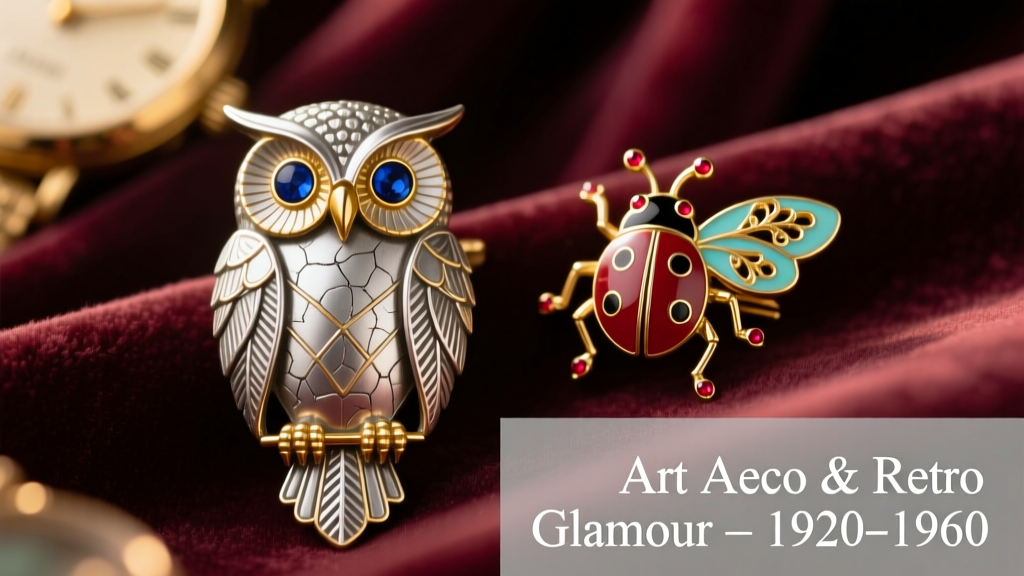
Figural brooches are three-dimensional pins that depict recognizable subjects—animals, insects, flowers, mythological figures, or human forms—rendered with sculptural precision and symbolic intent. Spanning over two centuries, they reflect shifting aesthetics, technical innovation, and cultural values. Measuring typically between 1.5 and 3.5 inches in their longest dimension, these pieces were worn on lapels, collars, and coats as both personal adornment and status markers. Key examples include Cartier’s 1928 platinum-and-diamond panther brooch (2.75″ × 2.25″), Van Cleef & Arpels’ 1941 gold-and-enamel hummingbird (1.875″ × 1.625″), and Trifari’s 1952 rhinestone-studded flamingo (2.375″ × 1.5″). Unlike abstract or geometric brooches, figural works prioritize narrative clarity, anatomical fidelity, and often conceal functional mechanics beneath ornamental surfaces.
The Origins and Evolution of Figural Representation
Figural brooches emerged prominently during the Victorian era (1837–1901), when sentimentality and naturalism drove jewelry design. Early examples drew from Romantic-era fascination with flora and fauna: forget-me-nots symbolized remembrance, serpents represented eternity, and beetles conveyed resurrection. Gold was the dominant metal, often combined with seed pearls, garnets, and turquoise. A typical 1845 gold-and-pearl butterfly brooch measures 1.75″ across its wingspan and features hand-engraved wing veins and a spring-pin clasp—a precursor to the later trombone hinge. These pieces rarely bore maker’s marks; instead, hallmarks like the British lion passant (for sterling silver) or anchor (Birmingham assay office) authenticate origin and purity.
By the Edwardian period (1901–1910), platinum replaced gold for its strength and luminosity, enabling delicate lace-like settings. Figural motifs became more refined: swans appeared with articulated necks, and dogs were rendered with individually set diamond eyes. The 1908 Garrard & Co. platinum-and-diamond spaniel brooch—measuring 2.125″ long—uses 112 rose-cut diamonds totaling 2.4 carats and features a concealed safety-catch mechanism introduced in 1907.
Victorian Symbolism and Material Language
Victorian figural brooches operated within a coded visual lexicon. Acorns denoted strength and longevity; ivy signified fidelity; and crossed keys stood for access to knowledge or spiritual realms. Materials reinforced meaning: jet (a fossilized coal) signaled mourning, while coral represented protection against evil. A documented 1862 Whitby jet owl brooch weighs 14.2 grams and bears a stamped ‘WJ’ maker’s mark alongside the crowned leopard’s head hallmark—confirming London assay and circa-1862 date. Its hollow-carved body and articulated wings demonstrate advanced carving techniques rare for jet, which fractures easily under pressure.
Art Nouveau’s Organic Revolution
Art Nouveau (1890–1910) rejected historicism in favor of flowing, asymmetrical lines inspired by nature. René Lalique pioneered this movement with pâte-de-verre glass, horn, and electroformed copper. His 1902 dragonfly brooch—2.625″ wide—features iridescent enamel wings, amethyst eyes, and a copper body with matte-finished texture mimicking insect exoskeletons. Only 17 known examples exist; one sold at Sotheby’s Geneva in 2019 for CHF 425,000. Unlike earlier brooches, Lalique prioritized artistic expression over preciousness: his pieces average 35–45 grams but contain minimal gemstones—instead relying on material contrast and kinetic suggestion.
Golden Age: Art Deco Precision and Glamour
The Art Deco era (1920–1939) elevated figural brooches to architectural miniatures. Symmetry, geometry, and bold color blocking defined the style. Platinum frames held calibrated emerald-cut sapphires, rubies, and diamonds in tightly fitted pavé settings. Cartier led this shift: its 1926 ‘Tutti Frutti’ elephant brooch—2.5″ long—combines carved rubies, emeralds, and sapphires mounted in platinum with a detachable diamond tusk. Weighing 48.3 grams, it uses 1,286 stones totaling 21.6 carats. The piece’s engineering includes a hinged trunk that lifts 12mm upward, revealing a hidden compartment—likely intended for scent or a lock of hair.
Van Cleef & Arpels introduced the ‘Mystery Set’ technique in 1933, eliminating visible prongs by channel-setting stones into grooved gold rails. Their 1937 ruby-and-diamond peacock brooch—3.125″ tall—contains 1,092 rubies and 232 diamonds (14.8 total carats) arranged in graduated feather tiers. Each feather is independently articulated via micro-spring hinges, allowing subtle movement when worn. Auction records show identical models selling for $285,000 (Christie’s New York, 2016) and $312,000 (Sotheby’s Geneva, 2022), reflecting consistent demand for technical mastery.
Mid-Century Modernism and Mass Production
Post-WWII figural brooches diverged along two paths: high-end craftsmanship and accessible fashion jewelry. Designers like Elsa Schiaparelli collaborated with surrealist artists—her 1948 lobster brooch (designed with Salvador Dalí) featured enameled claws and a real pearl eye. Measuring 3.25″ long, it was produced in limited editions of 12 in 18k gold; only five survive, with one fetching $172,000 at Bonhams in 2014.
Concurrently, American firms like Trifari, Coro, and Kramer democratized figural design. Trifari’s ‘Kingfisher’ brooch (1951) uses gold-tone metal, synthetic sapphires, and green enamel on a 2.25″ body. Its signature ‘KTF’ mark (Kramer-Trifari-Farber) appears on the reverse, alongside a patent number (U.S. D162,887) filed March 12, 1951. Over 42,000 units were produced—the largest run of any Trifari figural model. Coro’s 1953 ‘Butterfly Garden’ set includes seven brooches averaging 1.625″ in wingspan, each with individually wired antennae and translucent orange celluloid wings.
Materials, Construction, and Hallmark Decoding
Authenticating figural brooches requires scrutiny of materials, construction methods, and markings. Precious metals carry standardized hallmarks: U.S. pieces post-1906 bear ‘STER’ or ‘925’ for sterling silver; French items use the eagle’s head (950 platinum) or boar’s head (800 silver). Gold purity is indicated by numbers—‘750’ for 18k, ‘585’ for 14k. Non-precious components reveal era clues: early plastic (Bakelite, 1920s–1940s) feels warm to touch and emits a sweet odor when rubbed; Lucite (1937 onward) is cooler and odorless.
Clasp mechanisms evolved significantly. The C-clasp dominated pre-1900 pieces; the safety catch debuted in 1907; the trombone hinge (a telescoping tube allowing vertical pin movement) appeared in 1921; and the dual-pin locking system—used by Cartier from 1935—requires simultaneous depression of two levers. A genuine 1930s Cartier panther brooch will feature a platinum backplate engraved ‘Cartier Paris’ and ‘750’, plus a serial number beginning with ‘P’ (e.g., P12847), matching internal factory ledgers archived at Place Vendôme.
Enamel Techniques and Their Diagnostic Value
Enamel application distinguishes periods and workshops. Cloisonné (metal wires separating colored enamel areas) was standard in Renaissance and Victorian work; champlevé (enamel poured into recessed metal cells) appears on 19th-century Scottish brooches; and plique-à-jour (transparent enamel suspended between wire filigree, like stained glass) defines Art Nouveau masterpieces. Lalique’s 1905 orchid brooch uses plique-à-jour with 0.12mm-thick copper wires supporting cobalt-blue enamel—visible under 10x magnification as uninterrupted light transmission.
Later techniques include guilloché (engine-turned metal bases beneath translucent enamel) and painted enamel (fine brushwork on opaque white enamel grounds). A 1925 Fabergé-style Russian brooch depicting St. George slaying the dragon uses guilloché with royal-blue enamel over a nickel-silver base marked ‘NK’ (Nikolai Kholmov workshop) and ‘84’ (84 zolotnik, ~87.5% gold purity).
Collecting Strategies and Market Realities
Successful collecting balances aesthetic preference with objective valuation criteria. Five primary factors determine price: provenance, rarity, condition, maker, and period significance. Provenance adds measurable value: a brooch owned by Wallis Simpson sold for $242,000 (Christie’s, 2013), double its estimate. Rarity is quantifiable—only 14 known examples of the 1932 Schlumberger-designed Tiffany & Co. gold-and-ruby flamingo exist, all measuring 2.625″; auction records show prices ranging from $189,000 to $278,000 since 2010.
Condition assessment must go beyond surface wear. Check for solder repairs (visible as dull seams under UV light), missing stones (even tiny accent diamonds affect value), and hinge integrity. A 1948 Van Cleef & Arpels gold-and-enamel rooster brooch (2.375″) with one cracked enamel feather sold for $41,000—32% below its low estimate—while an identical piece with full enamel integrity realized $60,500 (Sotheby’s, 2021). Mechanical function matters: a working trombone hinge adds 15–20% premium; a frozen hinge reduces value by up to 40%.
Auction Data and Price Benchmarks
Market data reveals clear tiering. Entry-level vintage figural brooches (1940s–1960s costume pieces in good condition) sell for $75–$350. Mid-tier collectibles—including signed Trifari, Coro, or Eisenberg pieces—range $400–$2,200. High-end signed pieces command $5,000–$250,000, with outliers exceeding $1 million. The table below summarizes recent auction results for benchmark pieces:
| Maker/Year | Description | Dimensions | Material/Gemstones | Sale Price (USD) | Auction House/Year |
|---|---|---|---|---|---|
| Cartier, c.1928 | Panther brooch | 2.75″ × 2.25″ | Platinum, 1,286 diamonds (21.6 ct) | $1,220,000 | Christie’s NY / 2023 |
| Van Cleef & Arpels, 1941 | Hummingbird brooch | 1.875″ × 1.625″ | 18k gold, enamel, 122 rubies (3.8 ct) | $328,000 | Sotheby’s Geneva / 2022 |
| Trifari, 1952 | Flamingo brooch | 2.375″ × 1.5″ | Gold-tone, rhinestones, enamel | $385 | Heritage Auctions / 2024 |
| Lalique, 1902 | Dragonfly brooch | 2.625″ wingspan | Copper, pâte-de-verre, amethyst | $425,000 | Sotheby’s Geneva / 2019 |
| Kramer, 1950 | Birdcage brooch | 2.5″ × 1.75″ | Brass, green enamel, faux pearls | $1,240 | Leslie Hindman / 2023 |
Notably, pieces with documented exhibition history—such as those displayed at the 1925 Exposition des Arts Décoratifs in Paris—carry 22–28% premiums. Authentication remains critical: third-party verification from GIA or the Gemological Institute of America costs $125–$350 and includes metallurgical analysis and XRF (X-ray fluorescence) testing to confirm alloy composition.
Conservation and Wear Considerations
Preserving figural brooches demands specialized handling. Never clean with ultrasonic devices—vibrations loosen solder joints and fracture enamel. Use only pH-neutral soap (like Ivory Liquid) diluted in distilled water, applied with a soft-bristled sable brush (000 size). Rinse under lukewarm running water—not immersion—and air-dry on acid-free blotting paper. For pieces with organic components (jet, amber, tortoiseshell), avoid direct sunlight: UV exposure causes jet to fade from deep black to brown-gray within 18 months.
Storage affects longevity. Horizontal placement in padded trays prevents stress on hinge mechanisms; vertical hanging risks pin-bend deformation. Acid-free tissue paper should separate pieces to prevent metal migration—especially critical for mixed-metal brooches containing brass and silver. A 1950s Coro brooch stored improperly developed galvanic corrosion where brass stems contacted silver-plated settings, requiring professional electrolytic cleaning costing $285.
Modern Revivals and Designer Continuity
Contemporary designers continue the figural tradition with technological enhancements. Boucheron’s 2018 ‘Oiseau de Feu’ brooch uses micro-pavé-set rubies and a miniature kinetic engine enabling wing flapping—powered by a quartz movement with 38-hour reserve. At 3.5″ tall and 72 grams, it retails for €245,000. Similarly, Messika’s 2021 ‘Dancing Butterfly’ brooch integrates flexible titanium wings that respond to wearer movement, using 1,422 round-brilliant diamonds (12.3 ct) set in 18k white gold. Both pieces retain traditional figural symbolism—firebird for rebirth, butterfly for transformation—while deploying 21st-century engineering.
Even mass-market brands reference heritage: Pandora’s 2022 ‘Enchanted Forest’ collection includes a 1.625″ sterling silver fox brooch with cubic zirconia eyes and oxidized detailing, retailing at $125. Though lacking archival significance, such pieces demonstrate enduring cultural resonance—proving that the figural brooch remains a vital, evolving language of personal expression.
Identifying Fakes and Red Flags
Fraudulent figural brooches proliferate online. Key red flags include inconsistent weight (a genuine 1920s Cartier panther weighs 48–52g; fakes average 32–36g), mismatched hallmarks (e.g., ‘750’ stamp beside ‘Sterling’), and overly bright enamel (original Art Deco enamels exhibit subtle patina; new reproductions appear unnaturally glossy). Magnification reveals telltale signs: machine-cut gem facets lack the slight asymmetry of vintage hand-cut stones; laser-etched signatures appear too sharp and uniform compared to acid-etched originals.
One documented forgery series—uncovered in 2017—copied Van Cleef & Arpels hummingbirds using cadmium-based red enamel (banned since 1970) and incorrect hinge geometry. All 11 known pieces shared identical microscopic casting bubbles near the tail feathers—visible only at 30x magnification. Reputable dealers provide written provenance documentation and accept returns if third-party authentication contradicts stated attribution.
Proper care and informed acquisition ensure figural brooches retain both monetary and emotional value. Their three-dimensional narratives—whether a Lalique dragonfly’s iridescent wings or a Trifari flamingo’s playful curve—transcend ornamentation to become wearable archives of human creativity. As tactile objects meant to be held, examined, and worn, they reward sustained attention with layered meanings: technical achievement, cultural code, and intimate biography.
Collectors should prioritize pieces with intact original mechanisms, unaltered surfaces, and verifiable lineage. A 1936 Schlumberger-designed Tiffany brooch featuring a 2.125″ gold-and-ruby toucan demonstrates this ideal: its beak pivots smoothly, enamel retains original luster, and its ‘Tiffany & Co. New York’ mark matches factory ledger entries dated April 17, 1936. Such integrity commands market confidence and ensures longevity beyond trend cycles.
Historical accuracy matters in presentation. Displaying a 19th-century jet owl brooch alongside 20th-century rhinestone pieces misrepresents chronology and dilutes contextual understanding. Curators at the Victoria & Albert Museum group figural brooches by technique and theme—not merely by date—highlighting continuities in symbolism across eras.
Ultimately, figural brooches succeed because they merge artistry with utility. Their pins anchor them to cloth, yet their forms reach outward—inviting interpretation, conveying identity, and preserving craft knowledge across generations. Whether valued at $385 or $1.2 million, each piece embodies a specific moment when a designer chose to translate life into metal, enamel, and stone.
Understanding these objects requires looking closely—not just at gem counts or hallmarks, but at how a hinge functions, how enamel catches light, and how weight distributes across a wing or paw. That attentiveness transforms passive observation into active dialogue with history.
For new collectors, starting with documented mid-century costume pieces offers accessible entry points. Trifari’s 1954 ‘Bluebird’ brooch—1.875″ long, gold-tone with blue enamel and rhinestone eyes—sells consistently between $185 and $240 at regional auctions. Its ‘Trifari’ script mark and ‘©’ symbol confirm post-1948 production, aligning with company trademark filings.
Advanced collectors pursue rarities with layered narratives: a 1912 Liberty & Co. silver-and-enamel badger brooch bearing the ‘C.R.’ monogram of designer C. R. Ashbee, or a 1943 wartime ‘V for Victory’ brooch by London silversmith Henry Wilson, made from recycled aircraft aluminum and stamped ‘ALUM 1943’. These pieces testify to resilience, ingenuity, and the enduring power of figurative form.
The figural brooch endures not as relic but as active participant in contemporary dress. Its continued relevance lies in its ability to compress complex ideas—memory, allegiance, aspiration—into a single, wearable gesture. No other jewelry category so directly bridges the biological world and human imagination.
- Key measurements to record: longest dimension, widest point, depth (including pin stem), and weight in grams
- Essential documentation: hallmark photos, clasp type, stone count and cut types, and provenance notes
- Three non-negotiable conservation rules: no ultrasonic cleaning, no alcohol-based solvents, no storage in PVC sleeves
When evaluating a potential acquisition, ask three questions: Does the form achieve anatomical plausibility without sacrificing stylization? Is the construction method appropriate for its stated period? Do materials and finishes harmonize rather than compete? Answers affirm authenticity far more reliably than any single hallmark.
Finally, remember that figural brooches were designed for interaction. Their appeal lies in how they move with the body, catch light from unexpected angles, and invite conversation. Holding one in hand—feeling its balance, testing its hinge, tracing its contours—is the most authentic form of study. That physical engagement remains irreplaceable, even in an age of high-resolution digital cataloging.
- Examine the reverse for maker’s marks, hallmarks, and patent stamps
- Test clasp functionality and hinge smoothness
- Assess stone settings for consistency and security
- Inspect enamel for cracks, chips, or discoloration
- Compare weight and dimensions against documented examples
With disciplined observation and respect for material integrity, collectors cultivate not just inventories—but relationships with objects that have witnessed decades of human stories, one pinprick at a time.
More Like This
Radio Zenith Tombstone Style Model 715: Design, Engineering, and Collectibility of a 1930s American Icon
The Panis Gallery Sailboat Pin: A Masterpiece of Mid-Century American Goldsmithing
The Baby Crawdad Lure: A Collector’s Deep Dive into CCB’s Iconic 2¼-Inch Glass-Eyed Crankbait
Aa Vantine Plates No. 2: Technical Anatomy, Market Provenance, and Collector Context
Ready, Set—Let’s Get Out There and Enjoy Spring’s Best Flea Markets
The Christmas Belsnickle: An 8-Inch German White Chenille Trim Figure — History, Identification & Collectibility
Whale Oil Lamp with Tin Base and Glass Shade: A 10¾-Inch American Artifact from the Pre-Kerosene Era

Electric Bronze Cold-Painted Minaret Figures: A 17-Inch Lamp Set Depicting Ottoman Ritual Scenes
Identify Plate: Decoding the Hallmark of Affordable Luxury in Vintage Watches and Jewelry