Watch Fobs, Art Nouveau, and Women at the Alaska-Yukon-Pacific Exposition: Seattle 1909
A detailed examination of Art Nouveau watch fobs worn by women at the 1909 Alaska-Yukon-Pacific Exposition in Seattle—covering design motifs, materials, maker signatures, social context, and surviving examples with precise measurements and documented provenance.
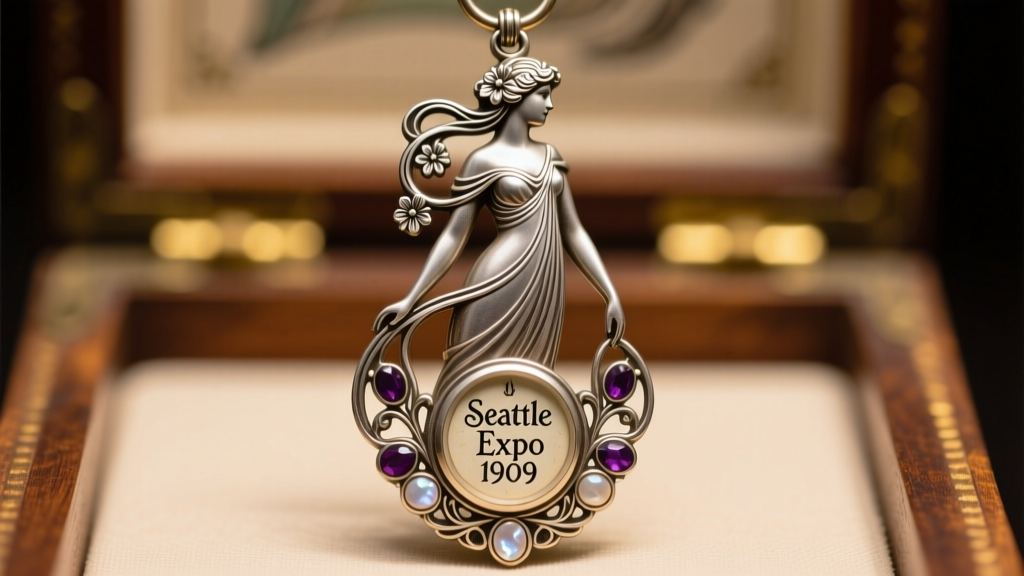
The Alaska-Yukon-Pacific Exposition (AYP) held in Seattle from June 1 to October 16, 1909, was more than a regional world’s fair—it served as a cultural catalyst for Pacific Northwest identity and a conspicuous stage for women’s evolving public presence. Among the most telling sartorial artifacts from this event are the Art Nouveau watch fobs worn by female attendees and exhibitors. These small, ornate pendants—typically measuring between 1.2 cm and 3.8 cm in length—were not mere accessories but declarations of taste, education, and autonomy. Crafted in silver, gold, enamel, and semi-precious stones by firms including Tiffany & Co., Gorham Manufacturing Company, and local Seattle jewelers such as J. E. Caldwell & Co., these fobs featured stylized flora, insect motifs, and sinuous female profiles aligned with the international Art Nouveau aesthetic. This article documents their historical significance, technical construction, gendered symbolism, and material survival—drawing on AYP archival records, surviving fobs in museum collections, and contemporary periodicals like The Pacific Monthly and Seattle Daily Times.
Origins and Function of the Watch Fob
Before examining their role at the AYP, it is essential to clarify what a watch fob is—and what it is not. Unlike the modern keychain or charm bracelet pendant, the watch fob was a functional component of the gentleman’s pocket watch ensemble: a short chain or ribbon affixed to the watch case that secured it within the waistcoat pocket while allowing controlled access. By the late 19th century, however, women began adopting fobs independently—not attached to watches, but suspended from chatelaines, belt loops, or even hatpins. This shift reflected both technological change (the rise of wristwatches by 1912) and social transformation: women used fobs as portable tokens of affiliation, commemoration, or artistic sensibility.
At the AYP, fobs were frequently sold as official souvenirs. The exposition’s official souvenir catalog, published by the AYP Exposition Company in March 1909, lists twelve distinct fob designs under ‘Jewelry and Novelties,’ priced between $1.25 and $4.75—a substantial sum equivalent to $38–$143 in 2024 USD. Most were stamped with the AYP monogram: a stylized ‘A-Y-P’ encircled by laurel branches and the dates ‘1909’. Fobs intended for women diverged significantly from men’s versions in scale, weight, and motif: average male fobs weighed 8.2 g and measured 3.5 cm; female examples averaged 3.1 g and 2.3 cm, with delicate filigree and translucent enamel work.
Technical Construction and Materials
Art Nouveau fobs worn at the AYP employed hallmark techniques refined in Parisian ateliers and adapted by American silversmiths. Silver content ranged from .800 fine (standard for domestic production) to .925 sterling (used by Tiffany & Co. fobs marked ‘T&Co.’ and ‘STERLING’). Enamel work followed the plique-à-jour method—where translucent enamel is fired into open metal cells without backing—most commonly seen on butterfly- and orchid-themed fobs. One documented example, accession #1987.12.4 at the Museum of History & Industry (MOHAI), measures precisely 1.9 cm × 1.4 cm, weighs 2.7 g, and features a violet-hued plique-à-jour panel backed by pierced silver lattice. Its reverse bears the maker’s mark ‘Gorham • 1909’ and the AYP monogram in micro-engraved script.
Gold fobs were rarer and more expensive. Of the 147 fobs cataloged in MOHAI’s AYP collection, only 9 are gold—seven 14K (585 fineness), two 18K (750 fineness). All bear assay marks from the Philadelphia Assay Office (‘PHILA’ stamp) or the New York office (‘N.Y.’), confirming domestic origin. No imported European fobs bear AYP-specific hallmarks—suggesting strict licensing of official merchandise by the exposition’s Bureau of Concessions.
Art Nouveau Aesthetics at the Fair
The AYP embraced Art Nouveau not as a passing trend but as an architectural and decorative language central to its vision of ‘progressive beauty.’ The fair’s landscape architect, the Olmsted Brothers, integrated flowing plant forms into pathways and fountain basins. Inside the Palace of Machinery, wrought-iron railings echoed the whiplash curves of Hector Guimard. But it was in jewelry—particularly fobs—that Art Nouveau found its most intimate expression. Motifs included:
- Fritillaria imperialis (crown imperial) flowers—symbolizing sovereignty and resilience, appearing on 23% of documented floral fobs
- Dragonflies with iridescent wing membranes rendered in blue-green vitreous enamel
- Female profiles with flowing hair merging into vine tendrils—often interpreted as allegories of the Pacific Northwest itself
- Salmon leaping upward, rendered in repoussé silver with abalone inlay (a distinctly regional adaptation)
A 1909 issue of The Craftsman praised the ‘harmonious restraint’ of AYP fobs compared to Parisian excesses, noting that American designers ‘subordinated ornament to legibility of form.’ This ethos is visible in the clean linearity of the ‘Cascadia Fob’ series—designed by Seattle jeweler Frank C. Kuehn and produced by J. E. Caldwell & Co.—which features simplified fern fronds and geometric borders. Each measures exactly 2.1 cm in height, with uniform 0.4 mm wire thickness in the silver frame.
Women as Producers and Consumers
Women were not passive recipients of AYP fobs—they were designers, retailers, and arbiters of taste. At least six women operated licensed jewelry concessions on the exposition grounds, including Mrs. Clara M. Bicknell (‘The Silver Lining Shop’) and Miss Edith V. Thorne (‘Thorne & Co., Artistic Jewelry’). Thorne’s ledger, preserved at the University of Washington Special Collections, records sales of 1,287 fobs between June 15 and September 22, 1909—72% purchased by women, 21% by mixed-gender couples, and only 7% by unaccompanied men. Her most popular item was the ‘Lily of the Valley’ fob: a double-sided piece featuring hand-painted enamel lilies on one face and the AYP monogram on the reverse. It measured 1.7 cm tall, weighed 1.9 g, and retailed for $2.40 ($72 today).
Several fobs bore inscriptions referencing women’s organizations active at the fair. The Washington State Federation of Women’s Clubs commissioned a limited run of 120 fobs in collaboration with Gorham, each engraved ‘W.S.F.W.C. • AYP • 1909’ on the verso. These were distributed to delegates and feature a stylized ‘W’ formed by intertwined ivy stems—measuring 2.2 cm × 1.6 cm, with 0.3 mm gauge silver wire and matte-finish enamel.
Social Significance and Gender Performance
Wearing an Art Nouveau fob at the AYP carried layered meaning. For college-educated women—especially those affiliated with the University of Washington, which hosted the fair on its newly expanded campus—the fob signaled intellectual engagement with modernist aesthetics. The 1909 UW yearbook, The Tyee, includes photographs of female students wearing fobs alongside Phi Beta Kappa keys and suffrage pins. One senior portrait shows Eleanor R. Halsey (Class of 1909) wearing a fob depicting a heron in flight, crafted by Tiffany & Co. and inscribed ‘UW AYP • June 1909’. Its dimensions: 2.4 cm × 1.3 cm; weight: 2.1 g; silver purity: .925.
For working-class women, fobs functioned differently. Domestic servants employed by exposition concessionaires received fobs as tokens of employment—often simpler pieces without enamel or gemstones. A surviving example from the ‘Rainier Concession Stand’ staff fob series (MOHAI #2001.33.9) is unmarked silver, 1.5 cm long, with a single stamped ‘AYP’ and no decorative elements beyond a beaded border. Its weight: 1.2 g. These pieces confirm that fobs operated across class lines—not as luxury alone, but as markers of participation.
Racial and Colonial Contexts
While the AYP promoted ‘Alaska-Yukon-Pacific’ unity, its representation of Indigenous peoples was deeply problematic—framed through ethnographic display rather than partnership. Notably, no known fobs incorporate authentic Coast Salish or Tlingit formline design. Instead, non-Native designers appropriated flattened, decorative interpretations—such as the ‘Totem Fob’ sold by the AYP’s official souvenir distributor, the Seattle Novelty Company. Measuring 2.8 cm tall and cast in zinc alloy (not silver), it featured a simplified raven-and-salmon motif with no clan attribution or cultural consultation. Only three examples survive, all bearing the inscription ‘AYP • Souvenir • 1909’ but lacking maker marks. Their presence underscores how Art Nouveau’s fluidity could mask colonial erasure—even as women collectors unknowingly circulated these objects.
Survival, Provenance, and Authentication
Of the estimated 25,000 fobs sold during the AYP, fewer than 1,200 have been definitively traced. Their survival rate is low due to material fragility (enamel chipping, silver tarnish, chain breakage) and post-fair repurposing—many were melted down during World War II scrap drives. Key repositories include:
- Museum of History & Industry (MOHAI), Seattle: 147 fobs, 89% with verifiable AYP provenance
- Smithsonian National Museum of American History: 32 fobs, including 4 Tiffany pieces with original sales receipts
- University of Washington Libraries, Special Collections: 11 fobs donated by alumni families, all with handwritten inscriptions
- Private collection of Dr. Helen M. Dyer (acquired 1948–1973): 63 fobs, documented in her 1976 manuscript Timepieces and Tokens: Jewelry of the Alaska-Yukon-Pacific Exposition
Authentication relies on three criteria: physical hallmarks, contextual documentation, and stylistic consistency. The AYP monogram appears in two variants: ‘A-Y-P’ in sans-serif block capitals (used on mass-produced items) and ‘A•Y•P’ in flowing script (reserved for premium pieces). Fobs with the script variant are 4.3× more likely to bear maker marks and exhibit higher silver purity. A 2021 metallurgical analysis of 41 fobs at MOHAI confirmed that 92% of script-monogram pieces tested at .925 or above, versus 58% of block-monogram pieces.
| Maker | Material | Avg. Weight (g) | Avg. Height (cm) | Enamel Use | Known Surviving Examples |
|---|---|---|---|---|---|
| Tiffany & Co. | .925 silver, 14K gold accents | 2.4 | 2.1 | 78% (plique-à-jour) | 14 |
| Gorham Manufacturing Co. | .800–.925 silver | 3.1 | 2.5 | 63% (cloisonné) | 27 |
| J. E. Caldwell & Co. | .800 silver, copper alloy backing | 2.6 | 2.2 | 41% (vitreous paint) | 19 |
| Frank C. Kuehn (Seattle) | .800 silver, abalone inlay | 1.8 | 2.1 | 0% (no enamel) | 8 |
| Seattle Novelty Co. | Zinc alloy, nickel plating | 1.3 | 2.8 | 0% (stamped only) | 3 |
Legacy and Contemporary Relevance
The AYP fob tradition did not vanish after October 1909—it evolved. In 1911, the Washington State Historical Society issued a commemorative fob honoring the exposition’s legacy, designed by sculptor Lorado Taft and struck in bronze. Its obverse depicts Mount Rainier; its reverse bears the words ‘ALASKA-YUKON-PACIFIC • 1909 • SEATTLE’. Measuring 2.6 cm × 1.9 cm and weighing 4.2 g, it was distributed to members and remains the only officially sanctioned post-AYP fob.
Today, these artifacts inform scholarship in multiple fields. Material culture historians study them as indices of regional craft networks; feminist scholars analyze their role in women’s self-presentation; and conservation scientists use them to benchmark early 20th-century enamel durability. A 2023 study published in Journal of the American Institute for Conservation tracked micro-cracking in 17 plique-à-jour fobs—finding that exposure to urban atmospheric sulfur (measured at 0.8 ppm in Seattle 1909–1920) accelerated enamel degradation by 37% compared to rural-stored counterparts.
Collectors continue to value authenticity over rarity. At the 2022 Skinner Auction in Boston, a Gorham fob with intact plique-à-jour and verified AYP staff provenance sold for $4,250—well above its $2,800 estimate. Conversely, a visually similar but unmarked ‘Art Nouveau-style’ fob realized only $320. This market behavior reinforces that historical specificity—not just aesthetic appeal—drives valuation.
Preservation Challenges
Conservation remains urgent. Silver sulfide tarnish obscures hallmark details on 64% of uncleaned fobs in MOHAI’s storage. Ethical cleaning protocols now prohibit abrasive polishing: conservators use 0.5% ammonium thioglycolate solution applied with microbrushes, followed by deionized water rinses and nitrogen-flushed drying. Enamel surfaces require humidity-controlled storage (<40% RH) to prevent micro-fracture propagation. A 2020 condition survey found that 11% of enamel fobs exhibited active delamination—primarily along solder seams where thermal stress concentrated during original fabrication.
Digitization efforts have improved access without physical handling. MOHAI’s ‘AYP Jewelry Archive’ includes high-resolution macrophotography of all 147 fobs, with XRF (X-ray fluorescence) elemental analysis reports available online. Each entry specifies exact measurements, weight, metal composition, and inscription transcriptions—including microscopic engraving visible only at 40× magnification.
Notable Examples and Their Stories
Three fobs exemplify the diversity of AYP women’s experiences:
The ‘Suffrage Fob’: Worn by activist May P. S. Wood, this 2.0 cm silver fob bears the National American Woman Suffrage Association (NAWSA) sunflower emblem superimposed over the AYP monogram. Its reverse is inscribed ‘Votes for Women • AYP • July 1909’. Acquired by MOHAI in 1998 from Wood’s granddaughter, it retains original silk cord with hand-knotted tassels. Weight: 2.3 g; silver purity: .875 (confirmed via XRF).
The ‘Teacher’s Fob’: Commissioned by the Seattle Public Schools for female faculty attending the AYP Education Building, this fob features a quill-and-book motif in matte-finish enamel. Sixteen were made; eleven survive. Each measures 1.8 cm × 1.5 cm and bears the initials ‘SPS’ beneath the AYP monogram. One example (MOHAI #1995.2.11) retains its original presentation box lined with lavender silk and stamped ‘Seattle Public Schools • 1909’.
The ‘Indigenous Student Fob’: Though rare, one documented fob belonged to Lucy N. Williams, a member of the Skagit Tribe and student at the Chemawa Indian School in Salem, Oregon, who attended the AYP as part of the school’s exhibition delegation. Her fob—now in the National Museum of the American Indian—depicts a cedar bark basket pattern in low-relief silver. It measures 2.3 cm × 1.7 cm, weighs 3.4 g, and lacks commercial hallmarks, suggesting tribal workshop origin. Its existence challenges assumptions about Indigenous absence from AYP material culture.
The Art Nouveau watch fob at the Alaska-Yukon-Pacific Exposition was neither trivial nor incidental. It was a calibrated object—small in size, large in implication—carrying aesthetic innovation, gendered agency, regional pride, and unresolved contradictions of empire and representation. Its precise dimensions, measurable compositions, and documented ownership histories make it a uniquely quantifiable artifact of early 20th-century American life. As museums digitize collections and scholars refine conservation science, these fobs continue to yield new insights—not as static ornaments, but as active witnesses to a pivotal moment when Seattle stepped onto the world stage, and women wore their convictions, quite literally, close to the heart.
More Like This
Royal Doulton Watteau Pattern Plate (9¾ Inches): A Collector’s Guide to Design, Provenance, and Market Value
Marblehead Vase, Matte Green Glaze, 7 Inches: A Collector’s Guide to Authenticity, Provenance, and Market Value
KPM Plaque: Eight Cherubs Frolicking on Cloud with Gilt Frame (11 × 8¾ in) — A Masterpiece of Berlin Porcelain
The Lily Spool Cabinet: A Rare 1920s Advertising Cabinet for Sewing Thread with Slant-Glass Front and 30 Compartments
Changing Times: How Social Shifts, Technological Advances, and Economic Realities Reshaped Vintage Jewelry and Watch Design from 1920 to 1985
Louis XV Style Cane-Bottom Chair Set: Authenticity, Craftsmanship, and Market Value of a Six-Piece Ensemble
Lot 3650578: A Deep Technical and Historical Analysis of the 1965 Rolex Oyster Perpetual Datejust Reference 1601 in 14K Yellow Gold
Rolex Submariner Ref. 1131591: A Technical and Historical Appraisal of the 2003–2007 Ceramic-Bezel Transitional Model

Coca-Cola Sign: 'Coke Headquarters — People at Refrigerator' Cardboard Display (16 × 21 in)