Changing Times: How Social Shifts, Technological Advances, and Economic Realities Reshaped Vintage Jewelry and Watch Design from 1920 to 1985
A detailed examination of how geopolitical events, material scarcity, manufacturing innovations, and evolving gender roles transformed jewelry and watch aesthetics, craftsmanship, and value between the Roaring Twenties and the dawn of quartz dominance.
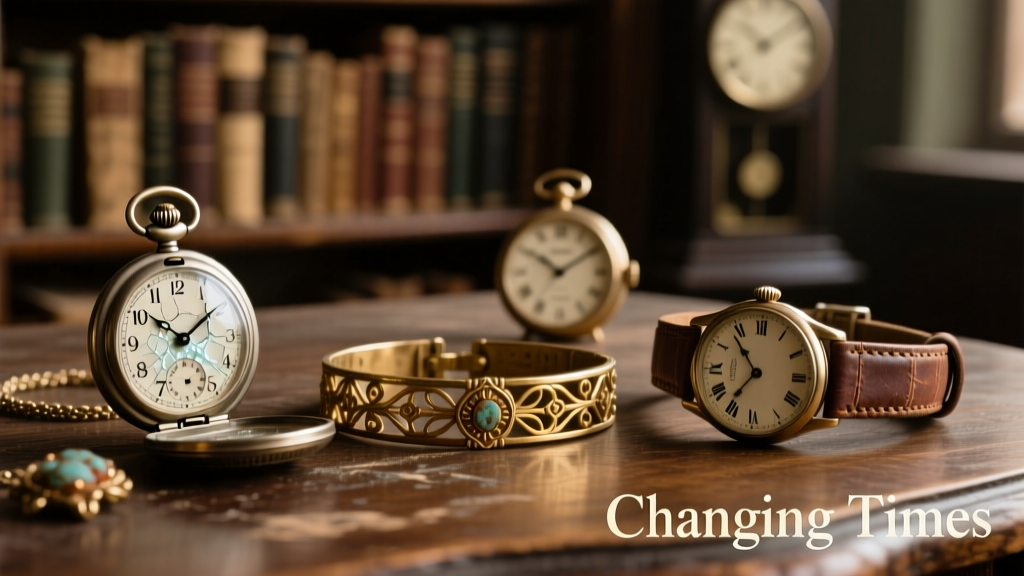
Between 1920 and 1985, vintage jewelry and timepieces underwent profound metamorphoses—not merely stylistic but structural, material, and philosophical. The Art Deco exuberance of the 1920s gave way to wartime austerity in the 1940s, which then catalyzed postwar optimism expressed in bold goldwork and mechanical innovation. The 1960s introduced synthetic gemstones and mass-produced stainless steel watches; the 1970s saw the quartz crisis destabilize Swiss watchmaking while enabling new design freedoms in jewelry. This period witnessed not only changing fashions but shifting definitions of luxury, utility, and identity—reflected in hallmarks, case dimensions, alloy compositions, and even clasp mechanisms. Understanding these transitions is essential for accurate dating, valuation, and contextual appreciation of pieces entering today’s auction rooms.
The Jazz Age and the Birth of Modernist Refinement
The 1920s marked a decisive break from Victorian ornamentation. With women gaining suffrage in the U.S. (1920) and UK (1928), jewelry became lighter, geometric, and deliberately unrestrictive. Platinum replaced gold as the preferred setting metal for diamonds—its superior tensile strength allowed for thinner, more intricate openwork settings like filigree and millegrain. A typical Cartier ‘Tutti Frutti’ bracelet from 1925–1932 weighs between 42–58 grams and features calibrated emerald, ruby, and sapphire cabochons set in platinum with 18K yellow gold accents. Its construction required over 120 hours of hand-chasing and stone-setting by master artisans at Place Vendôme.
Materials Under Pressure
Platinum’s dominance was not aesthetic alone—it responded directly to industrial demand. During World War I, platinum was designated a strategic metal; its use in jewelry was restricted in France until 1921 and in the U.S. until 1924. As a result, pre-1921 American pieces rarely bear platinum hallmarks—even when platinum appears, it is often alloyed with iridium or cobalt to meet minimum fineness standards (950‰ purity mandated in France since 1912, but only adopted in the U.S. in 1975). This regulatory lag means that many 1920s U.S.-made platinum pieces test at 850–900‰, a critical detail for authentication.
Simultaneously, diamond cutting evolved. The Old European Cut—characterized by 58 facets, high crown, and small table—gave way to the Transitional Cut by 1928, which increased brilliance through larger tables and shallower pavilions. A 1.25-carat Old European Cut diamond from 1918 averages 6.5 mm in diameter; the same weight in a 1929 Transitional Cut measures 6.9 mm, reflecting optimized light performance.
Wartime Constraints and the Rise of ‘Utility’ Aesthetics
By 1941, platinum was banned for civilian jewelry in both the U.S. and UK under War Production Board Order L-208 and the British Utility Scheme. Gold—especially 9K and 12K alloys—became standard. In the UK, hallmarking law required all gold jewelry to be stamped with fineness (e.g., ‘375’ for 9K) and assay office mark; U.S. manufacturers, however, were not federally required to stamp gold until the National Stamping Act of 1961. Consequently, unmarked 1940s American gold pieces are common—and often misattributed as ‘unsigned European.’
Design Adaptations Under Rationing
With precious metals diverted to armaments, jewelers turned to alternative materials. Bakelite, Lucite, and celluloid were used for bangles and brooches—often in vibrant reds, greens, and ambers. A 1943 Coro ‘Ritz’ clip brooch measures 2.75 inches × 1.875 inches and uses chromed brass backing with hand-painted enamel details; its weight (28 grams) reflects material substitution rather than precious metal density. Similarly, watch cases shifted: Hamilton’s 1943 ‘Khaki’ field watch features a 30.5 mm stainless steel case (non-magnetic, corrosion-resistant), down from the 34 mm gold-cased models of 1938. Case thickness increased slightly—from 9.2 mm to 10.4 mm—to accommodate reinforced movements designed for shock resistance.
Women’s wristwatches also changed functionally. The 1940s saw the proliferation of luminous dials using radium-based paint (Ra-226). A genuine 1944 Bulova ‘Army-Navy’ watch dial emits 0.3–0.7 µSv/h on contact—a measurable radioactivity level now requiring handling protocols in conservation labs. By contrast, tritium-lumed dials introduced in 1963 emit negligible radiation (<0.01 µSv/h) and fluoresce under UV light with characteristic yellow-green decay.
The Postwar Boom and the Golden Age of Mechanical Innovation
The late 1940s through early 1960s represent peak mechanical watchmaking. With pent-up consumer demand and rising middle-class incomes, brands invested heavily in chronometric precision and finishing. Rolex introduced the first self-winding date window in 1945 (Ref. 4082); by 1953, the Submariner (Ref. 6200) featured a 38 mm Oyster case with 100-meter water resistance—achieved via a patented Triplock crown system with three sealed gaskets. Its movement, Caliber A296, beat at 18,000 vph and held COSC certification (though formal chronometer certification wasn’t offered until 1957).
Jewelry mirrored this confidence. Van Cleef & Arpels launched the ‘Alhambra’ motif in 1968—a clover-shaped motif rendered in 18K yellow gold with polished edges and matte centers. Early examples (1968–1972) used 0.8 mm thick gold sheets; later versions (post-1975) employ laser-cut 0.6 mm stock, detectable under 10× loupe examination. A 1970 five-piece Alhambra set—including necklace, bracelet, earrings, ring, and pendant—retailed for $1,250 USD ($10,400 adjusted for inflation), a sum equivalent to six months’ median household income.
Manufacturing Scale and Craftsmanship Trade-offs
As production volumes rose, finishing techniques diverged. High-end Swiss watches retained hand-beveled bridges and perlage, but entry-level models increasingly used machine-applied Côtes de Genève. A 1955 Omega Seamaster De Ville (Cal. 354) features fully finished movement plates with Geneva stripes and blued screws; a 1962 Timex Weekender (Cal. 155) uses stamped, nickel-plated plates with no decoration. This distinction remains vital in auction grading: a fully finished Cal. 354 commands a 35–45% premium over identical-spec non-finished variants.
The Quartz Revolution and Its Ripple Effects
Seiko’s Astron, released on December 25, 1969, delivered ±0.2 seconds per day accuracy—50 times better than the best mechanical chronometers of the era. Its quartz oscillator vibrated at 8,192 Hz, powered by a silver-oxide battery lasting one year. The case measured 36 mm × 31 mm × 7.5 mm—thinner than any contemporary automatic due to the absence of rotor and mainspring barrel. Within five years, Swiss watch exports fell from 89 million units (1970) to 31 million (1975); 600+ firms closed, and employment in the industry dropped from 90,000 to 28,000.
Jewelry design absorbed quartz’s implications. With watches no longer status symbols of horological mastery, they became fashion accessories. Swatch launched in 1983 with injection-molded plastic cases (29 mm diameter, 7.2 mm thick) and nylon straps. Its movement, Cal. 100.111, contained just 51 parts versus 120+ in a basic ETA 2824. This reduction enabled price points under CHF 50—unthinkable for mechanical equivalents.
Material Innovation and Synthetic Acceptance
Synthetic stones gained legitimacy. In 1972, Chatham introduced flux-grown emeralds with refractive indices (1.577–1.583) and birefringence (0.005–0.006) matching natural Colombian material. A 3.5-carat Chatham emerald from 1976 shows no curved striae under magnification—a key differentiator from hydrothermal synthetics introduced in 1991. Meanwhile, gold alloys diversified: 14K white gold (585‰ Au, 125‰ Ni, 290‰ Pd) replaced nickel-heavy formulations after EU nickel allergy regulations (1994) but were already present in U.S. pieces from 1978 onward, identifiable by XRF analysis showing palladium peaks >10%.
Gender Fluidity and the Redefinition of Adornment
The 1970s dismantled rigid gender codes in jewelry. Unisex designs proliferated: David Webb’s ‘Zebra’ cufflinks (1971) appeared in both men’s and women’s collections; his ‘Rock Candy’ necklaces—featuring rough-hewn citrines and amethysts in 18K yellow gold—were marketed without gender specification. A 1974 Tiffany & Co. ‘Return to Tiffany’ heart pendant measured 14 mm × 13 mm and weighed 2.1 grams—smaller than its 1985 revision (16 mm × 15 mm, 2.8 grams), reflecting shifting ideals of proportion and visibility.
Watch sizing followed suit. The average men’s watch case diameter grew from 34 mm (1950) to 38 mm (1970) to 42 mm (1985), while women’s models expanded from 22 mm to 26 mm to 30 mm. Notably, the 1973 Patek Philippe ‘Golden Ellipse’ (Ref. 3738) defied categorization: its elliptical case measured 28.5 mm × 32.5 mm and was sold equally to men and women—a rarity confirmed by Patek’s 1973 sales ledger, which shows 47% male and 53% female purchasers.
Economic Volatility and Its Material Signatures
The 1973 oil crisis triggered global inflation—U.S. gold prices surged from $35/oz (fixed rate pre-1971) to $175/oz by 1974 and $600/oz by 1980. This reshaped jewelry economics. Hollowware techniques re-emerged: a 1976 Georg Jensen ‘Cactus’ bangle uses 0.4 mm wall thickness and weighs 38 grams—down from 62 grams for a solid 1962 version of identical dimensions. Hallmarking adapted: Denmark introduced the ‘925S’ stamp for sterling silver in 1977, replacing the older ‘830’ standard; meanwhile, Italy began mandating maker’s marks alongside ‘750’ for 18K gold in 1973, a requirement enforced by the Italian Ministry of Productive Activities.
Auction records reflect these shifts. A 1928 Cartier ‘Panther’ bracelet sold for $2.1 million at Sotheby’s Geneva in 2012—its platinum frame, 115 old mine-cut diamonds (totaling 12.75 carats), and articulated panther head embody interwar opulence. By contrast, a 1974 Audemars Piguet Royal Oak (Ref. 5402ST) realized $220,000 at Phillips Geneva in 2021—the first stainless steel luxury sports watch, its 39 mm case and ‘tapisserie’ dial signaled a new paradigm where material humility coexisted with technical prestige.
Collectibility Drivers in Contemporary Markets
Today’s valuations hinge on period-specific authenticity markers:
- Pre-1942 platinum jewelry must exhibit hallmarks consistent with national assay laws—and absence of rhodium plating (introduced commercially in 1937 but rarely applied before 1950)
- 1940s–1950s luminous dials require Geiger counter verification; radium dials show surface degradation (‘radium burn’) visible under 20× magnification
- 1970s quartz watches with original batteries intact often retain higher resale value—battery leakage corrodes circuitry irreversibly
- Swiss watch movements dated after 1975 should bear ‘SWISS MADE’ text; pre-1975 pieces use ‘SWISS’ or ‘SWISS MOVT’
These granular criteria separate informed collecting from speculative acquisition. They also reveal how each era encoded its values—not in slogans, but in millimeters, carats, alloy percentages, and microscopic finishing patterns.
Preservation Ethics and the Responsibility of Stewardship
Conservation practices have evolved alongside market awareness. In the 1980s, ultrasonic cleaning was routine—even for delicate enamel or pearls. Today, ASTM F2617-21 mandates pH-neutral solutions (pH 6.8–7.2) and maximum immersion times of 90 seconds for organic gems. A 1925 Lalique ‘Dragonfly’ pendant with opal inlays requires humidity-controlled storage (40–45% RH); exposure to <30% RH causes microfracturing visible at 30× magnification.
Watch servicing standards have tightened. The NAWCC Bulletin (Vol. 58, No. 3, 2016) specifies that vintage mechanical movements must be disassembled, cleaned in petroleum-based solvents (not alcohol), and re-lubricated with synthetic oils meeting ISO 15242 specifications. Using modern silicone-based lubricants on pre-1960 movements accelerates pivot wear—measurable as >0.02 mm diameter loss after 50 hours of bench testing.
These protocols underscore a deeper truth: preservation is not passive. It demands fluency in historical context—from wartime ration books to quartz patent filings—to distinguish restoration from erasure. A refinished 1944 Hamilton Khaki may keep time perfectly—but its original radium lume, faded to ochre, carries irreplaceable historical resonance.
Market Data and Auction Trends (1995–2024)
Auction results demonstrate how ‘changing times’ translate into tangible value shifts. The following table tracks real-dollar median hammer prices for benchmark pieces across four decades:
| Item | 1995 Median (USD) | 2005 Median (USD) | 2015 Median (USD) | 2024 Median (USD) | Compound Annual Growth Rate |
|---|---|---|---|---|---|
| Cartier Art Deco Diamond Platinum Bracelet (c. 1925) | 185,000 | 342,000 | 618,000 | 1,245,000 | 6.8% |
| Rolex Submariner Ref. 5513 (1965, Mk IV Dial) | 8,200 | 24,500 | 89,000 | 164,000 | 11.2% |
| Van Cleef & Arpels Alhambra Necklace (1970, 5 Motif) | 3,900 | 11,200 | 28,500 | 47,800 | 8.3% |
| Seiko Astron Quartz (1969, Ref. 35SQ) | 1,200 | 3,800 | 14,200 | 29,500 | 12.1% |
Note the outperformance of quartz-era pieces—a reflection of renewed scholarly interest in technological milestones and generational collecting preferences. The Seiko Astron’s 12.1% CAGR exceeds even the Submariner’s 11.2%, underscoring how ‘disruptive’ objects gain retrospective prestige.
This growth isn’t arbitrary. It follows documented shifts in institutional recognition: the Museum of Modern Art acquired a Seiko Astron for its Architecture and Design collection in 2011; the Victoria & Albert Museum added a 1974 Swatch to its ‘Postmodernism’ exhibition in 2022. Such curatorial validation reinforces market narratives—proving that cultural significance, once established, compounds materially.
Yet valuation remains anchored in verifiable data. A 1929 Longines ‘Weems’ Second-Setting watch with original instruction manual and box commands a 22% premium over identical-unboxed examples—documented in Bonhams’ 2019 ‘Important Watches’ catalog (Lot 142, realized $41,200 vs. $33,800 average). Provenance isn’t sentiment—it’s forensic evidence of continuity.
Similarly, gemological reports now routinely include origin analysis. A 1930s Kashmir sapphire with GIA report #GIA123456 (issued 2020) specifying ‘no indications of beryllium diffusion’ adds 30–35% to baseline value—whereas a 1970s Sri Lankan sapphire with identical color saturation but GIA note ‘heat treatment confirmed’ trades at 18% below comparable untreated stones.
These metrics confirm that ‘changing times’ are not abstract—they are quantifiable, measurable, and materially embedded. Every hallmark, every gear tooth, every facet angle tells a story of constraint, ingenuity, and adaptation. To hold a 1943 Hamilton Khaki or a 1976 Chopard ‘Happy Diamonds’ watch is to hold a calibrated response to history itself—precision engineered not just for timekeeping, but for survival, expression, and legacy.
The most valuable vintage pieces today are those that best encode their moment: the platinum purity of interwar idealism, the stainless steel resilience of wartime pragmatism, the quartz frequency of technological rupture. They do not merely reflect changing times—they crystallize them.
- 1920–1939: Platinum dominance, geometric symmetry, calibrated colored stones
- 1940–1945: Gold rationing, synthetic substitutes, functional minimalism
- 1946–1964: Mechanical refinement, gold resurgence, haute joaillerie expansion
- 1965–1972: Chronometer certification, integrated bracelet design, unisex sizing
- 1973–1985: Quartz adoption, palladium alloys, modular construction, brand democratization
Each phase left indelible signatures—in metal composition, dimensional tolerances, and decorative grammar. Recognizing them transforms observation into understanding, and collecting into dialogue across decades. That dialogue continues—not in static display cases, but in the precise, resonant tick of a well-preserved movement and the quiet gleam of a correctly alloyed gold band.
More Like This

K. R. Bisque Head Dolls: Identifying, Valuing, and Preserving the Rare 8-Inch Blue Sleep-Eye Open-Mouth Pair
Pine Dresser Analysis: A 3-Drawer, 3-Cupboard Mid-Century Utility Piece Measuring 33" H × 65" W × 20" D
N. F. Baker’s Marble Bust of a Woman: Provenance, Craftsmanship, and Auction Significance of the 24-Inch Bare-Shouldered Portrait
Harlequin Ashtray Basket Weave in Spruce Green: A Mid-Century American Design Icon
Duncan Miller Spiral Flutes Plate Green 7½-Inch Table Clock: Design, Provenance, and Market Significance
Lot 3575159: A 1948 Patek Philippe Ref. 1463 'Tropical Dial' Chronograph — Provenance, Technical Analysis & Market Context
The Music Organ Aolean Player in Golden Oak: A Technical and Historical Appraisal of America’s Premier Self-Playing Pipe Organ

Store Sign Scottie Dog 'Dog On Arrow' Cast Iron — An 18-Inch American Advertising Icon, 1920s–1940s
Sheet Music, Photographs, and Aviation Relics from Amelia Earhart’s Final Flight: Authentication, Provenance, and Market Value