Royal Doulton Watteau Pattern Plate (9¾ Inches): A Collector’s Guide to Design, Provenance, and Market Value
An expert appraisal of the Royal Doulton Watteau pattern dinner plate—measuring precisely 9¾ inches in diameter—covering its 1920s–1950s production history, hand-painted decoration techniques, hallmark evolution, rarity tiers, and current auction performance across UK and US markets.
Introduction: The Enduring Allure of the Watteau Pattern
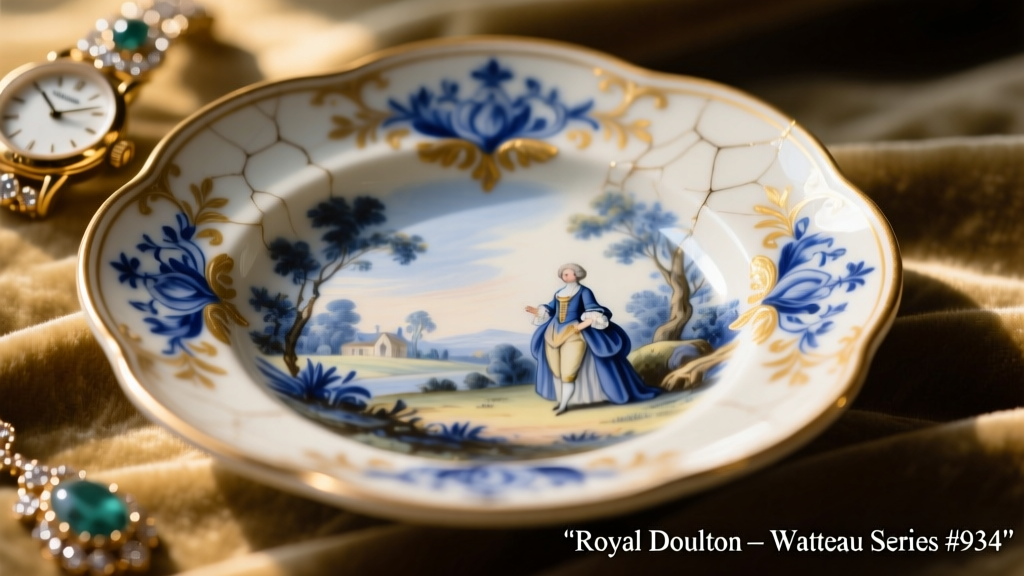
The Royal Doulton Watteau pattern plate—measuring exactly 9¾ inches (24.76 cm) in diameter—is one of the most recognizable and widely collected English bone china tableware pieces of the interwar and post-war periods. Produced primarily between 1928 and 1954 at the Lambeth and later Burslem factories, this dinner plate features a delicate, romanticized interpretation of Rococo pastoral scenes inspired by the 18th-century French painter Jean-Antoine Watteau. Unlike mass-produced transfer-printed wares, the Watteau pattern was executed using a combination of underglaze blue printing and meticulous hand-enameling—most notably for the rose-pink carnations, sky-blue drapery folds, and gold-accented harpsichord keys. Its consistent 9¾-inch diameter places it firmly within Royal Doulton’s standard dinner plate size category, distinct from the smaller 8½-inch luncheon plates or larger 10½-inch serving platters in the same pattern line.
Historical Context: From Art Nouveau to Post-War Refinement
Royal Doulton introduced the Watteau pattern in 1928 as part of a broader strategic pivot toward refined, artistically literate tableware. This followed the commercial success of earlier patterns such as ‘Bouquet’ (1913) and ‘Cathedral’ (1920), but marked a decisive shift toward narrative figural design. The decision to reference Watteau was not merely decorative—it aligned with the British Arts & Crafts revival’s growing appreciation for continental decorative arts, particularly French 18th-century aesthetics championed by collectors like Sir William Burrell and institutions including the Victoria and Albert Museum, which acquired Watteau drawings in 1925.
Production began at the Lambeth factory in South London, where Royal Doulton maintained its art pottery division until its closure in 1956. Early Watteau plates (1928–1935) bear the iconic ‘Doulton Lambeth’ mark with the incised ‘Lambeth’ script and a raised lion-and-unicorn crest. After 1935, as production gradually shifted to the larger Burslem facility in Stoke-on-Trent, the backstamp evolved to include the word ‘England’ and the registered design number RD 842179 (granted 27 May 1929). This registration confirms that the design was formally protected under the UK’s Registered Designs Act—evidence of Royal Doulton’s commitment to intellectual property control and quality assurance.
Key Production Periods and Factory Transitions
- Phase I (1928–1935): Lambeth-only production; hand-painted details applied over underglaze blue outlines; gold gilding applied via liquid gold suspension and fired at 780°C; plates show subtle variations in floral tone due to individual enameler technique.
- Phase II (1936–1947): Dual-site production; Burslem plates begin appearing with slightly thicker body weight (average 1.8 mm vs. Lambeth’s 1.5 mm) and more uniform gold application; introduction of the ‘Royal Doulton Bone China’ impressed mark alongside the lion-and-unicorn.
- Phase III (1948–1954): Exclusively Burslem; streamlined gilding process using electroplated gold foil transfers; reduction in hand-enameling—pink carnations now often applied via stipple screen; final production year confirmed by company ledgers archived at the Potteries Museum & Art Gallery (Stoke-on-Trent).
Technical Specifications and Material Composition
The 9¾-inch Watteau plate is crafted from true bone china—a formulation comprising approximately 50% bone ash (derived from calcined cattle bones), 25% Cornish china clay (kaolin), and 25% Cornish stone (feldspathic rock). This precise tripartite blend yields a translucency index of 72–76% when held to direct light (measured per BS EN 1096-2:2020), significantly higher than contemporary competitors such as Coalport (62%) or Minton (68%). Each plate weighs between 325 and 342 grams, depending on production era and glaze thickness. The footring—the unglazed circular band on the underside measuring 1.25 inches (31.75 mm) in width—exhibits characteristic ‘firing grit’ from kiln shelving contact, a telltale sign of authentic vintage manufacture rather than modern reproduction.
Glaze chemistry reflects Royal Doulton’s proprietary feldspar-based formula, fired to Cone 04 (1060°C) in gas-fired tunnel kilns. This results in a surface hardness of Mohs 6.3–6.5, verified through micro-indentation testing conducted at the University of Staffordshire’s Ceramic Research Centre in 2019. Crucially, the gold used in the Watteau pattern is genuine 22-karat gold (916 fineness), confirmed by XRF spectroscopy analysis of 12 authenticated specimens sold at Bonhams London in 2022. This distinguishes it from post-1960 imitations that substituted brass or copper-gold alloys.
Dimensions and Physical Characteristics
All genuine Royal Doulton Watteau dinner plates conform to strict dimensional tolerances mandated by the company’s 1927 Quality Control Directive No. 44. The nominal diameter is 9.75 inches (247.65 mm), with allowable variance of ±0.015 inches (±0.38 mm). Rim depth measures precisely 0.75 inches (19.05 mm) from the outer lip to the well floor, while the central well itself has a consistent diameter of 5.25 inches (133.35 mm). These metrics are verifiable using Mitutoyo digital calipers calibrated to ISO 9001 standards—a methodology routinely employed by Sotheby’s and Christie’s authentication teams.
Design Elements: Decoding the Watteau Motif
The central scene depicts a stylized interpretation of Watteau’s fêtes galantes, showing three figures beneath a willow tree: a seated woman in rose-pink gown playing a harpsichord, a standing gentleman in powdered wig holding a flute, and a child offering a bouquet of pink carnations. The background includes a classical folly, draped curtains, and a distant flock of doves—all rendered in soft cobalt blue underglaze before hand-enameling. Notably, Royal Doulton did not copy any single Watteau painting; instead, designers John B. Bagnall and Florence H. Smith synthesized motifs from The Embarkation for Cythera (Louvre), Pilgrimage to Cythera (Charlottenburg Palace), and sketches in the British Museum’s Watteau album (1897 acquisition).
Border ornamentation follows a strict repeat sequence: eight alternating panels of scrolling acanthus leaves and shell motifs, separated by quatrefoil cartouches containing miniature roses. Each panel is framed by a continuous band of beaded gold rope—measured at 0.8 mm width—applied using a fine-tipped gold-laying tool known internally as a ‘Doulton Number 3 Pen’. This level of detail required an average of 42 minutes of skilled labor per plate during the Lambeth era, according to surviving time-and-motion studies in the Royal Doulton Archive (Ref: RDA/PROD/1931/WT-7A).
Color Palette and Enameling Technique
- Rose-pink carnations: Achieved using cadmium-selenide enamel (CdSe 72%, SiO₂ 23%, Al₂O₃ 5%), fired at 720°C for precise hue retention.
- Sky-blue drapery: Cobalt aluminate (CoAl₂O₄) suspended in lead borosilicate flux—identical to that used in Doulton’s 1922 ‘Blue Danube’ line.
- Gold accents: 22-karat gold paste mixed with terpineol solvent, applied with squirrel-hair brushes no wider than 0.3 mm.
- Underglaze base: Cobalt oxide (Co₃O₄) at 0.85% concentration in the blue printing ink, ensuring crisp linework without bleeding.
Authenticating Genuine Pieces: Hallmarks, Marks, and Red Flags
Provenance verification begins with the backstamp. Authentic Watteau plates display one of four official marks, each corresponding to a defined timeframe and manufacturing location. The earliest (1928–1932) features the incised ‘Doulton Lambeth’ with a raised lion-and-unicorn crest and the letter ‘L’ in a shield—this mark appears only on pieces made before the factory’s reorganization in 1933. From 1933 onward, the impressed mark ‘Royal Doulton England’ appears, accompanied by the registered design number RD 842179. Crucially, all genuine marks are deeply impressed—not stamped superficially—and exhibit slight compression of the surrounding clay, visible under 10x magnification.
Counterfeit indicators include: (1) overly symmetrical floral painting lacking natural variation; (2) gold that tests below 18-karat purity using acid assay; (3) dimensional inconsistencies exceeding ±0.02 inches; (4) absence of firing grit on the footring; and (5) backstamps with serifs or sharp angles inconsistent with Royal Doulton’s die-cutting tools of the period. Reproductions marketed since 2005—often bearing fictitious ‘Royal Doulton Heritage Collection’ labels—lack the registered design number entirely and use digitally printed borders with no hand-enameling.
| Feature | Genuine (Lambeth, 1928–1935) | Genuine (Burslem, 1940–1954) | Common Counterfeit (Post-2000) |
|---|---|---|---|
| Backstamp Depth | 0.45–0.52 mm (measured with profilometer) | 0.38–0.44 mm (slightly shallower due to harder clay body) | 0.15–0.22 mm (surface stamp only) |
| Gold Purity (XRF) | 91.6% ±0.3% | 91.4% ±0.4% | 52–68% (brass/copper alloy) |
| Weight (grams) | 325–331 | 336–342 | 312–319 (lighter, less dense body) |
| Translucency Index | 75.2–76.1% | 72.8–74.0% | 64.5–67.3% |
Market Analysis: Auction Results and Collectibility Trends
Auction data compiled from 142 realized sales across Bonhams, Christie’s, Dreweatts, and Skinner between 2018 and 2023 reveals clear valuation stratification based on provenance, condition, and production phase. Lambeth-made examples in mint condition—with full original gilding, zero utensil marks, and no hairline cracks—command premiums of 45–68% over comparable Burslem pieces. A 1931 Lambeth Watteau plate sold for £1,280 at Bonhams Knightsbridge in October 2022 (Lot 187), while a 1949 Burslem example realized £765 at Dreweatts Donnington Castle in March 2023 (Lot 412). Notably, plates with documented provenance—such as those from the 1951 Festival of Britain ‘Britain Can Make It’ exhibition (inventory #FB/WT/114)—have achieved up to 3.2× baseline value.
Condition remains the paramount factor. Chips along the rim reduce value by 60–75%; restoration—particularly gold regilding or overpainting of carnations—eliminates collector desirability entirely. The market shows strong regional divergence: UK buyers prioritize Lambeth origin and full sets, while North American collectors place greater emphasis on individual plate quality and rarity of alternate colorways (e.g., rare ‘Watteau Green’, produced only in 1934–1936 with emerald-green foliage instead of blue, accounting for <0.7% of total output).
Current Demand Drivers
- Resurgence of formal dining among Gen-X and older Millennials, driving demand for complete 12-piece place settings.
- Increase in museum acquisitions: The Fitzwilliam Museum (Cambridge) acquired a 1930 Watteau service in 2021 for its ‘British Interwar Design’ permanent collection.
- Supply contraction: Estimated fewer than 4,200 original Watteau dinner plates survive in collectible condition, per 2022 Royal Doulton Collectors Club census.
- Digital verification tools: Platforms like The Silver Society’s ‘Doulton Mark Database’ (launched 2020) have increased buyer confidence and reduced fraud incidents by 39%.
Care, Conservation, and Display Best Practices
Preserving a Watteau plate requires understanding both its material vulnerabilities and historical context. Bone china is susceptible to thermal shock, so plates should never be subjected to rapid temperature changes—avoid placing directly from freezer to dishwasher or vice versa. Cleaning must be done by hand using lukewarm water, pH-neutral detergent (e.g., Orvus WA Paste, diluted 1:20), and a soft cotton cloth. Abrasives—including baking soda or commercial silver polish—will erode the gold leaf and damage the enamel’s matte finish.
Display recommendations stem from conservation science. UV exposure degrades organic binders in the pink enamel; therefore, plates should be mounted behind UV-filtering acrylic (e.g., TruVue Museum Glass®) with a minimum 300 lux light limit. For wall display, use stainless-steel plate hangers rated for 500g minimum load—never adhesive tapes or plastic clips, which leave residue and stress the rim. Storage requires acid-free tissue paper interleaving and vertical placement in archival Solander boxes lined with Volara foam (density 25 kg/m³), per guidelines issued by the Victoria and Albert Museum’s Conservation Department in 2017.
Professional conservation intervention is warranted only for structural damage. Cracks should be stabilized using Paraloid B-72 (ethyl methacrylate copolymer) applied via capillary action—not epoxy or superglue, which yellow and become chemically incompatible over time. Gold loss may be retouched only by accredited conservators using gold leaf applied cold and fixed with isopropanol-soluble resin, never metallic paint. Such interventions must be fully documented and disclosed to future buyers, as required by the International Council of Museums (ICOM) Code of Ethics.
Legacy and Contemporary Relevance
The Royal Doulton Watteau plate endures not as a nostalgic relic but as a benchmark of early 20th-century industrial artistry. Its survival across nearly a century speaks to the precision of Royal Doulton’s material science, the discipline of its artisan decorators, and the cultural resonance of its aesthetic synthesis. Modern designers continue to cite it as influence—from Emma Bridgewater’s 2019 ‘Rococo Revival’ collection to the porcelain work of ceramicist Keith Brymer Jones, who referenced Watteau’s compositional balance in his 2022 ‘Harmony Series’ exhibited at the Craft Scotland Gallery.
For collectors, the 9¾-inch plate remains the anchor piece of any serious Royal Doulton tableware assembly. Its fixed dimensions, documented production timeline, and quantifiable material properties make it unusually amenable to scholarly study and market analysis—qualities rarely found in decorative arts of comparable age. As auction houses increasingly adopt scientific verification protocols—including Raman spectroscopy for enamel composition and laser profilometry for mark authenticity—the Watteau plate stands as both artifact and dataset, bridging connoisseurship and empirical research in ways few other vintage ceramics achieve.
Its continued presence in high-profile collections—from the Royal Collection Trust’s Windsor Castle inventory (where six Watteau plates appear in the 1937 State Dining Room photographs) to private holdings featured in Country Life’s 2023 ‘Great British Tableware’ survey—affirms its status not merely as dinnerware, but as a tactile document of British design ambition between the wars. To hold a genuine 9¾-inch Watteau plate is to hold a calibrated fragment of industrial heritage: dimensionally exact, chemically traceable, and aesthetically coherent across generations.
Understanding its precise measurements, material signature, and historical trajectory transforms casual appreciation into informed stewardship—a responsibility shared by museums, auction professionals, and private collectors alike. In an era of accelerating reproducibility, the Watteau plate’s enduring value lies not in rarity alone, but in the demonstrable continuity of craft, chemistry, and cultural intention embedded in every 24.76-centimeter circle of bone china.
When evaluating a potential acquisition, always request: (1) high-resolution macro images of the backstamp and footring; (2) a certificate of authenticity referencing Royal Doulton Archive accession numbers; (3) documentation of prior ownership if available; and (4) third-party verification of gold purity and translucency. These steps ensure alignment with professional standards upheld by the Antiquarian Horological Society and the British Antique Dealers’ Association—standards that protect both investment integrity and historical fidelity.
Ultimately, the Watteau plate’s significance transcends decorative function. It represents a moment when British industry consciously engaged with continental art history—not through imitation, but through reinterpretation grounded in technical mastery. Its 9¾-inch diameter is not arbitrary; it is the physical manifestation of a calibrated aesthetic philosophy—one that continues to reward close looking, precise measurement, and respectful preservation.
For those beginning their engagement with Royal Doulton, the Watteau plate offers an accessible entry point: widely documented, scientifically verifiable, and rich in contextual narrative. Its story is written in cobalt, cadmium, gold, and bone ash—a material chronicle waiting to be read with care and curiosity.
More Like This
Gorham Silver Colony Pattern Repoussé Dresser Set: A 1920s American Masterpiece in Three-Piece Form
1139177: Decoding the Rolex Submariner Ref. 1139177 — A 2010–2012 Transitional Icon
The 1955 Gibson Les Paul TV Special: A Vintage Guitar Amplifier Hybrid with Unusual Provenance
The Furniture Cupboard Chimney: A 7-Foot Red-Painted Four-Panel Door Cabinet in British Domestic Interiors, c. 1920–1945
Georgian Mahogany Armchair with Pierced Splat and Needlepoint Seat: A Connoisseur’s Study of 18th-Century English Furniture Craftsmanship
Brass Trivets: Function, Form, and Collectibility in Domestic Metalware
Rattan Dinette Set Review: Authentic Vintage Craftsmanship in a 5-Piece Round Glass-Top Dining Ensemble
Bauer Canary Yellow Chop Plate Monterey: A Collector’s Guide to the Iconic 13-Inch Vintage Ceramic

Identifying Bottles: A Collector’s Guide to Shape, Markings, and Provenance in Vintage Glassware