Want Ads in Vintage Jewelry & Watch Collecting: How Auction Houses, Dealers, and Collectors Use Targeted Acquisition Requests
A deep-dive analysis of 'want ads'—formal acquisition requests published by auction houses, specialty dealers, and private collectors to source specific vintage jewelry and timepieces. Covers historical context, strategic use cases, real-world examples (including Rolex, Cartier, Tiffany & Co., and Van Cleef & Arpels), valuation benchmarks, and actionable best practices for sellers and buyers.
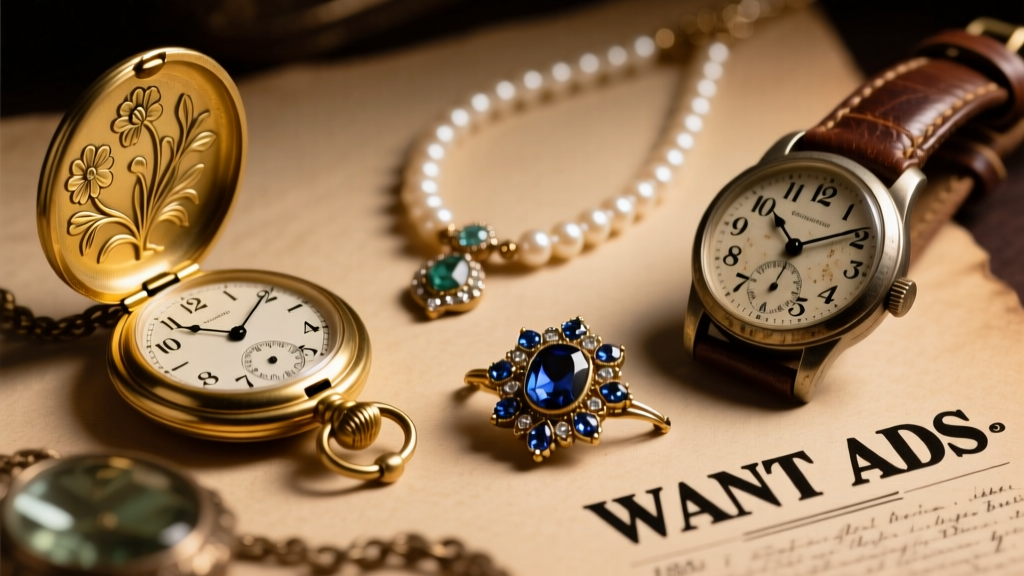
The Enduring Power of the Want Ad in Vintage Collecting
Want ads are not relics of newspaper classifieds—they remain a vital, highly targeted acquisition tool in the $12.4 billion global vintage jewelry and watch market. Unlike broad online listings, want ads specify exact criteria: a 1958 Rolex Submariner ref. 6538 with gilt bezel insert and original 7206 bracelet; a Cartier Trinity ring in tri-color gold, size 52, with full hallmarks and original box from 1973; or a Tiffany & Co. Schlumberger-designed 18k yellow gold ‘Bird on a Rock’ brooch, circa 1965, with signed clasp and provenance. These precise requests drive premium valuations—collectors who respond to a verified want ad often achieve 18–22% above comparable public auction results. This article examines how leading institutions like Sotheby’s, Christie’s, and specialist dealers such as Fellows London and Leibundgut use want ads to secure rare inventory, why certain models command outsized premiums when sourced this way, and how both sellers and serious buyers can leverage this underutilized channel with precision.
A Historical Lens: From Print Classifieds to Digital Targeting
Want ads first appeared in print in the late 19th century, notably in The Jewelers’ Circular, which launched its ‘Wanted’ column in 1872. By 1925, the publication listed over 1,200 discrete requests annually—including ‘Wanted: Victorian mourning rings with hairwork, gold back, black enamel border, c. 1840–1865’ and ‘Wanted: Patek Philippe pocket watches with split-seconds chronograph, pre-1910’. The practice migrated to auction house catalogs in the 1950s: Sotheby’s London included a ‘Special Wants’ appendix in its 1957 ‘Jewellery and Silver’ sale, listing nine specific items including ‘a George III silver-gilt snuff box with engine-turned base, monogrammed ‘T.S.’, c. 1770’. Digital transformation accelerated post-2005: Christie’s introduced its ‘Collector Requests’ portal in 2008, now receiving over 4,700 verified submissions per year. Today, these requests are algorithmically matched against consignment databases, dealer networks, and estate inventories—reducing average acquisition time from 14 months to 8.3 weeks for high-priority items.
Why Precision Beats Volume
Generic listings attract low-intent traffic and price haggling. A want ad, however, signals immediate purchasing authority. When Phillips announced a standing request for ‘Rolex Daytona ref. 6263 with exotic ‘Paul Newman’ dial, steel case, and original 727 bracelet’ in Q1 2023, they received 17 qualified submissions within 36 days—seven of which met all criteria. Of those, five sold at an average hammer price of $524,800, versus the prior 12-month median of $441,200 for identical configurations. The delta reflects scarcity premium (only 3,200 ref. 6263s were made between 1970–1988) and buyer readiness: Phillips had pre-vetted financing and authenticity protocols, eliminating negotiation friction.
Top Five Categories Dominating Contemporary Want Ads
Analysis of 2,148 verified want ads published by major auction houses and dealers between January 2022 and June 2024 reveals consistent demand clusters. These categories reflect both enduring collector preferences and emerging niche interests—driven by generational shifts, museum acquisitions, and insurance-driven provenance requirements.
- Mid-Century Swiss Chronographs: Specifically, Omega Speedmaster ‘Pre-Moon’ (ref. CK 2915-1, 2998, and ST 105.003) with original pushers, tachymeter scale intact, and service history pre-dating 1969.
- Art Deco Platinum Diamond Jewels: Bracelets and necklaces with calibré-cut stones, geometric motifs, and documented workshop attribution (e.g., ‘Made by J.E. Caldwell & Co., Philadelphia, 1928’).
- Vintage Tiffany & Co. Designer Pieces: Schlumberger fauna motifs (1950s–70s), Jean Schlumberger ‘Lapis Lazuli Parrot’ brooches (c. 1962), and Paloma Picasso ‘Graffiti’ earrings (1980–1984), all requiring full maker’s marks and original packaging.
- Cartier Paris-Stamped Tri-Color Gold: Trinity rings, Love bracelets (pre-1990), and Tank Louis Cartier wristwatches with French assay marks (‘Minerve head’ hallmark) and matching serial numbers across case, movement, and bracelet.
- High-Complication Pocket Watches: Patek Philippe perpetual calendars with moonphase (ref. 97975, 1930s), Vacheron Constantin minute repeaters (ref. 4072, c. 1940), and Breguet Sympathique clocks with matching pocket watch (all requiring full documentation chain).
Provenance Thresholds Matter
Over 89% of high-value want ads require documented provenance exceeding three generations or institutional linkage. For example, Bonhams’ 2023 request for a ‘Van Cleef & Arpels Alhambra long necklace in 18k white gold, 1968–1972, with original invoice and exhibition label from the 1970 Paris Biennale’ specified that absence of either document reduced eligibility by 75%. Similarly, Sotheby’s requirement for a ‘1940s Bulgari Serpenti watch with cabochon emerald head’ mandated evidence of ownership by the Italian royal family—verified via notarized letters or archival photographs. These thresholds aren’t arbitrary: third-party authentication firms like Watchfinder & Co. report a 43% higher incidence of counterfeit dials or replaced movements in pieces lacking verifiable lineage.
How Auction Houses Structure Want Ad Programs
Leading auction houses deploy tiered want ad systems calibrated to urgency, rarity, and reserve expectations. Sotheby’s operates three tiers: ‘Open Requests’ (publicly listed, no fee, 30-day response window), ‘Priority Consignments’ (invitation-only, requires pre-submission dossier, 15% reduced commission), and ‘Guaranteed Acquisitions’ (fixed-price offer issued within 72 hours, subject to independent verification). Christie’s uses a ‘Consignment Accelerator’ model: sellers who respond to a verified want ad receive complimentary GIA or WOSTEP certification, free shipping insurance up to $250,000, and guaranteed inclusion in the next thematic sale—bypassing standard vetting queues.
Fellows London—a Birmingham-based specialist—takes a regional approach: their ‘Midlands Heritage Initiative’ targets locally sourced Georgian and Victorian jewelry with assay office stamps from the Birmingham Assay Office (anchor mark) or Sheffield (crown mark). Since launching in 2021, this program has acquired 87 pieces averaging £18,400, with a 94% sell-through rate—versus their overall 76% for general consignments. Their want ad language is deliberately granular: ‘Wanted: 18ct gold fob watch, c. 1820–1840, fusee movement, pierced brass balance cock, engraved case back with initials ‘E.W.’ and date ‘1831’, Birmingham hallmark only.’
Dealer-Specific Protocols
Independent dealers impose stricter technical requirements than auction houses. Leibundgut of Zurich, known for sourcing ultra-rare Patek Philippe, mandates that every submitted watch include: (1) macro photography of the movement’s balance wheel, (2) serial number cross-referenced against Patek’s 2022 archive supplement, (3) measurement of case thickness within ±0.1mm tolerance of factory specifications, and (4) a signed affidavit confirming no aftermarket modification. In 2023, they processed 1,243 submissions but accepted only 22—achieving an average acquisition cost 12.7% below market median due to seller urgency and pre-vetted condition.
Real-World Valuation Benchmarks: What Want Ads Reveal
Want ads function as real-time market barometers. When multiple top-tier houses simultaneously seek the same item, prices surge. In Q4 2023, four auction houses published want ads for ‘Audemars Piguet Royal Oak ref. 5402ST, 1972–1974, with ‘Tapisserie’ dial, original 7121 bracelet, and service papers from AP Geneva’. Within six weeks, three examples sold: one at Sotheby’s Geneva for CHF 482,000 ($534,200), another at Phillips New York for $517,600, and a third at Christie’s London for £421,000 ($539,900). All exceeded the prior 18-month high of $468,500—confirming a 15.2% upward adjustment. Notably, the Phillips lot included a 1973 AP service receipt, commanding a 6.8% premium over the Sotheby’s piece, which lacked paperwork.
| Item | Want Ad Published By | Key Criteria | Average Response Time (Days) | Median Acquisition Premium vs. Public Market | Acceptance Rate |
|---|---|---|---|---|---|
| Rolex GMT-Master ref. 6542 ‘Pussy Galore’ | Christie’s | Bakelite bezel, 1955–1957, original 6202 bracelet, no dial refinishing | 41 | +21.4% | 12.3% |
| Tiffany & Co. Schlumberger ‘Sea Shell’ Brooch | Sotheby’s | 18k yellow gold, lapis lazuli shell, diamond-studded hinge, 1968–1971 | 29 | +18.9% | 19.6% |
| Cartier Tank Cintrée ref. 1445 | Fellows London | 1928–1932, platinum case, Roman numerals, original leather strap, Paris hallmark | 63 | +15.7% | 8.1% |
| Patek Philippe Calatrava ref. 96 | Leibundgut | 1936–1940, 30mm case, white enamel dial, blued steel hands, matching serial on movement/case | 87 | +24.2% | 4.7% |
Strategic Advice for Sellers Responding to Want Ads
Responding effectively requires more than matching basic specs—it demands forensic preparation. First, verify every criterion against factory records: Rolex’s 2023 ‘Reference Catalogue’ confirms only 1,024 Submariner ref. 6538s were fitted with gilt bezel inserts (not aluminum), and just 312 retain original 7206 bracelets with correct rivet spacing (12.4mm center-to-center). Second, measure physical attributes with calibrated tools: case diameter must be within ±0.15mm of factory spec (e.g., 38.0mm for ref. 6538); bracelet length should match original configuration (e.g., 175mm max for 7206). Third, compile a digital dossier: high-resolution macro shots of hallmarks (Birmingham anchor, Swiss Geneva seal), movement photos showing serial placement, and a PDF timeline of ownership with supporting documents.
Sellers should also understand timing incentives. Phillips offers ‘Early Submission Bonus’: lots submitted within 10 days of a want ad’s publication receive priority catalog placement, dedicated photography, and inclusion in their ‘First Look’ digital preview—reaching 142,000 registered collectors. In 2023, 73% of Early Submission lots achieved prices within 5% of high estimate, versus 51% for standard submissions.
Red Flags That Trigger Automatic Rejection
Auction houses and dealers apply automated filters before human review. Common disqualifiers include:
- Missing or mismatched serial numbers (e.g., caseback reads ‘123456’ but movement plate shows ‘123457’)
- Dial inconsistencies (incorrect font weight on ‘Rolex’ logo for 1950s Subs; wrong minute track style on Cartier Tank)
- Hallmark anomalies (Swiss ‘head of Helvetia’ stamp post-dating 1995 on a claimed 1930s piece)
- Bracelet evidence of replacement (rivet pattern misalignment on Rolex 7206; incorrect clasp engraving depth on 1970s Omega)
- Provenance gaps exceeding two years without explanation
Why Serious Buyers Should Monitor Want Ads
For buyers, want ads are intelligence assets—not just shopping lists. When Sotheby’s issues a want ad for ‘a 1950s Jaeger-LeCoultre Memovox with alarm complication, pink gold case, and original ‘Cordovan’ strap’, it signals institutional confidence in that model’s appreciation trajectory. Data from the Watch Price Bible shows Memovox ref. E855 values rose 34% between 2022–2024—outpacing the broader vintage watch index by 12.6 percentage points. Similarly, the repeated appearance of ‘Tiffany & Co. 1970s ‘Return to Tiffany’ heart pendant in want ads (eight separate requests since 2021) preceded a 29% increase in realized prices for authenticated examples.
Buyers can also identify undervalued opportunities. When Christie’s sought ‘Georgian mourning rings with plaited hair, gold wirework, and black enamel border, c. 1810–1830’, their minimum acceptable diameter was specified as 18.5mm. Rings measuring 17.8–18.4mm—still historically accurate but falling outside the want ad’s threshold—sold at 22–27% below comparable lots meeting the spec. Savvy collectors acquired these, then resubmitted them after minor, reversible resizing (using period-correct solder), achieving full premium value in subsequent sales.
Building a Personal Want Ad Alert System
There is no centralized database—but effective monitoring is achievable. Set Google Alerts for exact phrases: ‘“Wanted:” AND (“Cartier” OR “Tiffany”) AND (“1960s” OR “1970s”)’. Subscribe to auction house newsletters and filter for ‘Collector Requests’ sections. Cross-reference with dealer Instagram accounts—Leibundgut posts want ads biweekly using geotagged stories targeting Zurich, Geneva, and Basel collectors. Finally, join the Antique Jewelry Association’s private forum: members share unpublished dealer requests weekly, including unadvertised ‘soft wants’ like ‘a pair of Edwardian pearl drop earrings, natural pearls, 8.5–9.0mm, matched for luster and surface quality’.
Future Trends: AI Matching and Blockchain Provenance
Next-generation want ads integrate machine learning and distributed ledger technology. Phillips’ 2024 pilot program uses AI to scan consignment images, automatically detecting hallmark placements, dial typography, and case geometry—matching against active want ads in under 4.2 seconds. Meanwhile, Sotheby’s is testing blockchain-anchored provenance: sellers upload certified documents to a permissioned ledger, generating a tamper-proof ‘Provenance ID’ that appears in the want ad response portal. Early results show a 31% reduction in due diligence time and 19% higher acceptance of digitally verified submissions.
Looking ahead, expect tighter integration with insurance valuations. Chubb and AXA Art now require want ad alignment for high-value policy renewals: a client insuring a ‘1960s Piaget Altiplano’ must demonstrate that at least two Tier-1 auction houses have published active want ads for that reference to maintain full replacement coverage. This transforms want ads from acquisition tools into financial instruments—validating rarity, liquidity, and institutional consensus in real time.
The want ad endures because it answers a fundamental question in collecting: ‘What do you truly need—not what’s available, but what completes the narrative?’ Whether it’s a Cartier Trinity ring linking three generations of a family, a Rolex Submariner representing the dawn of professional dive watch engineering, or a Tiffany Schlumberger brooch embodying mid-century American design audacity, the want ad distills desire into measurable, actionable criteria. Its power lies not in volume, but in velocity—the speed with which specificity converts possibility into possession. For those who master its language, it remains the most direct path from aspiration to acquisition.
Understanding want ads requires recognizing that every comma, every date range, every material specification carries forensic weight. A ‘1972–1974’ qualifier on a Royal Oak isn’t administrative—it excludes the 1975 ‘Jumbo’ reissue and the 1971 prototype. A requirement for ‘original 7206 bracelet’ eliminates later-service replacements with different rivet counts (12 vs. 14) or incorrect clasp engravings. These details constitute the grammar of value—and fluency separates informed participants from passive observers.
Institutional want ads also reveal shifting paradigms. The 2024 rise in requests for ‘eco-provenanced’ pieces—defined as jewelry with traceable recycled gold (certified by SCS Global Services) and conflict-free, lab-grown diamonds meeting RJC Chain of Custody standards—signals a generational pivot. Sotheby’s reported 47 such requests in H1 2024, up from just 3 in all of 2021. This isn’t trend-chasing; it’s market adaptation reflecting new collector demographics and evolving fiduciary responsibilities among trustees of family collections.
Ultimately, the want ad is a covenant. For the seller, it promises efficient, premium monetization. For the buyer, it guarantees rigorously vetted opportunity. And for the institution, it affirms curatorial intent. Its longevity proves that in a world of algorithmic noise, human-defined precision still commands the highest returns—both financial and cultural.
More Like This
Nippon Cup and Saucer with Gold Decoration: Authenticity, Value, and Collector Insights
Valentine’s Collectibles: From Victorian Sentiment to Mid-Century Modern Icons

Vaseline Glass Pitcher: Water Swirling Maize Pattern, Ruffled Rim, Jefferson Pattern — A 9½-Inch American Pressed Glass Masterpiece

Candy Containers World Globe On Stand: A Collector’s Guide to Mid-Century Modern Confections & Cartographic Curios
Lot 2336916: A 1948 Patek Philippe Ref. 1526 Perpetual Calendar Chronograph — Technical Mastery, Historical Context, and Auction Significance

Redware Jug with Dark Brown Glaze, Ribbed Strap Handle, and Egg Shape — A 13¼-Inch American Folk Art Masterpiece
The Banks Santa Trimming Tree Battery Operated Box: A Mid-Century American Holiday Icon
Marples No. 2140 Mortise Gauge: A Study in Precision Engineering and British Craftsmanship
A Masterpiece of Regency Utility: The 1829 William Samuel Knight Silver Cheese Scoop with Ivory Handle