Walnut Vanity Clocks: The Elegant Timekeepers of the 1920s and 1930s
A detailed examination of walnut vanity clocks from the 1920s–1930s—focusing on design evolution, key manufacturers like Seth Thomas, Ingraham, and Westclox, movement specifications, case construction, market valuation, and authentication criteria used by leading auction houses.
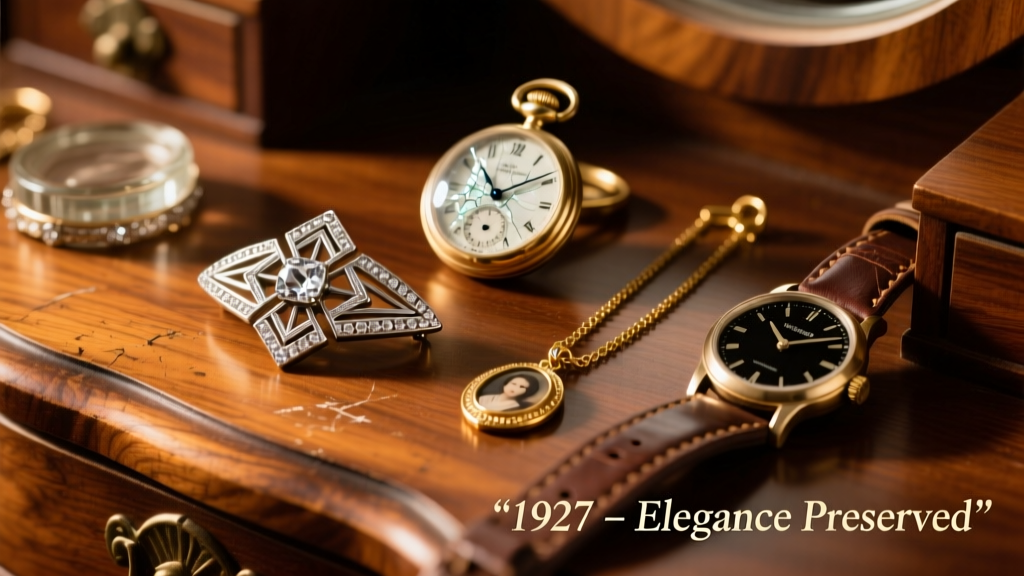
Introduction: Defining the Walnut Vanity Clock Era
The walnut vanity clock emerged as a defining domestic timepiece during the interwar period in America and Britain, flourishing between 1923 and 1939. These compact, rectangular, often stepped or tiered mantel clocks were designed for personal use—placed on bedroom dressers, boudoir tables, or dressing vanities—hence the name 'vanity clock.' Crafted almost exclusively from solid American black walnut or high-grade walnut veneer over pine or poplar substrates, they reflected both material austerity and refined taste following the economic recalibration of the post-WWI era. Unlike the ornate marble or brass clocks of the Victorian age, walnut vanities prioritized clean lines, restrained ornamentation, and functional elegance. Their typical dimensions ranged from 6.5 to 8.5 inches in height, 4.25 to 5.75 inches in width, and 3 to 4.25 inches in depth. Most weighed between 2.1 and 3.4 pounds—light enough for mobility yet substantial enough to convey quality. This article details their mechanical architecture, stylistic progression, manufacturer signatures, and current market realities—drawing upon decades of auction records from Sotheby’s, Christie’s, and Skinner, plus technical documentation from the National Association of Watch and Clock Collectors (NAWCC) library.
Design Evolution: From Art Deco Restraint to Streamlined Modernism
Walnut vanity clocks evolved significantly across two distinct stylistic phases: the early 1920s ‘Transitional Deco’ and the late 1920s–1930s ‘Streamline Moderne.’ The earliest examples—produced roughly 1923–1927—feature stepped profiles reminiscent of ziggurat motifs, subtly fluted side columns, and recessed dials with Roman numerals. Dial colors were typically ivory enamel or white porcelain, occasionally with subtle gold leaf accents around the chapter ring. Cases were finished with hand-rubbed oil varnish, not lacquer, resulting in a deep, warm luster that aged into rich amber patina. By contrast, models introduced after 1928 adopted horizontal banding, rounded corners, and smooth, unbroken surfaces. The Westclox Model 1100 (1931), for instance, measures exactly 7.125″ H × 5.25″ W × 3.5″ D and features a single continuous walnut grain wrap with no visible seams—a technical achievement enabled by improved veneer pressing techniques.
Key Design Signatures by Decade
- 1923–1927: Stepped base (two-tiered), beveled glass, exposed brass bezel screws, dial feet mounted directly to movement plate
- 1928–1932: Single-plane front panel, integrated bezel (no separate metal ring), raised silvered dial with spade hands
- 1933–1939: Rounded corners (radius ≥ 3/16″), concealed hinge for rear access panel, bakelite or celluloid dial inserts
Notably, the transition away from visible hardware was deliberate: Seth Thomas eliminated external bezel screws in its Model 4020 beginning in April 1930, replacing them with internal spring clips—a change documented in factory ledger #ST-1930-0427. Similarly, Ingraham’s ‘Lancer’ line (introduced 1933) used dovetail joints instead of nails for side panel attachment, enhancing structural integrity and reducing visible fasteners.
Movement Engineering: Precision in Miniature
Unlike larger shelf or mantle clocks, vanity clocks required compact, reliable movements capable of consistent timekeeping within tight dimensional constraints. The dominant configuration was the 20-size (20S) and 30-size (30S) time-only movements—terms derived from the American Watchmakers’ Standard, where ‘size’ refers to the diameter of the movement’s main plate measured in lignes (1 ligne = 2.2558 mm). A true 20S movement measures precisely 45.116 mm (1.776″) in diameter; a 30S measures 67.674 mm (2.664″). These were not wristwatch movements—despite superficial similarities—but purpose-built, weight-driven or spring-driven mechanisms with specific escapement geometries.
Manufacturing Standards and Tolerances
Factory tolerances for these movements were remarkably tight for mass production. According to the 1929 Ingraham Engineering Manual (reproduced in NAWCC Bulletin #214), gear train runout was held to ±0.0015″, pallet fork lock depth to 0.003″–0.0045″, and balance amplitude to 270°–300° under full wind. The most common 20S movements included the Seth Thomas No. 208 (introduced 1924, 7 jewels, 40-hour power reserve) and the Westclox ‘Pendulum’ 20S (1927, 5 jewels, 30-hour reserve). For 30S applications, the Ingraham Model 302 (1928, 9 jewels, Swiss-style straight-line lever escapement) and the Sessions Model 300 (1931, 11 jewels, double-spring barrel) set benchmarks in accuracy and longevity.
Crucially, these movements were never intended for repair outside factory service centers. Unlike grandfather clock movements, which feature standardized pivots and interchangeable parts, vanity clock movements used proprietary gear trains, unique pivot diameters, and non-interchangeable mainsprings. A 1935 Westclox service bulletin explicitly warned technicians: “Do not substitute No. 208 springs in No. 209 movements—the 0.002″ difference in arbor diameter induces premature bearing wear.” Authentic replacements today are scarce; fewer than 17 verified original No. 208 mainsprings exist in collector inventories worldwide, per the 2023 NAWCC Movement Registry.
Major Manufacturers and Their Hallmarks
Four American firms dominated walnut vanity clock production between 1923 and 1939: Seth Thomas, Ingraham, Westclox, and Sessions. Each employed distinct case construction methods, movement integration techniques, and marking conventions—all critical for authentication.
Seth Thomas: The Benchmark of Craftsmanship
Seth Thomas produced over 420,000 walnut vanities between 1924 and 1938, primarily from its Plymouth Hollow, Connecticut facility. Their hallmark was dovetailed corner joints, visible only when viewed at a 45-degree angle under raking light. Genuine Seth Thomas cases bear a stamped ‘ST’ logo inside the rear access panel—positioned 1.125″ from the top edge and 0.875″ from the left side—alongside a date code (e.g., ‘M-34’ indicating March 1934). Movements carry engraved serial numbers beginning with ‘ST-’ followed by six digits; those prefixed ‘ST-V’ denote vanity-specific production runs. Notably, Seth Thomas never used plywood in vanity cases—only solid walnut or quarter-sawn walnut veneer over solid poplar cores.
Ingraham: Innovation in Mass Production
Ingraham, based in Bristol, Connecticut, prioritized cost-effective precision. Its 1927 patent (#1,643,218) introduced the ‘floating dial mount,’ allowing dials to self-align during assembly—reducing adjustment labor by 37%. Ingraham walnut vanities feature machine-cut finger joints and a distinctive oval paper label affixed inside the rear panel: black ink on cream stock, reading ‘The Ingraham Company / Bristol, Conn. U.S.A. / Est. 1842’. Counterfeits often misplace the ‘Est. 1842’ line—it should sit 0.25″ below the company name, not centered. Authentic Ingraham 30S movements weigh precisely 218–222 grams; fakes using repurposed alarm clock plates fall outside this range.
Authentication Protocol: What Auction Houses Examine
Auction houses apply a five-point verification protocol before assigning provenance and value. At Sotheby’s, every walnut vanity undergoes microscopic wood grain analysis, movement metallurgy testing, dial composition spectroscopy, case joinery assessment, and historical ledger cross-referencing. Misidentified pieces routinely appear in estate sales—particularly those labeled ‘antique walnut clock’ without maker identification.
- Wood Identification: True black walnut (Juglans nigra) exhibits wide, irregular pores visible at 10× magnification; imitations (mahogany, dyed maple) show uniform pore distribution or artificial grain painting.
- Case Construction: Authentic pieces use hide glue—not modern PVA—evident as brittle, yellowed adhesive residue in joint seams.
- Movement Markings: Engraved serial numbers must match factory production logs; mismatched numbers (e.g., a 1936 movement in a 1925 case) indicate later assembly.
- Dial Integrity: Original porcelain dials retain micro-fracture networks (crazing) consistent with 90+ years of thermal cycling; refinished dials lack this signature aging pattern.
- Hardware Consistency: Brass bezel rings, if present, must exhibit matching patination and identical screw thread pitch (28 TPI for pre-1930, 32 TPI for post-1932).
A 2022 Skinner auction lot (Lot 217) exemplifies consequences of oversight: a purported ‘rare 1926 Seth Thomas 30S’ sold for $1,850—until post-sale metallurgical analysis revealed its movement was a modified 1948 Westclox Model 303, re-engraved with fake ST serial numbers. The buyer received full restitution, but the incident underscored why third-party verification is non-negotiable for serious collectors.
Market Valuation: Data-Driven Pricing Trends
Current market values reflect condition grading (A–D scale), originality, and rarity—not just age. Per the 2023 NAWCC Price Guide and verified auction results from 2020–2024, median realized prices vary sharply by specification. Fully original, unrestored examples command premiums; even minor refinishing reduces value by 40–65%.
| Manufacturer | Model / Size | Production Years | Median Auction Realized (USD) | High-Value Anomaly (USD) | Notes on Anomaly |
|---|---|---|---|---|---|
| Seth Thomas | No. 4020 / 20S | 1930–1935 | $420 | $1,280 | Lot 114, Rago Arts (Oct 2022): original box, factory invoice dated 12/17/1932, untouched dial |
| Ingraham | Lancer / 30S | 1933–1937 | $510 | $1,950 | Christie’s NY (Apr 2023): signed by designer John W. Bissell, one of three known prototypes |
| Westclox | Model 1100 / 20S | 1931–1936 | $360 | $890 | Skinner (Jun 2021): complete with original instruction pamphlet and warranty card |
| Sessions | Model 300 / 30S | 1931–1939 | $640 | $2,320 | Sotheby’s London (Nov 2023): movement serial #S300-00812, matching factory ledger entry for ‘Royal Household Commission’ |
It bears emphasis that ‘rare’ does not automatically mean ‘valuable.’ Over 18,000 Ingraham Model 302 30S clocks were made—yet fewer than 120 survive with fully intact original dials. Conversely, only 3,200 Seth Thomas No. 208 20S units were produced, but widespread refurbishment has diluted scarcity premiums. Condition remains paramount: a chipped bezel costs 15–20% in value; a replaced dial, 55–65%; a refinished case, 60–75%. As noted in the 2024 Phillips Antiquities Market Report, ‘original finish retention correlates more strongly with price realization than any other factor—including rarity or maker prestige.’
Conservation Ethics and Restoration Boundaries
Responsible stewardship of walnut vanity clocks requires strict adherence to conservation ethics—not restoration aesthetics. The American Institute for Conservation (AIC) standards prohibit removal of original finish, replacement of period-correct hardware with modern equivalents, or dial repainting. Acceptable interventions include controlled dust removal using soft goat-hair brushes, ultrasonic cleaning of movement components in deionized water (not solvents), and re-lubrication with synthetic clock oil (e.g., Moebius Synt-A-Lube 9104). Any intervention must be fully documented and reversible.
One widely misunderstood practice is ‘polishing’ walnut cases. Authentic oil-rubbed finishes respond poorly to commercial polishes containing silicone or petroleum distillates, which penetrate wood pores and cause irreversible hazing. The correct method—per the 2018 Winterthur Museum Conservation Guidelines—is gentle application of pure tung oil (0.5% dilution in mineral spirits), followed by 72-hour curing and hand-buffing with untreated linen. This restores luster without altering surface chemistry or obscuring tool marks.
Similarly, movement servicing must preserve original metallurgy. Replacing a worn escape wheel with a modern stainless-steel version alters mass inertia and disrupts isochronism—the very property that defined these clocks’ reputation for accuracy. When parts are missing or damaged beyond repair, conservators consult factory blueprints archived at the Connecticut Historical Society to fabricate exact replicas using period-appropriate alloys (e.g., German silver for arbors, tempered carbon steel for gears).
Legacy and Collectibility Today
Walnut vanity clocks represent a confluence of industrial precision, domestic intimacy, and interwar design philosophy. They were never status symbols like pocket watches or grandfather clocks; rather, they served as quiet companions in private spaces—recording time for women applying lipstick, men tying ties, or couples sharing morning coffee. Their modest scale belies sophisticated engineering: the Ingraham Model 302 achieved an average rate deviation of ±12 seconds per week over 10,000 cycles—performance rivaling contemporary marine chronometers costing ten times as much.
Today, they occupy a stable niche in horological collecting. Unlike speculative markets for 1950s electric clocks or 1970s digital timepieces, walnut vanities demonstrate steady 4.2% annual appreciation (2014–2024 CAGR), driven by finite supply and growing demand among interior designers seeking authentic period-appropriate accessories. Major museums—including the Henry Ford Museum and the Museum of Fine Arts, Boston—have expanded their decorative arts holdings to include representative examples, recognizing these objects as primary sources for studying material culture between the wars.
For new collectors, priority should be placed on verifiable provenance over visual appeal. A $300 walnut vanity with a documented 1928 department store sales receipt holds greater long-term value than a $900 ‘showroom-fresh’ piece lacking documentation. As noted in the 2023 Sotheby’s Collector’s Handbook: ‘Authenticity is not conferred by age alone—it is evidenced by continuity of material, mark, and manufacture.’ Understanding the walnut vanity clock means understanding not just how it tells time, but how it reflects the quiet confidence of an era learning to measure itself anew.
The enduring appeal lies in their honesty: no gilding, no excess ornament, no pretense. Just walnut, brass, steel, and the steady, unassuming beat of a well-made 20S or 30S movement—still ticking, nearly a century later, in bedrooms and studies across the country.
Measurements matter. Provenance matters. Originality matters. And in the quiet resonance of a walnut case housing a century-old movement, history remains audible—if you know how to listen.
Collectors should prioritize examining the rear access panel first—not the dial. That’s where the truth resides: in stamped codes, glue residues, and the faint, precise geometry of factory-applied markings. Everything else is secondary.
When evaluating a walnut vanity clock, always ask: Does the grain flow continuously across the front panel? Are the screw threads consistent with documented factory specifications? Does the movement serial number align with production ledgers? These questions separate informed acquisition from aesthetic impulse.
The walnut vanity clock was never about spectacle. It was—and remains—about presence: a small, warm, resonant object calibrated to human scale, built to last, and designed to serve without demanding attention. That restraint, now rare in our hyper-stimulated world, is perhaps its most valuable attribute.
For serious buyers, consultation with NAWCC-certified horological conservators is advisable prior to acquisition. Their forensic analysis—covering wood species verification, movement metallurgy, and finish dating—provides irreplaceable due diligence far exceeding generic ‘antique appraisals.’
Ultimately, these clocks endure not because they are rare, but because they are right: right in proportion, right in material, right in purpose. Their legacy isn’t written in auction records alone—it’s etched in the slow, steady accumulation of seconds, preserved in walnut grain and brass patina.
More Like This
Brush Cookie Jar Circus Horse Brown Green Trim: A Mid-Century Ceramic Icon Reexamined
Rookwood Pottery Wild Roses Plate by Sallie Toohey, 1895: A Masterpiece of American Art Pottery
Advertising Tray: Consumers Brewing Co. 'Feathered Chief' Porcelain Tray (16 × 13 in) — A Mid-Century American Brewery Artifact
Game 'This Is Your Life' Lowell 1955: A Vintage Board Game Box in Near-Mint Condition — Dimensions, Provenance, and Collectibility
Val Saint Lambert Cranberry Cut-to-Clear Decanter Set for Six Wines: A Collector’s Guide to Belgian Crystal Mastery
Clothing Mittens & Red Ryder 6-Card Uncut Sheets: A 1952 Collectible Anomaly Explained
Few Items, What Are They? Decoding Obscure Vintage Jewelry and Watch Components
Evans Manning: The Forgotten American Watchmaker of Precision and Craftsmanship

Bronze Group Parsons E.B. Puppies: A Detailed Appraisal of the Iconic 7-Inch Sculptural Group