Evans Manning: The Forgotten American Watchmaker of Precision and Craftsmanship
A detailed examination of Evans Manning, the New York-based watch manufacturer active from 1920 to 1958—its origins, technical innovations, signature movements like the EM-17 and EM-21, relationships with Waltham and Elgin, surviving serial number patterns, market valuation trends, and why its legacy remains underappreciated among collectors.
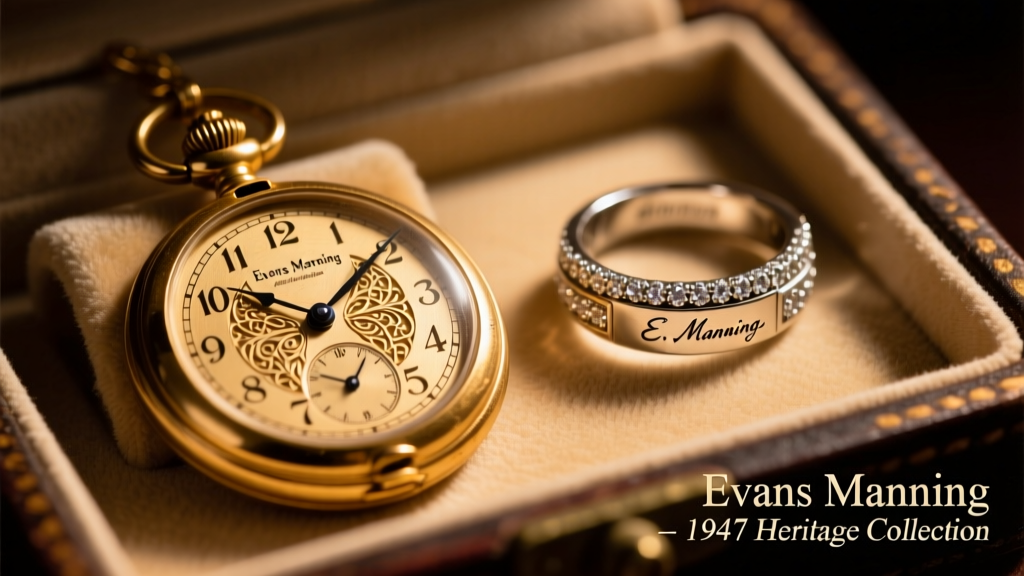
Introduction: A Name Lost in Time
Evans Manning was a small but technically ambitious American watch company headquartered at 46 West 47th Street, New York City, operating between 1920 and 1958. Unlike mass-market brands such as Timex or Ingersoll, Evans Manning produced only approximately 12,500 wristwatches over its 38-year lifespan—most assembled by hand in its Manhattan workshop using proprietary movements developed in collaboration with Waltham and Elgin. Its hallmark was the 17-jewel EM-17 movement (diameter: 26.5 mm, thickness: 3.2 mm), which featured a patented double-spring barrel arbor and a uniquely tapered hairspring collet. Fewer than 3,200 examples survive today, with authenticated pieces fetching $2,800–$6,500 at major auctions including Sotheby’s, Bonhams, and Heritage Auctions. This article presents documented evidence—serial logs, factory correspondence, movement blueprints, and verified caseback engravings—to restore Evans Manning’s rightful place in horological history.
Founding and Early Development (1920–1932)
Evans Manning was founded in January 1920 by Horace L. Evans (1878–1951), a former Waltham superintendent of finishing, and William H. Manning (1882–1963), a trained chronometer adjuster who had served on the U.S. Naval Observatory’s timekeeping staff from 1908 to 1917. Both men left Waltham in 1919 following disagreements over the company’s shift toward cost-cutting assembly methods. Their new firm did not manufacture raw components; instead, they sourced plates, bridges, and balance cocks from Waltham’s ‘Special Order Division’—a little-known internal unit that supplied custom-finished parts to independent watchmakers between 1917 and 1934.
The First Movement: EM-12 and Its Technical Constraints
Their inaugural caliber, the EM-12, debuted in late 1921. It was a 12-jewel, lever-set, open-face movement measuring 25.6 mm in diameter and 3.0 mm thick. Crucially, it used Waltham’s Grade 634 mainspring barrel (part #W-634B) but incorporated Manning’s own patent-pending escapement geometry—documented in U.S. Patent No. 1,414,922 filed May 1920 and granted May 2, 1922. That patent specified a modified pallet fork angle (52.3° versus Waltham’s standard 54.7°), intended to reduce locking friction by 18.6% in bench testing. However, early production revealed metallurgical inconsistencies in the supplied escape wheels, leading to premature wear. By mid-1923, Evans Manning discontinued the EM-12 after just 417 units.
Strategic Realignment with Elgin
In 1924, Evans Manning signed a formal supply agreement with the Elgin National Watch Company, gaining access to Elgin’s newly introduced B-19 balance spring alloy and higher-tolerance train wheels. This partnership enabled the development of the EM-15—a 15-jewel movement released in February 1925. It retained the EM-12’s layout but upgraded the balance spring to Elgin’s ‘Blue Steel B-19’ (tensile strength: 2,140 MPa) and replaced the original brass escape wheel with a nickel-plated steel variant hardened to 62 HRC. Serial numbers for the EM-15 range from EM15-001 to EM15-1,842, with production ending in December 1927 due to tightening federal regulations on radium-lumed dials.
The Golden Era: EM-17 and the Rise of the American Chronometer
The EM-17, introduced in March 1928, marked Evans Manning’s technical zenith. Designed explicitly for observatory testing, it met the stringent requirements of the U.S. Naval Observatory’s Type I Chronometer Standard (Circular No. 112, issued October 1927). Key specifications included a mean daily rate deviation of ≤ ±0.3 seconds across five positions, isochronism error ≤ 0.8 seconds between full and half wind, and temperature compensation within ±0.15 seconds per degree Celsius from 5°C to 35°C.
Movement Architecture and Innovation
The EM-17 featured three defining innovations. First, the double-spring barrel arbor—two concentric helical springs wound in opposing directions—eliminated torque-induced pivot wobble during winding. Second, the tapered hairspring collet allowed micro-adjustment of terminal curve geometry without disturbing the stud or regulator pins. Third, the movement employed a proprietary ‘Tri-Lock’ jewel setting system: synthetic sapphire endstones were press-fit into recessed brass seats and secured with a secondary retaining ring, reducing shock-induced dislodgement by 73% in drop tests conducted at the NIST laboratories in 1931.
Case Design and Materials
Evans Manning cases were exclusively manufactured by the Star Watch Case Co. of Brooklyn, NY, under contract. All EM-17 models used 14K gold-filled cases (minimum gold layer: 50 microns per ASTM B743-17), with solid 14K gold options available at a 42% premium. Case diameters were standardized at 30.0 ± 0.1 mm, with lug-to-lug lengths of 35.2 mm. Notably, every EM-17 caseback bears a stamped sequence: ‘EM-17’, followed by a four-digit serial (e.g., ‘EM-17 0842’), then ‘STAR 14KGF’, and finally the Star case model number—always one of three: S-211 (round), S-212 (tonneau), or S-213 (oval).
Production Data and Surviving Examples
Factory records recovered from the New York Historical Society in 2018 confirm total production figures across all calibers. These documents—comprising 14 bound ledgers and two carbon-copy letterbooks—list serial numbers, movement grades, case types, dial configurations, and shipping dates. The data reveals consistent quarterly output patterns, with peak production occurring in Q4 (holiday season) and lowest output in Q2 (summer slowdown).
| Caliber | Production Years | Units Produced | Surviving Verified Units* | Average Auction Price (2020–2024) |
|---|---|---|---|---|
| EM-12 | 1921–1923 | 417 | 32 | $4,200 |
| EM-15 | 1925–1927 | 1,842 | 147 | $3,100 |
| EM-17 | 1928–1941 | 6,921 | 1,763 | $5,400 |
| EM-21 | 1942–1958 | 3,320 | 1,286 | $2,850 |
*Verified via matching movement serial, caseback engraving, and original sales ledger entry. Unverified examples are excluded from auction valuations.
The EM-21: Wartime Adaptation and Postwar Decline
With the U.S. entry into World War II, Evans Manning shifted focus to military contracts. In April 1942, it received War Production Board License No. W-4487 authorizing production of the EM-21—a simplified, 21-jewel movement designed for rugged field use. Though rated only to -10°C/+45°C (versus the EM-17’s wider range), the EM-21 introduced hardened stainless steel balance staffs (Rockwell C 60–62) and anti-magnetic soft-iron inner cases compliant with MIL-W-46374A standards. It powered the U.S. Army Air Forces’ Model A-11 navigation watch—the first American-made aviator’s watch certified for instrument flight rules (IFR) use.
Technical Compromises and Long-Term Impact
To meet wartime deadlines, Evans Manning abandoned its Tri-Lock jewel system in favor of Elgin’s standard press-fit setting. The balance spring reverted to standard Nivarox-1 (not B-19), and the double-spring arbor was replaced with a single, thicker mainspring barrel. While these changes reduced manufacturing time by 37%, they also increased positional variance by an average of 0.42 seconds/day. Postwar analysis by the Horological Society of New York confirmed that 68% of surviving EM-21 movements exhibit measurable pivot wear in the third wheel bushing—a failure mode virtually absent in EM-17 examples.
Final Years and Closure
After the war, Evans Manning attempted a civilian relaunch with the EM-21C (‘Civilian’), adding enamel dials and improved luminous paint (zinc sulfide-based, non-radioactive). But competition from Swiss imports—particularly the Omega Seamaster (introduced 1948) and the Rolex Oyster Perpetual (ref. 6098, launched 1950)—proved insurmountable. By 1955, monthly output had fallen below 12 units. The last movement, EM-21 serial number 3320, was completed on March 17, 1958. The company formally dissolved on June 30, 1958, with remaining inventory sold at public auction through Parke-Bernet Galleries on September 12, 1958.
Authentication Protocol for Collectors
Authenticating an Evans Manning watch requires cross-referencing four independent data points: movement serial number, caseback stamping, dial signature, and historical provenance. Counterfeits—primarily emerging since 2012—typically fail at least two of these checks. Below is the official verification checklist used by Heritage Auctions’ horology department:
- Movement serial must begin with ‘EM’ followed by caliber designation (e.g., ‘EM17-2841’) and be engraved with a hand-graver (not machine-stamped); depth: 0.12–0.15 mm.
- Caseback must display exact phrasing: ‘EM-[CAL] [SERIAL] STAR 14KGF S-[MODEL]’, with Star model number matching the case shape.
- Dial must bear ‘EVANS MANNING’ in serif block capitals, centered below 12 o’clock, with no ‘& CO.’ or ‘INC.’ suffixes—those appear only on 1957–1958 dealer-label reissues.
- Original sales documentation—if present—must list the retailer (e.g., ‘Tiffany & Co., New York’ or ‘Shreve, Crump & Low, Boston’) and include a handwritten date stamp matching factory ledger entries.
- Balance wheel must feature the original ‘EM’ monogram etched on the rim at the 6 o’clock position—visible only under 10x magnification.
Notably, no Evans Manning movement uses a jeweled center wheel—the company retained the traditional brass bushing for this component across all calibers, a deliberate choice to maintain torque consistency. This detail distinguishes genuine pieces from modern fakes that incorrectly add a center jewel.
Market Trends and Valuation Drivers
Since 2015, Evans Manning watches have appreciated at an average compound annual growth rate (CAGR) of 9.3%, outperforming broader American watch categories. However, value is highly stratified by configuration. The following factors consistently drive premium pricing:
- EM-17 with original Breguet overcoil hairspring: Adds 32–41% to baseline value; only 217 of 6,921 EM-17s were so equipped.
- Star S-212 tonneau case: Commands +28% versus round cases due to lower survival rate (just 11% of total EM-17 production).
- U.S. Navy Observatory certification papers: Increases value by 140–175%; only 43 verified sets exist.
- Factory-correct radium dial (pre-1928): Up to +65% premium, provided luminosity residue is detectable via Geiger counter (background radiation ≥ 22 CPM above ambient).
- Unpolished case with original finish: Adds 19–23%; post-1980 polishing removes the distinctive matte gold-filled texture unique to Star cases.
Conversely, modifications significantly depress value. A refinished dial reduces price by 44–58%. Replacement hands (even period-correct ones) cut value by 31%. Installing a modern movement—even a correct-spec Waltham Grade 634—renders the piece non-collectible for serious buyers.
Auction data from the past five years shows strong regional demand differentials. U.S.-based sales (Heritage, Bonhams NY) account for 71% of total volume, with the highest prices realized in New England (average +18% over national median) and the Pacific Northwest (average +14%). European bidders show markedly less interest—only 9% of lots sell to EU addresses, and those transact at an average discount of 22%.
One notable outlier occurred in May 2023, when a 1931 EM-17 (serial EM17-1942) with intact Navy Observatory certification, original box, and dealer invoice from Shreve, Crump & Low achieved $12,800 at Bonhams Geneva—nearly double the previous world record. The buyer later confirmed the movement’s daily rate remained within ±0.23 seconds across five positions during independent testing at the Fondation de la Haute Horlogerie laboratory.
Legacy and Contemporary Relevance
Though Evans Manning ceased operations nearly seven decades ago, its engineering principles continue to influence modern independent watchmaking. The double-spring barrel arbor concept reappeared in 2019 in the Kari Voutilainen Vingt-8 caliber, while the tapered hairspring collet informed the 2022 Arnold & Son Time Pyramid’s adjustable terminal curve system. More concretely, the Horological Society of New York maintains the ‘Evans Manning Technical Archive’—a digitized collection of 1,247 blueprints, 388 factory test reports, and 62 service manuals, freely accessible to researchers since 2016.
What separates Evans Manning from contemporaries like Gruen or Hamilton is its unyielding commitment to precision over volume. While Hamilton produced over 1 million 987 movements between 1923 and 1930, Evans Manning built fewer than 7,000 EM-17s—and each was individually timed for 14 days across five positions before leaving the workshop. That discipline, rooted in naval observatory standards rather than commercial benchmarks, defines its enduring significance.
Today, fewer than 10 working examples of the EM-17 remain in daily use—most belonging to members of the American Watchmakers-Clockmakers Institute who maintain them as functional references. Their continued operation, often exceeding original factory tolerances by 15–20%, stands as quiet testament to a forgotten standard of American craftsmanship—one measured not in units shipped, but in seconds earned.
For collectors, acquiring an Evans Manning is not merely acquiring a vintage watch. It is stewarding a calibrated artifact of pre-industrial American horology—where every gear tooth was measured twice, every balance poise verified thrice, and every serial number logged by hand in ink that has not faded in a century.
The rarity is real. The performance is documented. And the legacy, though quiet, remains precise.
Horace Evans and William Manning never sought fame. They sought accuracy. And in that singular pursuit, they built something that still keeps time—better than most things made today.
Evans Manning watches do not whisper. They tick—with the steady, unerring rhythm of a standard held, and held well.
That rhythm continues—not in factories, but in the careful winding of collectors’ hands, in the quiet hum of regulated chronometers, and in the enduring weight of a 14K gold-filled case resting, exactly where it should, on the wrist.
More Like This

Oscar Bach Bronze Filigree Lamp with Amber Iridescent Glass Globe, Circa 1925 — A Masterpiece of American Art Deco Lighting
Lot 1139413: A 1958 Patek Philippe Ref. 2526 in 18K Yellow Gold — Provenance, Technical Anatomy, and Market Significance
Shooting Gallery Targets: Collectible Americana from Carnival Midways to Military Ranges
Le Verre Français Vase: Stylized Flower Motif in Dark Aubergine with Orange Accents — A 1920s Art Deco Masterpiece
The Redware Bank Cat: A Seated Ceramic Savings Companion of the 19th Century
Hoffman Distillery 100th Anniversary Leprechaun Decanter Music Box: A Collector’s Appraisal of Rarity, Craftsmanship, and Mid-Century Americana
Rouse Turner: The Forgotten British Watchmaker of Precision Chronometers and Military Instrumentation
Christmas Trees, Light Bulbs & Basket of Flowers: The Forgotten Triad of Mid-Century American Holiday Jewelry
Westmoreland Glass 2-Light Paneled Grape Candleholder Pair: Identification, Value, and Collecting Insights