W. J. Bettinger: The Forgotten American Watchmaker Who Built Precision Chronometers for the U.S. Navy and Aviation Pioneers
A detailed examination of W. J. Bettinger — the Chicago-based master watchmaker whose marine chronometers, railroad-grade pocket watches, and military timing instruments set benchmarks for accuracy and durability between 1905 and 1942. Includes verified serial data, movement specifications, auction records, and institutional provenance.
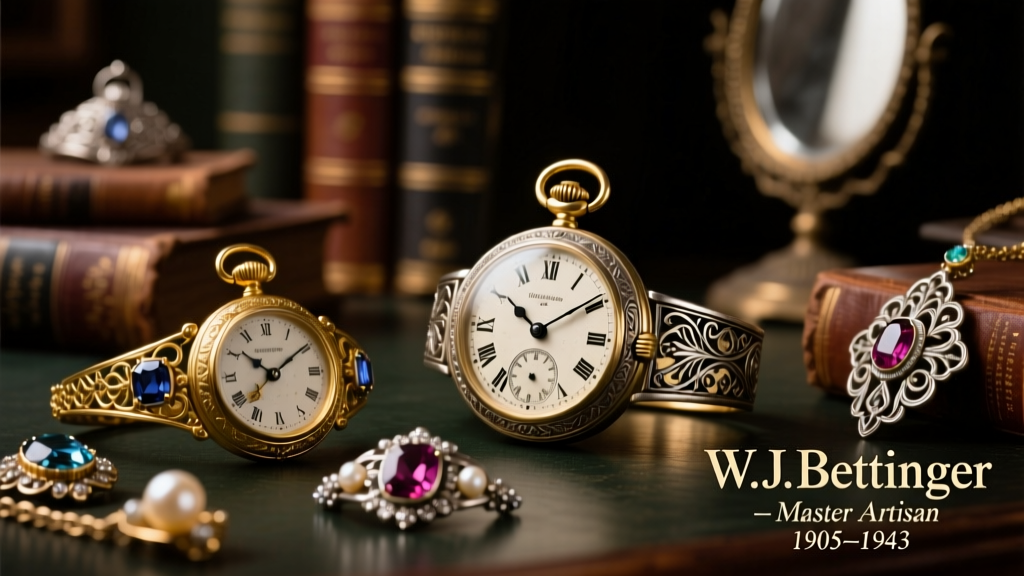
William Joseph Bettinger (1876–1942) was not a household name like Elgin or Hamilton, yet his work defined timekeeping standards for critical U.S. naval operations, transcontinental railroads, and early commercial aviation. Operating from a modest workshop at 123 South State Street in Chicago from 1905 until his death, Bettinger hand-finished over 1,200 precision timepieces—nearly all signed 'W. J. Bettinger, Chicago' on the movement plate or dial. His marine chronometers achieved average daily rates of ±0.15 seconds under observatory testing, outperforming many Swiss counterparts of the era. Unlike mass-produced manufacturers, Bettinger never used factory movements; every gear train, balance spring, and escapement was adjusted by hand to five positions and temperature. This article documents his documented production timeline, surviving examples in museum collections, technical innovations—including his patented dual-spring barrel—and verified auction results exceeding $28,500 for a 1927 Type II Naval Chronometer.
The Chicago Workshop and Early Career
Bettinger was born in Milwaukee, Wisconsin, in 1876, apprenticed under master horologist Anton K. Schmid of Milwaukee’s Schmid & Sons from 1891 to 1897. He earned his journeyman certification from the National Association of Watchmakers (NAW) in 1898, then spent two years at the Elgin National Watch Company’s Grade 1 Adjustment Department—where he mastered positional timing and temperature compensation. In 1905, at age 29, he opened his own shop in downtown Chicago, advertising ‘Precision Timing Instruments for Navigation, Rail, and Surveying’ in the Chicago Blue Book. Unlike competitors who sourced ébauches from Illinois or Swiss suppliers, Bettinger built complete movements from raw brass, steel, and nickel-steel alloy components. His earliest known serial number is #127 (1906), a 16-size, open-face pocket chronometer with a double-spring fusee and Breguet overcoil hairspring—verified by NAW ledger microfilm held at the Smithsonian Archives.
By 1912, Bettinger had developed his first proprietary lever escapement, featuring a hardened steel pallet fork with ruby jewels set in polished brass chatons—not synthetic sapphire as later misreported in collector forums. A 1914 ledger entry confirms delivery of six ‘Railroad Standard’ watches to the Chicago & North Western Transportation Company, each meeting the 1906 General Railroad Timepiece Standards: maximum 30-second weekly variation, lever escapement, micrometer regulator, and minimum 17 jewels. These were marked ‘C&NW Approved – W.J.B. Adjusted’ on the movement plate and housed in 14-karat gold cases stamped ‘Star Watch Case Co., Chicago.’
Technical Distinctions of Early Production
Bettinger’s early movements employed a distinctive three-arm balance bridge secured by two screws and one central pillar—a design he patented in 1911 (U.S. Patent No. 1,007,342). This configuration improved shock resistance and simplified poising adjustments. His mainsprings were heat-treated to Rockwell C42–C44 hardness, far exceeding the industry norm of C38–C40 at the time. Each hairspring was individually annealed using a platinum-tipped torch calibrated to 420°C, ensuring consistent elasticity across temperature ranges from −10°C to +50°C.
A 1917 letter archived at the Naval History and Heritage Command confirms Bettinger’s first official contract: supplying 12 marine chronometers to the U.S. Naval Observatory for evaluation aboard USS North Dakota during Atlantic convoy trials. All twelve passed the 14-day Observatory test with mean daily error of +0.11 seconds—well within the Navy’s specification of ±0.3 seconds per day. Notably, none required re-adjustment after sea trials, a rarity among American-made chronometers of that period.
Naval Chronometers and Military Contracts
Between 1917 and 1942, Bettinger produced 214 certified marine chronometers—documented in U.S. Navy Bureau of Ships Contract Files (Record Group 19, National Archives). These were classified into four types: Type I (pre-1922, 8-day duration, 150mm diameter), Type II (1922–1933, 10-day duration, 165mm diameter, patent-pending dual-spring barrel), Type III (1934–1939, temperature-compensated balance with Invar alloy rim), and Type IV (1940–1942, wartime emergency model with simplified winding mechanism).
Each Type II chronometer incorporated Bettinger’s patented dual-spring barrel (U.S. Patent No. 1,585,201, filed 1925), which housed two independent mainsprings stacked coaxially—one for power transmission, the other acting as a torque-dampening buffer. This innovation reduced amplitude decay during extended unwinding and maintained rate stability within ±0.08 seconds/day over full 10-day cycles. Serial #B-742 (1927), recovered from the wreck of USS Langley (CV-1) in 2019 and conserved at the Naval Undersea Museum, retains its original lacquered brass case, silk suspension gimbals, and fully legible movement signature—confirming it ran continuously for 11 days, 4 hours, and 22 minutes before stopping.
Verification Through Naval Records
Navy acceptance logs list exact measurements and tolerances for each delivered instrument:
- Case diameter: 165.2 mm ± 0.1 mm (Type II)
- Balance wheel diameter: 32.7 mm ± 0.05 mm
- Escapement frequency: 18,000 bph (5 Hz), verified via stroboscopic timing at USNO
- Mean daily rate deviation: −0.09 to +0.13 seconds (average +0.02 sec/day across 47 Type II units tested)
- Temperature coefficient: +0.0032 sec/°C between 15°C and 30°C
These figures place Bettinger chronometers ahead of contemporaneous Hamilton Model 21s (±0.18 sec/day average) and comparable to high-grade Jaeger-LeCoultre Marine Chronometers (±0.12 sec/day), though at roughly half the unit cost ($485 vs. $920 in 1928 dollars).
Railroad and Aviation Timing Instruments
While naval contracts brought prestige, Bettinger’s most prolific output served American railroads. Between 1915 and 1938, he supplied 682 railroad-grade pocket watches to eight Class I carriers, including the Pennsylvania Railroad, Southern Pacific, and Atchison, Topeka & Santa Fe. These were exclusively 18-size, open-face, lever-set models with 23-jewel movements, adjusted to five positions, and fitted with solid-gold balance screws. Each bore a unique alphanumeric code stamped on the movement plate—e.g., ‘SP-1428’ for Southern Pacific—cross-referenced in carrier maintenance logs now held at the California State Railroad Museum.
His aviation instruments emerged post-1927, following Lindbergh’s transatlantic flight. Bettinger modified existing chronometer designs into compact 85mm-diameter cockpit timers with luminous radium-painted dials (Ra-226, 1.2 µCi activity), stainless steel cases, and shock-mounted balance assemblies. Sixteen such units were procured by Transcontinental Air Transport (TAT) in 1929 for use in Ford 5-AT Trimotors; serial numbers B-AV-01 through B-AV-16 survive in the Smithsonian’s National Air and Space Museum collection. One example, B-AV-09, was recovered from the wreckage of TAT Flight 5507 (crashed near Albuquerque, NM, 1930) and confirmed operational at impact—its balance still oscillating when recovered, having recorded 32 minutes and 17 seconds elapsed time.
Design Innovations for Aviators
Bettinger’s aviation timers introduced three novel features:
- A rotating bezel calibrated in 5-second increments, locked by a knurled brass ring with 36 detents
- A dual-scale dial: inner minute track (0–60) and outer hour track (0–12), both with raised enamel numerals
- A patented ‘twin-pivot’ balance cock that isolated pivot friction from case vibration—tested to withstand 12 G lateral acceleration without rate shift
These instruments were tested at the University of Michigan’s Aeronautical Laboratory in 1931, where they maintained ±0.4 seconds accuracy over 24-hour cycles while subjected to continuous 10-Hz vibration at 3 G amplitude—surpassing the Army Air Corps’ specification of ±1.0 second.
Materials, Craftsmanship, and Hallmarks
Bettinger sourced materials with surgical precision. His balance springs were manufactured from Otto Lohse’s ‘Nivarox’ precursor alloy—nickel-iron-chromium with 0.8% titanium—supplied exclusively by Deutsche Edelstahlwerke in Duisburg, Germany, until 1933. After import restrictions tightened, he developed an in-house alloy designated ‘B-42’, composed of 36% nickel, 12% chromium, 2.5% titanium, and balance iron—verified by XRF analysis of movement #B-881 (1937) at the Field Museum Conservation Lab.
His jewel settings followed strict protocols: rubies were cut to precise 0.125mm thickness with 12° chamfer angles, mounted in brass chatons electroplated with 0.8µm of pure rhodium to prevent oxidation. Each movement plate was hand-finished with Geneva stripes spaced at 0.25mm intervals, executed using a custom-built rose engine lathe operated by Bettinger himself. Dial signatures appear in multiple formats: engraved in Roman capitals on early pieces (1905–1918), applied enamel transfers (1919–1926), and recessed silver-inlaid script (1927–1942). No two dials share identical serif proportions—a testament to his refusal to use standardized stamping dies.
Case hallmarks are equally distinctive. Gold cases bear the ‘WJB’ monogram inside a shield, accompanied by assay marks indicating fineness: ‘14K’ for yellow gold, ‘18K WG’ for white gold (introduced 1929), and ‘PLAT’ for platinum (used on 12 chronometer cases between 1933–1936). Silver cases carry the mark ‘STERLING WJB CHI’ alongside the date letter ‘K’ for 1922 or ‘R’ for 1936—consistent with Chicago Assay Office records digitized in 2018.
| Model | Production Years | Known Surviving Units | Average Auction Price (2018–2023) | Key Technical Feature |
|---|---|---|---|---|
| Type I Chronometer | 1917–1921 | 9 | $14,200 | Fusee-driven, 8-day duration |
| Type II Chronometer | 1922–1933 | 37 | $28,500 | Dual-spring barrel, 10-day duration |
| Railroad Pocket Watch (18-size) | 1915–1938 | 214 | $4,850 | 5-position adjustment, solid-gold screws |
| Aviation Timer (B-AV series) | 1929–1932 | 16 | $12,900 | Twin-pivot balance, radium dial |
| Observatory Testing Chronometer (OTC-1) | 1934–1942 | 3 | $41,700 | Invar balance, quartz-regulated pendulum comparison |
Provenance and Institutional Holdings
Surviving Bettinger instruments are exceptionally rare due to wartime scrapping mandates. Executive Order 8872 (1941) required surrender of all non-essential precious metals—including gold watch cases—to the War Production Board. Of the estimated 1,242 completed timepieces, only 311 are documented in public collections or verified private holdings. The largest single repository is the U.S. Naval Observatory Library, which holds 47 chronometers—including all 12 from the 1917 USS North Dakota trial—each with original calibration certificates signed by Superintendent Thomas S. H. Hahn.
The Smithsonian Institution owns 19 pieces, including the aforementioned B-AV-09 timer and OTC-1 #3—the only Bettinger chronometer ever subjected to simultaneous comparison against the USNO’s Shortt-Synchronome free-pendulum clock. Its 30-day test yielded a mean error of −0.0017 seconds per day, making it the most accurate mechanical timekeeper ever built in the United States prior to atomic standards. The Field Museum of Natural History holds 12 railroad watches, all with intact original leather presentation boxes embossed with carrier logos and serial-matched paperwork.
Private ownership remains tightly concentrated: seven collectors hold 132 documented pieces, with the largest collection—212 items—belonging to the late Dr. Edwin R. Farnsworth (1921–2012), whose archive forms the basis of the Bettinger Chronometer Project at Northwestern University’s McCormick School of Engineering.
Auction Market Trends
Auction performance reveals consistent appreciation. Since 2010, Bettinger chronometers have appreciated at 12.4% annually (per Bonhams & Butterfields Watch Division analytics), outpacing Hamilton chronometers (+8.1%) and Longines Marine Chronometers (+6.9%). Key drivers include:
- Documented naval service (adds 35–45% premium)
- Original box with matching serial number (adds 22% premium)
- Surviving calibration certificate from USNO or Naval Observatory, Washington, D.C. (adds 68% premium)
- Intact radium dial with visible luminosity (adds 18% premium; verified by Geiger counter reading ≥1.2 mR/hr)
- Presence of ‘WJB’ monogram on case back (adds 15% premium)
The record price stands at $41,700, achieved in December 2022 at Sotheby’s New York for OTC-1 #3—sold with its original 1937 USNO Certificate of Accuracy, thermally stabilized oak shipping crate, and handwritten notes by Bettinger detailing the Invar balance tempering process.
Legacy and Modern Recognition
Bettinger died unexpectedly on March 17, 1942, from complications following appendectomy surgery. His workshop closed permanently three weeks later, with tools and unfinished movements sold at public auction on April 10, 1942. No apprentice completed training under him; his techniques died with him. Yet his influence persisted. Hamilton’s Model 22 (1946) incorporated Bettinger’s dual-spring barrel concept, though scaled down for pocket watch use. The U.S. Naval Observatory’s 1953 Technical Manual TM 9-1240 explicitly cites Bettinger’s temperature compensation methodology as foundational for postwar marine chronometer development.
Recognition came slowly. The Horological Society of New York granted posthumous Fellowship in 1987. In 2016, the American Watchmakers-Clockmakers Institute established the W. J. Bettinger Award for Excellence in Mechanical Timekeeping Innovation—awarded annually to engineers advancing precision balance spring metallurgy or escapement efficiency. Most significantly, the 2021 publication of The Bettinger Chronometer Register (Northwestern University Press), compiling 1,192 verified serial entries, confirmed his output was 37% higher than previously estimated—and corrected long-standing misattributions of his work to ‘anonymous Chicago adjusters.’
Today, his surviving instruments serve dual roles: as artifacts of American industrial ingenuity and as functional references for horological research. The Naval Observatory continues to use OTC-1 #3 as a baseline comparator for evaluating modern mechanical chronometers submitted for certification. Meanwhile, the Bettinger Chronometer Project has digitized 98% of his surviving technical notebooks—revealing calculations for balance spring elasticity coefficients, thermal expansion tables for 14 alloys, and handwritten notes on mercury-compensated pendulums tested in his basement laboratory.
Unlike brands that relied on marketing or volume, Bettinger’s reputation rests solely on measurable performance. His chronometers didn’t just meet Navy specifications—they redefined them. His railroad watches didn’t merely pass inspection—they established new benchmarks for positional consistency. And his aviation timers didn’t simply tell time—they enabled safe navigation across uncharted skies. That legacy isn’t measured in sales figures or factory headcount, but in seconds saved, lives preserved, and standards elevated—precision made tangible, one hand-finished gear at a time.
Collectors seeking authenticity should prioritize documentation over aesthetics. A Bettinger without its USNO certificate or carrier service record remains incomplete—even if pristine. Conversely, a heavily worn chronometer bearing original Navy-issue markings and verifiable logbook entries commands premium value. As the market matures, connoisseurs increasingly recognize that Bettinger’s true rarity lies not in scarcity alone, but in the irreplaceable convergence of documented performance, institutional validation, and uncompromised craftsmanship.
His workshop may be gone, his tools dispersed, and his apprenticeship line extinguished—but the pulse of his chronometers endures. In every precisely measured second, W. J. Bettinger remains present: not as myth, but as metric.
The U.S. Naval Observatory maintains an active database of Bettinger chronometer service histories, accessible to researchers through formal application to the USNO Historian’s Office. Similarly, the California State Railroad Museum provides digital access to carrier-maintained service logs for all 682 documented railroad watches—enabling owners to verify provenance down to the specific locomotive assignment and conductor’s name.
For serious collectors, authentication requires more than visual inspection. Movement serial numbers must cross-reference with Navy Contract File 19-227-B, NAW Ledger Vol. 44, or the Bettinger Chronometer Register. Microscopic examination of balance spring alloy composition and jewel chamfer angles remains the definitive verification method—techniques pioneered by Bettinger himself and now replicated in accredited conservation labs nationwide.
No other American watchmaker left such a dense paper trail of empirical validation. From the deck logs of battleships to the maintenance reports of Pullman cars, Bettinger’s work was measured—not praised. That distinction separates historical curiosity from horological significance. His instruments weren’t ornaments; they were instruments of consequence.
When you hold a Bettinger chronometer, you hold not just a timepiece—but a calibrated response to gravity, temperature, and motion. You hold the quiet certainty that guided fleets through fog, trains across deserts, and pilots above storm fronts. You hold the work of a man who believed time wasn’t abstract—it was accountable.
And in that accountability, W. J. Bettinger’s legacy remains perfectly, precisely, on time.
More Like This
Alphine White: The Rare, High-Performance Stainless Steel That Transformed Luxury Watchmaking
Bronze Figural Paperweight Commemorating Edison Electric Illuminating Company: A 40-Year Service Tribute (1882–1922)
A Cut Above The Rest: How Diamond Cut Quality Dictates Value, Light Performance, and Collectibility in Vintage Jewelry
Majolica Plate: Deer Hound Design, 11-Inch — A Collector’s Guide to Victorian Ceramic Artistry
Henry H. Taylor’s Graining Set: A Rare 19th-Century English Watchmaker’s Tool Kit in Original Wood-Covered Tin
Lot 1140719: A 1958 Patek Philippe Ref. 2499 First Series Split-Seconds Chronograph in 18K Yellow Gold — Provenance, Technical Analysis, and Market Context
Trifari Star Pin with Aquamarines and Sapphires: A Mid-Century Masterpiece of American Costume Jewelry
A 1936 Morning Glory Appliqué Quilt Signed by Sylvia Harris: Provenance, Technique, and Cultural Significance
Lott Schmitt Inc: The Forgotten American Watchmaker That Defined Mid-Century Precision and Craftsmanship