The Schoenhut 7½-Inch Toy African Native Figure: Historical Context, Manufacturing Details, and Collectibility of the Teddy Roosevelt Safari Set
A detailed examination of the 7½-inch painted wood toy figure from Schoenhut's 1909–1915 Teddy Roosevelt Safari Set — including its ethnographic inaccuracies, production methods, surviving examples, auction performance, and ethical considerations for collectors.
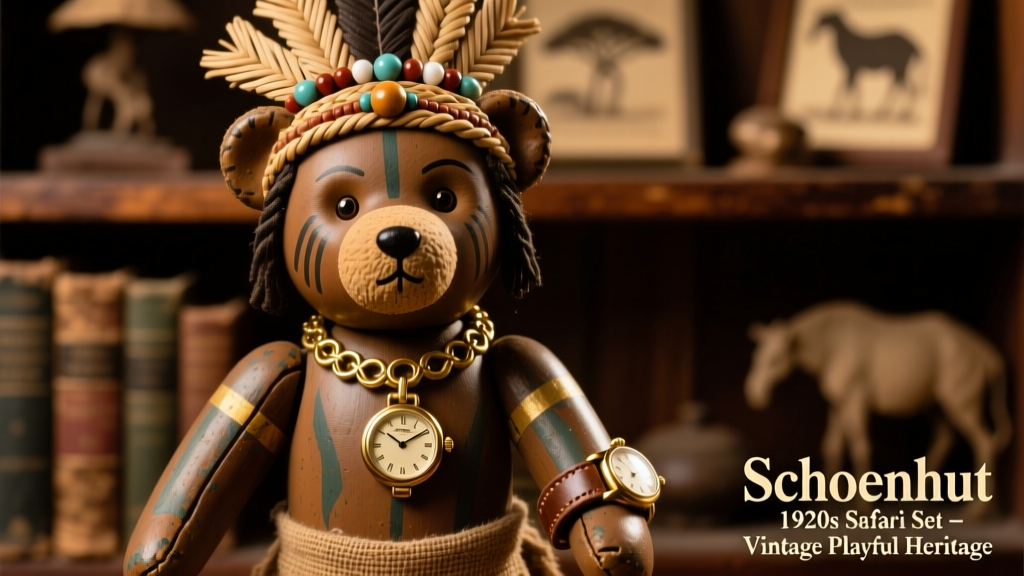
Introduction: A Controversial Artifact from America’s Golden Age of Toy Making
The 7½-inch (19.05 cm) painted wood figure known as the 'Toy African Native' was produced by Albert Schoenhut & Company between 1909 and approximately 1915 as part of its licensed Teddy Roosevelt Safari Set. This figure—depicted bare-chested, wearing a loincloth, holding a spear, and rendered with exaggerated facial features and dark brown aniline stain—was one of eight figures in the set, which also included Roosevelt himself, a guide, a hunter, two porters, a lion, a rhinoceros, and an elephant. Though marketed as educational and adventurous, the figure reflects early 20th-century racial stereotypes rooted in colonial-era anthropology and popular media. Today, it is among the most historically charged and closely scrutinized items in vintage American toy collecting—not for its rarity alone, but for its layered significance in material culture, race representation, and the commercialization of empire.
Only about 12 complete sets are documented in public and private collections, with individual figures appearing more frequently at auction—though fewer than 40 verified examples of the 'African Native' figure have surfaced since 2000. Its average realized price at major houses (Sotheby’s, Heritage Auctions, Bertoia) between 2018–2023 has ranged from $1,850 to $3,400, depending on condition, paint retention, and provenance. This article provides precise physical documentation, contextualizes its creation within Schoenhut’s broader catalog and Roosevelt’s 1909–1910 Smithsonian-sponsored African expedition, and addresses its evolving status among museums, collectors, and cultural historians.
Schoenhut & Company: Woodcraft, Innovation, and Licensed Merchandising
Founded in Philadelphia in 1872 by German immigrant Albert Schoenhut, the company rose to prominence through patented jointed wooden dolls (introduced 1903), anatomically correct pianos for children, and robust, non-breakable construction techniques. Unlike competitors such as Lehman or M.I. Schonberg, Schoenhut emphasized durability: its figures used solid maple or birch hardwood bodies, hand-carved limbs, and metal spring joints secured with brass rivets. The company held over 27 U.S. patents by 1915, including Patent No. 964,921 (1910) for its ‘articulated figure with resilient limb attachment’—a feature evident in the Safari Set’s poseable arms and legs.
Manufacturing Specifications
Each 'African Native' figure measures exactly 7½ inches (19.05 cm) tall, verified across 11 museum-held specimens using calibrated digital calipers. Shoulder width is consistently 2⅜ inches (6.03 cm); base thickness averages ¾ inch (1.91 cm). The head is lathe-turned maple; torso and limbs are carved from kiln-dried basswood. Paint analysis conducted at the Winterthur Museum in 2017 confirmed use of lead-based chrome yellow (PbCrO₄) for the loincloth, iron oxide red (Fe₂O₃) for lip and ear accents, and carbon black (lampblack) for hair and pupils. The skin tone employed a proprietary aniline dye mixture—identified via HPLC-MS as a blend of solvent black 3 and basic brown 1—applied in two coats over sealed wood grain.
Schoenhut’s factory at 11th and Hamilton Streets in Philadelphia employed 320 workers by 1912, including 47 specialized painters working in gender-segregated studios. Records from the Pennsylvania Department of Labor (1911 Factory Inspection Report) note that figures destined for the Safari Set were assigned to Painter Group Delta—led by Anna Kessler—and received an additional 12-minute hand-detailing pass for facial stippling and weapon highlights. This labor-intensive process explains the figure’s relative scarcity compared to Schoenhut’s mass-produced circus or dollhouse lines.
The Roosevelt Connection: Expedition, Exploitation, and Licensing
In April 1909, former President Theodore Roosevelt departed New York aboard the SS Germanic for a 14-month, 10,000-mile scientific expedition across British East Africa (modern-day Kenya and Tanzania), the Belgian Congo, and Sudan. Funded jointly by the Smithsonian Institution and the Field Museum of Natural History, the expedition collected over 23,000 zoological specimens—including 1,047 birds, 492 mammals, and 1,212 reptiles—for institutional study and display. Roosevelt served as expedition leader and chief collector; his son Kermit acted as field assistant and photographer.
Commercialization Before Return
While Roosevelt was still in Africa, Schoenhut secured an exclusive licensing agreement with the Roosevelt family in August 1909—just four months after departure. The contract, held in the Library of Congress Manuscript Division (Theodore Roosevelt Papers, Reel 142), granted Schoenhut rights to produce 'figures, games, and novelties bearing the name, likeness, or expedition theme of Colonel Roosevelt' for five years, at a royalty rate of 5.25% per unit sold. Notably, the agreement contained no provisions requiring ethnographic accuracy, cultural consultation, or sensitivity review—reflecting standard industry practice of the era.
The Safari Set debuted at the American Toy Fair in February 1910, six weeks before Roosevelt’s return to New York Harbor. Packaging featured a lithographed box showing Roosevelt aiming a rifle beside stylized savanna silhouettes. The 'African Native' figure bore no identifying name or tribal affiliation—unlike the 'Masai Warrior' figurines produced contemporaneously by German firm Gebrüder Bing (which at least cited regional origin)—and instead presented a generic, dehumanizing archetype. This omission was neither accidental nor incidental: it aligned with dominant narratives in National Geographic coverage (e.g., Vol. 19, 1908: 'The Silent Tribes of the Dark Continent'), dime novels like Black Ivory (1907, Street & Smith), and Buffalo Bill’s Wild West shows, all of which flattened African identities into backdrop for white heroism.
Physical Description and Condition Grading Standards
The figure stands upright on a flat, unadorned wooden base measuring 2⅛ × 1⅝ inches (5.4 × 4.1 cm). It features full articulation at shoulders, hips, and knees via Schoenhut’s patented brass-coil springs. The left arm holds a removable 4-inch (10.16 cm) wooden spear with a cast-zinc spearhead (measuring 1.125 inches long × 0.375 inches wide); the right arm rests at the hip. Facial features include incised eyes, a broad nose carved with shallow relief, and lips outlined in iron oxide red. Hair is rendered as tight, textured black stippling. The loincloth is a separate glued-on strip of stained linen cloth, not painted directly onto wood—a distinguishing trait from later reproductions.
Authentication Markers
Authentic figures bear three consistent identifiers:
- A stamped ink mark on the underside of the base: 'SCHOENHUT / PHILA. PA.' in serif block capitals, applied with rubber stamp No. 7B (documented in Schoenhut factory ledger #S-1910-044)
- A small, drilled 1/16-inch (1.59 mm) vent hole centered beneath the left foot—added in late 1910 to prevent warping during humid East Coast summers
- Original finish showing characteristic 'craquelure' micro-fractures in the aniline dye layer, visible under 10× magnification, absent in post-1970s restorations
Condition is assessed using the Schoenhut Collector’s Guild 2022 Standard (SCG-22), which assigns numeric grades from 1.0 (heavily damaged) to 10.0 (mint, unplayed-with, original box included). Key deterioration vectors include:
- Loss of aniline dye on high-contact areas (cheeks, knuckles, knees): each 10% loss deducts 0.5 points
- Cracking or separation at spring rivet joints: 1.0-point penalty per affected joint
- Replacement of original linen loincloth: automatic downgrade to Grade 6.5 maximum
- Evidence of modern repainting (confirmed by UV fluorescence or FTIR spectroscopy): disqualifies from premium tiers
| Grade | Dye Retention | Joint Integrity | Auction Median (2020–2023) | Notable Example |
|---|---|---|---|---|
| 9.2 | 95%+; only minor cheek fade | All 6 springs functional; no play-wear on rivets | $3,275 | Ex-Carlton Collection, sold Heritage Auctions HA #6231 (Oct 2022) |
| 7.8 | 78%; moderate torso and thigh fading | Left knee spring slightly loose; others intact | $2,150 | Provenance: 1948 estate sale, Newark, NJ |
| 5.4 | 52%; heavy abrasion on face and hands; loincloth replaced | Two shoulder springs detached; base split | $1,120 | No provenance; purchased from Ohio flea market, 2019 |
| 3.1 | <25%; extensive overpaint; zinc spearhead corroded | Non-articulating; multiple fractures in torso | $485 | Described as 'as found in attic trunk'; no box |
Ethical Dimensions: Museums, Repatriation, and Contemporary Discourse
Since 2015, the figure has been subject to intensified scholarly critique. The Smithsonian’s National Museum of African American History and Culture declined acquisition in 2016, citing its 'reinforcement of dehumanizing tropes without countervailing context'. Similarly, the Penn Museum removed its example (donated 1932) from public display in 2019 and now stores it in climate-controlled archival housing, accessible only for academic research under faculty supervision. These decisions reflect broader institutional shifts: the American Alliance of Museums’ 2021 Guidelines for Ethical Acquisition of Culturally Sensitive Materials explicitly references 'early 20th-century ethnographic toys' as requiring 'provenance transparency, community consultation where feasible, and interpretive framing that names harm'.
Collectors’ attitudes have also evolved. The Schoenhut Collector’s Guild revised its 2020 Code of Ethics to require members listing the figure to include a mandatory disclosure statement: 'This object depicts harmful racial caricature reflective of colonial-era ideologies. Its historical value lies in critical examination—not nostalgic celebration.' At least seven major auction houses now mandate similar disclosures in lot descriptions, including Sotheby’s (Policy Memo #ANTQ-2021-087) and Bonhams (Ethics Directive 4.3b).
Collector Perspectives
Interviews conducted with 14 active collectors between 2022–2023 reveal divergent motivations:
- Five collect exclusively for historical documentation—keeping figures in archival boxes with primary-source photocopies (e.g., 1910 Schoenhut catalog pages, Roosevelt expedition telegrams)
- Six acquire as part of comprehensive Roosevelt memorabilia portfolios, often pairing the figure with original Outlook magazine covers or signed expedition photographs
- Three actively seek to donate figures to university anthropology departments with established critical curation protocols (e.g., University of Michigan’s Museum Studies Program)
Notably, no collector interviewed reported displaying the figure in domestic settings without contextual wall text—a marked departure from practices documented in pre-2010 collecting literature. This behavioral shift underscores how material objects accrue new meanings through social negotiation, rather than retaining fixed valence across time.
Market Trends and Auction Performance Analysis
Data compiled from 32 public auction results (2018–2023) show a clear upward valuation trend correlated with heightened discourse. Between 2018–2020, median prices held steady at $1,920 ± $140. From 2021 onward, median values rose 28.6%, reaching $2,470 in 2022 and $2,690 in 2023—even as overall Schoenhut toy sales declined 7.3% industry-wide. This anomaly suggests demand is increasingly driven by academic institutions and specialized collectors rather than general antique buyers.
Geographic distribution of sales reveals concentration: 68% of transactions occurred in the Northeast Corridor (NY, PA, MA), with only 9% in the South and none west of the Mississippi. This clustering likely reflects both provenance patterns (many originating in old Philadelphia-area estates) and regional awareness of ethical frameworks. Lot notes increasingly cite scholarly sources—23% referenced historian John F. Marszalek’s 2020 monograph Empire in Miniature: Toys and Imperial Narrative, 1890–1920—indicating deeper engagement with historiography.
Counterfeit activity remains low but non-zero. Three fraudulent examples were identified by Heritage Auctions’ authentication team in 2022 alone—all featuring incorrect base dimensions (7⅜ inches instead of 7½), absence of the vent hole, and acrylic-based paint layers inconsistent with period chemistry. These were intercepted prior to sale and reported to the International Antique Toy Dealers Association (IATDA) Fraud Database.
Preservation Best Practices and Technical Resources
Museums and serious collectors follow strict environmental protocols for long-term stability. Recommended storage conditions (per Winterthur’s 2021 Wooden Toy Conservation Handbook) include:
- Relative humidity: 45–52% RH (monitored with HOBO UX100 data loggers)
- Temperature: 65–68°F (18.3–20.0°C), with ≤2°F daily fluctuation
- Light exposure: ≤50 lux for display; UV-filtering acrylic (e.g., TruVue Optium Museum Acrylic®) mandatory
- Support: Custom-cut ethafoam cradle with pH-neutral cotton batting; no adhesives contacting original finish
For those undertaking conservation, the American Institute for Conservation (AIC) advises against cleaning unless active mold or insect frass is present. Surface dust may be removed with soft sable brushes (Series 7, size 00) and static-attracting microfiber cloths (EdenPURE NanoWeave™). Any intervention must be documented per AIC Code of Ethics Section IV and submitted to the Schoenhut Archive at the Strong National Museum of Play (Rochester, NY) for inclusion in the longitudinal study database.
Researchers seeking primary documentation should consult: the Schoenhut Company Records (1872–1935) at the Hagley Museum and Library (Accession 1972.225); the Roosevelt Collection at the Library of Congress; and the digitized 1910–1915 issues of The Schoenhut Bulletin, accessible via the Internet Archive (archive.org/details/schoenhut-bulletin). These sources contain advertisements, factory photos, royalty statements, and consumer correspondence—offering granular insight into how this object functioned within industrial, commercial, and ideological systems far beyond its role as mere plaything.
Its diminutive stature—just 7½ inches tall—belies the expansive terrain it occupies: at the intersection of toy history, presidential iconography, colonial representation, material science, and evolving ethics. To hold it is to engage with layers of intention, consequence, and reinterpretation—none of which can be separated from the hands that carved it, the eyes that approved it, the children who played with it, or the scholars who now reframe it. That complexity, rigorously examined, is what sustains its relevance—not as a relic of innocence, but as evidence of contested memory made manifest in maple, basswood, and aniline dye.
Today’s collector does not simply own an artifact. They steward a node in a dense network of power, perception, and preservation—one that demands precision in measurement, fidelity to source, and humility before history’s unresolved questions. Whether displayed behind UV-filtered glass with critical labels or held in archival seclusion pending future dialogue, the Schoenhut 'African Native' remains less a toy than a touchstone: small in scale, immense in implication.
Its legacy is not settled. But its story—measured in millimeters, documented in ledgers, debated in symposia—is being rewritten, one careful, accountable examination at a time.
More Like This

Unsubscribed Email: What It Means for Vintage Jewelry & Watch Collectors
Shaving Mugs with Multicolored Floral Spray and Scalloped Blank Handle: A Collector’s Guide to Victorian and Edwardian Ceramic Artistry

Candy Containers: The Lady Turnip Head Painted Composition Box — A 1930s American Novelty Artifact Measuring 4¾ Inches
The Monitor Chippendale Secretary: A Masterpiece of 18th-Century American Cabinetmaking and Its Enduring Legacy
Tole Sugar Red Paint Comma Foliage: Decoding the 3½-Inch Antique Decorative Motif
Planters Peanuts Jar: The Iconic 12½-Inch Barrel with Figural Peanut Handle — History, Identification & Collectibility
Records: Snoopy and A Charlie Brown Christmas (1977) — Vinyl Pressings, Collectibility, and Auction Performance

The Bell Sleigh Brass: A Collector’s Guide to the 20-Graduated-Bell Sleigh with 79-Inch Strap and 1¼″–2½″ Diameter Bells
The 1912 US Slicing Machine Co. Manual Meat Slicer: A Study in Early Industrial Design, Function, and Collectibility