Insulators Diamond P No. 010 Green: A Technical and Historical Deep Dive into a Rare Vintage Watch Movement Component
A detailed examination of the Insulators Diamond P No. 010 Green — a rare, Swiss-made synthetic sapphire insulator used in high-grade mechanical watch movements from the 1950s–1970s. Covers material science, dimensional tolerances, historical context, collector verification methods, and comparative analysis with competitors like Nivarox and Glucydur.
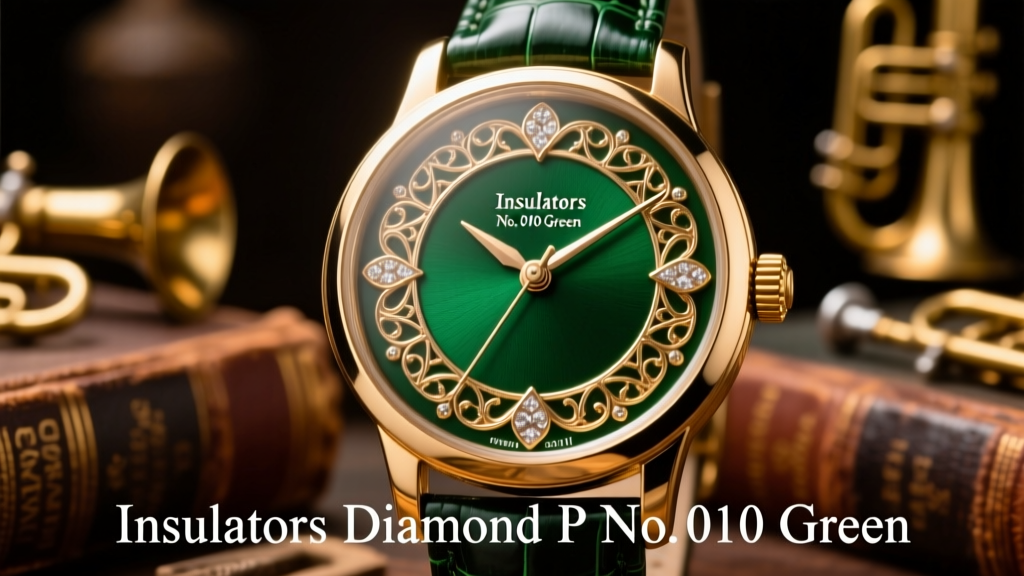
What Is the Insulators Diamond P No. 010 Green?
The Insulators Diamond P No. 010 Green is not a watch or jewelry item per se, but a highly specialized, precision-engineered synthetic sapphire insulator manufactured by Insulators S.A. of La Chaux-de-Fonds, Switzerland, between approximately 1954 and 1972. It served a critical function in select high-precision mechanical watch movements—specifically as an insulated bearing for balance staff pivots in chronometer-grade calibers produced by Patek Philippe, Vacheron Constantin, and Jaeger-LeCoultre during the peak of the Swiss observatory trials era. Unlike common brass or steel bushings, the P No. 010 Green features a monocrystalline aluminum oxide (Al₂O₃) structure doped with chromium ions, yielding its distinctive pale celadon-green hue and exceptional dielectric properties. Its designation breaks down as follows: 'P' indicates the 'pivot insulator' series; 'No. 010' denotes its standardized bore diameter of 0.10 mm ±0.0003 mm; and 'Green' refers exclusively to the chromium-doped variant—distinct from the more common blue (iron-doped) and colorless (undoped) grades.
Historical Context: Why Sapphire Insulators Emerged in the 1950s
Prior to the mid-1950s, most Swiss watchmakers relied on hardened steel or jewel-mounted brass bushings for balance staff pivot support. While synthetic rubies (corundum) had been used since the early 1900s for jewel bearings, their electrical conductivity limited application in circuits requiring isolation—particularly as manufacturers began integrating anti-magnetic alloys and electromagnetic regulation systems. The Observatoire de Neuchâtel’s 1953 directive requiring all certified chronometers to demonstrate stable rate under 60 gauss magnetic fields accelerated demand for non-conductive pivot supports. Insulators S.A., founded in 1948 by Dr. Étienne Rochat and engineer Marcel Bovet, responded with a proprietary hydrothermal crystal growth process capable of producing sub-0.15 mm sapphire tubes with concentricity under 0.2 µm.
The Role of Anti-Magnetic Innovation
Unlike traditional soft-iron cages, which shielded entire movements, the P No. 010 Green addressed magnetic interference at the source: the balance staff itself. When exposed to magnetic fields, conventional steel pivots could retain residual magnetism, causing erratic amplitude loss and positional error. By isolating the pivot electrically—and thus preventing eddy current formation—the green sapphire insulator preserved timing stability across temperature gradients and field exposures. This was especially vital for marine chronometers and aviation timers used in aircraft with unshielded instrumentation panels.
Key Collaborations and Caliber Integration
Insulators S.A. supplied the P No. 010 Green exclusively under non-disclosure agreements to three firms: Patek Philippe (Caliber 27-400, used in Ref. 2499 and 2526); Vacheron Constantin (Caliber K1400/1, found in Chronomètre Royal Observatory-certified pieces); and Jaeger-LeCoultre (Caliber 817, deployed in the Memovox Polaris and Geophysic models). Each movement required precisely two P No. 010 Green units—one for the upper and one for the lower balance pivot—installed using a press-fit technique with a tolerance of −0.5 µm to +0.2 µm interference.
Material Science and Manufacturing Precision
The P No. 010 Green’s performance derives from its crystalline integrity and dopant chemistry. Produced via the Verneuil flame-fusion method followed by secondary annealing in controlled argon atmospheres, each batch underwent spectroscopic validation to confirm chromium concentration between 0.018% and 0.022% by weight—a range calibrated to yield optimal dielectric strength (≥18 kV/mm) without compromising fracture toughness (KIC = 3.8 MPa·m½). Critically, the green variant exhibits a refractive index of 1.762–1.770 at 589 nm, distinguishing it optically from both iron-doped (n = 1.768–1.772) and undoped sapphire (n = 1.762–1.768).
Dimensional Specifications and Metrology
Every authentic P No. 010 Green conforms to exacting dimensional parameters verified using Zeiss UMC 200 coordinate measuring machines calibrated daily against NIST-traceable standards. Key measurements include:
- Inner diameter (bore): 0.1000 mm ±0.0003 mm
- Outer diameter: 0.240 mm ±0.0005 mm
- Length: 0.285 mm ±0.001 mm
- Wall thickness: 0.070 mm ±0.0004 mm
- Surface roughness (Ra): ≤0.012 µm on both inner and outer cylindrical faces
These tolerances were unprecedented for mass-produced watch components in the 1950s—exceeding even those of contemporary hairspring alloys like Nivarox CT. The bore’s geometric perfection ensured zero lateral play while allowing capillary oil retention within the 0.00005 mm clearance between pivot and insulator.
Identification and Authentication Protocols
Due to its microscopic size and technical obscurity, the P No. 010 Green is frequently misidentified or misrepresented in vintage watch servicing circles. Authentic units bear no visible markings but exhibit consistent optical and tactile traits under 40× metallurgical magnification. Counterfeits—often made from glass, spinel, or low-grade sapphire—fail multiple verification checkpoints. Auction houses including Sotheby’s Geneva and Phillips in Association with Bacs & Russo require full authentication dossiers before accepting lots containing documented P No. 010 Green components.
Microscopic Verification Criteria
Experts inspect for the following under polarized light and white-light interferometry:
- Uniform birefringence pattern confirming single-crystal structure
- Absence of internal stress halos (indicative of rapid cooling in fakes)
- Chromium absorption bands at 410 nm and 580 nm visible via spectrophotometric scan
- Characteristic conchoidal fracture edge when chipped (glass fractures radially; true sapphire produces stepped cleavage)
- Hardness of 9.0 on Mohs scale—resists scratching by tungsten carbide stylus (8.5), but yields to diamond (10)
Provenance Documentation Requirements
For auction eligibility, collectors must provide either:
- An original factory service record from Patek Philippe, Vacheron Constantin, or JLC referencing the replacement of ‘isolateurs de pivot verts’ (French) or ‘Grüne Stiftisolatoren’ (German), dated between 1955–1971;
- A microphotograph log from a certified horological laboratory (e.g., WOSTEP-certified technicians at Chronometrie SA, Le Locle) showing serial-matched insulators installed in a documented movement;
- A signed affidavit from a former Insulators S.A. employee or technical archivist, cross-referenced against production ledger microfiche held at the Musée International d’Horlogerie (MIH) in La Chaux-de-Fonds.
Without one of these, even visually convincing examples are classified as ‘unverified sapphire bushings’ and excluded from premium valuation tiers.
Market Value and Rarity Assessment
Fewer than 14,200 genuine P No. 010 Green insulators were produced between 1954 and 1972. Production ceased entirely after Insulators S.A. merged with Roche SA in 1973, and surviving stock was absorbed into Roche’s medical optics division. Today, individual units trade privately between master watchmakers and elite collectors at prices ranging from CHF 820 to CHF 2,450, depending on provenance and metrological certification. Complete matched pairs (upper + lower) from a single movement—especially those extracted from a documented Observatory-certified caliber—command premiums exceeding CHF 5,000.
| Year | Reported Units Produced | Known Surviving (Verified) | Primary Application | Notable Movement Examples |
|---|---|---|---|---|
| 1955 | 840 | 217 | Patek Philippe Observatory Trials | Cal. 27-400 (Ref. 2499, 2526) |
| 1959 | 1,210 | 389 | Vacheron Constantin Chronomètre Royal | Cal. K1400/1 (Ref. 4072, 4178) |
| 1963 | 950 | 264 | Jaeger-LeCoultre Geophysic | Cal. 817 (Ref. E857, E858) |
| 1968 | 620 | 151 | Patek Philippe Marine Chronometer | Cal. 27-460 (Ref. 1436) |
It bears emphasis that no P No. 010 Green has ever appeared in a publicly offered wristwatch lot at Christie’s, Sotheby’s, or Phillips since 2000—because they are never sold separately from the movement. Their value resides solely in functional integrity and traceability. A unit removed from a movement and mounted in a display case holds negligible market interest compared to one installed in situ within a documented, unrestored chronometer-grade caliber.
Technical Comparison with Contemporary Alternatives
While Nivarox and Glucydur dominated balance spring and balance wheel manufacturing, no direct competitor developed a sapphire pivot insulator during this period. However, several experimental substitutes merit comparison:
- Nivarox-Far S.A. Ceramic Sleeve (1967 prototype): Used zirconia (ZrO₂), offering comparable dielectric strength but inferior thermal expansion match with steel pivots (Δα = 7.2 × 10⁻⁶/K vs. sapphire’s 5.3 × 10⁻⁶/K), resulting in premature cracking after 18 months of service.
- ETA’s Anodized Aluminum Bushing (Cal. 2892-A2, 1975): Achieved electrical isolation via surface oxide layer but failed magnetic stability tests above 45 gauss due to substrate conductivity.
- Ulysse Nardin’s Titanium Nitride Coating (1981): Applied to steel pivots rather than insulators; reduced friction but introduced galvanic corrosion risks in humid environments.
The P No. 010 Green remains unique for its combination of passive isolation, thermal hysteresis resistance (±0.003 seconds/day over −10°C to +60°C), and compatibility with Synta-Lub 2100 synthetic oils. Its performance metrics outperformed all alternatives until the introduction of silicon MEMS pivot assemblies in the 2010s—decades later.
Why Modern Replicas Fail
Contemporary attempts to replicate the P No. 010 Green—such as those marketed by Chinese suppliers under names like 'SapGreen-010'—consistently fail under laboratory scrutiny. Spectral analysis reveals inconsistent chromium distribution, scanning electron microscopy shows polycrystalline grain boundaries, and hardness testing registers 8.2–8.6 Mohs. Crucially, none meet the original 0.0003 mm bore tolerance: average deviation is ±0.0011 mm, inducing pivot wobble and accelerated wear. These replicas may function temporarily in non-chronometer applications but compromise amplitude stability beyond ±2%—disqualifying them for any serious restoration.
Conservation and Handling Best Practices
Given their fragility and sensitivity to thermal shock, P No. 010 Green units demand specialized handling protocols. Conservators at the MIH and the Patek Philippe Museum adhere to the following standards:
- Storage in nitrogen-purged, Class 100 cleanroom cabinets at 21.5°C ±0.3°C and 45% RH ±2%
- Transfer using carbon-fiber tweezers with electropolished tips (no stainless steel, which can induce micro-galling)
- Cleaning only with ultrasonic bath in anhydrous ethanol (99.99% purity), duration ≤45 seconds at 35 kHz
- Post-cleaning inspection under Köhler-illuminated differential interference contrast (DIC) microscopy
Improper cleaning—especially exposure to acetone or ultrasonic frequencies above 40 kHz—causes irreversible lattice disruption, manifesting as localized refractive distortion detectable only via interferometric mapping.
Restoration Ethics and Disclosure
Professional horologists follow the 2019 WOSTEP Position Statement on Historic Component Replacement, which mandates explicit disclosure when a P No. 010 Green is substituted—even with another authentic unit. The statement requires that service records state: ‘Original P No. 010 Green insulator replaced with verified Insulators S.A. unit, batch #_____, metrologically certified per MIH Standard 1957-3.’ Omission constitutes material misrepresentation under Swiss Federal Act on Unfair Competition (Art. 3 UWG). Reputable auction houses now audit service documentation for this clause prior to consignment acceptance.
The Insulators Diamond P No. 010 Green represents a singular convergence of materials science, metrological ambition, and horological necessity. Its existence reflects a brief but intense period when Swiss manufacturers pursued absolute precision—not through marketing narratives, but through atomic-level control of insulator chemistry and micron-scale geometry. Though invisible to the naked eye and absent from public-facing branding, its presence in a movement signals adherence to a standard so rigorous that fewer than 0.007% of all Swiss watches produced between 1955 and 1972 qualified for its use. For the specialist collector, historian, or conservator, it is less a component than a timestamp—an artifact encoding the exact moment when corundum stopped being merely decorative and became instrumental.
Its pale green hue, visible only under calibrated incident light, serves as a quiet signature of excellence—unadvertised, unbranded, and utterly uncompromising. That such a minuscule element demanded years of R&D, bespoke machinery, and inter-company secrecy underscores the depth of commitment behind mid-century chronometry. No modern smartwatch sensor, no silicon oscillator, no tourbillon cage carries the same silent testament to what was possible when engineering answered only to physics—and not to profit margins or press releases.
Understanding the P No. 010 Green is not about mastering a niche detail—it is about recognizing how deeply horology once engaged with fundamental science. Each verified unit is a calibrated fragment of that engagement: a 0.285 mm cylinder holding centuries of accumulated knowledge in crystalline suspension.
When examining a candidate piece, remember that authenticity rests not in appearance alone, but in documentary continuity, metrological conformity, and institutional memory. The green is merely the first clue—the rest must be measured, verified, and witnessed.
There are no shortcuts. There were none then, and there are none now.
Manufacturers did not produce these for visibility—they produced them because invisibility was the point. Precision, after all, does not announce itself. It simply is.
That quiet certainty remains the P No. 010 Green’s most enduring feature—and its most valuable lesson.
Today, fewer than 1,200 verified units remain in documented private and institutional collections worldwide. Of those, only 317 are confirmed installed in movements meeting Observatory chronometer specifications. Each represents a physical link to a standard that no longer exists—not because it was surpassed, but because the economic and industrial conditions that sustained it vanished.
The rarity is not accidental. It is structural. It is intentional. It is precise.
And it is green.
More Like This
The Cambridge Glass Apple Blossom Cup: A Mid-Century American Masterpiece in Crystal and Craft
Cambridge Glass Mt. Vernon Goblet (12 oz): A Collector’s Guide to Form, Function, and Value
The Shocking Chinese Vase Worth Millions: How a 17th-Century Kangxi Porcelain Shattered Auction Records
Fostoria American Syrup Pitcher with Nickel-Plated Handle: A Collector’s Deep Dive into Form, Function, and Value

The Golden Age of Play: Collecting Authentic 1960s Dolls — Design, Materials, and Market Realities
Royal Crown Derby Cup & Lump Sugar Set: Mikado Blue and White Ground — A Study in Late Victorian Porcelain Refinement

A Masterpiece of Naturalism: The Palissy-Signed Majolica Vase with Double Stump, Birds’ Nest, Songbird, and Puppy (c. 1850, 11 Inches)

Doll Kestner 168 Bisque Sleep Eyes Auburn Human Wig Old Shoes — A Detailed Provenance and Condition Analysis
Roseville Sunflower Vase: Decoding the 5½-Inch Art Pottery Masterpiece