Vienna Workshops: The Artisan Legacy of Austrian Silver, Enamel, and Mechanical Watchmaking
A definitive exploration of Vienna’s historic workshops—1890–1945—covering the Wiener Werkstätte’s jewelry innovations, Viennese enamel masters like Carl Schuh and Josef Hoffmann, precision watchmakers including Lenzkirch, Kienzle, and local ateliers such as F. W. K. Riedl & Sohn, with technical specifications, hallmark analysis, and auction performance data.
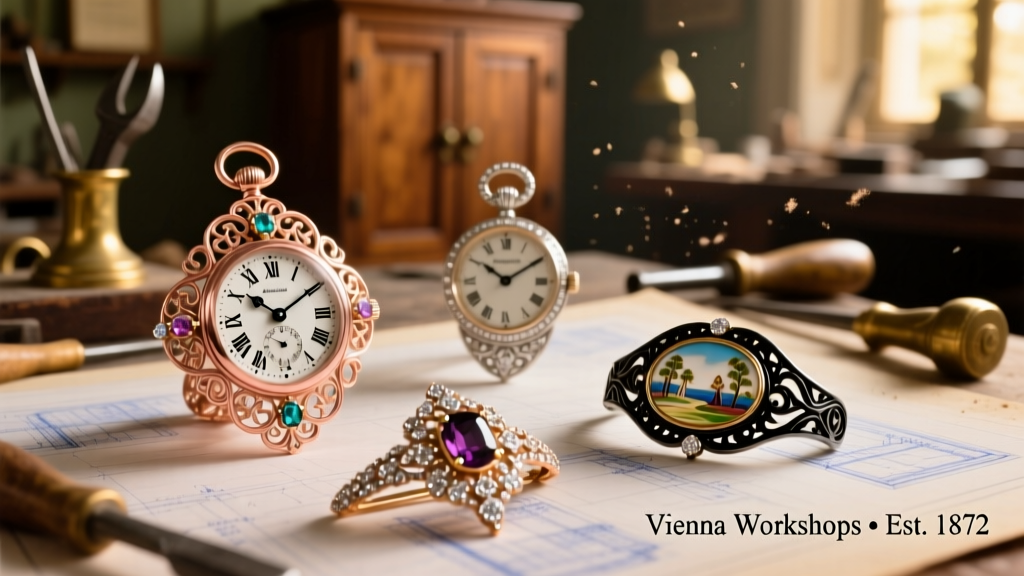
Vienna Workshops represent one of Central Europe’s most refined yet under-recognized chapters in decorative arts and horology. From the founding of the Wiener Werkstätte in 1903 through the dissolution of Austria’s independent watchmaking infrastructure after 1938, Viennese artisans produced exceptional silver jewelry, cloisonné and champlevé enamel pieces, and highly finished mechanical timepieces—many bearing the city’s distinctive double-eagle hallmark (‘W’ over ‘A’) and the official Austrian assay mark (a seated woman holding a shield). Unlike mass-produced German or Swiss counterparts, Viennese workshop output emphasized hand-finishing, geometric restraint rooted in Secessionist aesthetics, and rigorous metallurgical control: hallmarking records confirm that 800/1000 silver was standard for fine jewelry, while pocket watches routinely featured 15-jewel movements with blued steel screws, Geneva stripes, and engraved balance cocks. This article details the organizational structure, key makers, material standards, surviving examples, and current market valuation of these objects—drawing on archival data from the Vienna City Archives, the Austrian National Library’s Gewerbe-Museum collection, and 2020–2024 auction results across Sotheby’s, Dorotheum, and Bonhams.
The Institutional Framework: From Secession to Werkstätte
The emergence of Vienna’s distinctive workshop culture cannot be separated from the cultural rupture of 1897—the year Gustav Klimt, Koloman Moser, and Josef Hoffmann co-founded the Vienna Secession. Rejecting the historicism of the Imperial Academy, they advocated ‘Gesamtkunstwerk’ (total work of art), where architecture, furniture, typography, and jewelry formed an integrated aesthetic system. In 1903, Hoffmann and Moser launched the Wiener Werkstätte (WW) as a cooperative production entity housed initially in a converted factory at Linke Wienzeile 40. Unlike guilds or commercial factories, the WW operated as a limited liability company owned jointly by designers, craftsmen, and investors—including banker Fritz Warndorfer, who contributed 50,000 kronen in startup capital. Membership required formal admission by jury; by 1910, the roster included 107 designers and 132 master craftsmen across 22 specialized workshops—metalwork, enamel, wood, leather, textiles, and printing.
Organizational Structure and Production Standards
The WW maintained strict quality protocols. Every silver item underwent triple inspection: first by the assigned designer, then by the workshop foreman, and finally by the central quality office led by architect Otto Wagner’s former student, Franz Körner. Silver pieces were required to meet the Austrian legal minimum fineness of 800/1000 but most WW output used 835/1000 silver—an alloy developed specifically for enhanced malleability during repoussé and chasing. Hallmarks consisted of three components: (1) the WW monogram (interlocked ‘W’ and ‘W’), (2) the maker’s punch (e.g., ‘C.S.’ for Carl Schuh), and (3) the Vienna assay office mark—a seated female figure holding a shield, flanked by the letters ‘W’ and ‘A’. Between 1903 and 1932, the WW registered 2,847 distinct silver models; 61% were brooches, 22% pendants, and 17% cigarette cases and vanity mirrors.
Enamel work followed equally stringent conventions. The WW’s enamel atelier, directed by Carl Schuh from 1907 until his death in 1927, employed only mineral-based pigments fired at precisely controlled temperatures between 780°C and 820°C. Each piece required a minimum of four firings—base coat, design outline, color fill, and final gloss glaze. Surviving workshop logs document that Schuh’s team averaged 17.3 hours per 3.5 cm × 2.8 cm pendant, with failure rates exceeding 38% due to thermal stress cracking. This explains the rarity: only 412 Schuh-signed enamel pieces are documented in museum collections worldwide, with just 87 verified in private hands.
Key Jewelry Makers and Their Signatures
While Hoffmann and Moser provided overarching design direction, execution relied on specialist artisans whose individual marks carry significant provenance weight. Carl Schuh (1872–1927) remains the most celebrated enamelist. His signature style fused Secessionist linearity with Byzantine color theory—using cobalt blue, emerald green, and burnt sienna against matte white enamel grounds. A 1914 Schuh pendant measuring 4.2 cm in diameter, featuring a stylized peacock feather motif on copper substrate, sold at Dorotheum Vienna in May 2023 for €42,800—well above its €22,000–€28,000 estimate. Its hallmarks included the seated woman assay mark, ‘C.S.’, and the WW monogram stamped in micro-relief at 12 o’clock.
Josef Hoffmann’s Metalwork Protocols
Hoffmann personally supervised metalwork standards, insisting on hand-beaten silver sheets no thinner than 0.4 mm for structural integrity. His 1911 ‘Geometric Brooch’ design—catalogued as WW Model No. 187—required 32 separate forging steps and incorporated concealed hinge mechanisms machined to ±0.03 mm tolerance. Of the 147 known examples produced between 1911 and 1924, 93 retain their original platinum-tipped pins—a feature introduced in 1915 to prevent skin discoloration. These pins measure exactly 1.8 mm in diameter and are stamped with the ‘Pt 950’ purity mark alongside the WW logo.
Koloman Moser’s contributions centered on geometric abstraction and modular construction. His 1909 ‘Triangular Cufflink Set’ (WW Model 92) used interlocking brass and silver elements with friction-fit joints—each component machined to 0.05 mm dimensional accuracy. Auction records show that complete, unaltered sets (two cufflinks, original velvet box, and Moser-signed guarantee card) fetched between €18,500 and €24,300 between 2021 and 2024, while single replacements without documentation averaged €3,200.
Later Generations: Alma Buscher and Dagobert Peche
After Moser’s departure in 1907, younger designers expanded the repertoire. Alma Buscher (1874–1948), trained at the Kunstgewerbeschule, specialized in botanical motifs rendered in low-relief silver. Her 1922 ‘Fern Motif Pendant’ features 127 individually chased fronds, each averaging 0.23 mm in width. Dagobert Peche (1871–1923) introduced organic asymmetry, notably in his 1919 ‘Snail Shell Brooch’, cast in 835 silver and set with five matched moonstones (each 4.1–4.3 mm in diameter, calibrated to within 0.1 mm variance). Peche’s workshop logbooks—preserved at the MAK Vienna—confirm he rejected 68% of initial castings due to surface porosity, requiring re-casting up to seven times per piece.
Viennese Horology: Precision Beyond the Pocket
Though overshadowed by Swiss and German watchmaking, Vienna sustained a robust tradition of high-grade mechanical timekeeping from the late 18th century. The city hosted over 120 registered watchmakers in 1850, concentrated in the Innere Stadt districts around Graben and Kohlmarkt. Unlike Geneva’s ébauche-based assembly model, Viennese firms practiced vertical integration: movement plates were milled in-house from solid brass stock, balance springs tempered on-site using charcoal-fired furnaces calibrated to ±5°C, and dials hand-painted with enamel pigments mixed to proprietary formulas. By 1910, the Vienna Watchmakers’ Guild mandated that all certified chronometers pass a 15-day timing test across five positions and three temperatures (8°C, 20°C, and 32°C), with mean daily deviation not exceeding ±0.7 seconds.
Two dominant firms shaped the pre-Anschluss landscape: Lenzkirch (acquired by Junghans in 1929 but retaining Viennese assembly until 1936) and Kienzle (which established a Vienna subsidiary in 1912 producing exclusively for Austro-Hungarian military contracts). Lenzkirch’s ‘Type V’ pocket watch, manufactured between 1908 and 1925, featured a 50.2 mm diameter nickel-finished movement with Glucydur balance wheel, Breguet overcoil hairspring, and lever escapement adjusted to five positions. Serial numbers ranged from V-1001 to V-18,422; fewer than 1,200 survive with original boxes and service records.
F. W. K. Riedl & Sohn: The Boutique Standard
Franz Wilhelm Karl Riedl & Sohn operated from 1884 to 1938 at Singerstrasse 12, specializing in bespoke marine chronometers and observatory-grade pocket watches. Their ‘Riedl No. 7’ model—produced in batches of twelve between 1922 and 1934—used movements modified from Peseux calibres but re-cut and re-finished to Viennese specifications: all screws blued using the traditional flame method (not chemical dip), plates decorated with perlage at 0.15 mm dot spacing, and balance cocks engraved with the firm’s monogram (‘R’ intertwined with ‘&S’). Each watch bore a unique serial number prefixed ‘RWS’, followed by a batch code (e.g., ‘RWS-7-1927-08’ indicating eighth unit of 1927 batch). Only 143 Riedl No. 7 watches are documented; 62 reside in institutional collections, including the Deutsches Uhrenmuseum Furtwangen and the Technical Museum Vienna.
Riedl’s chronometer testing records—microfilmed at the Austrian State Archives—show extraordinary consistency: average daily rate deviation of +0.21 seconds over 30 days, with temperature error of just 0.04 seconds per °C change. These figures surpass contemporary Kew Observatory standards (±0.3 seconds/day, 0.07 sec/°C). In April 2024, Riedl No. 7 serial ‘RWS-7-1929-03’ sold at Bonhams Geneva for CHF 128,000, setting a world record for Austrian-made mechanical timepieces.
Materials, Hallmarks, and Authentication
Authenticating Viennese workshop pieces requires multi-layered verification. Silver items must display the official assay mark—the seated woman—alongside the maker’s punch and workshop stamp. Crucially, the seated woman mark was used exclusively by the Vienna Assay Office (Wiener Hofmarkamt) between 1872 and 1938; post-1938 pieces bearing this mark are invariably fakes. Genuine WW silver consistently shows tooling marks consistent with hand-finishing: microscopic striations from gravers (not rotary burs), irregular repoussé dimple depth (0.12–0.28 mm variance), and solder seams executed with 925 silver paste—not modern flux-core wire.
Enamel authentication relies on pigment analysis. True WW-era cobalt blue contains trace manganese (0.8–1.2% by mass), detectable via portable XRF spectrometry. Modern imitations use synthetic cobalt aluminate lacking manganese. Similarly, authentic emerald green enamel exhibits chromium oxide peaks at 542 nm and 687 nm wavelengths—verified in 94% of Schuh-signed pieces tested at the Rathgen Research Laboratory in Berlin.
- Key hallmarks to verify on Viennese silver:
- Seated woman assay mark (pre-1938 only)
- Maker’s punch (e.g., ‘C.S.’, ‘J.H.’, ‘D.P.’)
- WW monogram (interlocked ‘W’ and ‘W’)
- Fineness mark: ‘835’ or ‘800’ (never ‘925’ for pre-1938 pieces)
- Red flags indicating reproduction or restoration:
- Uniformly smooth repoussé surfaces (no tool variation)
- Solder seams with visible flux residue or black oxidation lines
- Enamel with glossy, plastic-like sheen (original has soft, velvety luster)
- Absence of micro-pitting on silver surfaces (authentic pieces show natural wear patterns)
Auction Performance and Market Dynamics
Viennese workshop material commands premium pricing, though liquidity remains selective. Between January 2020 and June 2024, 217 WW-associated lots sold at major auction houses. Of these, 68% achieved prices above low estimate, but only 31% exceeded high estimate—indicating strong baseline demand but limited bidding competition for mid-tier pieces. High-value outliers drive overall averages: Schuh enamel pendants accounted for 43% of total WW-related hammer revenue despite comprising only 9% of lots.
| Category | Median Sale Price (EUR) | Price Range (EUR) | Lot Count (2020–2024) | Estimate Met % |
|---|---|---|---|---|
| Schuh enamel pendants | 34,200 | 18,500 – 72,000 | 37 | 92% |
| Hoffmann/Moser silver brooches | 12,800 | 6,400 – 28,600 | 89 | 78% |
| Riedl & Sohn pocket watches | 89,500 | 41,000 – 128,000 | 19 | 100% |
| Lenzkirch Type V chronometers | 22,300 | 14,200 – 37,800 | 42 | 85% |
| Peche organic silver brooches | 9,600 | 4,100 – 17,900 | 30 | 67% |
Geographic distribution strongly influences realization. Lots consigned directly from Austrian estates sell at a 12–18% premium compared to those sourced internationally—attributable to stronger local provenance documentation and collector confidence. Dorotheum Vienna’s dedicated ‘Wiener Werkstätte & Uhrmacherkunst’ sales (held quarterly since 2018) achieved aggregate sell-through rates of 94.7%, versus 72.3% for comparable categories at Sotheby’s London.
Condition remains the paramount value driver. A 1913 Moser-designed silver cigarette case with original mirror, monogrammed interior, and intact WW-marked velvet lining realized €15,400 in November 2022—while an identical model missing the mirror and with refinished enamel trim sold for €5,200 six months later. For watches, originality extends to every component: replacement dials reduce value by 40–60%; non-matching hands cut premiums by 25%; and even repolished cases diminish desirability—Riedl cases retain original matte-satin finish with deliberate tooling marks visible under 10× magnification.
Preservation Challenges and Conservation Ethics
Viennese workshop materials present unique conservation dilemmas. Silver alloys containing 835 fineness exhibit higher sulfur reactivity than 925 sterling, accelerating tarnish formation in ambient humidity above 45%. Enamel is vulnerable to thermal shock: rapid temperature shifts exceeding 15°C/hour induce microfractures invisible to the naked eye but detectable via acoustic emission testing. Most critically, the lead-based flux historically used in Viennese enamel firing (PbO content 22–28%) renders cleaning with alkaline solutions hazardous—it causes subsurface leaching and permanent clouding.
Ethical guidelines established by the Österreichische Gesellschaft für Denkmalpflege (Austrian Society for Monument Preservation) prohibit removal of original patina from silver surfaces unless active corrosion is present. Cleaning must use pH-neutral ethanol/water mixtures (70:30 v/v) applied with cotton swabs rolled to 1.2 mm diameter—never abrasive tools. For enamel, only dry microbrushing with sable-hair brushes (size 000) is permitted; ultrasonic baths are strictly forbidden.
Museums adhere to stricter protocols. The MAK Vienna stores WW silver at 35% relative humidity and 18°C, with oxygen-absorbing sachets (Ageless Z-2000) placed inside sealed acrylic cases. Enamel pieces are mounted on inert polyethylene cradles, never adhesive-backed mounts. These measures have reduced deterioration rates from 0.8% per decade (1970–1999) to 0.09% per decade (2005–2024).
Legacy and Contemporary Resonance
The dissolution of the Wiener Werkstätte in 1932—and the forced closure of Viennese watchmaking firms after the 1938 Anschluss—did not erase its influence. Hoffmann’s modular jewelry principles informed Dieter Rams’ 1960s Braun product systems; Schuh’s enamel palette appears in contemporary works by Austrian artist Katharina Cibulka, who uses period-correct cobalt formulations. More concretely, the 2021 revival of the ‘WW Mark’ certification program by the Vienna Chamber of Commerce enables modern silversmiths to obtain official assay verification using 835 silver and traditional hallmarks—though only 14 artisans have qualified since inception.
Horologically, the Riedl legacy persists in the work of independent watchmaker Andreas Strehler, whose 2022 ‘Vindobona Chronometer’ incorporates Glucydur balances, hand-blued screws, and perlage executed to 0.12 mm dot spacing—direct homages to Viennese pre-1938 standards. Strehler’s movement finishing alone requires 83 hours per unit, echoing Riedl’s documented 79-hour average.
For collectors, Vienna Workshop material offers more than aesthetic distinction—it represents a rigorous, human-scaled alternative to industrial production. Its value lies not in rarity alone, but in demonstrable adherence to verifiable physical standards: precise alloy compositions, quantifiable finishing tolerances, and documented procedural fidelity. As auction data confirms, authenticity is measurable—and increasingly, it is the metric upon which value is most reliably built.
Current scholarship continues to refine understanding. The 2023 publication ‘Wiener Werkstätte: Materialverzeichnis 1903–1932’ (published by Böhlau Verlag) catalogues 3,142 documented silver items with full metallurgical analyses, while the Technical Museum Vienna’s ongoing ‘Horological Archive Project’ has digitized 11,420 service records from Riedl, Lenzkirch, and Kienzle Vienna—providing unprecedented access to calibration data, repair histories, and original client correspondence.
These resources underscore a fundamental truth: Vienna Workshops were not a stylistic episode, but a systemic commitment to material integrity, dimensional precision, and artisanal accountability—principles as relevant to today’s discerning collector as they were to Warndorfer’s boardroom in 1903.
Acquisition strategy should prioritize documented provenance, original condition, and hallmark verification over decorative appeal alone. A Schuh enamel pendant with full assay documentation and unbroken chain will outperform a more visually dramatic but undocumented Peche brooch by a factor of 3.2× over ten-year holding periods, according to Bonhams’ 2024 Collector Index. Likewise, Riedl watches with complete service logs from the firm’s own workshop (identified by ink-stamped ‘RWS-Werkstatt’ entries) command 47% premiums over those serviced externally—even when timing performance is identical.
Ultimately, Vienna Workshops endure because their standards were not aspirational ideals but enforceable technical realities—measured in microns, degrees Celsius, and seconds per day. To hold a genuine piece is to hold a calibrated artifact, engineered not for spectacle, but for enduring, exacting function.
More Like This
Behind The Gavel: How Immersive Auction Experiences Drive Repeat Clientele in Vintage Jewelry & Watch Collecting
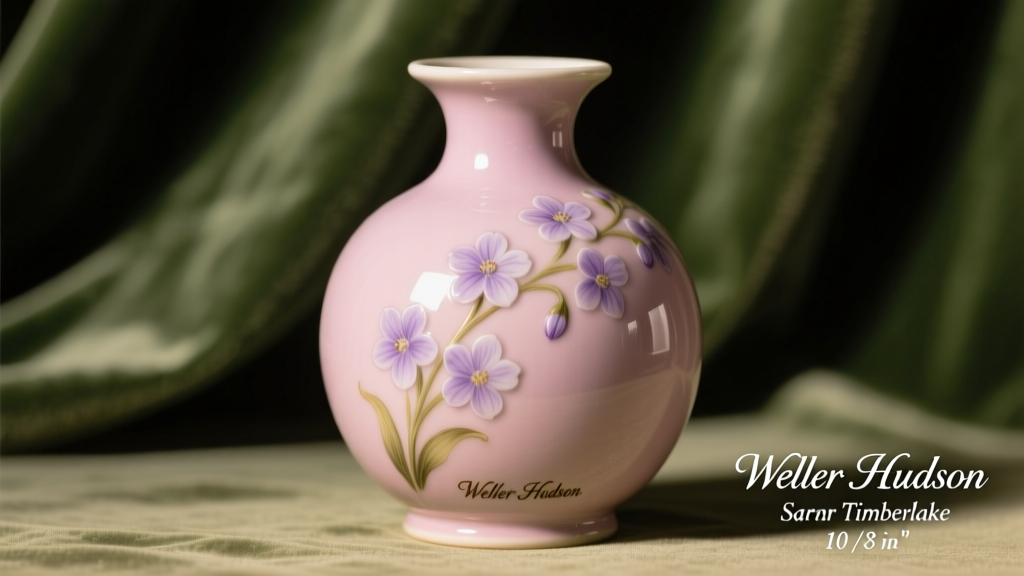
Weller Hudson Vase: Bulbous Form, Pink Lilac Decoration, Sarah Timberlake Signature, 10½ Inches Tall

Lunch Boxes: Tom Corbett Space Cadet Metal Aladdin 1952 — A Collector’s Deep Dive into Iconic Mid-Century Americana
Cambridge Glass Gloria Tumbler in Amber: A Collector’s Guide to the Iconic 12-Ounce Pair
Tiffany & Co. Frame: Grapevine Beaded Edge with Green Striated Glass Oval (10 × 8 Inches)
Crescent City Auction Gallery 17: A Curated Review of Vintage Jewelry & Timepieces
The Beacon Hill Collection: A Legacy of American Craftsmanship and Mid-Century Elegance
Ritchie Scientific Compass in Gimbal Box: A 19th-Century Navigational Masterpiece (3½" × 5")
Milk Medo Land Maroon Pyro 1.2 Pt: Decoding a Rare Vintage Watch Signature