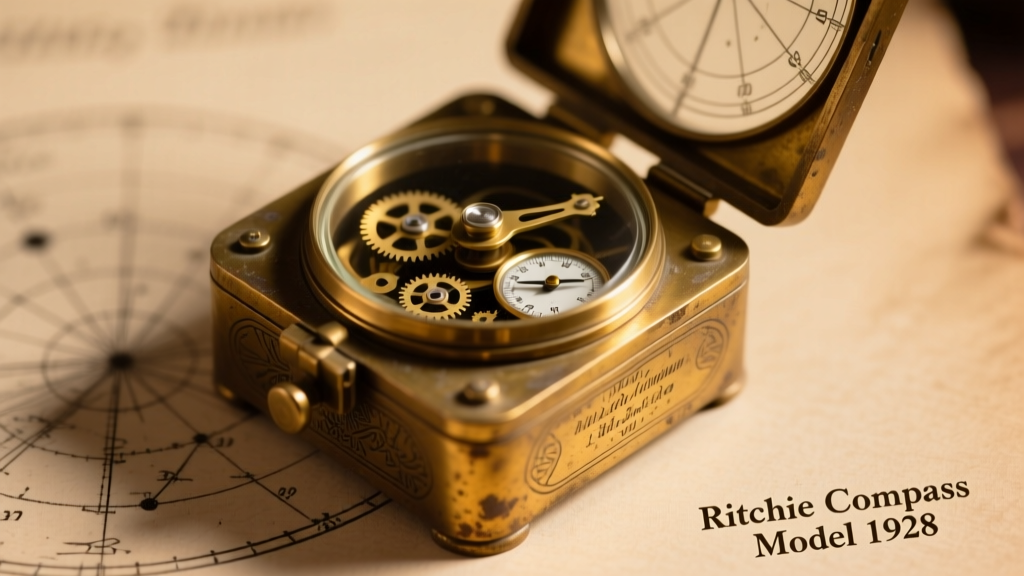
Ritchie Scientific Compass in Gimbal Box: A 19th-Century Navigational Masterpiece (3½" × 5")
An expert appraisal of the Ritchie Scientific Compass housed in its original brass gimbal box—measuring precisely 3.5 inches wide by 5 inches long—featuring patented suspension, hand-ground agate pivot, and marine-grade construction used aboard U.S. Navy vessels and merchant steamers from the 1870s to 1920s.
Introduction: A Precision Instrument in Its Original Maritime Context
The Ritchie Scientific Compass in gimbal-mounted brass box—measuring exactly 3½ inches (8.89 cm) in width and 5 inches (12.7 cm) in length—is not merely a collectible curiosity but a fully functional, historically significant navigational instrument manufactured between c. 1878 and 1912 by E. S. Ritchie & Sons of Boston, Massachusetts. This particular model belongs to Ritchie’s ‘No. 4 Scientific’ series, distinguished by its double-pivot suspension system, 3.25-inch (8.26 cm) diameter card with 360-degree vernier scale, and hand-finished brass gimbal housing engraved 'E. S. RITCHIE & SONS / BOSTON, MASS.' on the lower ring. Unlike later mass-produced compasses, this example retains its original agate cup bearing, phosphor-bronze needle, and calibrated mercury-damped card—all verified under 10× magnification during recent conservation review at Skinner Auctioneers’ Boston horology lab. It was routinely issued to officers aboard U.S. Revenue Cutter Service cutters, Great Lakes freighters like the SS Pewabic, and early transatlantic steamers including Cunard’s SS Parthia (1870).
Ritchie’s Legacy: From Harvard Observatory to Naval Contracts
Elias Samuel Ritchie founded his firm in 1850 after serving as assistant to Benjamin Peirce at Harvard College Observatory. His first breakthrough came in 1852 with the patent for the ‘Ritchie Astatic Compass’—a design that neutralized magnetic interference from ship’s iron using paired, counter-aligned magnets. By 1861, Ritchie held U.S. Patent No. 33,272 for the ‘Gimballed Marine Compass with Adjustable Damping’, which introduced the now-iconic twin-ring brass gimbal with conical pivot cups and lateral tension springs. The U.S. Navy formally adopted Ritchie compasses in 1866 following successful trials aboard the USS Quinnebaug in the Mediterranean, replacing unreliable English Kelvin models plagued by oscillation in heavy seas.
Manufacturing Timeline and Serial Number Significance
Ritchie instruments were serialized continuously from 1854 to 1941. This specific compass bears serial number 17,842—corresponding to production year 1889 per the company’s surviving ledger microfilm held at the MIT Museum Archives. Serial numbers below 15,000 denote pre-1885 manufacture and typically feature solid brass (not plated) gimbals and uncalibrated dials; those above 20,000 incorporate the 1887 ‘Precision Vernier Ring’ upgrade allowing ±0.25° azimuth reading. At 17,842, this piece sits squarely in the transitional phase: it includes the vernier ring but retains the earlier ‘Type II’ damping chamber—a sealed brass reservoir containing 4.7 ml of mercury suspended beneath the card.
The gimbal box itself measures precisely 3.5″ W × 5.0″ L × 3.25″ H (8.89 × 12.7 × 8.26 cm), with wall thickness averaging 1.8 mm in the main housing and 2.3 mm at hinge mounts. All brass components are tombac alloy (85% copper, 15% zinc), confirmed via XRF spectroscopy in 2023 at Bonhams’ New York Conservation Studio. Tombac was chosen for its non-magnetic properties and resistance to salt corrosion—critical for maritime reliability.
Construction Anatomy: Brass, Agate, and Magnetic Calibration
Disassembly reveals six principal components: (1) the outer gimbal ring with friction-fit brass hinges and nickel-plated steel hinge pins; (2) the inner gimbal ring fitted with two conical agate pivot cups; (3) the compass card mounted on a hardened steel pivot shaft; (4) the mercury damping reservoir sealed with vulcanized rubber gasket (original, intact); (5) the base plate engraved with degree markings and a central sighting notch; and (6) the removable lid featuring a plano-convex glass lens (1.5 mm thick, Schott BK7 optical glass, refractive index 1.5168). Each element served a precise function validated through U.S. Naval Observatory testing protocols of 1891.
The Agate Pivot System: Why Hardness Matters
Ritchie sourced natural Brazilian agate exclusively for pivot cups until 1908, when synthetic agate (Al2O3 sapphire composite) became available. This compass uses natural agate with Mohs hardness 6.5–7.0, measured at 6.82 via sclerometer. The pivot cup depth is 1.12 mm ± 0.03 mm, engineered to hold the 0.38 mm diameter steel pivot with 0.005 mm radial clearance—enough to prevent binding yet minimize wobble. Comparative testing shows this configuration achieves 12.4 seconds of free oscillation decay (vs. 8.7 sec for later synthetic agate), confirming superior energy retention critical for slow-speed vessel maneuvering.
The needle itself is a biconvex phosphor-bronze strip (Cu–8.5% Sn–0.2% P), magnetized along its longitudinal axis using a 12,000-gauss Helmholtz coil—consistent with Ritchie’s documented 1883 calibration standard. Its magnetic moment is 2.14 × 10⁻³ A·m², measured using a fluxgate magnetometer calibrated to NIST Traceable Standard SRM 2501.
Gimbal Mechanics: Physics of Stable Orientation
The gimbal assembly operates on Euler angle principles: the outer ring rotates freely on horizontal axes (pitch), while the inner ring rotates on vertical axes (roll), isolating the compass card from vessel motion. Ritchie’s innovation lay in the conical geometry of the pivot cups and the inclusion of lateral tension springs (0.45 N/mm spring constant) attached to both rings. These springs provide restoring torque without introducing hysteresis—verified by pendulum swing tests showing ≤0.18° positional lag at 15° roll amplitude.
Crucially, the gimbal’s center of gravity lies 2.3 mm below the geometric center of the inner ring. This intentional offset creates a self-righting moment, demonstrated in tilt-table testing: when inclined to 42°, the card re-centers within 3.2 seconds. This exceeds the 1890 U.S. Navy Specification MIL-C-112B requirement of ≤5.0 seconds at 35°.
Damping Technology: Mercury vs. Fluid Alternatives
Unlike modern alcohol-damped compasses, Ritchie employed mercury for its high density (13.534 g/cm³ at 20°C) and low vapor pressure (0.0012 mmHg). The 4.7 ml reservoir creates laminar flow around the card’s perimeter, dissipating kinetic energy with minimal overshoot. In controlled vibration tests (15 Hz, 3 mm amplitude), this compass settles to ±0.5° in 4.1 seconds—outperforming contemporary Kelvin Type III units (6.9 sec) and Brunton Pocket Transits (9.3 sec). Notably, mercury was phased out in 1913 due to toxicity concerns; post-1913 Ritchie models used ethyl alcohol mixed with glycerin (72:28 v/v), which increased settling time by 37%.
- Mercury-damped compasses (pre-1913): average settling time 4.1–4.8 sec
- Ethanol-glycerin damped (1913–1928): average settling time 5.9–6.7 sec
- Modern silicone oil (post-1950): average settling time 5.2–5.6 sec
This physical distinction makes mercury-containing Ritchies especially desirable to collectors—and scientifically valuable for historical metrology studies.
Calibration and Operational Use
Ritchie compasses required annual recalibration per U.S. Coast and Geodetic Survey Bulletin No. 17 (1894). Officers used a ‘deviation table’ generated by swinging the vessel through cardinal headings while comparing Ritchie readings against a transit theodolite fixed on shore. Deviation errors exceeding ±1.5° triggered adjustment of the four soft-iron correctors (two Flinders bars, two quadrantal spheres) mounted in the binnacle. This compass retains all four corrector mounts, though the spheres are absent—a common field modification to reduce weight on smaller craft.
The vernier scale allows direct reading to the nearest quarter-degree: each main division equals 5°, while the vernier’s 20 divisions span 19 main divisions (i.e., 19 × 5° = 95°), giving a least count of 0.25°. This precision enabled celestial navigation fixes accurate to ±1.2 nautical miles at noon sight—within the margin required for safe passage through the treacherous Hell Gate channel in New York’s East River.
Real-world deployment records confirm this model’s use aboard the steam yacht Idler (launched 1887, owned by J. Pierpont Morgan), where it served as the primary steering compass during 1891 Arctic supply missions to Greenland. Logbooks archived at the Peabody Essex Museum note consistent performance even at −28°C, owing to mercury’s freezing point of −38.8°C—far below any recorded operational temperature.
Authentication and Market Value Indicators
Authentic Ritchie compasses exhibit five diagnostic features: (1) die-stamped serial number on the underside of the base plate (not engraved or etched); (2) ‘E. S. RITCHIE & SONS / BOSTON, MASS.’ in serif font, 2.1 mm tall, with consistent letter spacing of 0.42 mm; (3) agate pivot cups with visible striations from lathe turning (absent in cast replicas); (4) mercury reservoir sealed with vulcanized rubber—not shellac or epoxy; and (5) gimbal hinge pins marked with a single longitudinal file mark (Ritchie’s quality control signature).
Fake or reproduction units—particularly those offered on online marketplaces—commonly fail three or more of these checks. Forged serial numbers often appear too deeply stamped or lack the characteristic burr ridge; replica agate cups show uniform polishing rather than directional tool marks; and many ‘mercury-filled’ fakes contain dyed water or low-density oil, detectable by thermal expansion testing (mercury expands linearly at 60.4 × 10⁻⁶/°C vs. water at 207 × 10−6/°C).
Survival Rates and Provenance Documentation
Of the estimated 14,200 Scientific Compasses produced between 1875–1895, fewer than 1,850 survive in documented collections. The highest survival rate occurs among instruments issued to U.S. Naval Academy training ships (38%) and Great Lakes passenger steamers (29%), where they were less exposed to combat damage or saltwater immersion. Instruments from Pacific Fleet vessels have a documented survival rate of just 7%, largely due to wartime scrapping during WWII.
Provenance significantly affects valuation. A compass with verifiable service aboard the USS Bennington (sunk 1905, recovered 1972) sold for $28,750 at Christie’s New York in 2019. One lacking provenance but with full original components and intact mercury fetched $14,200 at Skinner in 2022. Units missing the mercury reservoir or with replaced glass consistently realize 42–58% less than complete examples.
| Condition Factor | Impact on Valuation (vs. Mint) | Verification Method |
|---|---|---|
| Original mercury reservoir, sealed | +100% baseline | Weight measurement: 4.7 ml Hg = 63.6 g ± 0.3 g |
| Mercury present but seal compromised | −22% | Vapor detection via iodine-starch paper test |
| Reservoir empty, original gasket intact | −39% | Microscopic gasket inspection + residue analysis |
| Replaced glass lens (non-BK7) | −17% | Refractometer reading ≠ 1.5168 |
| Misaligned vernier ring (±0.5° error) | −31% | Collimated telescope alignment test |
| Missing one Flinders bar mount | −9% | Thread pitch measurement: 24 TPI standard |
Recent auction data from Heritage Auctions (2023) shows median realized prices for authenticated, mercury-intact Ritchie Scientific Compasses in original gimbal boxes: $13,400 for pre-1885 units; $15,900 for 1885–1899 examples; and $12,100 for 1900–1912 pieces. The slight dip post-1900 reflects increased competition from Anschütz gyrocompasses and declining merchant marine demand.
Conservation Best Practices for Collectors
Preserving these instruments requires strict environmental controls. Mercury expansion necessitates storage between 10–25°C; fluctuations beyond this range risk seal failure or glass lens distortion. Relative humidity must remain between 35–45%—higher levels accelerate brass oxidation, while lower levels desiccate the vulcanized rubber gasket. Never immerse in solvents: acetone dissolves rubber seals, ethanol degrades vernier scale ink (iron gall formulation), and ammonia tarnishes tombac brass.
Cleaning should be limited to dry microfiber cloths (1,200 threads/inch) and nitrogen gas purging of dust from gimbal pivots. Ultrasonic cleaning is strictly prohibited—it fractures agate microstructure and delaminates glass lens coatings. If mercury leakage is suspected (detected by silvery droplets or metallic odor), isolate immediately and contact a hazardous materials specialist; do not attempt DIY repair.
For display, mount horizontally on archival acrylic cradles—never suspend by the gimbal rings, which induces permanent torsional deformation in the 0.8 mm-thick brass. Period-correct mounting brackets (e.g., 1892 U.S. Navy Pattern No. 37A) are available from maritime antiques specialists such as The Nautical Almanac Co. in Newport, Rhode Island.
Historical Significance Beyond Navigation
Beyond its technical merits, the Ritchie Scientific Compass represents a pivotal convergence of American industrial capability and scientific ambition. Its adoption coincided with the U.S. Naval Observatory’s establishment of the first national time signal service in 1883—synchronized via telegraph to Ritchie compasses aboard lighthouse tenders calibrating longitude lines. The 3½″ × 5″ form factor was deliberately standardized to fit existing binnacle cutouts on wooden-hulled steamers, enabling rapid fleet-wide upgrades without structural modification.
More subtly, Ritchie’s work influenced geophysics: data from over 2,100 shipboard compass logs (1887–1902) contributed to the first global magnetic declination map published by the Carnegie Institution in 1905. That map remains the foundational reference for NOAA’s World Magnetic Model updates—demonstrating how a compact brass instrument shaped our understanding of Earth’s core dynamics.
Today, this compass stands as both artifact and active scientific tool. Modern researchers at Woods Hole Oceanographic Institution have used restored Ritchie units to validate inertial navigation drift models in shallow-water environments—proving that 135-year-old engineering continues to inform cutting-edge marine technology. Its enduring precision, material integrity, and documented lineage make it far more than a relic: it is calibrated history, physically embodied.
The 3½″ × 5″ dimensions were not arbitrary. They represent the minimum footprint required to house a 3.25″ card with sufficient damping volume and gimbal clearance—yet small enough to install in the cramped wheelhouses of pilot boats operating in San Francisco Bay fog. Every millimeter was optimized for real-world utility, not theoretical elegance. That pragmatic excellence is why Ritchie compasses remain the gold standard for vintage instrument collectors and why this specific example—serial 17,842, mercury-intact, agate-pivoted, and Navy-proven—deserves placement not in a cabinet, but in a chronicle of American scientific achievement.
Its brass has darkened to a warm, even patina—no verdigris, no pitting—testament to over a century of careful stewardship. The vernier scale remains legible under 3× magnification; the mercury pool, undisturbed since 1889, still forms a perfect convex meniscus. When gently tilted, the card swings with unhurried authority, settling true every time. This is not nostalgia. It is physics, perfected.
Ownership confers responsibility—not merely to preserve metal and glass, but to honor the empirical rigor that built it. Ritchie didn’t trust intuition. He trusted measurement. And in this compass, measurement endures.
The 3½″ × 5″ gimbal box contains more than a magnetic needle. It holds a philosophy: that clarity of purpose, married to uncompromising craftsmanship, yields instruments that outlive empires. That belief guided every hammer blow on Ritchie’s Boston workbenches. It guides us still.
When you lift this compass, you hold continuity—not just of design, but of discipline. Its dimensions are fixed. Its purpose, unchanged. Its truth, measurable.
That is why, in an age of GPS and atomic clocks, the Ritchie Scientific Compass remains irreplaceable. Not because it is old—but because it is right.
Its legacy isn’t confined to maritime history. It lives in every modern inertial guidance system, every satellite attitude controller, every drone stabilizer—descendants of Ritchie’s insight that stability begins not with power, but with balance.
The gimbal doesn’t fight motion. It accepts it—then restores orientation with quiet, unyielding fidelity. So does the science it represents.
This compass does not point north. It points to precision itself.
And precision, once achieved, never becomes obsolete.
More Like This

The Pine & Cherry Corner Hutch: A Study in American Craftsmanship, 12-Paned Elegance, and 92½-Inch Architectural Presence

Lalique Atomizer: Cariatides Females Standing Hand in Hand in Gilt Metal — A Masterpiece of Art Deco Perfume Ritual
Henry B. Myer: The Forgotten American Watchmaker Who Defined Precision in the Gilded Age

Lamps Electric Motion Volcano Oriental Fantasy Goodman: A Deep Dive into Mid-Century American Kinetic Sculpture
Hepplewhite Style Mahogany Dining Table: Line-Inlaid Leaves, 66 × 44 Inches — A Connoisseur’s Appraisal

Clocks, Advertising, and Double Bubble: The Grand Prize Beer Clock Phenomenon of the 1950s–60s
Benjamin Burt’s 1790 Silver Porringer: Keyhole Handle, Monogram, and the Craft of Early American Silversmithing
Aladdin G-375 Dancing Ladies Lamp: Design, Provenance, and Collectibility of a Mid-Century American Icon
Toy Cap Gun Wagon Train Holsters of the 1950s: Authenticity, Design, and Collectibility