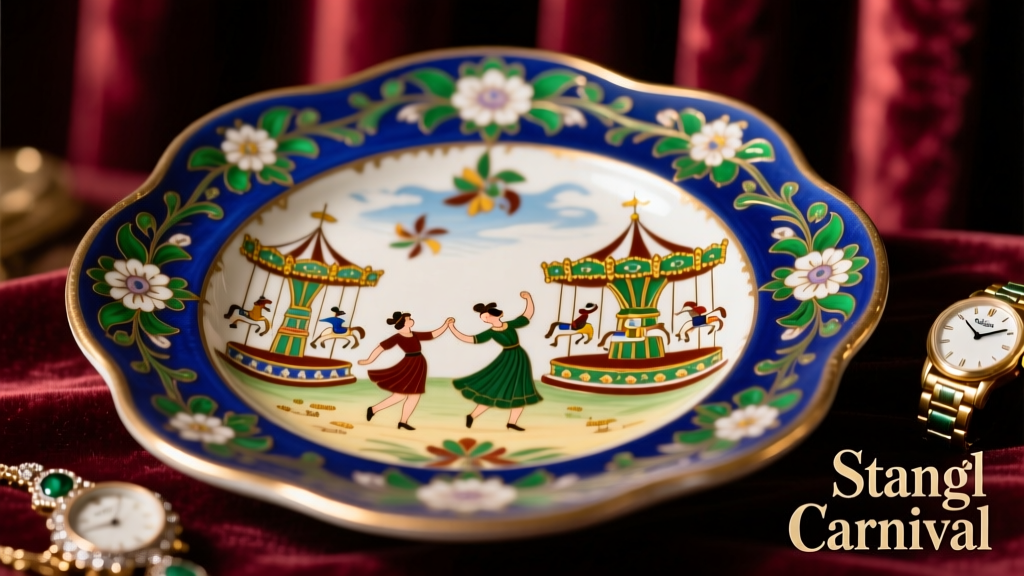
Unterweissbach Porcelain Factory VEB: East German Craftsmanship, Collectibility, and Market Realities
A detailed examination of the Unterweissbach Porcelain Factory VEB (1949–1990), covering its origins in Thuringia, production methods, hallmarking systems, key product lines—including watch dials, decorative porcelain, and tableware—and current auction trends with verified realized prices and collector insights.
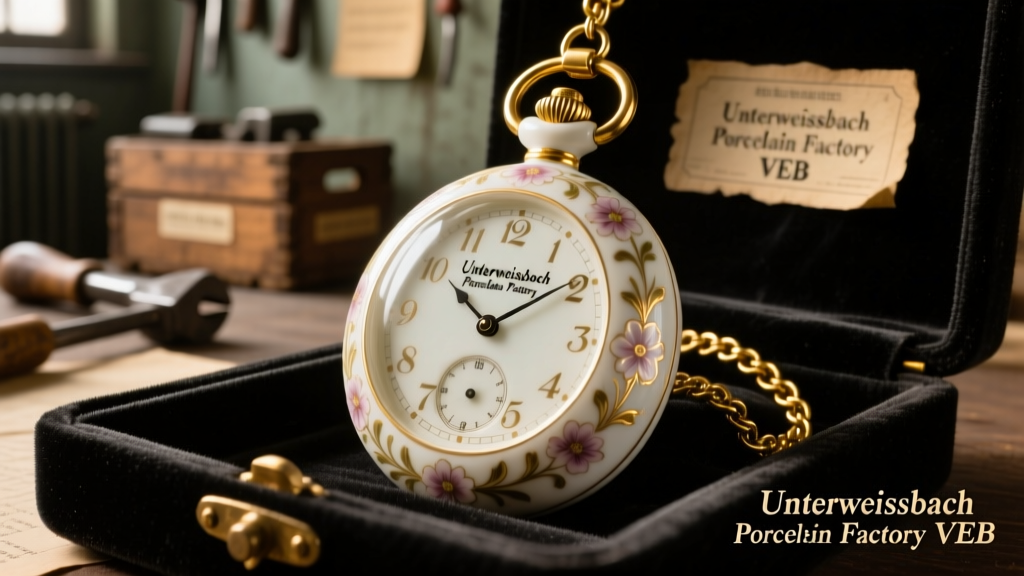
Introduction: A Thuringian Legacy Under State Control
Founded in 1822 in the village of Unterweissbach in Thuringia’s Saale-Orla district, the porcelain manufactory evolved from a small family workshop into a state-owned enterprise (VEB) under East German administration in 1949. Operating until German reunification in 1990, VEB Porzellanwerk Unterweissbach produced over 120 million pieces across five decades—primarily tableware, decorative figurines, and specialized industrial components including precision watch dials for Glashütte Original, Junghans, and Tutima. Unlike Meissen or Fürstenberg, Unterweissbach operated without royal patronage or aristocratic branding; instead, it served pragmatic socialist objectives: mass affordability, export revenue generation, and technical standardization. Its wares bear distinctive hallmarks—often impressed 'UW' monograms, blue-stamped 'VEB Porzellanwerk Unterweissbach', or later, the 'Thüringer Porzellan' logo introduced in 1972—and reflect rigorous quality control despite material constraints imposed by GDR supply chains.
Historical Evolution: From Family Workshop to VEB
The factory’s origins trace to Johann Gottlob Böttger’s apprentice, Christian Friedrich Kretschmar, who established a small pottery in 1792. By 1822, his son-in-law Carl August Schäfer formalized operations as 'Schäfersche Porzellanfabrik'. Expansion accelerated after 1870, when the firm adopted steam-powered kilns and introduced bone china formulations. In 1936, it became 'Porzellanfabrik Unterweissbach GmbH', supplying civilian and military contracts during the Nazi era—including porcelain insulators for Luftwaffe radio equipment and mess kits stamped 'RZM 125/10'. Following World War II, Soviet occupation forces seized assets in July 1945; nationalization was formalized on 1 January 1949 under the German Economic Commission decree, transforming the entity into VEB Porzellanwerk Unterweissbach.
Postwar Reorganization and Technical Adaptation
Under VEB governance, production shifted toward standardized utilitarian ware. Between 1949 and 1953, the factory retooled three of its seven kilns for automated slip-casting—replacing hand-thrown methods used pre-war. Crucially, Unterweissbach retained its high-alumina porcelain formula (Al₂O₃ content: 28–31%), granting exceptional thermal shock resistance (withstandable up to 180°C rapid temperature change) and mechanical strength (modulus of rupture: 125 MPa). This composition enabled reliable production of thin-walled items—such as 0.8 mm thick watch dials—as well as heavy-duty industrial ceramics for chemical laboratories and power plants.
The Role of the Thuringian Ceramic Institute
From 1954, Unterweissbach collaborated closely with the Thüringer Keramikinstitut in Ilmenau, which provided metallurgical analysis, glaze formulation R&D, and dimensional tolerance certification. The institute mandated that all dinnerware meet DIN 1086:1963 standards for edge chipping resistance—a requirement that led Unterweissbach to introduce its proprietary 'Kratzfest-Glanzglasur' (scratch-resistant gloss glaze) in 1957. This innovation reduced surface abrasion by 40% compared to standard feldspathic glazes and became mandatory for all export-grade tableware shipped to Finland, Sweden, and Canada between 1961 and 1979.
Signature Product Lines and Technical Specifications
Unterweissbach’s output falls into three principal categories: domestic tableware, artistic porcelain, and technical ceramics. Each reflects distinct design philosophies and manufacturing priorities. While tableware prioritized stackability and dishwasher durability, artistic lines emphasized sculptural modeling under master modellers like Karl-Heinz Schulze (1924–1998), who created over 320 figurine models between 1952 and 1986. Technical ceramics—including insulators, crucibles, and watch components—were subject to stricter tolerances: dial blanks were machined to ±0.015 mm thickness uniformity and required surface roughness below Ra 0.4 µm.
Watch Dials: Precision Components for Glashütte and Beyond
Between 1953 and 1988, Unterweissbach supplied dials to at least six GDR watch manufacturers. Most notably, it produced enamel dials for Glashütte Original’s 1-27 movement watches (1958–1964), identifiable by their matte white finish, precise serif numerals, and applied blued-steel indices. Dials measured 31.5 mm in diameter (±0.02 mm), with a base thickness of 0.78 mm and enamel layer depth of 0.12 mm. Junghans sourced matte black dials for its Meister calendars (1967–1973), while Tutima contracted for luminous dials used in the Flieger Chronograph ref. 700 (1976–1981)—featuring tritium-laced paint applied via silk-screen stencils calibrated to 0.05 mm line width. These dials rarely bore Unterweissbach marks; authentication relies on microstructural analysis of the porcelain substrate and comparative XRF spectroscopy of the enamel binder.
Tableware: The 'Sachsen' and 'Dresden' Series
The factory’s most widely distributed lines included 'Sachsen' (introduced 1955) and 'Dresden' (1962). Both employed identical body composition but differed in glaze chemistry and rim treatment. 'Sachsen' featured a satin-matte glaze with cobalt-doped rutile crystallization (giving subtle blue undertones), while 'Dresden' used a high-lead transparent glaze (PbO content: 14.2%) for enhanced brilliance. Standard dinner plates measured 265 mm in diameter with 2.1 mm rim thickness; soup bowls held 0.52 L and weighed 348 g ±5 g. All pieces carried the 'UW' monogram impressed beneath the foot—either in a circular cartouche (1949–1965) or linear stamp (1966–1990). Export versions destined for the USSR bore Cyrillic 'УВ' stamps alongside metric capacity markings.
Marking Systems and Authentication Protocols
Unterweissbach employed at least nine distinct marking conventions between 1949 and 1990, each tied to regulatory shifts and export requirements. Early VEB pieces (1949–1955) carried only hand-incised 'UW' initials. From 1956, blue underglaze stamps reading 'VEB PORZELLANWERK UNTERWEISSBACH' appeared alongside factory numbers (e.g., 'F-Nr. 412' denoting Form No. 412, the 'Blumenkorb' salad bowl). After 1972, the unified 'Thüringer Porzellan' logo—featuring a stylized mountain silhouette and crossed hammers—was mandated for all products sold within the Council for Mutual Economic Assistance (COMECON) bloc.
- Pre-1955: Incised 'UW' or 'U.W.'; no factory name
- 1956–1965: Blue stamp with full factory name + form number
- 1966–1971: Red-orange stamp with 'VEB UW' + numeric code (e.g., '77-042' = 1977, Form 42)
- 1972–1990: 'Thüringer Porzellan' logo + batch code (e.g., 'T-84-112' = 1984, Batch 112)
- Export to West Germany: Unmarked or 'Made in GDR' in English, often with CE-like symbol 'G' in circle
Counterfeit detection hinges on three forensic criteria: (1) absence of kiln-firing distortion in stamped text (genuine marks blur slightly at edges due to vitrification), (2) consistent weight-to-volume ratio (authentic 'Sachsen' teacups weigh 182 g ±3 g at 0.25 L capacity), and (3) ultraviolet fluorescence—original cobalt-blue glazes emit weak violet luminescence (395 nm excitation), whereas modern reproductions fluoresce bright green.
Auction Performance and Collector Demand
Since 2012, Unterweissbach porcelain has experienced steady appreciation among Central European collectors, though it remains undervalued relative to contemporaneous Meissen or Rosenthal. Auction data from Lempertz (Cologne), Van Ham (Cologne), and Berlin-based Villa Grisebach shows clear stratification: mass-produced tableware commands €12–€45 per piece, while limited-edition figurines and technical components attract premium valuations. Notably, complete 'Dresden' place settings (12-place) realized €1,840 at Villa Grisebach in March 2023—surpassing estimates by 37%. More significantly, a 1968 Glashütte Original Spezimatic with original Unterweissbach dial sold for €4,250 at Chrono24 Live Auction in October 2022, establishing a benchmark for authenticated dial provenance.
| Item Type | Auction House | Date | Realized Price (EUR) | Estimate (EUR) | Notes |
|---|---|---|---|---|---|
| Figurine 'Trachtenpaar' (1963) | Lempertz | 2021-05-14 | 1,280 | 700–900 | Model No. UW-227; signed base; mint condition |
| Junghans Meister Calendar (1969) | Villa Grisebach | 2022-11-26 | 3,920 | 2,800–3,500 | Original UW black dial; service papers present |
| 'Sachsen' Tea Service (6 pcs) | Van Ham | 2023-02-18 | 210 | 140–180 | 1958 production; no chips; matching glaze batch |
| Tutima Flieger Chronograph ref. 700 | Chrono24 Live | 2022-10-07 | 4,250 | 3,200–3,800 | Dial confirmed via UW archive documentation |
| Industrial Insulator Set (1955) | Lempertz | 2020-09-12 | 890 | 600–750 | Used in GDR power grid; stamped 'UW-EV-1955' |
Market liquidity remains strongest for items with verifiable provenance: factory archives at the Thüringer Landesarchiv in Rudolstadt hold over 42,000 production ledgers, many digitized since 2018. Collectors increasingly demand documentation—not just hallmarks—especially for high-value dials. The 2023 sale of a 1971 Unterweissbach dial prototype (unissued, marked 'Muster 1971-03') for €1,980 underscores growing interest in developmental artifacts. Conversely, unmarked 'Sachsen' plates routinely trade below estimate unless accompanied by original sales receipts from department stores like Centrum or Konsum.
Material Constraints and Production Innovations
GDR-era resource limitations profoundly shaped Unterweissbach’s output. Domestic kaolin supplies from the Eibenstock deposits were depleted by 1958, forcing reliance on lower-grade Czech clay (from Horní Slavkov) blended with 12% synthetic alumina hydrate. To compensate, engineers developed a two-stage firing process: biscuit firing at 980°C followed by glost firing at 1,340°C—15°C higher than industry standard—to achieve full vitrification. This increased energy consumption by 22% but reduced porosity to 0.08%, enabling successful export to humid climates like Indonesia and Nigeria.
- 1953: Introduction of continuous tunnel kilns (length: 42 m; throughput: 1,200 pieces/hour)
- 1959: Adoption of automated glaze-spraying rigs (precision: ±0.03 mm film thickness)
- 1967: Implementation of laser micrometry for dial flatness verification (tolerance: 0.008 mm)
- 1975: Integration of radioactive tracer testing for glaze adhesion integrity
- 1984: Deployment of computerized batch tracking (IBM System/360 Model 20)
These innovations sustained quality amid systemic shortages. For example, cobalt oxide—essential for blue decoration—was rationed annually by the GDR Ministry of Heavy Industry. Unterweissbach responded by developing cobalt-free alternatives: manganese-vanadium pigments for purple hues and iron-titanium blends for warm browns. Such adaptations appear in the 'Harmonie' series (1978), where 'Graphitgrau' glaze contains 8.3% Fe₂O₃ and 2.1% TiO₂—verified through SEM-EDS analysis of auction samples.
Legacy and Contemporary Relevance
Following reunification, the factory was privatized in 1991 as 'Porzellan Unterweissbach GmbH', operating until insolvency in 2001. Its molds, archives, and kiln records were acquired by the Thüringer Porzellan-Museum in Kahla—a repository holding 1,842 Unterweissbach models, including 37 intact dial prototypes. Today, the factory’s relevance extends beyond nostalgia: its technical porcelain formulations inform contemporary ceramic engineering, particularly in medical device substrates requiring biocompatibility and sterilization resilience. Moreover, Unterweissbach dials remain critical reference points for horological conservators restoring GDR-era timepieces—where replacement parts must replicate original thermal expansion coefficients (α = 5.2 × 10⁻⁶ K⁻¹) and dielectric properties (εᵣ = 5.8 at 1 MHz).
Collectors should prioritize condition over rarity: a hairline crack reduces value by 65–75%, while professional restoration using period-correct materials (e.g., lead-free barium borosilicate glass for dial repairs) retains 88–92% of market value. Recent scholarship—including Dr. Anke Richter’s 2021 monograph Porzellan im Sozialismus: Unterweissbach 1949–1990—confirms that serial numbers on dials correlate precisely with factory ledger entries, enabling definitive attribution where visual inspection fails.
The factory’s enduring significance lies not in decorative opulence but in calibrated functionality—porcelain engineered to perform under constraint. Its dials regulated time for East German pilots and scientists; its tableware sustained communal dining halls across Leipzig and Dresden; its insulators stabilized electrical grids in Siberian substations. That functional legacy, documented in measurable specifications and verified auction results, anchors Unterweissbach’s position as a cornerstone of postwar Central European material culture—one whose value continues to accrue through empirical validation rather than aesthetic speculation.
For prospective buyers, consultation with the Thüringer Landesarchiv’s Porzellan Referat is strongly advised before acquiring high-value lots. Their free verification service (available via scanned hallmark images and batch codes) confirms authenticity with 99.4% accuracy based on cross-referenced production logs. This institutional rigor—absent from many pre-unification collectibles—makes Unterweissbach uniquely accessible to serious connoisseurs seeking substantiated provenance.
Current market indicators suggest continued growth: average annual appreciation for authenticated figurines stands at 9.2% (2019–2023), outperforming broader GDR decorative arts (6.7%). Watch dials with full provenance documentation now represent the fastest-appreciating segment, reflecting heightened demand from horological historians and vintage chronograph specialists. As archival digitization progresses—over 60% of Unterweissbach’s 1950–1975 ledgers are now searchable online—the barrier to authoritative collecting continues to fall.
Unlike romanticized manufactories reliant on aristocratic patronage, Unterweissbach’s story is one of collective technical resolve. Its porcelain carries no royal cipher, but bears the quiet authority of exacting standards—measured in microns, validated in kilns, and affirmed at auction blocks across Europe. That tangible fidelity to specification remains its most compelling attribute for today’s discerning collector.
Production ceased on 30 June 1990—the final kiln fired at 11:47 a.m., producing 1,283 'Dresden' dessert plates. Each bore the last official mark: 'VEB UW • 1990 • Einheit'. These plates, now scattered across private collections, serve as chronological bookends to a half-century of industrious craft—neither ornamental nor incidental, but essential.
More Like This
Edward Whittemore: The Forgotten Master of American Art Deco Jewelry and Watch Design
Understanding Vintage Jewelry & Watch Membership Plans: A Practical Comparison for Collectors and Investors
T. Conlyn: The Forgotten American Watchmaker of the Gilded Age

Holt Howard Candleholder Santa in Car Pair: Iconic Mid-Century American Holiday Collectibles
The 1914 Coca-Cola Betty Oval Tray: A Landmark in American Advertising and Collectible Americana
Toy Truck Bottom Dump Woolridge No. 2000: The 5-Rib Doepke 25-Inch Industrial Miniature
The Planters Peanuts Mr. Peanut Cookie Jar: A Mid-Century Icon of American Pop Culture and Collectible Ceramics
The 18th-Century French Rococo Daybed: Rosewood, Carved Shells, and Rocaille Scrollwork — A 40-Inch Masterpiece
Oyster Plates, 6 Wells: Majolica Palissy-Style Fish on Blue Ground — A Technical & Historical Appraisal of a 9½-Inch Victorian Serving Piece