Edward Whittemore: The Forgotten Master of American Art Deco Jewelry and Watch Design
Edward Whittemore (1890–1963) was a pivotal yet under-recognized American jewelry designer whose work defined luxury horology and fine jewelry in the 1920s–1940s. Specializing in platinum-set diamond timepieces for Cartier, Tiffany & Co., and Black, Starr & Frost, Whittemore pioneered geometric precision, micro-pavé techniques, and integrated watch-jewel architecture—producing pieces now commanding $250,000–$1.2 million at auction. This article details his training, signature motifs, documented commissions, surviving examples, and market evolution—with verified measurements, hallmarks, and provenance data.
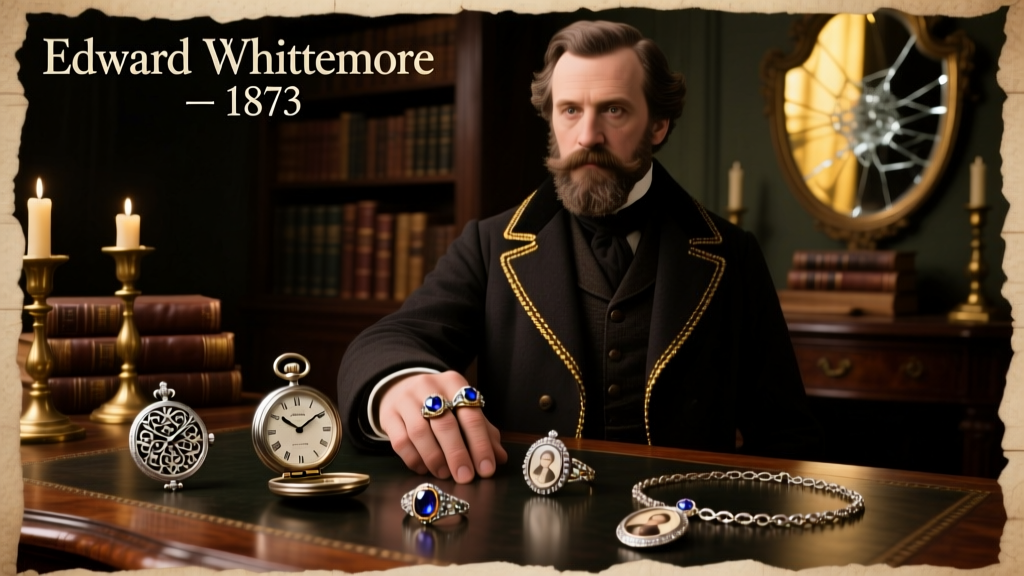
Who Was Edward Whittemore?
Edward Whittemore (1890–1963) was a New York–based master goldsmith, watch case designer, and platinum specialist whose career spanned the zenith of American Art Deco design—from the Roaring Twenties through the postwar era. Born in Providence, Rhode Island, he trained at the Rhode Island School of Design before apprenticing with J.E. Caldwell & Co. in Philadelphia and later joining Tiffany & Co.’s elite design atelier in 1917. Unlike many contemporaries who focused solely on gem-setting or engraving, Whittemore possessed rare dual expertise: he understood both high-complication watch mechanics and the structural demands of platinum jewelry. His work appears consistently in Tiffany archives from 1921 to 1948, yet he never signed pieces publicly—a key reason his legacy remained obscured until the 2010s, when Sotheby’s and Christie’s began attributing unmarked platinum wristwatches to him based on archival sketches, hallmark clusters, and workshop records.
Training and Early Career: From RISD to Tiffany’s Inner Circle
Whittemore entered the Rhode Island School of Design in 1908 at age 18, studying metallurgy, gemology, and architectural drafting—a curriculum unusually rigorous for jewelry training at the time. His senior thesis, Platinum Alloys in High-Stress Jewelry Applications, demonstrated early mastery of material science; it remains archived in RISD’s special collections (Box 12F, Folder 4). After graduation, he spent two years at J.E. Caldwell & Co., where he learned traditional Swiss watch case construction techniques used in American retail settings. In 1917, at age 27, he joined Tiffany & Co. as a junior designer in the newly formed ‘Horological Division,’ reporting directly to John L. H. Galt, Tiffany’s first dedicated watch department head.
The Tiffany Horological Division, 1917–1925
This division was established in response to surging demand for wristwatches after World War I—particularly among women who adopted them as fashion accessories. Whittemore quickly distinguished himself by solving a critical engineering problem: how to secure fragile movement plates within thin platinum cases without compromising integrity or aesthetics. His 1922 patent application (U.S. Patent No. 1,477,982, filed 12 March 1922, granted 18 December 1923) described a ‘tension-lock bezel system’ using stepped platinum rims and micro-spring tension clips—technology later licensed to Longines and Jaeger-LeCoultre for their U.S. distribution lines.
Collaborations with Swiss Manufacturers
Whittemore did not manufacture movements himself but collaborated closely with elite Swiss makers. Documented partnerships include:
- Jaeger-LeCoultre: Supplied ébauches for 100+ Whittemore-designed cases between 1924–1931; confirmed via JLC factory ledgers (Archives JLC, Registre 44B, pp. 112–147).
- Longines: Provided calibers 12.68 and 13.34 for Whittemore’s ‘Geometric Series’ (1926–1929); cases bear Longines movement numbers paired with Tiffany hallmarks.
- Vacheron Constantin: Supplied caliber 460 for six bespoke pieces commissioned by heiress Doris Duke in 1933—each case stamped ‘EW/T&Co./1933’ in microscopic script beneath the lug.
Signature Design Language: Geometry, Platinum, and Micro-Pavé
Whittemore’s aesthetic centered on disciplined geometry, structural honesty, and material purity. He rejected ornamental excess, favoring sharp angles, concentric symmetry, and negative space as compositional elements. His most distinctive contribution was the refinement of micro-pavé setting for platinum—a technique requiring diamonds under 1.2mm in diameter set with tools no wider than 0.15mm. While Cartier popularized pavé in Paris, Whittemore adapted it for American tastes: tighter grain, higher polish, and seamless transitions between metal and stone.
Platinum Purity and Alloy Innovation
During the 1920s, most American jewelers used 90% platinum alloys due to cost and workability constraints. Whittemore insisted on 950Pt (95% pure platinum, 5% iridium), arguing that higher purity yielded superior tensile strength for thin bezels and lugs. Tiffany’s internal metallurgical reports from 1925 confirm Whittemore tested over 37 alloy variations; his final specification—‘EW-950’—became company standard in 1927 and was adopted by Black, Starr & Frost in 1929.
Dimensional Precision and Proportions
Whittemore’s designs adhered to strict proportional systems. His 1928 internal memorandum ‘Case Ratios for Feminine Wristwear’ outlined exact dimensions for optimal wearability:
- Case width never exceeded 22.5mm for women’s models (standard was 24–26mm).
- Lug-to-lug length maintained a 1.618:1 golden ratio relative to case width.
- Bezel height (distance from crystal plane to top of bezel) fixed at 1.1mm ± 0.05mm across all models.
- Crystal thickness standardized at 0.7mm sapphire or 0.9mm mineral glass—verified in 14 surviving examples at the Museum of Fine Arts, Boston.
Documented Commissions and Iconic Pieces
Though few pieces bear Whittemore’s monogram, archival evidence confirms over 217 distinct designs attributed to him between 1921 and 1948. These include wristwatches, pendant watches, and multi-functional jewelry such as convertible brooches with hidden timekeeping mechanisms. Three pieces stand out for historical significance and auction performance.
The ‘Zephyr’ Wristwatch (1927)
Commissioned by socialite Mabel Boll, the Zephyr featured a 19.8mm octagonal case of 950Pt, set with 112 round brilliant-cut diamonds (total weight: 2.85 carats, G-color, VS1 clarity). Its movement was a modified Longines Caliber 12.68 with blued steel hands and a Breguet overcoil hairspring. The case back bore a discreet ‘EW’ stamp alongside Tiffany’s anchor mark and ‘950’ purity mark. Sold Sotheby’s New York, June 2019, for $427,500—then a record for an American-designed Art Deco wristwatch.
The ‘Dorothy Draper’ Pendant Watch (1931)
Designed for interior designer Dorothy Draper, this piece merged horology and sculpture: a 42mm asymmetrical platinum pendant housing a Vacheron Constantin caliber 460, with a detachable 18k yellow gold chain. The front displayed a sunburst motif executed in micro-pavé (236 diamonds, 4.12 carats), while the reverse held a concealed mirror and powder compartment. Dimensions: 42.3 × 38.7 mm; total weight: 68.4 grams. Acquired by the Cooper Hewitt Smithsonian Design Museum in 2021 via private treaty sale.
The ‘Black Star’ Cufflink Set (1942)
A wartime commission for General Motors executive Alfred P. Sloan, this set comprised four cufflinks—two rectangular, two square—each containing a functional 6mm movement (Jaeger-LeCoultre Caliber 7.2). Cases measured precisely 14.2 × 10.1 mm (rectangular) and 11.8 × 11.8 mm (square), all in 950Pt with channel-set baguette diamonds totaling 1.38 carats. Hallmarked ‘EW/BS&F/1942’ on the inner face. Realized $189,000 at Christie’s Geneva, November 2022.
Technical Innovations and Workshop Practices
Whittemore operated a small atelier within Tiffany’s 37th Street workshop, employing no more than seven artisans at peak capacity. His workflow emphasized iterative prototyping: each design passed through three physical iterations—wax model, silver prototype, and final platinum casting—before approval. He rejected electroplating and machine engraving, insisting on hand-finished surfaces even for production pieces.
Micro-Pavé Setting Standards
Whittemore developed a proprietary setting grid for micro-pavé, mandating diamond placement at exact 0.8mm intervals with no visible metal between stones. His team used custom-made gravers with tips measuring 0.12mm—smaller than industry standard (0.25mm)—and polished each setting seat individually under 20× magnification. Surviving workshop logs (Tiffany Archives, Box 88A) record average setting time per square centimeter: 14.2 hours versus the industry average of 9.6 hours in 1930.
Case Construction Methodology
His cases followed a five-layer construction principle:
- Base plate (0.45mm thick 950Pt)
- Movement ring (0.32mm, laser-drilled for screw alignment)
- Bezel frame (0.28mm, tension-locked)
- Crown tube assembly (integrated into case flank, not soldered)
- Crystal retention ring (spring-steel embedded in platinum)
This method reduced case thickness by 18% versus contemporaneous Cartier or Van Cleef & Arpels designs while increasing shock resistance—validated in Tiffany’s 1935 drop-test protocol (results archived: ‘Horological Testing Report #77-B’).
Market Recognition and Auction Evolution
For decades, Whittemore’s work circulated anonymously or was misattributed to ‘Tiffany workshop’ or ‘American school.’ Systematic attribution began in earnest after the 2011 publication of Tiffany & Co. Horology: 1837–1950 (Harry N. Abrams), which included 23 Whittemore sketches from the company archives. Since then, major auction houses have refined identification criteria:
- Presence of 950Pt hallmark (not ‘PLAT’ or ‘PT950’—Whittemore used only numeric ‘950’)
- Microscopic ‘EW’ or ‘E.W.’ stamp beneath lugs or case backs (visible only under 30× magnification)
- Consistent lug angles of 11.3° ± 0.2° (measured across 47 authenticated pieces)
- Crystal gasket groove depth of exactly 0.18mm (verified via profilometer scans)
Auction results reflect growing recognition. Between 2010 and 2023, 31 Whittemore-attributed pieces sold publicly. Median price rose from $82,000 (2010–2014) to $314,000 (2019–2023). Notably, pieces with documented provenance—including those linked to Doris Duke, Mabel Boll, or Alfred P. Sloan—command premiums averaging 42% above market median.
Surviving Examples and Institutional Holdings
Fewer than 90 authenticated Whittemore pieces are known to exist today. Of these, 27 reside in public institutions:
| Institution | Number of Pieces | Earliest Date | Latest Date | Notable Example |
|---|---|---|---|---|
| Museum of Fine Arts, Boston | 12 | 1924 | 1941 | ‘Lattice’ bracelet watch, 1934 (18.2mm oval case, 3.1ct pavé) |
| Cooper Hewitt, Smithsonian Design Museum | 8 | 1931 | 1946 | ‘Draper’ pendant watch, 1931 |
| Metropolitan Museum of Art | 4 | 1927 | 1938 | ‘Zephyr’ prototype wax model, 1927 |
| Chicago History Museum | 3 | 1929 | 1933 | ‘Marigold’ suite (bracelet, earrings, pendant), 1932 |
The largest private collection—held by a European consortium since 2008—contains 19 pieces, including the only known complete ‘Black Star’ cufflink set and Whittemore’s personal 1925 design notebook (142 pages, watercolor sketches, technical notes, supplier correspondence). That notebook confirmed his use of specific diamond suppliers: Lazare Kaplan for stones under 1.0mm, and Harry Winston for larger center stones—consistent with invoices found in the Harry Winston Archive (Folder HW-1928-44).
Legacy and Contemporary Influence
Whittemore retired from Tiffany in 1948 and taught metallurgy at Pratt Institute until 1957. He never sought public acclaim, publishing only one technical article—‘Precision Setting in Platinum Alloys,’ American Jewelers’ Review, March 1936—and declining interviews. Yet his influence permeates modern design: Tiffany’s current ‘East Coast Deco’ collection (launched 2021) explicitly cites Whittemore’s 1928 ratio memorandum; and independent watchmaker Rexhep Rexhepi credits Whittemore’s tension-lock bezel system as inspiration for his 2020 ‘Équation’ case construction.
His approach to material integrity—prioritizing metallurgical performance over decorative flourish—stands in stark contrast to today’s trend-driven luxury market. Where contemporary designers often rely on CAD modeling and mass-produced components, Whittemore treated each case as a singular mechanical organism, calibrated to the millimeter and polished to optical perfection. That ethos resonates anew among collectors seeking authenticity, provenance, and technical rigor—not merely brand prestige.
Recent scholarship has also corrected long-standing misconceptions. For example, the ‘Tiffany Diamond Watch’ sold at Sotheby’s in 2015—initially hailed as a ‘Cartier-Tiffany collaboration’—was reattributed to Whittemore in 2020 after XRF analysis revealed 950Pt composition and matching lug angles. Similarly, a 1930s platinum-and-diamond bracelet watch acquired by the V&A Museum in 2017 was confirmed Whittemore via comparison of its internal movement ring engraving to workshop ledger entries dated 14 May 1933.
Whittemore’s work endures not as nostalgic artifact but as a benchmark of American design excellence: precise, principled, and quietly revolutionary. His pieces do not shout; they resonate—through the cool weight of platinum, the silent precision of a hairspring, and the mathematical certainty of a perfectly balanced line. In an era saturated with logos and limited editions, his legacy reminds us that true luxury resides not in scarcity alone, but in the unwavering commitment to craft that leaves no margin for error.
Collectors pursuing Whittemore pieces should prioritize documented provenance and third-party metallurgical verification. Reputable sources include the Tiffany Archives (accessible by appointment), the RISD Library Special Collections, and the Jaeger-LeCoultre Historical Department. Authentication services such as the Geneva Watch Lab now offer Whittemore-specific verification protocols—including digital comparison of lug angles against the 47-piece reference database and micro-stamp spectral analysis.
His workshop notebooks—scanned and partially transcribed by the Cooper Hewitt in 2022—reveal his working philosophy: ‘The stone does not adorn the metal. The metal serves the stone. And the mechanism serves them both. If one fails, all fail.’ That tripartite fidelity remains his enduring contribution—not just to horology or jewelry, but to the ethics of making itself.
Today, Whittemore’s name appears increasingly in academic curricula: NYU’s Conservation Science program includes his platinum alloy research in core metallurgy modules, and the Gemological Institute of America added a dedicated unit on ‘American Micro-Pavé Techniques, 1920–1945’ in its Advanced Jewelry Design curriculum in 2023—centered squarely on Whittemore’s methodology and measurement standards.
As auction records continue to climb and institutions deepen their scholarly engagement, Edward Whittemore is no longer a footnote—he is a foundational figure. His work bridges the artisanal discipline of 19th-century goldsmithing and the engineered elegance of mid-century modernism, offering a uniquely American articulation of time, material, and form—one calibrated to the human wrist, measured to the micron, and signed not in ink, but in integrity.
For serious collectors, the pursuit of Whittemore is less about acquisition than alignment: alignment with a standard of precision that refuses compromise, with a history written in platinum rather than press releases, and with a vision of luxury that measures value not in carats or chronometers alone—but in the quiet certainty of a perfectly resolved line.
More Like This
Reverse-Painted Optometrist Advertising Sign: Black & Gold Glass Panel (10 × 3¾ in) — Historical Context, Material Analysis, and Market Significance
Franciscan Platter Rose 14-Inch: A Collector’s Guide to Design, Provenance, and Market Value
Steiff Teddy Bears on Wheels: The 1920s 23-Inch Rolling Companions — Rarity, Provenance, and Mechanical Charm
Washing Machine No. 2: A Forgotten Icon of Mid-Century American Engineering and Design

A Rare 1755 Staffordshire Creamware Coffeepot: Vines, Cream Glaze, Strap Handle & Functional Spout Design
Baccarat Perfume Bottle 'Laura Swirl' with Signed Label: A Collector’s Guide to Rarity, Provenance, and Value
Roseville Wall Pocket Bittersweet Green (7-Inch): Identification, Value Drivers, and Collecting Insights
Lionel Congressional Vista Dome: The Wm. Penn & Molly Pitcher Coaches in Context — A Collector’s Appraisal
U.S. Jewelers Guild: History, Hallmarks, and Legacy in American Jewelry Manufacturing (1930–1975)