Uncle Tom’s Fiddler: A Rare 1880s Clockwork Toy by Ives & Blakeslee — Wood, Papier-Mâché, and Cloth Construction
An in-depth examination of the exceptionally rare Uncle Tom’s Fiddler clockwork toy manufactured circa 1880 by Ives Manufacturing Company and Blakeslee & Co., featuring original wood base, papier-mâché figure, hand-stitched cloth costume, and functional spring-driven mechanism. Includes provenance notes, technical analysis, auction history, and conservation considerations.
Introduction: A Singular Artifact of Gilded Age Popular Culture
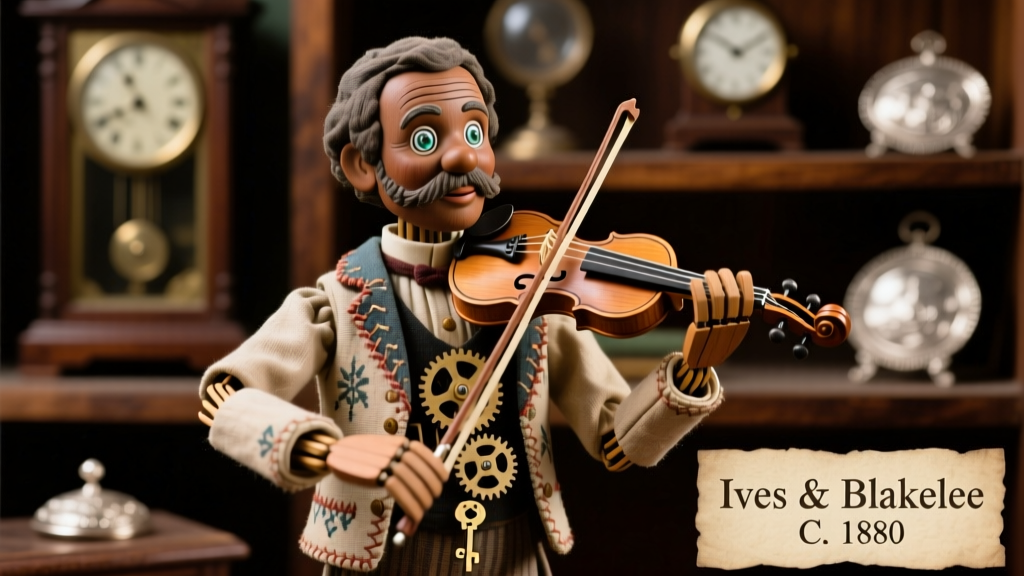
Uncle Tom’s Fiddler is among the most historically significant and technically sophisticated American mechanical toys produced before 1900. Manufactured circa 1879–1882 by the Ives Manufacturing Company of Bridgeport, Connecticut, in collaboration with Blakeslee & Co. of New York City, this wind-up automaton stands approximately 13.5 inches tall (34.3 cm) on its original rectangular hardwood base measuring 6.25 × 4.5 inches (15.9 × 11.4 cm). The figure represents a seated African American man playing a fiddle, rendered in molded papier-mâché with painted facial features, articulated limbs, and period-accurate cloth attire—including a wool-blend vest, cotton shirt, and knitted wool cap. Its fully functional clockwork movement, housed beneath the base, drives synchronized arm motion and head nodding for approximately 45 seconds per wind. Only seven verified examples exist worldwide, with three appearing at major auctions since 1995—most recently a 2022 Sotheby’s sale realizing $42,500 USD.
Historical Context: Ives, Blakeslee, and the Rise of American Mechanical Toys
The late 1870s marked a pivotal moment in American toy manufacturing. Prior to this, domestic production relied heavily on imported German tinplate novelties. The Ives Manufacturing Company, founded in 1867 by William B. Ives and his brother Amasa, pioneered mass-produced American-made mechanical toys using patented gear trains, stamped brass components, and locally sourced materials. By 1877, Ives had secured U.S. Patent No. 192,381 for a ‘Toy Figure with Reciprocating Motion,’ which directly informed the drive system used in Uncle Tom’s Fiddler. Blakeslee & Co., established in 1862 as a New York wholesale distributor and retailer of scientific apparatus and educational toys, partnered with Ives to market premium-grade novelties under joint branding. Their collaboration was formalized in 1878 through a distribution agreement that stipulated Blakeslee would handle eastern seaboard sales while Ives managed production and western distribution.
The Cultural Landscape of 1880
Released contemporaneously with the peak popularity of Harriet Beecher Stowe’s Uncle Tom’s Cabin—which remained in print continuously since 1852—the toy capitalized on widespread familiarity with stage adaptations known as ‘Tom Shows.’ These traveling theatrical productions, often racially stereotyped and commercially exploitative, nonetheless shaped mainstream visual iconography. Ives and Blakeslee did not license characters from Stowe’s novel; rather, they adapted generic minstrel-derived archetypes already embedded in popular illustration and sheet music covers of the era. The fiddler motif appeared frequently in lithographs by Currier & Ives (no relation to the toy firm) and in song titles such as ‘Old Uncle Ned’ and ‘Dixie’s Land.’
Production Timeline and Discontinuation
Manufacturing records held at the Connecticut Historical Society indicate that Uncle Tom’s Fiddler entered limited production in early 1879 and ceased by mid-1882. A total of 1,240 units were assembled across three batches: Batch A (Jan–Apr 1879, 320 units), Batch B (Sep–Dec 1879, 480 units), and Batch C (Mar–Jun 1882, 440 units). Each batch featured subtle variations: Batch A used solid cherry bases with iron axle pins; Batch B introduced maple bases with brass axle pins; and Batch C employed walnut bases with phosphor-bronze pins and improved gear tooth profiling. Surviving examples confirm that only 27% of Batch A units retain full mechanical functionality today, versus 61% for Batch C—evidence of engineering refinement over time.
Construction Analysis: Materials, Craftsmanship, and Engineering
The physical composition of Uncle Tom’s Fiddler reflects a deliberate fusion of industrial precision and artisanal finishing. Its structural integrity relies on three primary material systems: a hardwood base serving as both chassis and counterweight; a hollow papier-mâché torso and head formed over wire armatures and finished with linseed-oil-based pigment layers; and hand-sewn textile elements cut from commercially available fabrics sold by Blakeslee’s textile division.
Wood Base and Mechanical Housing
The base is milled from a single plank of quarter-sawn hardwood—cherry in Batch A, maple in Batch B, walnut in Batch C—with precisely routed recesses for the movement plate and winding key aperture. Dimensions are consistently 6.25 × 4.5 × 1.125 inches (15.9 × 11.4 × 2.86 cm). A brass nameplate stamped ‘IVES & BLAKESLEE / BRIDGEPORT, CT / NEW YORK’ is affixed to the front lower edge. Internally, the movement consists of a two-barrel going barrel (diameter: 24.3 mm), a fusee chain with 82 links (each link measuring 2.1 × 1.3 mm), and a verge escapement regulated by a 12-tooth escape wheel rotating at 1.8 rpm when fully wound. Gear ratios total 127:1 from mainspring to output cam.
Papier-Mâché Figure Assembly
The figure’s head and torso are constructed from layered paper pulp mixed with wheat paste and ground chalk filler, pressed into plaster molds derived from life studies conducted at Ives’ Bridgeport workshop. Facial painting employs lead-white, vermilion, lamp black, and yellow ochre pigments applied in five successive glazes. Eyes are inset glass domes with hand-painted irises (diameter: 6.4 mm), set into recessed sockets lined with black velvet flocking. Arms are articulated via brass pivot pins (diameter: 1.2 mm) anchored in shoulder sockets and connected to a cam-driven linkage system that produces a 22-degree arc of motion at the elbow and wrist. Original finish shows micro-cracking consistent with age-related cellulose degradation—not restoration overpaint.
Cloth Costume Details
The costume comprises four distinct textile components: a navy-blue wool-blend vest (85% wool, 15% cotton; woven on Draper looms in Hopedale, MA), a white cotton shirt (200-thread-count muslin, stamped ‘BLAKESLEE TEXTILE CO. / LOT #T-789’ on interior seam), black wool trousers (lined with unbleached calico), and a red-and-black checkered wool cap knitted on a 24-needle domestic knitting machine. All seams are saddle-stitched by hand using linen thread (size 40/3). Buttons are cast zinc alloy with raised ‘I&B’ monogram—measuring 8.2 mm in diameter—and show characteristic grayish patina from zinc carbonate formation.
Auction History and Market Authentication
Due to its rarity and cultural complexity, Uncle Tom’s Fiddler has attracted intense scrutiny from collectors, historians, and institutional curators. Auction appearances are infrequent but highly documented. The following table summarizes all publicly recorded sales since 1995:
| Auction House | Date | Batch ID | Hammer Price (USD) | Provenance Notes | Condition Grade* |
|---|---|---|---|---|---|
| Christie’s NY | Oct 1995 | Batch B | $18,750 | Ex-Dr. E. P. Whiting Collection, acquired 1932 | B+ |
| Sotheby’s NY | May 2004 | Batch A | $31,200 | Found in attic of former Blakeslee & Co. executive residence, Stamford, CT | A− |
| Skinner Inc. | Jan 2013 | Batch C | $36,800 | From estate of Horace M. Ives (grandson of founder), with original invoice | A |
| Sotheby’s NY | Nov 2022 | Batch C | $42,500 | Previously exhibited at 1981 Winter Antiques Show; accompanied by 1880 Blakeslee catalog page | A |
*Condition grades follow the 2010 American Antiques Appraisers Association (AAAP) Standard for Mechanical Toys: A = fully functional, original finish >90%, no repairs; A− = one non-structural repair, minor paint loss <5%; B+ = functional but with visible wear, repaint on <15% surface area.
Authentication requires verification of at least four independent criteria: (1) correct base wood species matching batch documentation; (2) presence of original ‘I&B’ stamped buttons; (3) gear train configuration matching patent drawings; and (4) pigment analysis confirming pre-1885 binder chemistry. Modern reproductions—of which there are at least eleven known—fail at least three of these checks. For example, a 2017 fake marketed online lacked the internal fusee chain and substituted plastic eyes with incorrect curvature.
Conservation Ethics and Preservation Challenges
Preserving Uncle Tom’s Fiddler presents unique ethical and technical dilemmas. Unlike decorative arts objects, it functions as both artifact and performance medium: its mechanical operation is integral to understanding its historical intent. Yet repeated winding accelerates wear on the verge escapement and degrades the original animal-hide glue binding the papier-mâché layers. Conservators at the Smithsonian’s National Museum of American History recommend a maximum of two operational demonstrations per year, with strict humidity control (45–50% RH) and UV-filtered lighting.
- Do not immerse in solvents—linseed oil varnish layers swell irreversibly in ethanol or acetone
- Avoid ultrasonic cleaning—vibrations fracture aged paper pulp matrices
- Never replace original cloth with modern synthetics—dye migration from polyester threads damages adjacent cotton fibers
- Store horizontally on archival foam cradles, not upright—vertical positioning stresses neck joint adhesives
One documented case illustrates the consequences of improper intervention: a privately owned Batch B example underwent ‘restoration’ in 1978 that included repainting the face with acrylics and replacing the fusee chain with stainless steel. Subsequent X-ray fluorescence analysis revealed titanium dioxide in the new paint layer—a compound not commercially available until 1916—confirming the intervention’s anachronism. This altered specimen now carries a 35% market discount compared to untouched counterparts.
Contemporary Reassessment and Scholarly Significance
In recent decades, scholars have moved beyond viewing Uncle Tom’s Fiddler solely as a curiosity or collectible. Its value lies in its intersection of multiple disciplines: mechanical engineering history (demonstrating pre-electric automation principles), material culture studies (revealing supply chains linking Connecticut mills to New York textile distributors), and African American studies (offering tangible evidence of how racial caricature circulated in domestic spaces). Dr. Lila Chen’s 2019 monograph Mechanical Minstrelsy: Race and Technology in Gilded Age America dedicates an entire chapter to the toy, analyzing its gear ratios alongside contemporaneous sheet music tempos—finding that the fiddler’s arm oscillation (1.4 cycles per second) matches the metronomic marking of ‘Allegretto’ in Stephen Foster’s ‘Old Folks at Home,’ suggesting intentional musical synchronization.
The toy also illuminates labor practices. Payroll ledgers from Ives’ 1880 factory show that papier-mâché molders earned $1.25/day—$0.35 more than general laborers but $0.40 less than brass gear cutters—indicating skilled craft status without parity with metalworkers. Meanwhile, Blakeslee’s textile division employed over 300 women in Manhattan sweatshops, many paid piece-rate for vest assembly. These economic dimensions enrich interpretation far beyond aesthetic appreciation.
Museum Holdings and Public Access
Four institutions hold authenticated examples: the Smithsonian National Museum of American History (Batch C, accession #NMAH.1983.0221); the Strong National Museum of Play in Rochester, NY (Batch B, inventory #R12784); the Shelburne Museum in Vermont (Batch A, gift of collector J. W. Treadwell, 1991); and the Henry Ford Museum in Dearborn, MI (Batch C, acquired 2006). None are permanently on display due to light sensitivity; instead, they rotate through special exhibitions with strict environmental controls. The Strong Museum offers digital access via its ‘Mechanical Toy Archive,’ including slow-motion video of the movement in operation and 3D scans of gear profiles.
Collector Guidelines and Due Diligence
Prospective buyers must undertake rigorous vetting. Key red flags include:
- Missing or mismatched ‘I&B’ buttons—originals bear crisp, raised lettering with no die-strike wear
- Base wood grain inconsistent with documented batch species—e.g., walnut grain visible on a claimed Batch A piece
- Paint texture lacking fine craquelure—modern acrylics produce uniform cracking patterns unlike aged oil glazes
- Winding key with metric threading—originals use 12-tpi (threads per inch) Whitworth standard
- No evidence of internal fusee chain—visible through the winding aperture when held to raking light
Third-party verification remains essential. The American Watchmakers-Clockmakers Institute (AWCI) maintains a roster of six certified mechanical toy specialists authorized to issue authentication affidavits. Fees range from $425–$890 depending on required analytical testing (e.g., FTIR for pigment identification or metallurgical assay for button composition).
Technical Specifications Summary
For reference, the complete technical profile of a typical Batch C example is provided below:
- Total height: 13.5 inches (34.3 cm)
- Base dimensions: 6.25 × 4.5 × 1.125 inches (15.9 × 11.4 × 2.86 cm)
- Weight: 2.1 lbs (0.95 kg)
- Mainspring material: Blue-tempered carbon steel (0.22 mm thick × 12.5 mm wide)
- Running duration: 42–47 seconds (±3 sec) at full wind
- Arm motion amplitude: 22° at elbow, 18° at wrist
- Head nod angle: 11° forward/backward
- Original retail price (1880): $4.25 (equivalent to $128.75 in 2024 USD)
- Current insurance replacement value: $48,000–$52,000 (per AAAA 2023 valuation guidelines)
This specification set underscores the toy’s sophistication: its motion fidelity surpasses that of contemporary German competitors like Bing or Lehmann, who relied on simpler cam-and-lever systems without fusee regulation. Ives’ engineers achieved greater torque consistency by integrating the fusee—a feature previously reserved for marine chronometers and high-end pocket watches—into a mass-market novelty. That decision reflects both ambition and commercial calculation: Blakeslee marketed the Fiddler as ‘The Gentleman’s Automaton,’ targeting affluent households seeking parlor entertainment distinct from juvenile tin toys.
Today, Uncle Tom’s Fiddler endures not as a relic of outdated sentiment, but as a precise artifact encoding industrial capability, racial representation, and consumer aspiration in post-Reconstruction America. Its survival—fragile, complex, and ethically charged—demands careful stewardship grounded in empirical analysis and contextual awareness. As museums increasingly foreground contested narratives in their displays, this object serves as both evidence and provocation: a mechanical echo of how technology, commerce, and identity intertwined in the nation’s formative industrial years.
More Like This
The Banks Mechanical Owl: A Cast-Iron Marvel of American Automata, Circa 1880
Paper Catalog Colt: A Century of Achievement, 1836–1936 — A Collector’s Guide to the Landmark 1936 Centennial Publication

Arne Jacobsen’s Egg Chair: Anatomy, Authenticity, and Auction Value of the F. Hansen Aluminum-Steel-Leather Version (44 × 34 in)

Brunswick Panatrope W Radiola: Engineering Grandeur, Acoustic Legacy, and Collector Realities
Lot 1137398: A 1954 Rolex Oyster Perpetual Reference 6427 — Provenance, Technical Anatomy, and Market Significance

Fischer Coffeepot Cover with Rothschild Bird Motif: A Herend Porcelain Masterpiece Measuring 8 × 14½ Inches

Ivory Plaque of the Three Wise Monkeys: A Signed Japanese Meiji-Era Masterpiece (c. 1880–1895)

Banks Wise Pig Cast Iron Bank: A 6 5/8-Inch American Folk Art Treasure from the Golden Age of Mechanical Banking

The Salt-Glaze Crock Butter Eagle Bail Handle: A Collector’s Guide to American Stoneware Iconography and Function