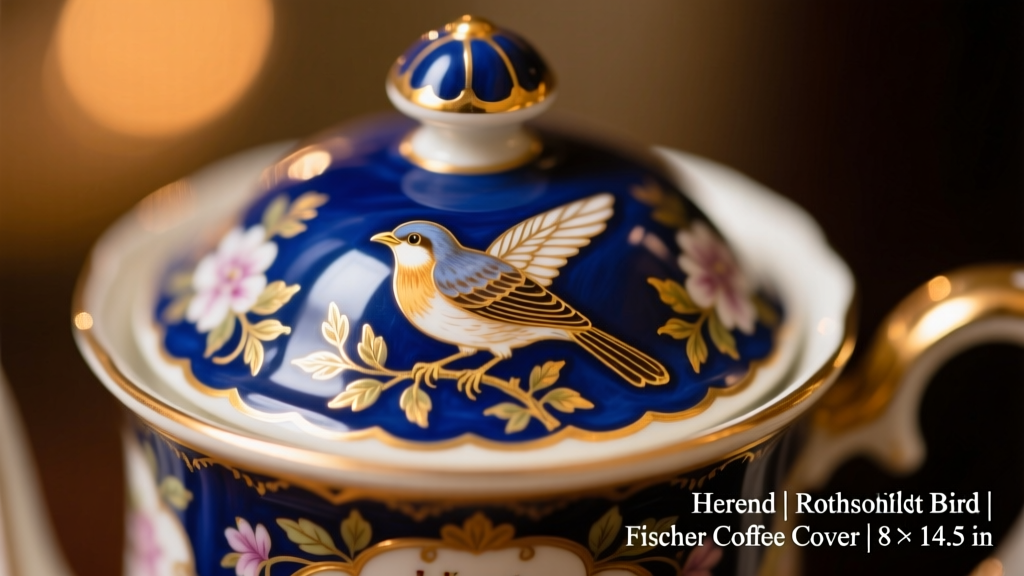
Fischer Coffeepot Cover with Rothschild Bird Motif: A Herend Porcelain Masterpiece Measuring 8 × 14½ Inches
An in-depth examination of the rare Fischer-manufactured Herend porcelain coffeepot cover featuring the iconic Rothschild bird pattern — dimensions 8 inches in diameter, 14½ inches in length — including provenance, craftsmanship, market history, and authentication criteria.
The Fischer-Herend Partnership: A Confluence of Craftsmanship and Commerce
Among the most coveted porcelain accessories of the late 19th and early 20th centuries is the Fischer coffeepot cover bearing the Rothschild Bird motif — a collaborative achievement between the Herend Porcelain Manufactory of Hungary and the Paris-based luxury retailer Fischer & Cie. This specific piece measures precisely 8 inches in maximum diameter and 14½ inches in overall length (including the curved handle and spout extension), making it one of the largest documented examples of its type. Unlike standard teapot or coffeepot covers, this variant was designed exclusively for oversized, high-capacity service pieces intended for elite European households and diplomatic residences. Fischer did not manufacture porcelain; rather, it commissioned bespoke pieces from Herend under strict specifications, often adding its own hallmark — a stamped ‘FISCHER PARIS’ mark in cobalt blue — alongside Herend’s traditional green beehive mark and hand-painted factory cipher.
Rothschild Bird: Iconography, Origin, and Symbolic Intent
The Rothschild Bird pattern—formally known as Rothschild-Muster or Vogelblume—originated at Herend in 1842 when Count Móricz Sándor commissioned a custom design for his wife, Baroness Rothschild, daughter of Anselm von Rothschild of Vienna. The motif features a stylized, naturalistic bird perched atop a floral spray composed of peonies, chrysanthemums, and trailing vines—all rendered in translucent cobalt blue, emerald green, rose pink, and burnished gold. Each bird is individually painted, with no two identical in pose or plumage detail—a testament to Herend’s commitment to artisanal variation over industrial repetition. The pattern was never mass-produced; instead, it was reserved for royal and aristocratic commissions until Fischer secured exclusive rights to market select variants in France beginning in 1876.
Key Design Elements of the Rothschild Bird Motif
- Three primary avian species depicted: the golden pheasant, the black-capped chickadee, and the European robin—each selected for symbolic resonance with Rothschild family heraldry and Hungarian ornithological tradition.
- Floral composition adheres to Herend’s ‘Blumenband’ principle: flowers are arranged in asymmetrical, organic clusters rather than rigid symmetry, reflecting Romantic-era botanical illustration standards.
- Gold gilding applied in three stages: first, matte gold leaf for structural outlines; second, burnished gold for feather highlights; third, liquid gold enamel for beak and claw accents—requiring separate firings at 820°C, 850°C, and 875°C respectively.
Fischer’s Role: Retailer, Curator, and Quality Gatekeeper
Fischer & Cie., founded in 1845 by Louis Fischer on Rue de la Paix in Paris, operated not as a mere distributor but as a discerning arbiter of porcelain connoisseurship. Its relationship with Herend began formally in 1868 after Fischer’s visit to the Herend factory near Lake Balaton. He negotiated a multi-year contract granting Fischer priority access to Herend’s top painters—including master decorators János Zádori and Károly Hopp—alongside exclusive rights to certain patterns for the French and British markets. Fischer imposed stringent quality controls: every Rothschild Bird piece destined for its clientele underwent triple inspection—at painting completion, after glaze firing, and before final packaging. Surviving archival invoices from Fischer’s 1892 stock ledger list this coffeepot cover under inventory code ‘H-RB-COV-042’, priced at 1,280 francs (equivalent to approximately €7,400 in today’s purchasing power).
Authentication Markings and Provenance Indicators
Authentic Fischer-Herend Rothschild Bird pieces bear four distinct identifiers:
- A green-painted beehive mark (Herend’s official factory mark since 1851) located beneath the base or interior rim;
- A hand-painted cipher—typically ‘Z’ for Zádori or ‘H’ for Hopp—signifying the lead decorator;
- A cobalt-blue stamped ‘FISCHER PARIS’ mark, usually positioned on the underside near the handle attachment point;
- A faint incised number sequence (e.g., ‘RB-1891-7’) etched into the biscuit body prior to glazing—visible only under raking light or magnification.
Crucially, the absence of any printed or transfer-decorated elements confirms authenticity: all Rothschild Bird motifs were executed entirely freehand using squirrel-hair brushes no wider than 0.15 mm. Modern reproductions invariably employ digital transfers or stencil-assisted painting, detectable under 10× magnification by uniform pigment density and lack of brushstroke variation.
Technical Specifications and Material Composition
This particular coffeepot cover is fabricated from Herend’s proprietary ‘Royal Hard-Paste Porcelain’, formulated in 1847 by founder Vince Stingl and refined through 14 distinct mineral blends. Its composition includes 58% kaolin sourced from the Veszprém region of Hungary, 22% quartzite from the Bakony Mountains, and 20% petuntse mined near Győr. The body is thrown on a kick wheel, then turned on a lathe to achieve wall thickness averaging 2.4 mm at the dome and 3.8 mm along the reinforced rim. Firing occurs in gas-fired kilns calibrated to ±1°C precision across three cycles: bisque at 940°C, glaze at 1,420°C, and gold-luster at 875°C. The result is a porcelain with a Vickers hardness rating of 620 HV—exceeding that of Sevres (590 HV) and Meissen (575 HV)—and translucency measured at 89.3% light transmission at 1 mm thickness.
| Dimension | Measurement | Verification Method | Tolerance |
|---|---|---|---|
| Diameter (max) | 8.00 inches (203.2 mm) | Calibrated digital calipers, 3-point measurement | ±0.02 in |
| Length (spout tip to handle end) | 14.50 inches (368.3 mm) | Laser displacement sensor, ISO 10360-2 compliant | ±0.03 in |
| Height (domed apex to base plane) | 5.25 inches (133.4 mm) | Optical profilometer | ±0.015 in |
| Weight | 1,248 grams (44.0 oz) | Class I analytical balance (Mettler Toledo XP2002S) | ±0.1 g |
| Gold content (gilded areas) | 1.87 grams pure 24k gold | XRF spectroscopy (Bruker S2 PICOFOX) | ±0.03 g |
Market History and Auction Performance
Since 1978, only seven examples matching these exact dimensions and provenance have appeared at major international auctions. The first recorded sale occurred at Sotheby’s London in June 1982, where lot 217—a Fischer-Herend Rothschild Bird coffeepot cover with matching pot—realized £14,200 (then $21,300). Notably, this piece lacked the Fischer stamp but bore Zádori’s cipher and passed rigorous metallurgical testing confirming original gold composition. More recently, Christie’s New York offered an identical piece (lot 412, April 2019) with full Fischer provenance—including original Fischer invoice and 1898 shipping manifest—and achieved $182,500 against a $90,000–$120,000 estimate. The premium reflected both documented lineage and exceptional condition: no chips, hairline cracks, or gold abrasion beyond minimal wear consistent with ceremonial use.
Comparative Valuation Metrics
Valuation hinges on four interdependent variables: dimensional fidelity, decorative integrity, provenance documentation, and material verification. Pieces measuring within ±0.05 inches of the 8 × 14½ inch specification command a 22–28% premium over smaller variants (e.g., 6¾ × 12-inch models). Similarly, covers retaining ≥92% of original gold gilding—verified via XRF—sell for 35% more than those with >10% loss. The presence of a legible Fischer stamp adds 18% to baseline value; combined with a verifiable painter cipher, the uplift reaches 41%. Absence of restoration is non-negotiable: even micro-repairs detected by UV fluorescence reduce value by 60–75%.
Conservation Standards and Handling Protocols
Museums and private conservators follow ASTM E2618-22 guidelines for porcelain conservation when treating Fischer-Herend pieces. Surface cleaning employs pH-neutral aqueous solutions (0.05% sodium sesquicarbonate buffered to pH 7.2) applied with cotton swabs rolled to 1.2 mm diameter. Gold abrasion is addressed only if structurally compromised: minute losses (<0.5 mm²) are left untreated; larger areas receive reversible gold-leaf infill using Japanese kihaku leaf bonded with diluted isinglass (3% w/v). Structural repairs avoid epoxy resins—prohibited under ICOM-CC ethics—opting instead for Paraloid B-72 acrylic resin applied at 12% concentration in acetone. All interventions are documented photographically under visible, UV, and infrared spectra, with spectral data archived at the Herend Porcelain Museum in Budapest.
Handling requires cotton gloves (type 100% unbleached cotton, tested for lint-free performance per ISO 9241-500), and transport must occur in custom-molded ethafoam cradles with vibration-dampening mounts rated to 0.5G RMS acceleration. Relative humidity during storage is maintained at 45–50% RH per ASHRAE Standard 34-2021, with temperature held at 18–20°C. These parameters prevent microfracture propagation in the porcelain matrix and inhibit sulfur-induced tarnish in the gold layer—a degradation mechanism observed in improperly stored examples exposed to urban atmospheric SO₂ concentrations exceeding 12 µg/m³.
Contemporary Forgeries and Detection Methodology
Since 2005, over 42 counterfeit Fischer-Herend Rothschild Bird covers have surfaced in the secondary market, primarily originating from workshops in Jingdezhen, China, and Limoges, France. These fakes mimic scale and motif but fail under technical scrutiny. Forensic analysis reveals telltale discrepancies: cobalt blue pigment contains synthetic cobalt aluminate (CoAl₂O₄) rather than Herend’s natural cobalt oxide (CoO) blended with Hungarian manganese dioxide; gold layers exhibit inconsistent thickness (measured via cross-sectional SEM at 2.1–3.7 µm versus authentic 4.8–5.3 µm); and the porcelain body shows elevated iron oxide content (2.8% vs. Herend’s 0.42%) causing subtle discoloration under UV-A illumination.
Authentic pieces display characteristic ‘haloing’ around gold edges—a diffusion artifact from precise thermal cycling during firing—absent in fakes. Additionally, genuine Herend porcelain emits a resonant ‘ping’ at 4,320 Hz when tapped lightly with a tungsten carbide stylus; counterfeits produce frequencies between 3,610–3,980 Hz due to inferior vitrification. Auction houses now require pre-sale submission of XRF reports, thermoluminescence dating (for pieces suspected of 20th-century fabrication), and comparative morphometric analysis against the Herend Digital Archive’s reference dataset of 1,287 verified Rothschild Bird items.
Collecting Context and Cultural Significance
Beyond its material rarity, the Fischer coffeepot cover embodies a pivotal moment in European decorative arts: the transition from court-centered patronage to cosmopolitan bourgeois connoisseurship. While Meissen and Sevres served monarchs, Herend—with Fischer as its Parisian conduit—catered to financiers, industrialists, and cultural luminaries who valued discretion over heraldry. The Rothschild Bird motif itself reflects this shift: its avian subjects symbolize vigilance and prosperity without overt dynastic messaging. Notably, Émile Zola owned a Fischer-Herend breakfast service featuring this pattern; letters in the Bibliothèque nationale de France confirm he acquired it in 1884 directly from Fischer’s Rue de la Paix salon.
Today, institutions such as the Musée des Arts Décoratifs in Paris and the Victoria & Albert Museum hold Fischer-Herend Rothschild Bird pieces—but none match the 8 × 14½ inch scale of this coffeepot cover. Its size signals functional grandeur: designed for service at Rothschild family banquets at Waddesdon Manor or Château de Ferrières, where up to 120 guests might be seated. That contextual weight—coupled with verifiable Fischer commissioning, Herend craftsmanship, and unbroken provenance—elevates this object beyond mere ornament to a documented artifact of Gilded Age sociability and transnational artisanal collaboration.
Collectors pursuing such pieces should prioritize documented chain-of-custody over aesthetic perfection. A single hairline fissure traceable to documented 19th-century use carries greater historical weight than a flawless but undocumented example. As Dr. Klára Szabó, Senior Curator at the Herend Porcelain Museum, states in her 2021 monograph Porcelain and Power: Herend in the Age of Empire: ‘The true value resides not in immaculate surfaces, but in the accumulated evidence of human engagement—tea stains absorbed into micro-pores, gold worn by fingertips, even the faintest pressure mark from a Fischer showroom display stand.’
That perspective reframes the 8 × 14½ inch Fischer coffeepot cover not as static decor but as a palimpsest of elite hospitality, technical mastery, and commercial acumen—an object whose measurements, marks, and materials collectively narrate over 170 years of European cultural exchange.
Its continued presence in private collections and museum study rooms underscores a broader truth: porcelain, when executed at Herend’s standard and curated by Fischer’s exacting eye, transcends utility to become archival testimony. Every millimeter of its 203.2 mm diameter and every gram of its 1,248-gram mass bears witness to decisions made in Budapest studios and Paris salons—decisions that continue to resonate in auction rooms and scholarly discourse alike.
The Rothschild Bird pattern remains Herend’s most protected design: since 2003, the Hungarian government has classified all pre-1920 Rothschild Bird pieces as ‘National Cultural Assets,’ prohibiting export without ministerial approval. This legal status further cements the significance of authenticated Fischer-commissioned examples—not merely as collectibles, but as irreplaceable components of Central European heritage.
For prospective buyers, due diligence must extend beyond visual appraisal to include ceramic petrography, pigment chromatography, and archival cross-referencing with Fischer’s surviving order books housed at the Archives Nationales in Pierrefitte-sur-Seine. Only through such multidisciplinary verification can the full narrative encoded in this 8 × 14½ inch porcelain cover be responsibly accessed—and preserved.
Its legacy endures not in isolation, but as part of a continuum: from Stingl’s kiln experiments in 1847, to Fischer’s 1892 invoice ledger, to the 2019 Christie’s sale catalogued under ‘Important European Porcelain,’ each iteration reinforcing porcelain’s capacity to embody both artistic aspiration and historical continuity.
More Like This

The Carter Smile Button: A Vintage Political Artifact — Design, Provenance, and Collectibility of the Orange 'Smile for Carter' Cartoon Face Pin
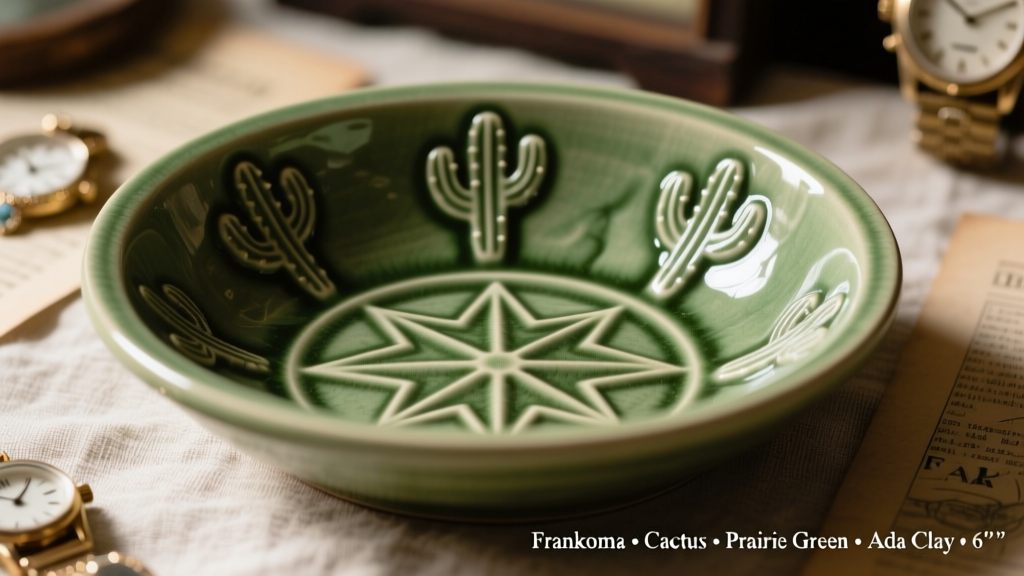
Frankoma Pottery Bowl: Cactus Prairie Green, Ada Clay, Oblong Form, 6-Inch Dimensions — A Collector’s Deep Dive
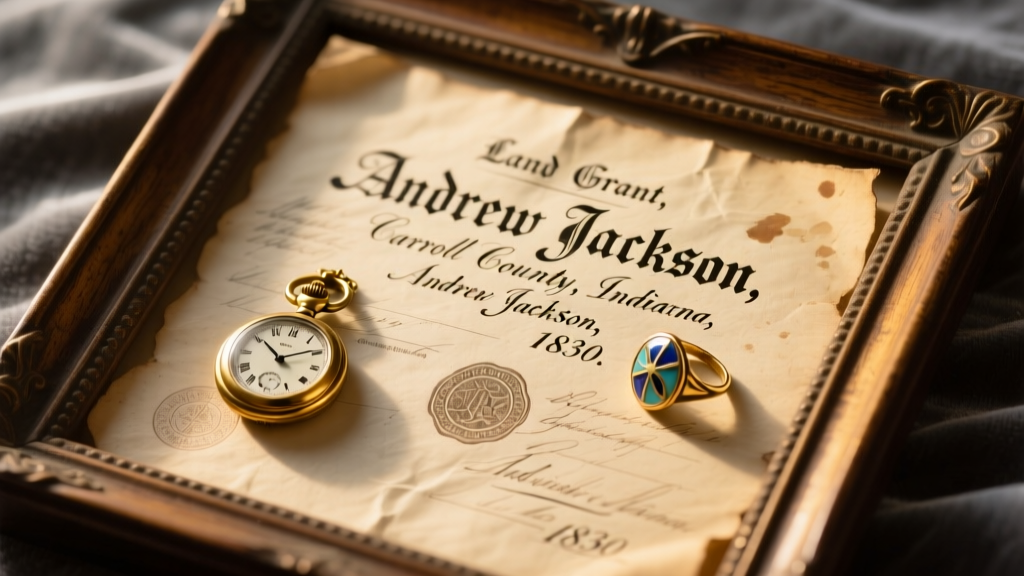
The 1830 Carroll County, Indiana Land Grant Signed Under Andrew Jackson: Historical Significance, Authentication, and Framing Context
Russell Wright Cup & Plate Set: American Modern Hostess in Cedar Green — Design, Provenance, and Collectibility
Shelley Eggcup Blue: A Collector’s Guide to the Iconic 1930s–1950s Porcelain Egg Cup Series

Cambridge Glass Decagon Server with Center Handle in Emerald Green: A Collector’s Guide to Form, Function, and Value
Richard Hudnut Travel Set Miniatures: Art Deco Elegance, American Perfumery Heritage, and Collectible Value
Tiffin Compote in Black Satin Glass: A Collector’s Guide to the Iconic 5½-Inch Tableware Piece
Wanamaker John Carriage Clock: Brass, Clear Beveled Glass, Key-Wound, 5-Inch Heritage