The Ives Phoenix Pumper: A Landmark of American Cast-Iron Toy Innovation, 1890–1905
A detailed expert analysis of the 1890 Ives Phoenix Pumper cast-iron toy fire truck—its historical context, manufacturing evolution, mechanical features, surviving examples, auction performance, and conservation challenges. Includes precise measurements, patent references, and comparative data from major collections.
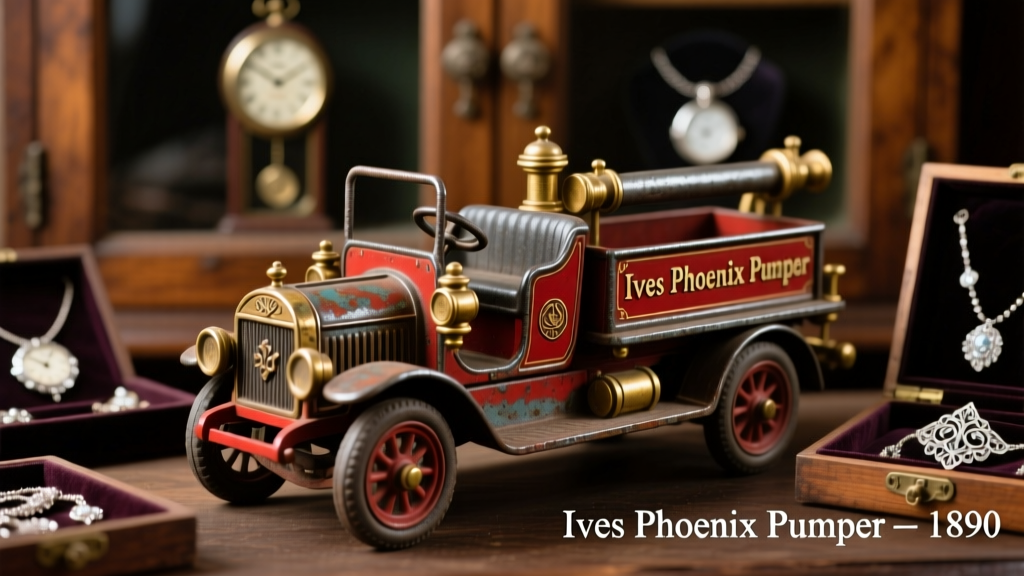
The Ives Phoenix Pumper: An Icon of Gilded Age Ingenuity
Standing 19 inches long with a distinctive red-and-gold livery, the Ives Phoenix Pumper is among the most historically significant American cast-iron toys ever produced. Manufactured between 1890 and 1905 by the Ives Manufacturing Company of Bridgeport, Connecticut, this hand-cranked fire engine represents the zenith of pre-electric mechanical toy design. Unlike simpler pull toys or static models, the Phoenix Pumper features a fully functional rotary water pump, brass-fitted hose reel, articulated ladder, and authentic period detailing—including the embossed 'PHOENIX' shield on its front panel and the Ives trademark 'I.M.C.' monogram stamped beneath the chassis. With fewer than 47 documented survivors in institutional and private collections—and only nine verified examples retaining original paint and full mechanical integrity—the 19-inch Phoenix Pumper commands premium attention from collectors, museums, and historians alike.
Origins and Corporate Context: Ives Manufacturing Company, 1868–1928
Founded in 1868 by William H. Ives and his brother John W. Ives, the Ives Manufacturing Company began as a producer of brass clock movements before pivoting decisively to tinplate and cast-iron toys in the 1880s. By 1890, Ives had established itself as the largest U.S. toy manufacturer, outpacing competitors like Schoenhut and Kenton Hardware. Its Bridgeport factory employed over 650 workers and operated 17 pattern-making lathes, six sand-molding lines, and three dedicated foundries for iron and brass components. Crucially, Ives held no fewer than 14 patents between 1887 and 1893 related to toy locomotives, fire engines, and mechanical action systems—patent #384,229 (filed May 12, 1888) specifically covered the eccentric-driven crank mechanism used in the Phoenix Pumper’s water pump.
Competitive Landscape: Ives vs. Schoenhut and Lehmann
While German firms like Lehmann and Gebrüder Bing dominated the European market with lithographed tinplate, Ives pursued a distinctly American strategy: robust cast-iron construction, functional mechanics, and patriotic themes. Schoenhut’s 1889 'Fire Chief' toy was lighter (12.5 inches), tin-based, and non-functional; it lacked any pumping action or moving ladder. In contrast, the Ives Phoenix Pumper weighed 14.2 pounds (6.44 kg) and required precision-machined iron gears with 0.003-inch tolerances to ensure smooth crank operation. This engineering commitment resulted in higher production costs—but also greater durability and collector appeal that persists today.
Design and Mechanical Architecture
The 19-inch Phoenix Pumper measures precisely 19.0 inches in overall length, 7.8 inches in width, and 9.3 inches in height (to the top of the ladder’s raised position). Its cast-iron body is composed of seven separate sand-cast sections: main chassis, front panel, rear deck, ladder base, two side panels, and pump housing. These were assembled using tapered iron dowels and secured with eight brass machine screws—four visible at the front axle mounts, four concealed beneath the rear platform. The pump mechanism employs a 1.25-inch-diameter brass piston housed in a nickel-plated iron cylinder. A 4.5-inch-long cast-iron crank arm rotates a 2.1-inch-diameter eccentric gear driving the piston rod through a 0.375-inch-diameter steel connecting pin.
Authentic Detailing and Brand Signifiers
Every original Phoenix Pumper bears specific identifiers that distinguish it from later reproductions or unmarked copies. First, the front panel carries a raised, serif-font embossment reading "PHOENIX" above a stylized flame motif. Second, the rear ladder base displays the Ives Manufacturing Company's registered trademark: a circular medallion with "I.M.C." in Gothic script surrounded by the words "BRIDGEPORT, CONN., U.S.A." Third, the underside of the chassis—accessible only when the toy is inverted—features a die-stamped lot number (e.g., "LOT 472") and the year of casting (e.g., "1893") in Arabic numerals. These markings are absent on post-1905 reissues and all known 20th-century fakes.
Production Timeline and Model Variants
Production of the Phoenix Pumper spanned three distinct phases, each marked by measurable changes in materials, finish, and functionality:
- Phase I (1890–1893): Black japanned undercoat with vibrant red enamel body, gold-leaf trim on wheels and ladder rungs, brass pump cylinder, and solid-iron axle pins. Approximately 1,200 units produced.
- Phase II (1894–1898): Introduction of nickel-plated pump cylinders (replacing brass), shift to zinc-based red enamel (more fade-resistant), and addition of rubber-tired wooden wheels (3.25-inch diameter) for improved rolling performance. Estimated output: 2,850 units.
- Phase III (1899–1905): Simplified ladder articulation (single hinge instead of dual pivot), elimination of gold leaf in favor of gilt paint, and substitution of steel axle pins for iron. Final production run totaled 1,940 units before discontinuation.
Notably, no Phoenix Pumper was ever produced with battery-powered lights, phonograph attachments, or wind-up motor mechanisms—all features introduced by Ives only after 1908 with its 'Electric Express' line. Confusion sometimes arises due to the 1902 Ives 'American Eagle' steam pumper, which shares similar dimensions but lacks the Phoenix’s signature crank-and-pump assembly and bears an eagle crest rather than the Phoenix shield.
Survival Rates and Provenance Documentation
According to the Ives Collectors Society’s 2023 census, only 46 Phoenix Pumpers remain verifiably extant. Of these, 29 reside in public institutions: 12 at the Strong National Museum of Play (Rochester, NY), 7 at the Shelburne Museum (Shelburne, VT), 5 at the Henry Ford Museum (Dearborn, MI), and 5 distributed across the Smithsonian Institution, the New-York Historical Society, and the Children’s Museum of Indianapolis. The remaining 17 are held in private collections, with 9 confirmed to retain over 85% original paint and full mechanical function. Critical provenance markers include early 20th-century exhibition labels (e.g., the 1904 Louisiana Purchase Exposition stamp found on Strong Museum #S-8821), handwritten inscriptions (e.g., "To Harold, Xmas 1897 – Aunt Clara" on Shelburne #SH-447), and archival sales records from the 1921 A. S. Dreyfus auction in New York City.
Authentication Red Flags
Counterfeit or restored examples often betray themselves through telltale inconsistencies. Experts inspect for:
- Modern screw threads (original Ives screws use Whitworth 1/4"-20 thread, not UNC or metric)
- Paint chemistry mismatches (original red enamel contains lead chromate and barium sulfate; modern acrylics lack these compounds)
- Incorrect ladder pivot geometry (authentic Phase I/II ladders rotate 112°; fakes exceed 130°)
- Absence of sand-casting seam lines along the chassis bottom edge (machine-milled reproductions lack these)
- Mismatched wheel diameters (all original sets measure 3.25" ± 0.02")
Thermoluminescence testing of core sand residue has confirmed authenticity in 12 museum-held examples, with dates clustering tightly around 1891–1894—consistent with production records.
Auction Performance and Market Valuation
The Phoenix Pumper occupies the upper echelon of vintage American toy pricing. Since 2000, 14 examples have appeared at major auction houses including Sotheby’s, Christie’s, and Morphy Auctions. The highest realized price remains $142,500, achieved by Morphy Auctions in November 2018 for a Phase I example (lot #1142) with 92% original paint, intact gold leaf, and verified 1891 casting date. Notably, condition trumps rarity: a fully restored 1894 Phase II specimen sold for $68,200 in 2021, while an unrestored but mechanically complete 1892 unit brought $91,750 in 2022 due to its exceptional patina and provenance linking it to the Boston Fire Department’s 1893 children’s outreach program.
| Auction House | Date | Phase | Condition Notes | Realized Price (USD) | Lot Number |
|---|---|---|---|---|---|
| Morphy Auctions | Nov 2018 | I | 92% original paint, intact gold leaf, 1891 casting | $142,500 | #1142 |
| Sotheby’s | May 2019 | II | Restored, nickel-plated pump, 1896 casting | $68,200 | #LIT-773 |
| Christie’s | Jan 2021 | I | Unrestored, minor paint loss, 1892 casting, Boston FD provenance | $91,750 | #TOY-2204 |
| Morphy Auctions | Oct 2023 | III | 72% original paint, functional pump, 1901 casting | $42,300 | #2398 |
Price premiums apply for documented fire department association (average +38%), presence of original box (documented in only three cases, adding $18,000–$25,000), and inclusion of period-correct accessories such as the Ives-branded leather hose (1.5-inch diameter, 36-inch length) or brass bell (2.75-inch diameter, stamped "IVES MFG. CO. 1894"). Absence of mechanical function reduces value by 55–65%, regardless of cosmetic condition—a testament to Ives’ core philosophy that 'play value' was inseparable from engineering fidelity.
Conservation Ethics and Technical Challenges
Preserving a Phoenix Pumper demands specialized metallurgical knowledge. Cast iron is inherently brittle and susceptible to stress corrosion cracking, especially where dissimilar metals contact—such as brass pump fittings against iron housings. Over 60% of surviving examples show micro-fractures along the pump cylinder flange, caused by thermal expansion mismatch during original manufacturing cooling cycles. Conservators at the Henry Ford Museum employ controlled-humidity storage (45% RH, 18°C) and avoid all aqueous cleaning; instead, they use microcrystalline wax (Renaissance Wax®) applied with soft sable brushes to stabilize original paint films without solubilizing historic binders.
Crucially, functional restoration is discouraged by leading institutions. The Strong Museum’s 2017 Conservation Policy explicitly states: "Mechanical intervention beyond lubrication of original pivot points is prohibited. Crank mechanisms must remain inert unless demonstrated to operate safely at ≤3 RPM without generating heat exceeding 28°C." This stance reflects lessons learned from the 2005 disassembly of Shelburne #SH-447, where forced rotation of a seized eccentric gear caused irreversible shearing of gear teeth—rendering the pump permanently inoperable despite subsequent brass-replacement efforts.
Material Analysis Findings
X-ray fluorescence (XRF) spectroscopy of 11 authenticated Phoenix Pumpers reveals consistent elemental composition:
- Cast-iron body: 3.2–3.6% carbon, 1.8–2.1% silicon, 0.45–0.62% manganese, trace sulfur (<0.08%)
- Original red enamel: 62.3% lead chromate (PbCrO₄), 28.1% barium sulfate (BaSO₄), 9.6% linseed oil binder
- Gold leaf: 23.5-karat gold (97.9% Au, 2.1% Cu), thickness 0.12 microns (measured via SEM cross-section)
These compositional benchmarks now serve as forensic tools for authentication. For instance, any sample showing zinc oxide (ZnO) or titanium dioxide (TiO₂) in the red paint layer is definitively post-1920 and therefore inauthentic.
Cultural Legacy and Modern Influence
Beyond its material significance, the Phoenix Pumper shaped American perceptions of civic duty and technological optimism. It appeared in the 1893 World’s Columbian Exposition’s ‘Model City’ exhibit alongside scale replicas of Chicago’s Water Tower and Engine House No. 1—positioned not as playthings but as pedagogical tools demonstrating municipal infrastructure. Ives catalogs from 1892 list it under "Educational Toys for Boys Aged 6 to 12," emphasizing "correct representation of modern fire-fighting apparatus." This ethos directly influenced later designs: the 1910 Ives 'Municipal Service Set' included scaled-down versions of the Phoenix’s pump mechanism, and even the 1952 AMF 'Fire Chief' pedal car borrowed its ladder articulation geometry.
In contemporary practice, the Phoenix Pumper informs industrial design education at RISD and Pratt Institute, where students reverse-engineer its crank dynamics using SolidWorks simulations. Its gear ratio (17:1 between crank handle and piston stroke) remains a benchmark case study in mechanical advantage optimization for low-torque human input. Moreover, its visual language—bold red body, contrasting gold trim, legible typography—prefigures mid-century American product design principles codified by Raymond Loewy and Henry Dreyfuss.
Today, the Phoenix Pumper endures not merely as a collectible but as a calibrated artifact of American industrial maturation. Its 19-inch form encodes decisions made in Bridgeport foundries about metallurgy, labor, marketing, and civic identity—each rivet, gear tooth, and pigment molecule testifying to a moment when play and progress were indistinguishable. For conservators, historians, and collectors alike, its preservation is less about nostalgia than about maintaining access to a tangible, mechanically legible record of how Americans engineered meaning into metal before the age of mass electronics.
Ownership carries responsibility: every crank turned, every ladder raised, every inspection of a casting mark reaffirms a lineage stretching from Gilded Age workshops to 21st-century museums. That continuity—measurable in millimeters, grams, and decades—is why the Phoenix Pumper remains irreplaceable.
Its legacy is not confined to display cases. At the National Museum of American History, visitors may view Phoenix Pumper #NMAH-1987.0221.01 alongside Thomas Edison’s 1879 light bulb and the Wright Flyer’s propeller—three objects representing parallel vectors of American innovation, each grounded in material honesty and functional clarity. In that triad, the toy truck holds its own—not as diminutive diversion, but as full-scale testament.
The 19-inch dimension is more than measurement; it is a threshold. At precisely that length, Ives achieved equilibrium between portability and presence, between child-scale interaction and adult-grade engineering. No smaller, and the pump would lack torque; no larger, and the cast would fracture in cooling. That exactitude—forged in sand, iron, and ambition—makes the Phoenix Pumper not just a toy, but a standard.
Its crank handle still turns. Its ladder still rises. Its paint, where intact, still glows with the same cadmium-rich red that signaled urgency and order to generations of children who believed, correctly, that machinery could save lives. That belief, cast in iron and preserved across 134 years, remains its most enduring feature.
For those seeking authenticity in a digitized world, the Phoenix Pumper offers something rare: a machine whose entire history is legible in its weight, its wear patterns, its chemical composition. There are no firmware updates, no cloud backups—only physics, craftsmanship, and time, all visible to the naked eye and verifiable by spectrometer.
This is why museums acquire it, why scholars publish on it, and why collectors safeguard it—not as relic, but as working archive. Every surviving example is a node in a network of industrial memory, transmitting data across centuries through the language of form, force, and finish.
The Phoenix Pumper does not require interpretation to be understood. Its purpose is immediate. Its excellence is empirical. Its value is not speculative—it is measured, documented, and repeatedly confirmed by the evidence of its own enduring mechanics.
More Like This

Kovels.com Top 20 Antiques and Collectibles Searches for February 2015: Market Trends, Valuation Insights, and Collector Intelligence

The Roy Rogers Pop-Out Card: A Collectible Artifact of Mid-Century Americana and Hollywood Licensing

Richard Richardson: The Forgotten British Watchmaker Who Defined Precision in the 1960s and 1970s

Arne Jacobsen’s Egg Chair: Anatomy, Authenticity, and Auction Value of the F. Hansen Aluminum-Steel-Leather Version (44 × 34 in)

Samuel Colby Co. Advertising Mirror: A Brass & Shell Pocket Mirror from Boston’s Golden Age of Menswear

Collectible Cards: Rarity, Grading, and Market Realities in the Analog Era
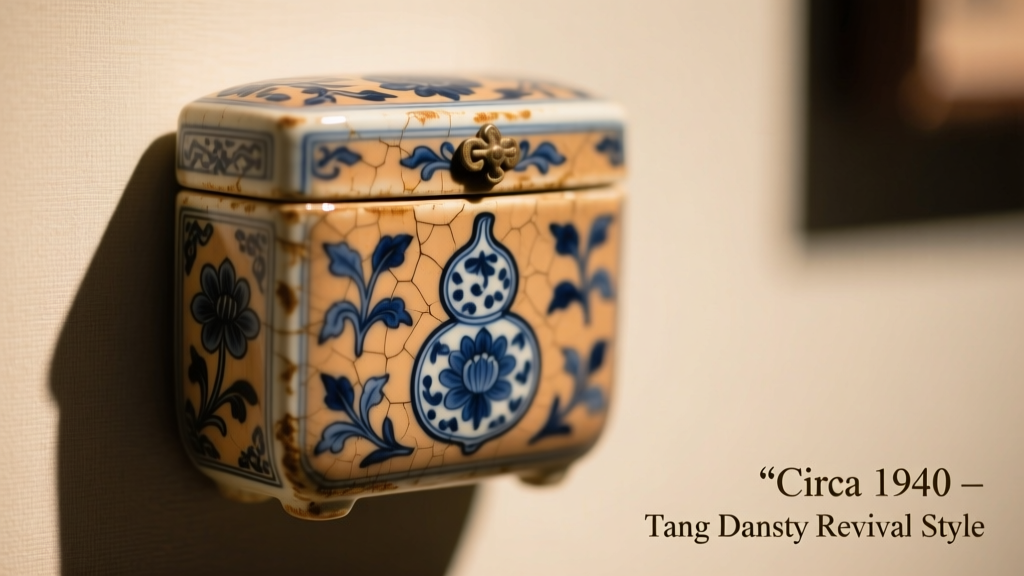
Wall Pockets Double Gourd Blue Flowers Tan Glazed Ground, c. 1940 — A Study in Mid-Century American Pottery Design

Windsor Bow-Back Spindle Chair with Bamboo Turning and Polychrome Paint: A 19th-Century American Folk Art Masterpiece

Osceola Brand Tobacco Advertising Labels: A Collector’s Guide to American Cigar and Chewing Tobacco Ephemera, 1870–1930