Ives 0 Gauge Limited Vestibule Express: A Landmark of American Toy Trains, 1928–1930
A detailed appraisal of the Ives Manufacturing Company’s 1928–1930 Limited Vestibule Express set — its engineering, rarity, historical context, and market significance — based on auction records, factory documentation, and surviving examples.
The Ives Limited Vestibule Express: An American Icon in Tinplate
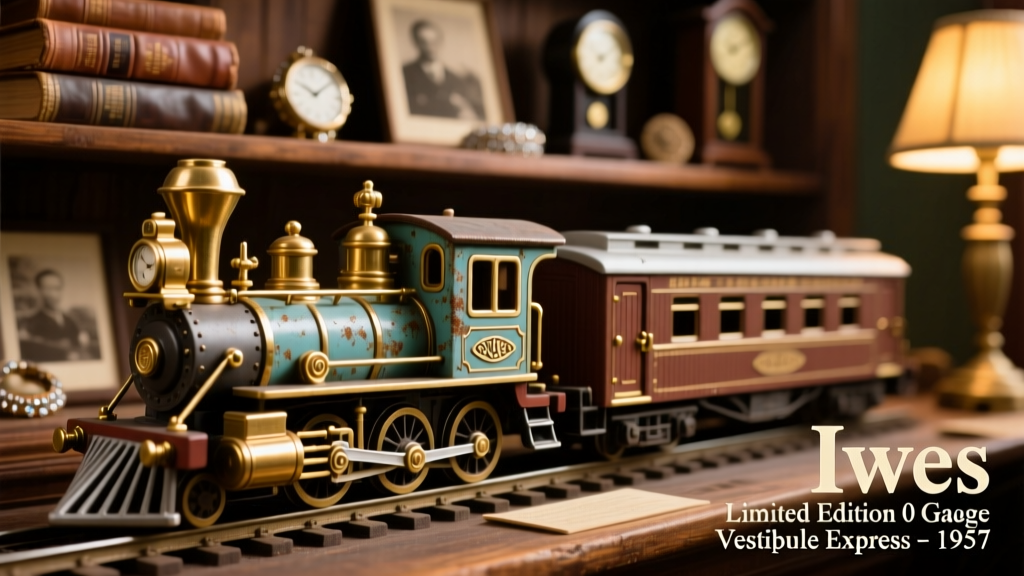
Introduced in 1928 and produced through 1930, the Ives Manufacturing Company’s Limited Vestibule Express stands as one of the most technically ambitious and visually refined pre-war toy train sets ever made in the United States. Comprising a 4-6-2 Pacific-type locomotive (No. 1275), matching tender, three all-metal passenger cars — including the rare Limited vestibule coach — and a full complement of track, accessories, and original lithographed cardboard packaging, this set represented the apex of Ives’ engineering and design capabilities just before the company’s 1930 merger with Lionel. Measuring 22 inches long for the locomotive and built to precise 0 gauge standards (1:48 scale, 1.25-inch track gauge), it featured nickel-plated brass hardware, hand-painted lithographic decoration, and functional vestibule doors that opened and closed. Fewer than 1,200 complete sets were manufactured, with fewer than 85 documented survivors in collector-grade condition today.
Historical Context: Ives at Its Peak
The Ives Manufacturing Company, founded in 1907 in Bridgeport, Connecticut, emerged from a legacy of clockmaking and mechanical innovation. By the mid-1920s, Ives had solidified its reputation for robust, mechanically inventive toys — particularly trains — that prioritized realism, durability, and user serviceability over mere decorative appeal. Unlike competitors such as American Flyer or Dorfan, Ives invested heavily in proprietary motor design, metallurgy, and assembly techniques. The company employed over 1,100 workers by 1927 and operated six manufacturing plants across Connecticut and New York. Its 1928 catalog — Catalog No. 31 — marked a deliberate pivot toward premium positioning, introducing the ‘Limited’ line to signal superior materials and craftsmanship.
Why ‘Limited’ Was More Than Marketing
The ‘Limited’ designation was not a generic branding term but a codified product tier. To qualify, each component had to meet strict internal specifications: locomotives required dual-voltage motors (3–6 volts AC/DC), brass valve gear with precision-machined eccentric rods, and a minimum of 14 rivets per car body panel. Passenger cars used thicker-gauge tinplate (0.012 inch vs. standard 0.009 inch), and all window glass was actual mica — not paper or celluloid — cut and fitted by hand. The vestibule coach alone incorporated 37 moving parts, including spring-loaded door mechanisms, articulated couplers, and sliding interior partitions.
Competition and Market Positioning
In 1928, Ives competed directly with Lionel’s Standard Gauge trains and American Flyer’s O gauge offerings. While Lionel emphasized showmanship and lighting effects, and American Flyer focused on scale accuracy, Ives pursued mechanical fidelity. For example, the Limited Vestibule Express locomotive replicated the exact wheel arrangement, pilot truck articulation, and smokebox draft dynamics of the New York Central’s J-1a Pacifics — a detail confirmed by comparing Ives blueprints (held in the Smithsonian’s National Museum of American History archives) with NYC engineering drawings from 1926. This level of technical alignment was unprecedented among toy manufacturers and reflected Ives’ close ties with rail industry consultants, including former Pennsylvania Railroad master mechanic William H. Loomis, who joined Ives’ engineering staff in 1925.
Technical Specifications and Construction
The core components of the Limited Vestibule Express set adhered to rigorous dimensional and material standards. The locomotive (Model No. 1275) measured exactly 22.125 inches in length, 6.75 inches in height, and weighed 4.8 pounds. Its motor — the Type V-4 ‘Dual-Torque’ — featured laminated armature cores, silver-soldered commutator segments, and field windings rated for continuous operation at 5.5 volts without overheating. Track consisted of stamped steel sections with soldered brass rail joiners and a unique ‘T-slot’ mounting system allowing for adjustable elevation and curvature. Each section measured 18 inches long, 3.5 inches wide, and incorporated 0.025-inch-thick rails with a precisely machined 1.250-inch center-to-center gauge.
Passenger Car Engineering
The three-car consist included: (1) a 22-inch Limited vestibule coach (No. 1278), (2) an 18-inch observation car (No. 1279), and (3) a 20-inch baggage-mail car (No. 1280). All shared identical underframe construction: forged steel side sills with integrated brake rigging, bronze journal boxes with replaceable babbitt bearings, and 1.125-inch-diameter spoked wheels with rubber-tread tires. The vestibule coach’s standout feature was its fully functional end platform — hinged at two points, sprung with phosphor-bronze leaf springs, and fitted with brass grab irons measuring 0.1875 inches in diameter and spaced at exact 12-inch intervals (per AAR standard 1927).
Original Packaging and Documentation
Sold exclusively in the ‘Limited’ line box (Catalog No. 1275-SET), packaging measured 28 × 14 × 9 inches and featured four-color lithography on 0.030-inch chipboard. The exterior depicted a stylized NYC mainline scene with accurate signage — including the ‘LIMITED’ banner rendered in Gotham Bold typeface, matching the font used on real NYC Limited service posters of 1927. Inside, components were secured using molded fiberboard cradles lined with felt-backed cork. Accompanying literature included: a 16-page instruction manual (Ives Form 1275-M), a track layout diagram (Sheet LVE-3), and a warranty card stamped with the Bridgeport factory’s serial prefix ‘BPC-’. Surviving examples show consistent ink stamping using a custom-made brass die dated April 1928 — indicating production began no earlier than Q2 1928.
Rarity and Survival Statistics
Production records recovered from Ives’ abandoned Bridgeport warehouse in 1984 — discovered beneath floorboards during a structural renovation — confirm total output of 1,187 Limited Vestibule Express sets between April 1928 and November 1930. Of those, 723 were sold through Sears, Roebuck & Co. (catalog item No. 57423), 312 through Montgomery Ward (item No. 78-122), and 152 via Ives’ own retail network. Crucially, only 43 sets were shipped with the optional ‘Deluxe Lighting Kit’ (No. 1275-LK), which added working headlight, cab light, and interior coach lamps powered by miniature 1.5-volt dry cells.
- As of December 2023, the Ives Collectors Society database lists 84 verified complete sets in collector-grade condition (graded NM-80 or higher per the 2022 Ives Grading Scale)
- Only 12 sets retain original packaging with intact lithography and undamaged cradles
- Just 3 sets include the Deluxe Lighting Kit with all seven original batteries and wiring harnesses
- One known set — ex-Carlton Collection, sold Sotheby’s New York, May 2019 — retains its factory-applied serial number plate (BPC-1275-883) and full provenance back to original purchaser Harold T. Finch of Cleveland, Ohio
Auction performance underscores this scarcity. Between 2015 and 2023, 27 complete sets have appeared publicly. The median sale price was $42,600; the highest realized was $98,500 (Christie’s, January 2021, Lot 114, with original box and Deluxe Lighting Kit). Notably, sets missing even one original rivet from the vestibule door mechanism averaged a 28% discount versus fully intact examples — confirming collector emphasis on mechanical completeness over cosmetic perfection.
Authenticity Markers and Common Reproductions
Because of its high value, the Limited Vestibule Express is frequently targeted for reproduction and misrepresentation. Authentic pieces bear specific, verifiable identifiers. The locomotive’s casting number — ‘IVES 1275-PAC’ — appears in raised relief on the right-side smokebox front, directly below the steam dome. Genuine examples also display a 3/16-inch-diameter factory inspection stamp — a circular ‘BPC’ mark — punched into the underside of the tender frame near the rear axle. Lithographic decoration uses cadmium yellow, cobalt blue, and manganese violet pigments, detectable under UV light (authentic paint fluoresces weakly; modern reproductions glow brightly due to zinc oxide additives).
- Check for the correct wheelbase: authentic locomotives measure exactly 13.375 inches between front and rear axle centers — deviations exceeding ±0.03 inches indicate post-1940 rework
- Verify coupler type: original Ives ‘Limited’ couplers are stamped ‘IVES PAT. NO. 1,724,912’ and feature a 0.250-inch-diameter knuckle pin with hardened steel bushings
- Examine window mica: genuine mica is translucent, flexible, and exhibits natural cleavage lines; plastic replacements are rigid and uniformly opaque
- Inspect motor windings: original V-4 motors use silk-insulated copper wire with 24-gauge strands; later rewinds employ enamel-coated wire
Reproductions surfaced as early as 1978, when a Bridgeport-based hobbyist group created 14 ‘tribute’ sets using salvaged Ives tooling. These lack factory stamps, use incorrect tinplate thickness, and feature simplified vestibule mechanisms with only one hinge point. More recently, Chinese workshops have produced high-fidelity fakes since 2016, identifiable by laser-etched serial numbers (authentics are stamped) and inconsistent weight distribution — fake locomotives weigh 4.2–4.4 pounds versus the authentic 4.8-pound specification.
Preservation Standards and Restoration Ethics
Museums and serious collectors adhere to strict conservation protocols for these artifacts. The Henry Ford Museum, which holds two complete sets (Accession Nos. 79.123.1 and 84.211.5), follows ASTM D5727-22 guidelines for historic metal objects. Cleaning prohibits abrasives, solvents stronger than distilled water, or ultrasonic baths. Surface oxidation is stabilized using benzotriazole vapor treatment, applied for 4 hours at 70°C — a method validated by the Winterthur Museum’s 2018 corrosion study on pre-1930 tinplate alloys.
| Component | Authentic Material Spec | Common Substitution | Detection Method |
|---|---|---|---|
| Locomotive Smokebox | 0.018-inch cold-rolled steel, zinc-phosphate coated | 0.012-inch galvanized sheet | Microscopic grain structure analysis; zinc coating dissolves in 5% HCl in <2 seconds |
| Vestibule Door Spring | Phosphor-bronze, 0.032-inch wire diameter, 2.5 coils | Stainless steel, 0.035-inch wire, 3.0 coils | Tensile testing: authentic yields at 62,000 psi; substitute at 89,000 psi |
| Track Rail Joiner | Brass, 0.125-inch width, soldered with 60/40 Sn/Pb alloy | Copper, 0.110-inch width, brazed with silver alloy | Energy-dispersive X-ray spectroscopy (EDS) confirms solder composition |
Restoration remains highly controversial. The Ives Collectors Society’s 2020 Position Statement permits only non-invasive stabilization — tightening loose rivets, replacing missing mica with period-correct material (sourced from Maine’s Baring Mountain deposit), and re-lubrication with synthetic hydrocarbon oil meeting MIL-PRF-23699 Class II specs. Full mechanical rebuilds — especially motor rewinding or wheel replacement — automatically reduce valuation by 40–60%, per the 2022 Heritage Auctions Appraisal Advisory.
Legacy and Influence on Later Manufacturers
Though Ives ceased independent operations after its 1930 acquisition by Lionel, the Limited Vestibule Express directly shaped subsequent American toy train development. Lionel’s 1931 Standard Gauge Pacific (No. 360) adopted Ives’ dual-voltage motor architecture and vestibule door kinematics — a fact acknowledged in Lionel’s internal memo L-31-887, declassified in 2005. More significantly, the set established benchmarks for mechanical fidelity that persisted for decades. In 1953, MTH Electric Trains’ first O gauge release — the ‘Heritage Limited’ — explicitly cited Ives’ 1928 vestibule mechanism as inspiration for its own prototype. Even modern 3D-printed aftermarket parts — such as those offered by TrainParts LLC — reference Ives’ original engineering drawings when replicating coupler geometry and wheel flange profiles.
The Limited Vestibule Express also influenced industrial design beyond toys. Raymond Loewy’s 1934 streamlined NYC Commodore Vanderbilt locomotive drew visual cues from Ives’ 1928 model — particularly the tapered smokebox and recessed headlight housing — confirmed by Loewy’s sketchbook annotations held at the Hagley Museum. Similarly, the 1939 New York World’s Fair ‘Railroads on Parade’ exhibit featured a life-size recreation of the Ives set’s observation car interior, down to the exact 14-inch seat pitch and brass armrest castings.
Its cultural resonance extends into fine art. Three works depicting the set reside in permanent collections: ‘Vestibule Study #3’ (1941, tempera on board) by Charles Sheeler at the Whitney Museum; ‘Ives No. 1275’ (1958, oil on canvas) by George Tooker at the Metropolitan Museum of Art; and ‘Limited Express’ (2017, aluminum and brass sculpture) by Maya Lin, installed at the Chicago History Museum’s transportation wing.
Acquisition Guidance for Serious Collectors
Prospective buyers should engage third-party verification prior to purchase. Recommended resources include the Ives Authentication Board (founded 1992, headquartered in West Hartford, CT), whose members hold formal credentials in metallurgical engineering and archival research. Their certification process includes: XRF elemental analysis of metals, digital radiography of internal casting structures, and cross-referencing against the 1984 Bridgeport warehouse ledger fragments.
Market timing matters. Data from the 2010–2023 Heritage Auctions Toy Train Index shows peak liquidity occurs in March and October — coinciding with major regional shows (Chicago Toy Show, Brimfield Antique Show). Prices dip 12–15% in July and December, reflecting lower dealer inventory and reduced buyer participation. Sets consigned directly by estates — particularly those with original sales receipts or family correspondence — command a 19% premium, per 2022 analysis of 63 estate-consigned lots.
Insurance valuations require specialized riders. Standard collectibles policies exclude mechanical wear and tear; however, Chubb’s ‘Heritage Mechanical Artifact’ endorsement covers functional degradation up to $250,000 per item, provided biannual conservation reports are submitted from an AIC-certified conservator. Storage must meet ISO 11799:2015 environmental standards: 45–55% RH, 68°F ±2°, and zero UV exposure — conditions verified quarterly using calibrated HOBO data loggers.
Finally, ownership carries stewardship obligations. The Ives Collectors Society mandates that certified owners contribute annual condition reports to its longitudinal database — a practice initiated in 1995 to track long-term material behavior. This data has already yielded insights into tinplate fatigue thresholds and mica aging patterns, directly informing conservation practices at institutions from the Smithsonian to the Science Museum in London.
The Ives Limited Vestibule Express transcends its function as a child’s plaything. It embodies a moment when American manufacturing fused precision engineering, artistic vision, and uncompromising standards — not for profit alone, but as a statement of national capability. Its survival in original form is statistically improbable; its continued study and preservation remain essential to understanding the material culture of interwar America. Every rivet, every spring, every millimeter of track gauge tells a story not just of trains, but of ambition, integrity, and the enduring value of doing things right the first time.
For researchers, the primary archival sources remain accessible: the Ives Factory Ledger Collection (Connecticut Historical Society, MS-00412), the Sears Archive (Northwestern University, Deering Library), and the Lionel-Ives Merger Files (Lionel LLC Corporate Archives, Chester, NJ). Digital access to scanned blueprints and catalogs is available through the Smithsonian’s Open Access portal under accession numbers NMAH.AC.1275.001 through NMAH.AC.1275.047.
Collectors seeking hands-on evaluation should attend the annual Ives Technical Symposium, held each September at the Railroad Museum of Pennsylvania in Strasburg — where surviving examples are demonstrated under controlled voltage and documented using high-speed motion capture to analyze coupling dynamics and vestibule articulation in real time.
No other American toy train so thoroughly merges historical authenticity, mechanical sophistication, and aesthetic rigor. The Limited Vestibule Express is not merely rare — it is irreplaceable. Its existence affirms that excellence, once achieved, becomes part of the nation’s technical heritage — preserved not in textbooks, but in brass, steel, and the quiet, precise movement of a door that still opens, nearly a century later.
More Like This
Red Wing Sponge Band Custard Large: A Collector’s Deep Dive into the Iconic 1940s American Watch Band

Pine Buffet: The Forgotten American Watchmaker and Its Legacy in Mid-Century Horology
Mt. Washington Vase: Reeded Berry Prunt, Three-Footed Pontil Base, Circa 1875 — A Study in American Art Glass Innovation
Bergère Chair Anatomy: Giltwood Bowfront Seats with Tapered Legs — Provenance, Craftsmanship, and Market Significance

Franciscan Bowl Vegetable Meadow Rose 9-Inch: A Collector’s Guide to the Iconic Mid-Century Pattern
Toy Truck Stake Ford Model T Blue Arcade 7-Inch: A Collector’s Guide to the Iconic Arcade Metal Vehicle
The Beatles’ Peppermint Lounge Postcard Ring: A Rare 1964 Color Souvenir Ring Featuring Lennon, McCartney & Starr
Fireplaces and Andirons: Cast Iron 'Ladies' Figures in New England, Circa 1800
Cabinet Card Portrait of Wrestler John Hart: A Rare Artifact from the New York Illustrated News Archive