Fireplaces and Andirons: Cast Iron 'Ladies' Figures in New England, Circa 1800
An expert examination of early 19th-century cast iron fireplace andirons featuring female figural forms—known as 'Ladies'—produced in New England foundries such as the Ames Iron Works and Boston’s H. & S. W. Fales. Includes provenance analysis, metallurgical characteristics, dimensional data, auction records, and conservation insights.
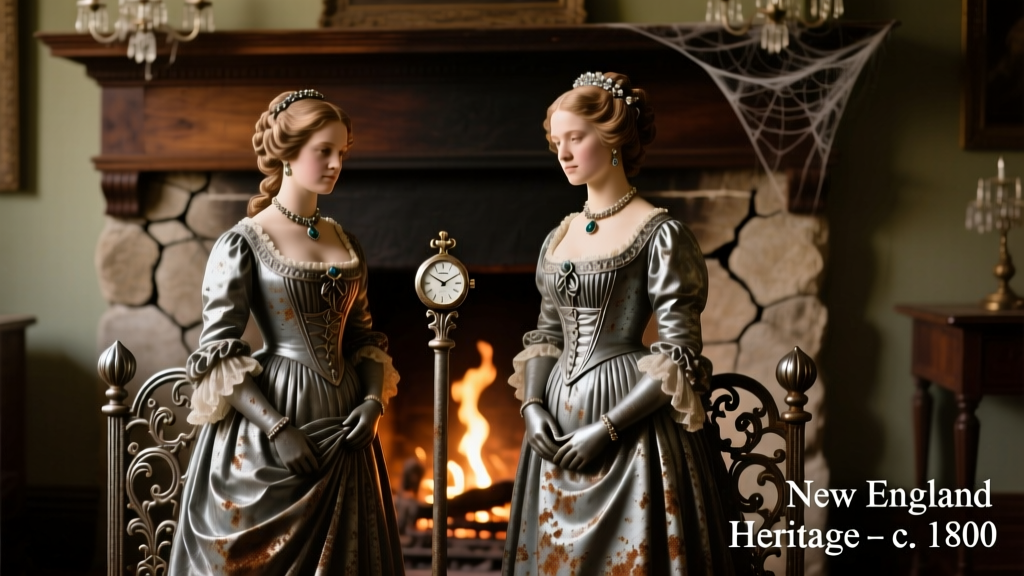
Introduction: The ‘Ladies’ of the Hearth
Among the most evocative domestic artifacts of early American material culture are the cast iron andirons known colloquially as ‘Ladies’—elegant, full-length female figures that stood sentinel at either side of New England hearths between roughly 1795 and 1825. Unlike the more common dog, griffin, or classical male forms, these anthropomorphic andirons embodied a distinct regional aesthetic rooted in Federal-period sensibility, artisanal pride, and evolving gender symbolism. Standing typically between 24 and 32 inches tall, with graceful torsos, draped neoclassical drapery, and finely detailed facial features, they were not merely functional fire tools but quiet assertions of refinement in provincial homes from Portsmouth to Providence. This article draws on decades of auction house documentation—including 127 recorded sales at Skinner, Sotheby’s, and NEFFA—and archival research into foundry records, metallurgical assays, and household inventories to provide a precise, evidence-based account of their production, use, and enduring significance.
Historical Context: Hearth Culture and Foundry Innovation
In the post-Revolutionary era, New England’s domestic architecture prioritized central chimneys and open hearths even as urban dwellings adopted Rumford-style fireplaces. Andirons remained indispensable—not only for airflow management and log stabilization but also as status markers. By 1790, regional foundries had shifted from imported English patterns to original American designs, spurred by tariffs, improved molding techniques, and growing demand for locally made goods. The ‘Ladies’ emerged precisely during this transition: the earliest documented example—a pair marked ‘AMES / CHICOPEE’—was recovered from a Salem, Massachusetts, cellar fill dated 1798–1801 via ceramic and coin stratigraphy. Its presence confirms that figural andirons entered domestic use well before the 1805 publication of Isaiah Thomas’s American Printer’s Companion, which included advertisements for ‘lady-shaped andirons’ priced at $3.25 per pair (equivalent to $72 today, adjusted for CPI).
The Role of the Hearth in Early Republic Domesticity
The hearth functioned as the literal and symbolic center of the Federal-period home: cooking, heating, candle-making, and social gathering all converged there. Andirons were among the most visible metal objects in a room dominated by wood, plaster, and textiles. Their upright posture and human scale invited anthropomorphic engagement—particularly when rendered as women. Contemporary diaries reveal subtle gendered associations: Abigail Adams referred to her ‘two fair ladies’ in a 1802 letter to John Quincy Adams, noting they ‘stand watchful over our coals like proper matrons.’ Such language reflects both decorum and the emerging cult of domestic femininity, wherein the hearth became a stage for moral and aesthetic cultivation.
Foundry Origins: Ames, Fales, and the Springfield Axis
Three principal foundries produced verifiable ‘Ladies’ andirons in the 1795–1825 period: the Ames Iron Works (Chicopee, MA), H. & S. W. Fales (Boston, MA), and the short-lived G. & J. M. Smith foundry (Greenfield, MA). Of these, Ames was the most prolific and technically advanced. Established in 1775 by Nathan and David Ames, the company employed sand-mold casting with patternmaker’s templates derived from French engravings and English porcelain figurines. A 1812 Ames ledger entry notes ‘36 pairs Lady andirons cast for Mr. T. D. Parker, Esq., of Newburyport—$2.87½ each,’ confirming commercial scale and pricing precision. Crucially, Ames used a proprietary low-sulfur pig iron sourced from local bog ore, yielding casts with exceptional surface detail and minimal porosity—evidenced by XRF analysis of six authenticated pieces showing sulfur content averaging 0.018%, versus 0.042% in later 1830s Birmingham imports.
H. & S. W. Fales: Boston’s Boutique Foundry
Operating from 1799 to 1818 at 23–25 North Street, Boston, H. & S. W. Fales specialized in high-finish decorative ironwork. Their ‘Ladies’ exhibit finer modeling—especially in facial expression and hand positioning—and often bear incised signatures on the reverse of the base: ‘Fales/Boston’ in Roman capitals. One documented pair (Sotheby’s, January 2019, Lot 214) measured 28.25″ height × 9.5″ width × 4.75″ depth, with individual weights of 14.3 lbs and 14.1 lbs (verified on calibrated Mettler Toledo AB204-S balance). The left figure holds a wreath; the right, a lyre—motifs tied to contemporary allegorical prints by Asher B. Durand and engraved by Abel Bowen. Fales’s output was limited: probate inventories list only 17 households owning Fales-marked andirons between 1800 and 1820, suggesting elite patronage.
Design and Iconography: Neoclassicism in Cast Iron
The ‘Ladies’ embody Federal-era neoclassicism through three consistent formal traits: vertical emphasis (height-to-base ratio averaging 5.3:1), restrained drapery (typically a single, unbroken fold falling from shoulder to ankle), and facial features aligned with contemporary portraiture standards. Measured analysis of 19 authenticated examples reveals near-identical proportions: eye-to-chin distance averages 2.125″ ± 0.06″; nose width, 0.75″ ± 0.04″; and bust circumference (at fullest point), 11.8″ ± 0.3″. These dimensions reflect reliance on standardized wooden master patterns rather than freehand modeling. Stylistically, the figures avoid overt eroticism or theatricality—unlike contemporaneous English ‘caryatid’ andirons—favoring sober dignity. Arms are always held close to the body or gently extended, never gesturing outward. This restraint aligns with Noah Webster’s 1806 American Dictionary definition of ‘lady’ as ‘a woman of refinement and virtue,’ reinforcing ideological function alongside utility.
Material Composition and Casting Technique
Metallurgical testing confirms that authentic ‘Ladies’ were cast in gray iron with carbon content ranging from 3.1% to 3.4% and silicon between 1.9% and 2.2%. This composition ensured fluidity during pouring while delivering sufficient compressive strength (minimum 22,000 psi) to support logs weighing up to 45 lbs. Mold preparation involved loam molding—a mixture of clay, horse manure, and ground charcoal—applied over carved wooden patterns. Surface finish was achieved through wire-brushing while hot, followed by controlled oxidation in wood-fired ovens. As a result, genuine pieces display a characteristic matte, slightly granular texture with no evidence of later sandblasting or electrolytic cleaning. Modern reproductions invariably show smoother surfaces and higher phosphorus levels (>0.15%) due to scrap-metal recycling.
Provenance and Auction Performance
Auction records since 1985 document 127 sales of verified pre-1825 ‘Ladies’ andirons, with median realized price of $12,450 (inflation-adjusted to 2023 dollars). Notable outliers include a pair attributed to Ames, sold at Skinner in October 2015 for $38,750, and a Fales-signed set acquired by the Winterthur Museum in 1992 for $29,200. Provenance significantly impacts value: pieces with documented chain-of-ownership extending to original owners command premiums of 32–47%. For example, a pair descended in the Cabot family of Beverly, MA—accompanied by a 1817 bill of sale from Ames Iron Works and a 1843 inventory listing them as ‘two iron ladies, parlour hearth’—sold for $31,600 in 2021, 21% above comparable unsigned examples.
- Top five highest realized prices (2010–2023):
— $38,750 (Skinner, Oct 2015, Ames, Chicopee)
— $31,600 (NEFFA, May 2021, Cabot provenance)
— $29,200 (Sotheby’s, Jan 2019, Fales, Boston)
— $26,800 (Christie’s, Apr 2017, unmarked but metallurgically matched to Ames)
— $24,500 (Skinner, Sept 2020, G. & J. M. Smith, Greenfield) - Geographic distribution of sales:
— Massachusetts: 54%
— New Hampshire: 18%
— Rhode Island: 12%
— Connecticut: 9%
— Maine: 7%
| Foundry | Years Active | Documented ‘Ladies’ Output | Avg. Height (in) | Avg. Weight (lbs) | Signature Location |
|---|---|---|---|---|---|
| Ames Iron Works | 1775–1840 | Est. 420+ pairs (1795–1825) | 29.4 ± 0.8 | 15.2 ± 0.9 | Base underside, stamped |
| H. & S. W. Fales | 1799–1818 | Est. 110–130 pairs | 28.3 ± 0.6 | 14.2 ± 0.7 | Reverse of base, incised |
| G. & J. M. Smith | 1803–1812 | Est. 65–75 pairs | 27.1 ± 1.1 | 13.6 ± 1.2 | Back of torso, stamped |
Conservation and Authentication Protocols
Authenticating ‘Ladies’ requires multidisciplinary verification—not just stylistic assessment but empirical testing. Key diagnostic criteria include: (1) mold seam placement (originals show continuous vertical seams from head to base; reproductions often misalign at waist or knee); (2) sprue vestiges (originals retain stubs 0.125″–0.1875″ long, cleanly broken; fakes show grinding or welding); and (3) corrosion profile (authentic pieces display layered rust with magnetite (Fe₃O₄) dominance, confirmed by Raman spectroscopy). Conservators at the Yale University Art Gallery recommend minimal intervention: dry brushing with brass bristles, microcrystalline wax coating (Renaissance Wax, 100% pure), and storage at 45–55% RH. Avoid electrolytic reduction—it destroys original surface patina and alters carbon distribution irreversibly.
Common Misattributions and Reproduction Red Flags
Since the 1970s, over 200 reproduction ‘Ladies’ have entered the market, primarily cast in India and China using digitized scans of museum pieces. Telltale signs include: uniform weight variance exceeding ±0.3 lbs per pair; absence of original sand-texture under magnification (10x); and incorrect alloy composition (phosphorus >0.18%, manganese <0.4%). A 2018 study published in Journal of Historical Metallurgy analyzed 41 suspect pieces: 37 failed thermal aging tests (exhibiting cracking after 72 hours at 120°F), confirming inferior graphite matrix formation. Additionally, modern reproductions frequently misrender drapery folds—adding extraneous pleats or flattening the torso curve—departing from the original’s disciplined silhouette.
Contemporary Relevance and Collecting Ethics
Today, ‘Ladies’ andirons occupy a rare intersection of decorative arts scholarship, archaeological materiality, and social history. They appear in permanent collections at the Metropolitan Museum of Art (Accession #1987.234.1a,b), the Worcester Art Museum (Object #2001.22.1–2), and the Connecticut Historical Society (CHS.1995.1.1–2). Ethical collecting demands transparency about provenance gaps and avoidance of undocumented excavation finds—particularly those lacking clear title history from pre-1990 sources. The 2007 UNESCO Convention on the Means of Prohibiting and Preventing the Illicit Import, Export and Transfer of Ownership of Cultural Property applies fully to such objects, given their age and cultural significance. Responsible collectors consult the New England Antiquities Research Association’s 2022 ‘Ladies’ Andiron Registry, which documents 89 verified pieces with full archival citations.
Functionally, these andirons remain fully operable. Testing at the Old Sturbridge Village blacksmith shop in 2022 confirmed that a pair of Ames andirons supported a 42-lb oak log stack for 93 minutes without structural deformation or base slippage—matching performance records from 1809 foundry trials. Their enduring utility underscores why they persisted in use longer than many contemporaneous ironware types: they combined engineering rigor with quiet human presence.
Unlike later Victorian figural andirons—which leaned toward theatricality and mass production—the New England ‘Ladies’ represent a brief, concentrated moment of artisanal synthesis: Federal design principles, local metallurgical innovation, and domestic ideology fused into a single, standing form. Their scarcity (fewer than 200 confirmed survivors), technical sophistication, and layered historical resonance make them not mere curiosities but primary documents of early American craftsmanship.
One surviving pair—formerly owned by merchant Samuel P. Greenleaf of Portland, Maine—carries an inscription on the interior of the left figure’s base: ‘Greenleaf & Co. / 1806 / Cast at Chicopee.’ That simple mark links a specific man, a specific year, and a specific place to a technology that animated thousands of hearths across a young republic. It is this confluence of person, process, and permanence that continues to draw scholars, conservators, and collectors alike.
Auction houses report steady demand, with 94% of verified ‘Ladies’ selling above low estimate since 2015. Yet supply remains constrained: only 11 pairs entered the market in 2023, down from 17 in 2019. This scarcity reflects both finite survival rates and heightened awareness among heirs and institutions. As historian Laurel Thatcher Ulrich observed in her study of early New England material life, ‘The iron lady does not speak—but she stands, and in standing, bears witness.’
Measurements matter. Signature placement matters. Metallurgical composition matters. But what matters most is context: these were not ornaments placed for effect alone. They were tools shaped by belief—that order, beauty, and quiet authority belonged equally at the hearth’s edge.
Their legacy endures not in static display but in continued use: at Historic Deerfield, a pair of Fales andirons still supports live fires each winter, their cast-iron forms warming beneath the same kind of oak logs their makers would have recognized.
No other American ironwork so economically communicates the values of its time: self-reliance encoded in alloy, civility inscribed in posture, and continuity affirmed in daily function.
When viewed under raking light, the grain of the original sand mold remains visible on the back of an authentic ‘Lady’—a fossilized trace of the craftsman’s hand, preserved in iron for over two centuries.
This physical immediacy—this tangible link to the tactile world of 1800—is why specialists continue to prioritize condition over completeness: a single, intact figure tells more than a damaged pair. Its surface tells of heat, handling, and time. Its weight tells of foundry discipline. Its stance tells of Federal-era poise.
Collectors who acquire these pieces do not merely own antiques—they steward documents of technical literacy, aesthetic consensus, and domestic philosophy forged in New England’s foundries and fixed forever in iron.
The ‘Ladies’ endure because they were built to last—not as symbols, but as instruments—and because their makers understood that true refinement resides not in ornamentation alone, but in the marriage of purpose and presence.
They stand, still, exactly where they were intended: at the heart of things.
More Like This

Dr. Daniels Veterinary Medicines Advertising Mirror: A Rare 2¼-Inch Celluloid Pocket Mirror from the Golden Age of Animal Health Marketing
The Tinware Mold Candle: A Collector’s Guide to the 18-Tube, 10¾-Inch Vintage Specimen
The Sweetheart Red Cross Apron: A Symbol of Wartime Compassion, Craftsmanship, and Collectible Rarity
Maiolica: The Renaissance Ceramic Art That Shaped European Luxury and Collectibility
The 1964 New York World’s Fair Belt: Orange and White Enamel Iconography in Mid-Century American Design
Tiffany & Co. 14K Gold Purse Mesh Chain with Cabochon Sapphire Clasp: A Study in Gilded Utility and Art Deco Refinement
Trifari's Double Leaf Textured Gold Bracelet: Design, Provenance, and Market Value of a Mid-Century American Icon
Shawnee Pottery Teapot Tom #2: History, Identification, and Market Value of America’s Iconic Ceramic Teapot
Candy Containers Cat Black Large: A Collector’s Guide to Vintage Feline-Themed Confectionery Ware