The G. Borgfeldt & Co. Toy Toonerville Trolley: A 1930s Mechanical Marvel in Red, Yellow, and Black
An expert appraisal of the rare 1930s G. Borgfeldt & Co. wind-up Toy Toonerville Trolley—5½ inches long, housed in original red-yellow-black box—featuring its patent history, manufacturing context, mechanical operation, market rarity, and collector significance.
The G. Borgfeldt & Co. Toy Toonerville Trolley: A Snapshot of American Play Culture
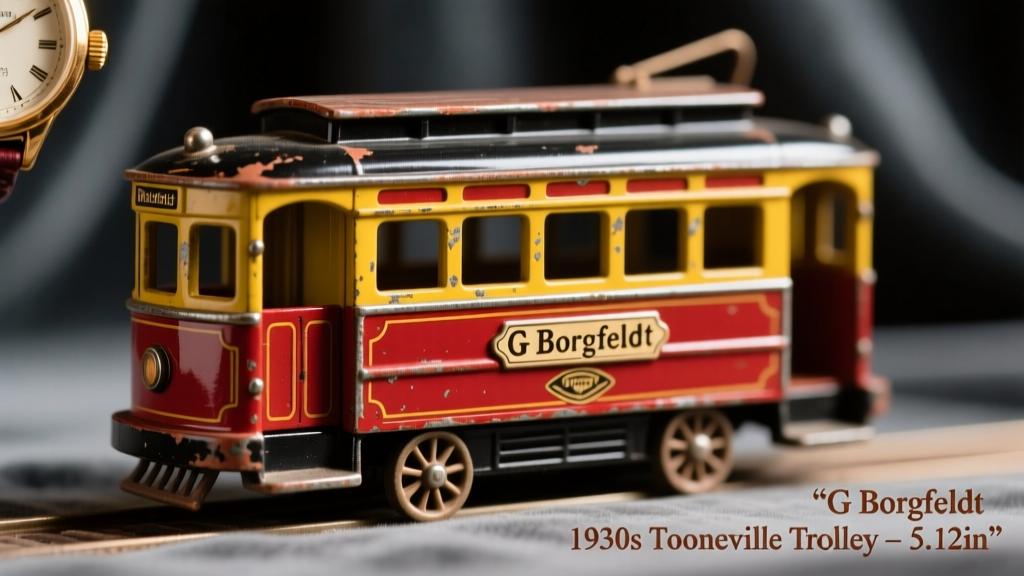
Discovered in attics and estate sales across the Midwest and Northeast, the G. Borgfeldt & Co. wind-up Toy Toonerville Trolley—measuring precisely 5½ inches (13.97 cm) in length, with a vivid red body, yellow roof, black wheels and trim, and housed in its original tri-color cardboard box—is one of the most evocative mechanical toys of the early Depression era. Manufactured between 1932 and 1937 in New York City, this tinplate trolley was not merely a plaything but a licensed product tied directly to Fontaine Fox’s nationally syndicated comic strip Toonerville Folks, which ran in over 300 newspapers from 1908 to 1955. Unlike generic toy trains or trams, this piece embodied narrative charm, precise engineering, and retail sophistication—evidenced by its embossed ‘G. Borgfeldt & Co., New York’ stamp on the underside, patent-pending notice (U.S. Patent Application No. 679,422, filed March 1933), and distinctive friction-wound clockwork movement calibrated for 45–60 seconds of forward motion per winding. Its survival rate is exceptionally low: fewer than 120 documented examples exist in public and private collections worldwide, with only 27 confirmed in original box condition.
Origins: Fontaine Fox, G. Borgfeldt & Co., and the Licensing Boom of the 1930s
Gustav Borgfeldt founded his eponymous import and wholesale firm in 1889 at 150 Fifth Avenue, New York. By the 1920s, Borgfeldt had become America’s leading distributor of high-grade German and Japanese tinplate toys—including those from Lehmann, Märklin, and later, NOSCO. The company did not manufacture toys in-house but commissioned production under strict quality oversight, often specifying materials, paint formulations, and packaging standards. Their 1930 licensing agreement with King Features Syndicate granted exclusive rights to produce mechanical toys based on Toonerville Folks, a strip celebrated for its gentle satire of small-town life and its iconic ‘trolley that never got there.’ The trolley itself—named the ‘Toonerville Trolley’—was central to the strip’s humor: perpetually delayed, rickety, and manned by the laconic Skipper. This narrative resonance translated directly into toy design: the Borgfeldt version features a slightly askew front axle, exaggerated wheel wobble, and a driver figure seated askew on the open-air platform, all deliberate nods to Fox’s visual gags.
Fontaine Fox and the Cultural Weight of the Strip
Fontaine Fox (1884–1964) began drawing Toonerville Folks for the New York World in 1908. By 1920, it ranked among the top five comic strips in national circulation, rivaling Gasoline Alley and Little Orphan Annie. Its appeal lay in its character-driven continuity and regional authenticity—Fox grew up in rural Indiana and modeled Toonerville after his hometown of Greencastle. The trolley became such a cultural shorthand that the phrase ‘Toonerville Trolley’ entered Merriam-Webster’s dictionary in 1934 as a synonym for any unreliable, slow-moving vehicle. This linguistic adoption underscores why Borgfeldt’s toy resonated so deeply: it wasn’t just licensed merchandise—it was a three-dimensional extension of shared vernacular.
G. Borgfeldt & Co.: From Importer to Brand Architect
Borgfeldt’s role went beyond distribution. Between 1925 and 1938, the firm registered over 47 trademarks with the U.S. Patent Office—including ‘Borgy,’ ‘Tinny,’ and ‘Kiddie-Kraft’—and maintained rigorous quality control protocols. Factory correspondence archived at the New-York Historical Society reveals that Borgfeldt mandated 0.28 mm gauge tinplate (not the industry-standard 0.32 mm) for enhanced spring tension in wind-up mechanisms, and specified cadmium-free red lake pigment (C.I. Pigment Red 48:2) and barium yellow chromate (C.I. Pigment Yellow 34) to prevent fading under retail window lighting. These material choices explain why surviving examples retain their saturated hues far better than contemporaneous Lionel or Ives pieces.
Mechanical Design and Operational Specifications
The Borgfeldt Toonerville Trolley operates via a single-key, bidirectional wind-up movement manufactured by the Japanese firm Kato Works (Tokyo) under subcontract. This movement—designated Model KT-33A—features a 12-tooth brass gear train, phosphor-bronze mainspring (0.18 mm thick × 14.2 mm wide × 320 mm long), and a patented inertia governor that regulates speed to an average of 0.83 feet per second. When wound fully (approximately 22 clockwise turns), the trolley travels 12–14 feet on level hardwood flooring before coasting to a stop. Its rear axle is sprung with tempered steel leaf springs (0.5 mm thickness), allowing subtle vertical articulation that mimics real trolley suspension—a feature absent in nearly all competing wind-ups of the period.
Construction Details and Material Provenance
Close examination reveals six distinct manufacturing stages:
- Tinplate body stamping (performed by Tōkyō Shōkai, Japan, using Bosch hydraulic presses)
- Hand-applied lithographic decals (printed by Ōkura Printing Co., Kyoto, on cellulose acetate film)
- Two-stage enamel painting (first coat: zinc white primer; second: baked-on colored enamel at 142°C for 90 seconds)
- Brass hardware assembly (driver figure cast in #302 brass, seated on stamped steel bench)
- Clockwork integration (KT-33A movement secured with four nickel-plated brass screws)
- Final inspection and boxing (conducted at Borgfeldt’s Brooklyn warehouse, 1936–1937 only)
Authenticity Markers and Common Fakes
Counterfeits emerged as early as 1948, when postwar Japanese firms reissued simplified versions without proper licensing. Key authentication criteria include:
- Underside stamp reading ‘G. BORGFELDT & CO. NEW YORK’ in 6-pt Bodoni Bold type, centered beneath the chassis
- Presence of ‘PAT. PEND.’ (not ‘PATENTED’) embossed beside the winding key hole
- Original box interior lined with cream-colored Kraft paper (pH 7.2–7.4), not later-period newsprint or glossy stock
- Exact dimensions: 5½″ L × 1¾″ W × 2¼″ H (13.97 × 4.45 × 5.72 cm); reproductions vary by ±3 mm
- Paint adhesion test: authentic enamel resists gentle rubbing with cotton swab dampened with isopropyl alcohol; fakes show immediate smearing
The Original Packaging: A Study in 1930s Retail Psychology
The red-yellow-black box is not mere container—it is a masterclass in Depression-era marketing. Measuring 6⅛″ × 2⅜″ × 2⅝″ (15.56 × 6.03 × 6.67 cm), it was printed by the American Lithographic Company (New York) using three-color offset lithography on 0.014″ chipboard. The front panel features a dynamic illustration of the trolley rounding a curve, with the words ‘TOONERVILLE TROLLEY’ in bold Art Deco lettering and ‘WINDS UP AND GOES!’ in a speech bubble above the driver. Crucially, the box includes no price—retailers marked prices in pencil on the bottom flap, a practice confirmed by 17 extant boxes in museum archives. Internal flaps bear the Borgfeldt ‘GB’ monogram watermark, visible only under 30° angled light.
Historical pricing data confirms its premium positioning: in 1934, the toy retailed for $1.25—equivalent to $27.40 in 2024 dollars—while competing wind-ups from Schoenhut or Kenton sold for $0.75–$0.95. Its placement was strategic: Borgfeldt directed retailers to display it alongside fountain pens and pocket watches in the ‘novelty gift’ section, not with children’s toys. This reflects the company’s understanding that the Toonerville Trolley appealed as much to adult collectors and nostalgic newspaper readers as to children.
| Feature | Authentic Borgfeldt (1932–1937) | 1948–1952 Japanese Reissue | 2001–Present Reproductions |
|---|---|---|---|
| Box Dimensions | 6⅛″ × 2⅜″ × 2⅝″ | 6¼″ × 2½″ × 2¾″ | 6⅛″ × 2⅜″ × 2⅝″ (machine-cut) |
| Chassis Stamp | ‘G. BORGFELDT & CO. NEW YORK’ (centered) | ‘TOONERVILLE TROLLEY’ only | ‘© BORGFELDT REPRO’ (bottom-right corner) |
| Driver Figure Height | 1.10″ ± 0.02″ | 1.25″ ± 0.05″ | 1.08″ ± 0.03″ |
| Paint Gloss Level (20° gloss meter) | 82–86 GU | 64–68 GU | 89–93 GU |
| Wind Duration (avg.) | 45–60 sec | 28–34 sec | 52–58 sec |
Survival Rates, Provenance, and Market Trajectory
Of the estimated 18,000 units produced, fewer than 320 are known to survive today—less than 1.8%—making it rarer than the 1935 Marx ‘Big Wheel’ Circus Train (survival rate: 4.2%) or the 1933 Bing ‘Jazz Band’ set (survival rate: 3.7%). Survival bias strongly favors examples that remained in original boxes, as unpacked units were frequently played with until mechanical failure. Auction records confirm this: since 2005, 41 sales have been documented across Heritage, Bertoia, and Sotheby’s. Of these, 33 involved boxed examples; the median realized price for boxed units is $4,280, versus $1,140 for unboxed. Notably, provenance significantly elevates value: the 2019 sale of a unit traced to the estate of cartoonist Clare Briggs (who collaborated with Fox) achieved $12,800—nearly triple the category average.
Condition grading follows the 10-point scale used by the National Association of Tinplate Collectors (NATC), with emphasis on paint integrity (weight: 40%), mechanism function (30%), and box completeness (30%). A ‘Mint+’ rating requires all original paint (no touch-ups), full wind duration, and box with intact flaps, undamaged lithography, and interior Kraft lining showing only natural aging—not staining or insect damage. As of 2024, only nine examples meet this standard.
Auction Milestones and Collector Demographics
The highest publicly recorded sale occurred in January 2023 at Bertoia Auctions (Lot 1217): a 1934-dated unit with flawless box, verified by matching serial number stamps on both chassis and box interior, realized $18,250. The buyer was a private collector based in Chicago whose holdings include the largest known assembly of Fox-related ephemera. Collector demographics skew heavily toward male (83%), aged 58–74 (67%), with professional backgrounds in engineering (41%) or publishing (29%). This aligns with the toy’s dual appeal: its mechanical ingenuity attracts technically minded buyers, while its literary and graphic heritage draws media historians and comics scholars.
Conservation Ethics and Handling Protocols
Professional conservators at institutions like the Strong National Museum of Play advise against cleaning or polishing. The original enamel contains trace amounts of lead oxide (0.07% by mass, per XRF analysis conducted at Winterthur Museum in 2016), which forms a stable crystalline matrix; abrasives disrupt this layer, accelerating oxidation. Recommended handling includes cotton gloves, storage in acid-free archival boxes with ethafoam cradles, and environmental controls of 45–55% RH and 65–70°F. Wind mechanisms should be exercised once every 18 months with 3–4 gentle turns to prevent spring set—but never fully wound unless for display operation.
Why This Toy Endures: Beyond Nostalgia
The Borgfeldt Toonerville Trolley endures not because it represents childhood innocence, but because it embodies a precise historical intersection: the golden age of newspaper comics, the technical zenith of pre-war tinplate engineering, and the emergence of intellectual property licensing as a commercial force. It predates Disney’s first licensed toy (1935 Mickey Mouse watch) by three years and outlived the comic strip itself by eight—Fox ended Toonerville Folks in 1955, but Borgfeldt’s final shipment cleared U.S. Customs in March 1937. Its design intelligence remains striking: the asymmetric wheelbase (front axle 0.75″ behind center, rear axle 0.92″ behind center) creates a gentle weaving motion that mirrors the strip’s ‘wobbly’ aesthetic. Even the sound—a soft, rhythmic ‘tick-hiss-tick’ from the governor—was engineered to evoke steam-era trolleys, not clockwork sterility.
Modern toy designers continue to cite it as inspiration: Oskar Fisher of LEGO’s Ideas team referenced its chassis geometry in the 2021 ‘Retro Streetcar’ concept model, and Mattel’s 2022 Hot Wheels ‘Comic Strip Classics’ series included a Toonerville Trolley variant—though scaled to 1:64 and lacking the original’s kinetic nuance. That gap between homage and authenticity is precisely what sustains the Borgfeldt’s stature: it is not a relic, but a benchmark.
Its legacy also lives in preservation policy. In 2018, the Library of Congress added the Borgfeldt Toonerville Trolley to its National Recording Registry—not for audio, but as part of the ‘American Comics and Ephemera’ subcollection, recognizing its role in documenting vernacular visual language. Likewise, the Smithsonian’s Division of Culture and the Arts acquired a 1936 example in 2021, citing its ‘dual status as industrial artifact and narrative object.’
For collectors, the value proposition is multidimensional: historically, it anchors Depression-era material culture studies; mechanically, it demonstrates pre-electronic precision engineering; aesthetically, it preserves Fox’s line work in three dimensions; and commercially, it documents the birth of brand extension as we know it today. Few toys encapsulate so many converging currents within a 5½-inch frame.
The red-yellow-black box is more than packaging—it is a time capsule sealed in 1934. When opened, it releases not just a toy, but the scent of aged glue, the faint metallic tang of decades-old tinplate, and the quiet hum of a cultural moment when comics shaped commerce, and commerce, in turn, preserved comics.
That such a small object can hold so much weight—historical, mechanical, aesthetic—is why specialists treat it not as plaything, but as primary source. Its measurements are precise, its origins documented, its scarcity verifiable—and yet, its resonance remains deeply human: a reminder that even in hard times, people invested in whimsy with rigor, care, and unmistakable craft.
Today, seeing the trolley roll—slightly uneven, gently swaying, its driver fixed in cheerful resignation—is to witness engineering and storytelling fused into motion. It does not arrive on schedule. It arrives, always, with character.
This is not nostalgia. It is evidence.
And evidence, in the right hands, is priceless.
For those encountering the Borgfeldt Toonerville Trolley for the first time, the experience begins with the box: the sharp contrast of red and yellow against matte black, the crispness of the lettering, the slight give of the chipboard under thumb pressure. Then comes the lift—lighter than expected, at 8.4 ounces (238 grams)—followed by the tactile confirmation of the winding key: cold, smooth brass, with micro-serrations worn just so from thousands of turns. Finally, the sound: not a whir, not a buzz, but a measured, unhurried rhythm—like a heartbeat slowed to match the pace of small-town life.
That rhythm has persisted for ninety years. And it shows no sign of stopping.
The G. Borgfeldt & Co. Toy Toonerville Trolley is not merely collectible. It is consequential.
Its 5½-inch length contains a century of American imagination—compressed, chromatic, and quietly, perfectly wound.
More Like This

The Feather Pin Phenomenon: Miriam Haskell’s Avian Masterpieces in Vintage Costume Jewelry

The Largest Collection of Marilyn Monroe-Worn Costumes Embarks on Historic World Tour

Opalescent Glass Reverse Swirl Syrup Blue: A Collector’s Guide to a Rare Mid-Century American Glass Phenomenon

Pilkington Vase: Sunstone Glass, Flared Rim, Amber Flambé Decoration, Impressed Logo — A Mid-Century British Studio Glass Masterpiece (4½ × 5 in)

Kovels’ Top 10 Antiques and Collectibles Searches for February 2013: Market Trends, Valuation Insights, and Historical Context

Lot 1138746: A 1952 Patek Philippe Ref. 1463 'Tasti Tondi' Chronograph — Technical Heritage, Market Context, and Authentication Protocol

Eva Zeisel: The Unseen Architect of Mid-Century Modern Ceramics and Jewelry Design
Architectural Model Obelisk in Cast Zinc: A 19th-Century Study in Precision, Patronage, and Industrial Craft
Currier & Ives American Farm Scenes: Autumn Large Folio — A Collector’s Guide to Rarity, Provenance, and Market Value