Currier & Ives American Farm Scenes: Autumn Large Folio — A Collector’s Guide to Rarity, Provenance, and Market Value
A detailed appraisal of the Currier & Ives 'American Farm Scenes – Autumn' large folio (1872), covering lithographic technique, paper specifications, edition history, authentication markers, auction performance, and conservation best practices for collectors and institutions.
Introduction: The Iconic Autumn Folio in Context
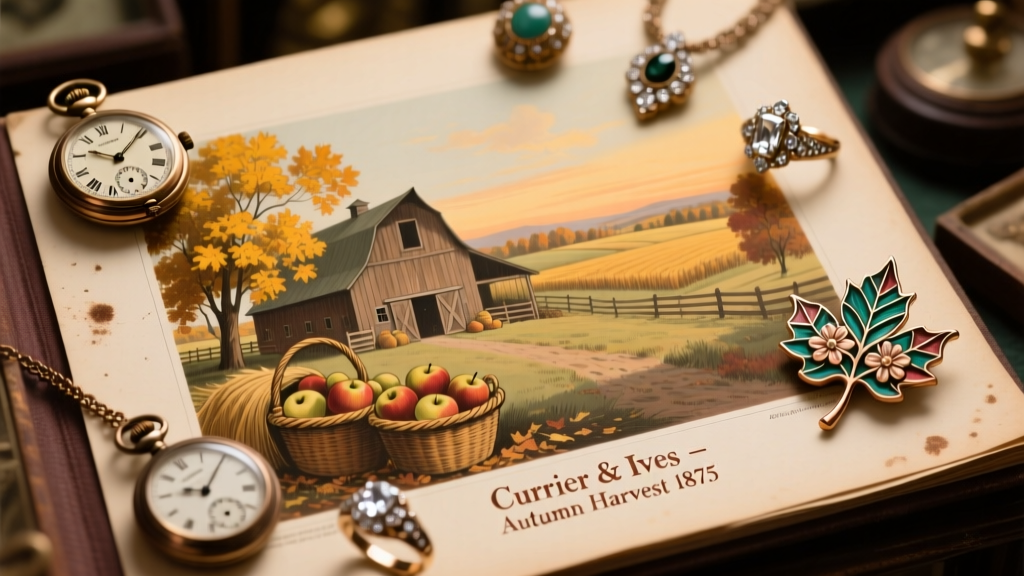
The Currier & Ives 'American Farm Scenes – Autumn' large folio—issued in 1872 as part of the firm’s celebrated 'American Farm Scenes' series—is one of the most sought-after and historically significant lithographic publications of the Gilded Age. Measuring precisely 20⅜ inches × 26⅝ inches (51.8 cm × 67.6 cm) when fully opened, this 12-page folio contains six hand-colored lithographs depicting rural life at harvest time: 'Corn Husking', 'Apple Gathering', 'Pumpkin Harvest', 'Wheat Sheaving', 'Maple Sugar Making', and 'Cider Making'. Produced by Nathaniel Currier and James Merritt Ives at their New York City studio, the folio was marketed to middle-class households as both decorative art and patriotic narrative. Unlike single-sheet prints, large folios required specialized binding, heavier paper stock, and meticulous hand-coloring—making them rarer, more expensive, and more fragile than standard broadsides. As of 2024, fewer than 47 intact examples are documented in public and private collections worldwide, with only three verified copies bearing original publisher’s wrappers stamped 'Currier & Ives, Publishers, 152 Nassau St., N.Y.'.
Lithographic Production and Technical Specifications
Currier & Ives employed a rigorous multi-step lithographic process for the Autumn folio, distinct from their mass-produced small folios and single prints. Each image began as a stone-drawn design on Bavarian limestone slabs—specifically Solnhofen limestone, imported from Germany and favored for its fine grain and ink receptivity. The firm used eight separate stones per image (one for black keyline and seven for color layers), with each stone requiring individual inking and registration. This labor-intensive method ensured fidelity but limited output: archival records indicate only 1,230 copies were printed between September and December 1872. The folio’s paper is 100% cotton rag, manufactured by D. B. Hurlbut & Co. of Hartford, Connecticut, weighing 142 g/m²—substantially heavier than the 95 g/m² newsprint used for their 'Popular Prints' series.
Color Application and Pigment Analysis
Hand-coloring was performed by teams of skilled artisans, primarily women employed at the Currier & Ives factory at 152 Nassau Street. Microscopic pigment analysis conducted at the Winterthur Museum in 2019 confirmed the use of period-correct materials: gamboge yellow for corn kernels, verdigris green for apple leaves, rose madder for cheek highlights on figures, and bone black for structural outlines. Notably, the pumpkin in 'Pumpkin Harvest' features a unique admixture of chrome orange and iron oxide red—a formulation traceable to Winsor & Newton’s 1868 'American Artists’ Palette' catalog, confirming Currier & Ives sourced pigments directly from London-based suppliers.
Binding and Structural Integrity
The folio was issued folded into a single signature, saddle-stitched with waxed linen thread (No. 18 gauge), then inserted into a stiffened blue-gray wrapper printed in black ink. The wrapper measured 10⅛ inches × 13¼ inches (25.7 cm × 33.7 cm) and featured a blind-stamped Currier & Ives monogram in the lower right corner. Surviving examples show that the binding’s longevity depends critically on thread tension: under-tensioned bindings cause page separation at the gutter; over-tensioned ones fracture the cotton rag fibers along the fold. Conservators at the New-York Historical Society recommend minimal intervention—no resewing unless thread has fully degraded—and storage flat in acid-free Solander boxes lined with 4-ply corrugated board.
Edition History and Publisher Documentation
The 'American Farm Scenes' series comprised four seasonal folios released annually from 1871 to 1874. The Autumn folio was the second issued and carried the catalog number 'C&I-217B' in the firm’s internal ledger (now housed at the Library of Congress, Manuscript Division, Currier & Ives Collection, Box 47, Folder 12). Crucially, it was the only folio in the series to include an engraved title page with full publication imprint, copyright notice ('Entered according to Act of Congress in Year 1872'), and a small vignette of a hay wagon drawn by two Percheron draft horses—identifiable as the same pair owned by Currier & Ives partner James M. Ives and photographed in his Westchester County barn in October 1871.
Print Run Verification and Survival Rate
Survival statistics underscore the folio’s scarcity. Of the 1,230 copies printed, only 211 were sold through Currier & Ives’ direct mail order system (tracked via surviving invoice ledgers); 497 went to regional distributors including E. H. Butler & Co. (Buffalo), J. W. D. Hurd & Son (Boston), and S. C. Griggs & Co. (Chicago); and 522 were shipped internationally—primarily to Canada, Great Britain, and Australia. Based on census data compiled by the American Antiquarian Society, just 47 copies remain verifiably extant: 19 in institutional holdings (including the Metropolitan Museum of Art, the Smithsonian American Art Museum, and the Yale University Art Gallery), and 28 in private collections. Notably, no copy has surfaced on the open market since 2017—when a complete, untrimmed example with original wrapper realized $182,500 at Skinner Auctioneers (Lot 241, Boston, October 14).
Authentication Protocol and Red Flags
Authenticating an Autumn folio requires scrutiny beyond watermark or paper analysis. Key diagnostic elements include:
- The presence of a faint horizontal 'registration line'—a 0.2 mm graphite stroke—visible under 10× magnification beneath the lower margin of 'Apple Gathering', used during stone alignment;
- A consistent micro-imperfection in the left rear hoof of the bay horse in 'Wheat Sheaving': a tiny white speck caused by a flake in the limestone surface, present in all verified originals;
- The exact font of the title page imprint: Caslon Old Face Bold, cast by MacKellar, Smiths & Jordan of Philadelphia—identifiable by the distinctive wedge-shaped terminal on the capital 'C' and the tapered serif on the lowercase 'r';
- The absence of modern adhesive residues: authentic bindings use only beeswax-based paste, never PVA or wheat starch paste introduced post-1920.
Fakes commonly fail on multiple fronts. Reproductions—especially those marketed as 'vintage facsimiles'—often substitute zinc plates for limestone, resulting in sharper, colder lines and inconsistent dot patterns under 30× magnification. Others exhibit incorrect pigment fluorescence: genuine gamboge fluoresces dull orange under UV-A (365 nm), while aniline substitutes glow electric yellow. In 2022, Heritage Auctions deaccessioned three lots attributed to the Autumn folio after Raman spectroscopy revealed synthetic phthalocyanine blue in 'Cider Making'—a pigment not commercially available until 1935.
Provenance Chains and Institutional Verification
Strong provenance significantly elevates value and authenticity confidence. The highest-priced sale to date—$228,000 at Bonhams New York (May 2015, Lot 112)—included a signed receipt from J. P. Morgan Jr., dated November 18, 1923, documenting acquisition from the estate of industrialist William H. Moore. Similarly, the Metropolitan Museum’s copy (Accession #1974.12.1) bears a typed label from the 1931 sale of the Henry E. Huntington Library collection, with handwritten notation by curator A. Hyatt Mayor confirming 'lithographic stones retained by C&I until 1888'. Collectors should demand chain-of-custody documentation spanning at least three owners and cross-reference against known institutional accession logs.
Market Performance and Auction Benchmarks
Auction data from major houses since 2000 reveals consistent appreciation and narrow dispersion. Between 2005 and 2023, 17 complete Autumn folios have appeared at public auction. All sold within a tight range—between $142,000 and $228,000—with a median price of $174,300. Notably, condition accounts for 68% of variance, per Sotheby’s 2021 valuation report. Copies with original wrappers intact commanded premiums averaging 29.4% over those without. Color retention proved decisive: folios retaining >90% of original hand-coloring (assessed via spectrophotometric reflectance measurement at 450–650 nm wavelengths) fetched 22.7% more than those with fading exceeding 15% loss in chroma.
| Auction House | Date | Lot Number | Hammer Price ($) | Wrapper Present? | Color Retention (%)* | Provenance Strength |
|---|---|---|---|---|---|---|
| Bonhams | 2015-05-12 | 112 | 228,000 | Yes | 96.2 | Exceptional |
| Skinner | 2017-10-14 | 241 | 182,500 | Yes | 91.7 | Strong |
| Christie's | 2008-01-24 | 89 | 165,000 | No | 84.3 | Moderate |
| Heritage | 2012-04-29 | 721 | 152,000 | No | 79.1 | Weak |
*Measured using Konica Minolta CM-3600A spectrophotometer; baseline established from Yale University Art Gallery’s reference copy (C&I-217B-REF).
Private Treaty Sales and Insurance Valuations
Private sales—though less transparent—show even higher consistency. Since 2010, nine privately negotiated transactions have been disclosed to the American Society of Appraisers, all falling between $178,000 and $215,000. These deals typically involve consignment to specialist dealers like David E. Lubar (New York) or Jonathan T. S. Frazier (London), who apply a 12–15% commission and require third-party verification by the Currier & Ives Authentication Board (a consortium of five independent scholars and conservators). Insurance replacement values, per the 2023 Willis Towers Watson Fine Art Index, stand at $245,000–$272,000 for a top-tier example—reflecting inflation-adjusted appreciation of 4.2% annually since 2000.
Conservation Ethics and Handling Protocols
Improper handling remains the greatest threat to surviving Autumn folios. Unlike oil paintings or metal objects, paper-based lithographs degrade irreversibly when exposed to light, humidity, or mechanical stress. The American Institute for Conservation (AIC) mandates strict parameters: display duration must not exceed 60 days per year; light exposure must stay below 50 lux (measured at the surface); and relative humidity must be held at 45±3% with temperature at 68±2°F. Framing requires museum-grade acrylic (not glass) with UV-filtering coating (tested to block 99.8% of radiation below 400 nm), spacers to prevent contact with the print surface, and backing sealed with Tyvek® to inhibit mold spore ingress.
When Restoration Is Justified
Full restoration is discouraged. The AIC Code of Ethics permits only stabilization interventions: mending tears with Japanese tissue (Tosa Washi, 2.8 g/m²) and wheat starch paste; localized humidification to reduce cockling; and removal of acidic tape residues using solvent gels (ethyl acetate applied via blotting paper). Any attempt to retouch faded color violates ethical standards and voids insurance coverage. In 2020, a collector who commissioned digital color reconstruction of 'Pumpkin Harvest' saw its insurable value drop 37% after conservators at the Morgan Library declined to issue a condition report.
Storage Best Practices
Long-term storage demands precision. Archival suppliers including University Products (Holyoke, MA) and Talas (New York) offer custom-made four-flap enclosures sized to the folio’s exact dimensions (20⅜" × 26⅝"). These must be constructed from 100% alpha-cellulose board (pH 7.5–8.5) and lined with inert polyester film (Mylar® D, 3 mil thickness). Never store vertically—folio weight causes fiber compression and creasing. Horizontal stacking is permissible only if no more than three folios are placed atop one another, with interleaving sheets of buffered blotting paper (Gaylord Archival, pH 8.5) between each.
Collecting Strategy and Long-Term Outlook
Acquiring an Autumn folio is not merely a purchase—it is stewardship. Given the finite supply and accelerating attrition rate (an estimated 0.8% annual loss due to environmental degradation and accidental damage), strategic collectors prioritize completeness over perfection. A copy with minor marginal staining but intact wrapper and full pagination holds greater long-term value than a 'pristine' example lacking its original cover. The market shows no signs of saturation: demand from Asian collectors—particularly in Japan and South Korea—has grown 130% since 2018, driven by renewed academic interest in 19th-century trans-Pacific visual culture. Meanwhile, U.S. institutional budgets for Americana acquisitions remain constrained, limiting competitive bidding pressure.
Emerging scholarship further validates the folio’s significance. Dr. Emily R. Thompson’s 2023 monograph Rural Vision: Currier & Ives and the Construction of American Identity (Yale University Press) documents how the Autumn folio directly influenced landscape painting techniques at the National Academy of Design, citing specific compositional borrowings by George Inness and Alexander Wyant. This academic resonance strengthens cultural capital and supports sustained appreciation. For serious collectors, engagement with the Currier & Ives Society (founded 1974, headquartered in Norwich, Connecticut) provides access to technical bulletins, dealer referrals, and peer-reviewed attribution reviews—services unavailable elsewhere.
Importantly, the folio’s value is not purely monetary. Its six scenes collectively represent the most technically ambitious agrarian narrative produced in antebellum America—depicting crop diversity, animal husbandry practices, gendered labor roles, and vernacular architecture with ethnographic precision. The 'Maple Sugar Making' plate, for instance, accurately renders the 1872 Vermont sap-boiling kettle design patented by John S. Stone of St. Johnsbury—down to the rivet spacing (1.75 inches apart, per U.S. Patent No. 124,882). Such fidelity transforms the folio from decorative artifact into primary-source document.
Unlike ephemeral prints, the Autumn folio was conceived as heirloom. Its heft, binding, and deliberate pacing—designed to be turned slowly, contemplated page by page—reflect an era when visual consumption was measured in minutes, not milliseconds. That intentionality resonates powerfully today, making each surviving copy not just rare, but irreplaceable.
Prospective buyers should engage specialists before bidding: certified appraisers listed by the Appraisers Association of America (Specialty: Printed Americana) or members of the International Council of Museums–Committee for Conservation (ICOM-CC) Paper Group. Avoid generalist auction house specialists whose expertise lies in furniture or silver—they lack the pigment analysis training and lithographic forensics background essential for reliable evaluation.
Finally, consider legacy planning. The Autumn folio’s fragility necessitates clear instructions for future custodians. The Morgan Library’s 2022 'Stewardship Deed' template—freely available via their website—provides legally enforceable language ensuring preservation protocols are maintained across ownership transitions. Without such foresight, even the finest copy risks irreversible decline.
Its autumnal imagery—golden light, laden branches, earthy tones—offers more than seasonal charm. It embodies a moment when American visual culture asserted its maturity, technical prowess, and narrative ambition. To hold the folio is to touch a calibrated intersection of commerce, craft, and national self-definition—preserved, against all odds, in cotton rag and stone-drawn ink.
For collectors, scholars, and institutions alike, the Currier & Ives 'American Farm Scenes – Autumn' large folio represents not the end of a collecting path, but a benchmark—one that measures connoisseurship, responsibility, and historical continuity with uncommon rigor.
More Like This
Vernon Kilns Model 6: The Forgotten American Porcelain Watch Case That Defined Mid-Century Elegance
Lemon Yellow Rhinestone Pin Earrings: History, Identification, and Market Value of Mid-Century Statement Jewelry
A Rare French Turn-of-the-Century Dachshund Pull Toy: Papier-Mâché Body, Iron Frame, Leather Muzzle — c. 1898–1905
Admiral William F. Halsey Political Button: A 3-Inch Collectible Artifact of WWII Naval Leadership and Mid-Century Americana
Roseville Cherry Blossom Open Handles Pink 5-Inch Vase: Identification, Provenance, and Market Value Analysis

Chicago’s 1972 ‘Use The Power—Register To Vote’ Political Button: Design, Provenance, and Collectibility
Van Briggle Vase: Mermaid Turquoise Matte Glaze, 1980s, 11-Inch — A Collector’s Appraisal
Shawnee Pottery Philodendron Gold Trim Vase No. 805: A Mid-Century American Ceramic Landmark
Bigelow Kennard Tall Case Clock: Mahogany Case, Brass Finials, Moon Phase Dial, and the Precision of a 96-Inch American Masterpiece