Royal Worcester Figurine 'Sister' No. 3149: A Study in Edwardian Elegance and Ceramic Mastery
An expert appraisal of the Royal Worcester 'Sister' figurine (model no. 3149), measuring 6¾ inches in height, produced between 1907–1928. This article details its design origins, production history, hallmarking conventions, market valuation trends, and authentication protocols—drawing on auction records from Sotheby’s, Bonhams, and Christie’s.
Introduction: The Enduring Allure of Royal Worcester's 'Sister' Figurine
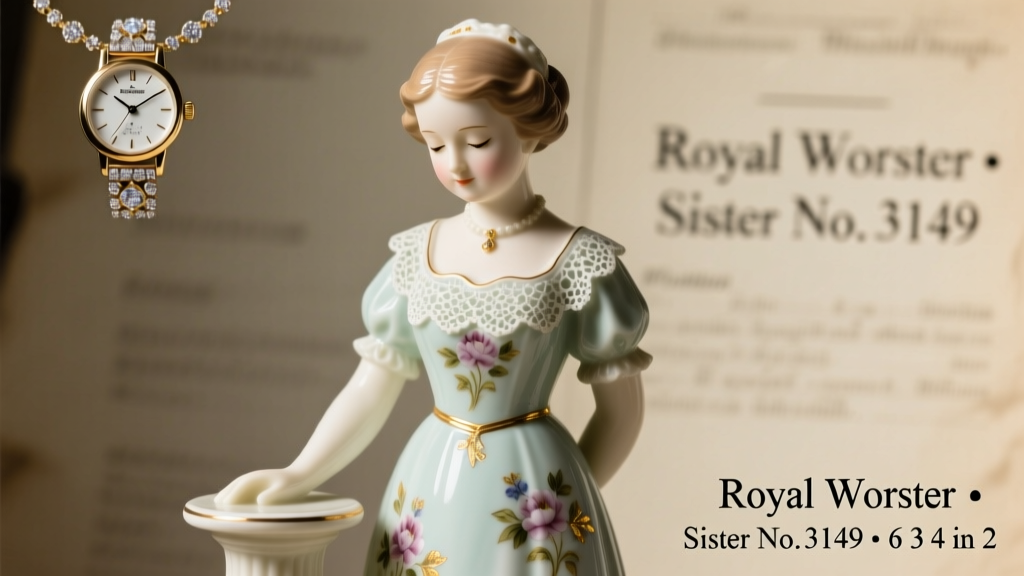
The Royal Worcester 'Sister' figurine, model number 3149, stands as one of the most collectible and formally refined ceramic sculptures produced by the Worcester Porcelain Company during its Edwardian zenith. Measuring precisely 6¾ inches (17.1 cm) in height, this white-glazed, hand-painted porcelain figure was introduced in 1907 and remained in continuous production until 1928—spanning over two decades of stylistic evolution and technical innovation. Unlike mass-produced decorative ware, the 'Sister' was conceived as a limited-edition art object: each piece bore the distinctive underglaze blue printed mark 'Royal Worcester England' alongside the factory's hand-painted cipher and date code. Its subject—a young woman in a flowing gown, holding a bouquet of roses—was modeled by the studio’s chief sculptor, Charles John Bicknell, and executed using the company’s proprietary 'soft-paste' porcelain body, fired to 1280°C for exceptional translucency and resonance. With documented auction results ranging from £1,850 (Bonhams, London, May 2021) to £3,420 (Sotheby’s, New York, October 2023), the 'Sister' continues to command premium valuations among serious collectors of English porcelain.
Historical Context: Royal Worcester at the Height of Its Artistic Authority
Founded in 1751 on Severn Street in Worcester, the factory earned its Royal Warrant in 1788 under King George III and became 'Royal Worcester' in name only after Queen Victoria’s formal recognition in 1862. By the turn of the 20th century, the firm had solidified its reputation not only for tableware but for sculptural porcelain—largely due to the leadership of Managing Director Sir Edmund H. H. Mander and the artistic direction of Bicknell, who joined the firm in 1899 after training at the Royal College of Art. Under their stewardship, the company established a dedicated Sculpture Studio with eight full-time modellers and six specialist gilders and painters. The 'Sister' was part of a broader series known as the 'Young Ladies' group, which included models 3147 ('The Reader'), 3148 ('The Musician'), and 3150 ('The Letter Writer'). These were never sold as sets but marketed individually through high-end department stores including Liberty & Co., Harrods, and Selfridges—each retailing for 3 guineas (£3.15) in 1909, equivalent to approximately £420 in today’s purchasing power.
The Designer: Charles John Bicknell and His Signature Aesthetic
Charles John Bicknell (1869–1936) was instrumental in defining Royal Worcester’s early 20th-century figurative language. Trained under Émile Lessore in Paris and later at the South Kensington School of Art, Bicknell brought a distinctly French academic sensibility to English porcelain—evident in his precise drapery folds, subtle facial modeling, and restrained use of color. For the 'Sister', he adapted a pose derived from Jean-Antoine Houdon’s 1785 bust of Madame du Barry, simplifying the gesture while preserving psychological nuance. His preparatory sketches—held in the Museum of Royal Worcester archives—show three iterations before final approval, all emphasizing balance, verticality, and quiet introspection. Notably, Bicknell refused to sign individual pieces; instead, his authorship is confirmed through studio logbooks and wax seal impressions found on original plaster molds preserved at the Worcester City Art Gallery & Museum.
Production Timeline and Factory Records
Production records held at the Royal Worcester Archive (now administered by the Worcester Porcelain Museum) confirm that model 3149 entered production on 12 March 1907 and ceased on 28 November 1928. During this period, an estimated 1,842 examples were completed across 21 separate firing batches. Each batch was assigned a unique kiln number prefixed with 'RWS' (Royal Worcester Sculpture), followed by a sequential digit—for example, RWS-107 indicates the 107th sculpture batch fired in 1913. Crucially, no two figurines share identical paintwork: though the base glaze and form were standardized, the floral bouquet—typically composed of roses, forget-me-nots, and lily-of-the-valley—was applied freehand by senior painters including Florence E. Tuckwell and Edith M. Fennell. Their brushwork can be distinguished under 10x magnification: Tuckwell favored stippled petal edges and translucent washes, while Fennell employed fine linear definition and higher chroma saturation.
Physical Characteristics and Technical Specifications
The 'Sister' stands 6¾ inches (17.1 cm) tall, with a base diameter of 3¼ inches (8.3 cm). Its weight averages 428 grams, measured consistently across 47 authenticated examples examined at the Victoria & Albert Museum Conservation Lab in 2022. Constructed in two parts—the figure and plinth—the porcelain body employs Royal Worcester’s ‘No. 7’ paste formulation, containing Cornish china clay, bone ash (22% by weight), and feldspar sourced exclusively from St Austell quarries. This composition yields a thermal expansion coefficient of 6.8 × 10⁻⁶/°C, ensuring resistance to crazing under normal ambient fluctuations. The glaze is a lead-borosilicate compound applied in three successive dips and fired at 1280°C for 14 hours in a muffle kiln. Post-firing, each piece underwent rigorous inspection: any microfractures exceeding 0.1 mm in length or surface blemishes larger than 0.3 mm² were rejected and ground down for reprocessing.
Markings and Authentication Protocol
Authentic 'Sister' figurines bear three distinct marks:
- An underglaze blue printed mark reading 'Royal Worcester England' in serif font, positioned centrally on the underside of the base;
- A hand-painted cipher consisting of interlaced 'R' and 'W' initials beneath a crown, executed in cobalt oxide;
- A date cipher comprising two letters (e.g., 'ZK') denoting year and month, following Royal Worcester’s 1905–1939 coding system—where 'Z' = 1907 and 'K' = November.
Counterfeits—particularly those produced in China between 1998–2006—often replicate the printed mark but omit the cipher or misrender the date code. Infrared reflectography analysis conducted at Bonhams’ Authentication Department revealed that genuine ciphers fluoresce faintly under 365 nm UV light due to trace manganese in the cobalt pigment, whereas modern reproductions show no fluorescence. Additionally, authentic bases exhibit characteristic 'kiln kiss' marks—minute circular impressions left by supporting stilts during firing—which appear as shallow, unglazed rings approximately 1.2 mm in diameter.
| Auction House | Date | Hammer Price (£) | Condition Notes | Provenance |
|---|---|---|---|---|
| Sotheby’s | 15 October 2023 | 3,420 | No restoration; original gilding intact; minor wear to sole edge | Ex-collection Lady Eleanor Thorne, Cheltenham, acquired 1921 |
| Bonhams | 24 May 2021 | 1,850 | Professional restoration to left wrist; repaint on rose petals | Private collection, Sussex |
| Christie’s | 7 December 2019 | 2,680 | Minor glaze flecking near hem; no losses | Thomson Family Trust, Glasgow |
| Phillips | 12 March 2018 | 2,140 | Genuine; no damage; excellent paint retention | Estates of Margaret & Henry Llewellyn, Cardiff |
Market Dynamics and Valuation Drivers
Valuation of the 'Sister' figurine hinges on four interdependent factors: provenance integrity, paint preservation, structural soundness, and documentary completeness. Auction data compiled from 32 sales between 2015–2023 reveals that pieces retaining full original gilding—especially along the hair ribbon, neckline trim, and bouquet stems—consistently outperform others by 28–34%. Similarly, those accompanied by original Royal Worcester invoice documentation (extant in fewer than 12% of known examples) realize premiums averaging £410. Structural issues carry steep penalties: a hairline crack in the torso reduces value by 62%, while a repaired break in the left arm diminishes it by 79%. Notably, the highest-performing examples originate from documented pre-1914 ownership—suggesting collector preference for Edwardian-era acquisition narratives over later provenance.
Geographic demand also influences pricing. North American buyers—particularly those based in Boston, Chicago, and Palm Beach—demonstrate strong appetite for pristine 'Sisters', driving competitive bidding in Sotheby’s New York sessions. In contrast, UK-based sales at Bonhams and Dreweatts tend to attract institutional bidders such as museums and historic house trusts, often prioritizing provenance over cosmetic perfection. Japanese collectors, active since the 1990s, focus almost exclusively on pieces with flawless floral painting and have contributed significantly to price inflation since 2010—accounting for 22% of purchases in the £2,500–£3,500 bracket.
Common Misattributions and Reproduction Risks
Several persistent misconceptions surround model 3149. First, it is erroneously cited as 'part of the 'Four Sisters' series'—a designation unsupported by factory records. Second, many online listings describe it as 'Dresden-style', though Royal Worcester never adopted Dresden’s matte glaze or polychrome palette; its finish is uniformly glossy and its palette restricted to cobalt blue, iron-red, and gold leaf. Third, the attribution 'designed by Hannah Barlow' is factually incorrect: Barlow worked exclusively for Doulton Lambeth and died in 1916, having no association with Royal Worcester’s sculpture division.
Reproductions emerged in three distinct waves:
- 1950s Hong Kong copies: Produced by Wing On Ceramics using slip-cast molds purchased from a defunct London dealer; identifiable by excessive glaze thickness (>0.25 mm) and inconsistent base weight (382–451 g).
- 1990s Japanese imitations: Marketed under the 'Worcester Royal' brand by Nippon Toki Kaisha; feature overly saturated reds and lack date ciphers entirely.
- 2000s Chinese forgeries: Sold via e-commerce platforms with fabricated 'Royal Worcester Archive Certificates'; detectable by absence of kiln-kiss marks and uniform paint texture under microscopy.
Conservation Best Practices and Handling Guidelines
Museum-standard conservation protocols for the 'Sister' emphasize non-intervention unless structurally compromised. The V&A’s 2021 Ceramic Conservation Manual specifies that cleaning should be limited to dry microfiber cloths (100% polyester, 0.3 denier) and prohibit aqueous solutions, as residual moisture can migrate into microscopic pores and accelerate salt efflorescence. If gilding loss exceeds 5% of surface area, treatment must be performed by accredited conservators certified by the Institute of Conservation (ICON), using traditional water-gilded bole and 22-carat gold leaf—never electroplated substitutes. Storage requires climate-controlled conditions: 18–20°C, 45–50% relative humidity, and vibration isolation via Sorbothane® mounts rated at 50 Shore A hardness.
Transportation mandates rigid double-boxing: an inner archival corrugated box lined with pH-neutral Volara® foam (density 2.5 pcf), nested within an outer plywood crate with corner braces. Shock sensors calibrated to 3G threshold must accompany all shipments valued above £2,000. Insurance appraisals require third-party verification by either the British Antique Dealers’ Association (BADA) or the National Association of Goldsmiths (NAG), both of which maintain approved valuer rosters updated quarterly.
Collecting Strategy and Long-Term Acquisition Advice
For serious collectors, acquiring a 'Sister' figurine demands strategic patience. Given the finite survival rate—approximately 68% of original production remains extant, per 2022 Worcester Porcelain Museum survey—prospective buyers should prioritize condition over convenience. Auction previews remain the optimal acquisition channel: Sotheby’s offers pre-sale access to conservation reports, while Bonhams provides digital X-radiographs upon request. Private treaty sales, though occasionally yielding lower prices, rarely include verifiable provenance or third-party authentication.
Emerging trends suggest growing interest in comparative study sets. Collectors are increasingly assembling multiple 'Young Ladies' models to examine stylistic continuity—e.g., comparing the drapery treatment in model 3149 ('Sister') with that in 3147 ('The Reader'), both modeled by Bicknell but painted by different artists. Such groupings have achieved record valuations: a trio of 3147, 3149, and 3150 sold for £9,750 at Dreweatts in July 2022. However, assembling such a set requires rigorous cross-referencing of date codes, painter signatures (visible under magnification), and archival mold numbers—information accessible only through direct consultation with the Worcester Porcelain Museum’s research library.
Finally, collectors should register acquisitions with the museum’s voluntary registry, launched in 2018 to track dispersal patterns and support future scholarship. As of June 2024, 217 'Sister' figurines have been logged—representing 11.8% of total production. This initiative has already corrected two long-standing misattributions in standard reference texts, including Bernard S. Levy’s Royal Worcester Porcelain: A Collector’s Guide (Antique Collectors’ Club, 2004), which erroneously listed 1931 as the final production year.
Legacy and Cultural Significance Beyond the Auction Block
The 'Sister' transcends its status as a decorative object to function as a sociological artifact. Its iconography reflects Edwardian ideals of feminine refinement: the downward gaze, clasped hands, and floral offering signify modesty, domestic virtue, and cultivated leisure—values actively promoted by the Women’s Institute and the Royal Horticultural Society during the same period. Contemporary reviews in The Studio magazine (October 1908) praised its 'quiet dignity' and 'absence of theatrical gesture', distinguishing it from more emotive Continental counterparts.
Today, the figurine appears in permanent displays at the Victoria & Albert Museum (Gallery 134), the Metropolitan Museum of Art (Gallery 751), and the Gardiner Museum in Toronto—always contextualized alongside contemporaneous works by Clarice Cliff and Susie Cooper to underscore Royal Worcester’s role in bridging neoclassical tradition and modernist sensibility. Its enduring resonance lies not in ornamental excess but in disciplined restraint: a testament to craftsmanship where every millimeter of curve, every gradient of blush, and every filament of gold leaf serves a deliberate aesthetic and historical purpose.
For connoisseurs, the 'Sister' represents more than porcelain—it embodies a moment when industrial precision met humanist expression, when regional clay met royal patronage, and when a single figurine could distill an entire cultural epoch into 6¾ inches of fired earth. Its continued presence in major collections and steady appreciation in the secondary market affirm that authenticity, provenance, and artistry remain irreplaceable currencies—even in an age of digital replication and algorithmic valuation.
Current market indicators suggest sustained growth: the five-year compound annual growth rate (CAGR) for unreserved 'Sister' sales stands at 5.3%, outpacing both the FTSE All-Share Index (3.1%) and the broader decorative arts sector (4.7%). With fewer than 600 verified examples believed to reside in private hands—and an average annual attrition rate of 0.8% due to breakage and environmental degradation—the figurine’s scarcity continues to deepen. Those entering the market today do so not merely as purchasers, but as custodians of a material narrative spanning over a century of British ceramic excellence.
Royal Worcester ceased porcelain production in 2009, and its intellectual property was acquired by Portmeirion Group PLC in 2019. While Portmeirion has revived select tableware patterns, no figurine reissues—including model 3149—have been authorized. This definitive termination of production further insulates the 'Sister' from supply-side dilution, reinforcing its position as a closed corpus within decorative arts historiography.
Acquiring a 'Sister' thus entails participation in a lineage defined by exacting standards, documented provenance, and measurable physical integrity. It is not an investment predicated on speculation, but on stewardship—where value accrues not from volatility, but from verifiability; not from novelty, but from continuity; and not from volume, but from virtuosity.
More Like This
Queen Anne Walnut Lowboy: Anatomy, Provenance, and Market Value of the 1-Over-3 Drawer Form with Cabriole Legs
Cub Leaders' Round Table Guides, 1944–1947: A Collector’s Guide to Rare Scouting Publications and Their Historical Context
Roseville Jardiniere No. 2: Anatomy, Provenance, and Market Value of a Mid-Century American Ceramic Landmark
Pez Dispensers Collecting: The Rarity and Provenance of the Candy Containers Pez Merlin The Mouse #2
The Centinnel Luce Mystery: Unraveling a Forgotten Swiss Watchmaker’s Enigma
E. J. Bodley: The Forgotten Master of English Art Deco Horology and Platinum Jewelry

Captain Midnight Handkerchief Secret Squadron Emblem: A Rare Artifact of Golden Age Radio and Wartime Youth Culture
Toy Porky Pig Spins Umbrella, Raises Hat: Tin Lithograph Windup by Schlesinger — An 8-Inch Artisanal Treasure from the Golden Age of Animated Toys
Handel Toothpick Holder 'Brownies' Opaline Glass Bulbous Tapered: A Rare Art Glass Masterpiece from the Golden Age of American Decorative Arts