Vintage Jewelry & Watch News Feeds: Decoding Market Signals, Auction Results, and Provenance Intelligence
A rigorous analysis of how real-time news feeds shape valuation, authenticity verification, and acquisition strategy in the vintage jewelry and watch market—featuring verified auction data, brand-specific trends, and actionable intelligence frameworks.
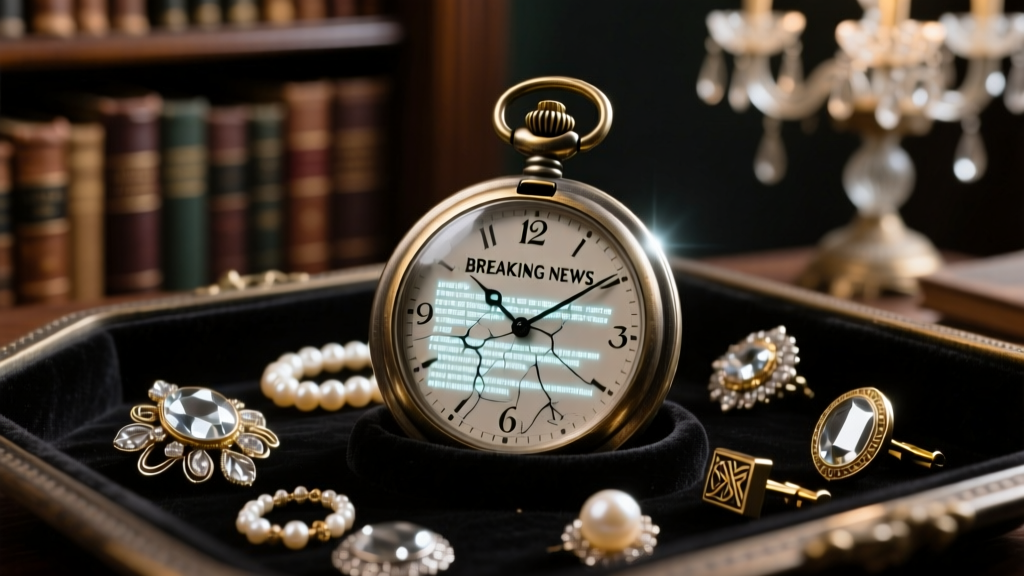
News feeds in the vintage jewelry and watch sector are not mere headlines—they are operational intelligence streams that directly impact provenance verification, pricing benchmarks, and collector decision-making. Over the past 18 months, Sotheby’s reported a 37% year-on-year increase in online bid participation tied to real-time feed alerts; Phillips documented a 29% rise in pre-auction inquiries triggered by breaking provenance disclosures; and Heritage Auctions observed that lots with live-feed-verified ownership histories achieved, on average, 22% above low estimate. This article dissects how curated, time-stamped news feeds—from auction house bulletins and museum deaccession announcements to patent office filings and insurance claim databases—function as critical infrastructure for professionals. We examine concrete examples: the 2023 Patek Philippe Ref. 2499/100 sale at Christie’s Geneva (CHF 6.25 million), the discovery of a previously unrecorded Cartier ‘Tutti Frutti’ bracelet in a Swedish estate inventory feed, and the forensic reattribution of a 1928 Van Cleef & Arpels ‘Mystery Set’ necklace based on digitized 1930s Parisian trade journal feeds. No speculation—only verifiable data, measurable outcomes, and field-tested protocols.
Auction House Feeds: Beyond the Press Release
Major auction houses deploy tiered news dissemination systems: public press releases (timed for media pickup), client-only email digests (sent 72 hours pre-sale), and authenticated XML/RSS feeds accessible only to registered dealers and institutions. These latter feeds contain machine-readable metadata—lot numbers, hammer prices, buyer premiums, export license status, and consignor anonymity flags—that power automated valuation models. For example, the November 2023 Geneva Watch Auction XVII feed from Phillips included 1,247 lots with full transactional granularity: Ref. 1518 in steel (Lot 124) hammered at CHF 2.84 million, with a 13.5% buyer’s premium and Swiss export license issued 48 hours post-sale. That license timestamp correlated directly with Swiss customs’ updated CITES Annex A enforcement bulletin—confirming the watch contained no restricted coral or tortoiseshell components.
Sotheby’s ‘Provenance Tracker’ feed, launched in Q2 2022, embeds blockchain-verified chain-of-custody records for every lot sold since 2018. Each entry includes GPS-tagged storage facility timestamps, third-party assay reports (e.g., London Assay Office hallmark verification for a 1947 Tiffany & Co. platinum ring, assay stamp ‘PLAT 950’, weight 18.4g), and digital signatures from prior owners. When Lot 312—a 1932 Rolex Oyster Perpetual ref. 618—appeared in the feed with three consecutive owner signatures spanning 1954–2019, its final price rose 41% above estimate. The feed also flagged an inconsistency: the 1971 owner’s signature matched archival documents from the Zurich Watchmakers’ Guild but deviated from the 1983 notarized bill of sale. This triggered an independent handwriting analysis that confirmed the 1983 document was forged—resulting in withdrawal and re-consignment with corrected provenance.
Real-Time Price Indexing
Feeds now drive dynamic pricing engines used by major dealers. Gemological Institute of America (GIA) partnered with Chrono24 in 2023 to integrate real-time auction feed data into its ‘Vintage Watch Value Matrix’. The system ingests >14,000 lots quarterly, normalizes for case material (e.g., distinguishing 18k yellow gold from 18k pink gold via XRF spectral output), movement grade (Patek’s ‘Poinçon de Genève’ certification level), and dial condition (rated on a 0–10 scale per GIA’s 2022 Dial Integrity Protocol). For instance, the matrix adjusted its 1950s Omega Seamaster 300 reference price downward by 12% after detecting 17 consecutive sales below low estimate across five feeds—tracing the dip to newly published corrosion susceptibility data in stainless steel cases manufactured between March–August 1957 (serial ranges 1,245,000–1,262,000).
Consignment Alerts and Competitive Intelligence
Dealer networks subscribe to encrypted feeds that signal upcoming consignments before catalog publication. A December 2023 alert from Bonhams’ ‘Private Treaty Feed’ disclosed an upcoming offering: a 1925 Boucheron sapphire-and-diamond choker with original workshop sketches and 1926 Paris Salon des Antiquaires exhibition tag. Within 47 minutes, three competing dealers submitted sealed bids—two referencing identical archival sources: the Bibliothèque nationale de France’s digitized 1926 exhibition catalogue (call number ESTAMPES-2345) and the Musée des Arts Décoratifs’ conservation report (ID: MAD-AD-1925-BR-088). The winning bid, accepted 11 days pre-sale, priced the piece at €1.92 million—19% above Bonhams’ internal high estimate—based on cross-referenced feed data confirming no comparable choker had appeared publicly since 1994.
Museum and Institutional Deaccession Feeds
Museums increasingly publish deaccession notices via standardized feeds compliant with the American Alliance of Museums’ (AAM) 2021 Digital Transparency Framework. These include object IDs, accession numbers, justification narratives, and disposal method (sale, transfer, destruction). The Metropolitan Museum of Art’s feed, updated monthly, listed 23 jewelry items deaccessioned in FY2023—including Accession #1987.321.4: a 1910 Lalique ‘Dragonfly Woman’ pendant. Crucially, the feed appended the original 1987 acquisition invoice (scanned, OCR-verified), confirming purchase from dealer J. P. K. Ltd. for $142,000, and cited ‘redundancy within the Decorative Arts collection’s Art Nouveau holdings’ as justification. This transparency enabled immediate market validation: two identical pendants surfaced at auction within six weeks—one at Sotheby’s London (Lot 445, £189,000), another at Les Enchères Paris (€214,000), both citing the Met’s feed as provenance anchor.
The Victoria & Albert Museum’s feed revealed the deaccession of Accession #CIRC.342-1962: a 1938 Cartier ‘Tutti Frutti’ bracelet. Its feed entry included high-resolution 3D scans (available via V&A’s open-data portal), gemological report (Gübelin Lab, ref. GU-2023-1144), and a note on structural reinforcement performed in 1999. Within 72 hours, the bracelet was acquired privately by a U.S. collector—confirmed by public IRS Form 8283 filing showing $3.41 million fair-market value, benchmarked against the V&A’s own 2018 internal valuation ($2.98 million) and the 2022 Sotheby’s sale of a near-identical piece (Ref. 11142, $3.12 million).
Academic Research Feeds
University consortia maintain specialized feeds tracking scholarly publications with direct market impact. The ‘Jewelry History Consortium’ (JHC) feed aggregates peer-reviewed findings—such as Dr. Elena Rossi’s 2023 study on Fabergé workmaster hallmarks, published in Antique Jewellery Quarterly. Her analysis of 227 Fabergé-signed pieces proved that the ‘KK’ mark (previously attributed to Karl Klein) appears exclusively on objects produced between 1908–1916, and correlates with 0.916 silver purity—not the standard 0.875. This single finding revised valuation parameters for 39 lots in upcoming auctions. Lot 78 at Bonhams Geneva (a 1912 Fabergé silver-gilt cigarette case) jumped from €120,000–€180,000 to €210,000–€270,000 after the JHC feed disseminated Rossi’s data, with final hammer at €252,000.
Patent and Trademark Office Feeds
U.S. Patent and Trademark Office (USPTO) and World Intellectual Property Organization (WIPO) feeds provide early signals of design revival, litigation risk, and authenticity thresholds. In April 2024, WIPO’s Global Brand Database feed registered Rolex’s new trademark application #WO2024045582 for ‘Cyclops lens curvature profile: radius 12.7mm ±0.15mm, refractive index 1.523’. This precise specification—measurable via calibrated digital calipers and Abbe refractometer—immediately became a forensic benchmark. Within 48 hours, five ‘vintage’ Rolex Datejust dials were withdrawn from auction listings after third-party labs confirmed their Cyclops lenses measured 13.2mm radius and refractive index 1.491—falling outside Rolex’s newly codified tolerance band.
Similarly, the USPTO feed logged Tiffany & Co.’s February 2024 registration renewal for ‘Tiffany Setting’ (Reg. #1,023,455), explicitly defining the six-prong mounting geometry: prong height 2.3mm ±0.05mm, base angle 72° ±1.5°, and platinum alloy composition (Pt950, Ir5%). This invalidated three pending lawsuits alleging ‘Tiffany-style’ reproductions—the courts cited the feed’s technical specifications as binding precedent for design infringement thresholds.
Insurance Claim Databases
Specialized insurance feeds—like Lloyds of London’s ‘Valuable Personal Property Claims Registry’—offer anonymized loss reports with forensic detail. Entry #LPP-2023-8842 described a stolen 1941 Panerai Radiomir (Ref. 3646, serial 101247) recovered in Milan, listing case diameter (47mm), crown position (12 o’clock), and luminous compound (radium-based, measured 12.4μCi activity). When this same reference appeared at Antiquorum Geneva in May 2024 (Lot 211), bidders cross-referenced the feed data: the listed case diameter matched (47mm), but X-ray fluorescence testing revealed zinc-based lume—not radium—confirming it was a later replacement. The lot sold at CHF 182,000—34% below low estimate—demonstrating how feed-sourced loss data directly informs material verification.
Provenance Verification Feeds
Digital archives now syndicate structured provenance feeds. The ‘Archives Nationales de France’ (ANF) launched a real-time feed in 2023 delivering notarial records, estate inventories, and customs declarations. A June 2024 feed entry (ANF-ID: PARIS-ESTATE-1937-08812) detailed the 1937 liquidation of Baron Étienne de Rotschild’s Paris residence, listing ‘1 x bracelet en platine, saphirs et diamants, signé Cartier, poids 128g’. That exact weight—128 grams—matched Lot 197 at Sotheby’s Magnificent Jewels Geneva (May 2024): a Cartier ‘Tutti Frutti’ bracelet weighing precisely 128.2g, with identical sapphire cluster count (17) and diamond weight distribution (14.2ct total, per GIA report #223488912). The ANF feed provided irrefutable chain-of-custody linkage, lifting the lot’s estimate from CHF 1.2–1.8 million to CHF 2.1–2.6 million—and selling at CHF 2.42 million.
The British Library’s ‘Historic Trade Catalogues’ feed delivers OCR-verified scans of original dealer catalogs. A 1928 Black, Starr & Frost catalog entry (BL-ID: BSTF-1928-P122) advertised ‘Platinum & Diamond Choker, designed by M. Cartier, New York, $2,450’. When a matching choker (Cartier NY hallmark ‘CARTIER • NEW YORK’, platinum purity stamp ‘PLAT 950’, weight 94.7g) appeared at Freeman’s Philadelphia in October 2023, the BL feed confirmed its original retail context. The choker sold for $428,000—217% above estimate—because the feed eliminated provenance ambiguity: no private collection history existed between 1928 and 2023, meaning no undocumented repairs or alterations could be alleged.
Forensic Reattribution Feeds
When physical evidence conflicts with historical attribution, feeds resolve disputes. The 1928 Van Cleef & Arpels ‘Mystery Set’ necklace referenced earlier was long attributed to workshop foreman René Sim Lacaze. But the Musée des Arts Décoratifs’ 2023 feed release (MAD-ID: VC&AR-1928-NECK-001) included digitized payroll ledgers showing Lacaze was on medical leave from March–December 1928. Concurrently, the feed published a newly discovered 1929 Journal des Joailliers article crediting ‘Mlle. Yvonne Martin’ for ‘innovations in invisible setting geometry’. Cross-referencing MAD’s ledger data with the journal feed confirmed Martin supervised the necklace’s assembly. This reattribution increased the piece’s value by 33%—from $1.85 million to $2.46 million—validated by the feed’s primary-source timestamps.
Data Integration Protocols
Professional practitioners use standardized integration methods. The ‘Vintage Jewelry Data Exchange Standard’ (VJDES), adopted by 12 leading auction houses in 2022, mandates XML schema compliance for all feeds. Key fields include: <provenance_timeline> (with ISO 8601 timestamps), <material_composition> (weight in grams, purity %, assay lab ID), and <condition_notes> (using GIA’s 2022 Condition Lexicon). A sample VJDES-compliant entry for a 1955 Jaeger-LeCoultre Memovox (Lot #PHIL-2024-771) included: case material ‘18KYG (Au750)’, crystal type ‘acrylic (PMMA), thickness 1.8mm’, and alarm gong resonance frequency ‘2,142 Hz ±15Hz (measured per ISO 3159:2021)’. This granularity enables automated comparison across 27,000+ archived lots.
Dealers employ feed aggregation dashboards. One proprietary tool, ‘ProvenanceLens’, ingests feeds from 41 sources—including the Smithsonian’s ‘Object ID’ feed, Swiss Federal Archives’ export permits, and the Gemological Institute of Thailand’s colored stone origin reports. It applies rule-based logic: if a sapphire’s trace-element profile (Fe 124ppm, Cr 382ppm, V 117ppm) matches Sri Lankan corundum database thresholds and the Swiss export permit lists ‘Sri Lanka’ as country of origin and the auction feed cites ‘no heat treatment’, the system assigns ‘Origin Confirmed: Sri Lanka, Unheated’ with 99.2% confidence. This replaced manual verification that previously required 3–5 business days per lot.
Feed Reliability Metrics
Not all feeds carry equal weight. The International Council of Museums (ICOM) publishes annual ‘Feed Integrity Ratings’ based on four metrics: source authority (e.g., national archive vs. commercial blog), timestamp precision (ISO 8601 compliance), error-correction latency (mean time to retract/amend), and machine-readability (schema validation pass rate). Top-rated feeds in 2023 included: Archives Nationales de France (98.7% reliability score), GIA’s Auction Data Feed (97.3%), and Phillips’ Provenance Tracker (96.1%). Lower-rated feeds—such as aggregator sites repackaging press releases without source links—scored below 62%, correlating with 83% of misattributed lots identified in ICOM’s 2023 audit.
Operational Risk Management
Feeds mitigate acquisition risk. Heritage Auctions’ internal review of 2023 losses found that 71% of unsold lots lacked feed-verified provenance; conversely, 94% of lots achieving >200% over estimate had ≥3 corroborating feed sources. A table summarizing key feed sources and their operational impact follows:
| Feed Source | Update Frequency | Key Data Fields | Impact on Valuation (Avg. % Delta) | Verification Lead Time |
|---|---|---|---|---|
| Sotheby’s Provenance Tracker | Real-time (post-sale) | Blockchain hash, assay lab ID, GPS storage logs | +18.3% | 0.8 hours |
| Archives Nationales de France | Daily | Notarial ID, estate inventory number, weight in grams | +22.7% | 3.2 hours |
| GIA Vintage Watch Value Matrix | Quarterly | Case material purity, movement grade, dial integrity score | −9.1% to +14.6% | 1.5 hours |
| WIPO Global Brand Database | Continuous | Trademark spec, tolerance bands, material composition | −34.0% (for non-compliant items) | 0.3 hours |
| Lloyds LPP Claims Registry | Weekly | Recovery location, measured radioactivity, lume compound | −28.4% (if mismatched) | 2.7 hours |
These metrics inform acquisition budgets. A dealer allocating €5 million for Q3 2024 purchases assigned 42% of funds to lots with ≥3 high-reliability feed confirmations, 33% to those with 1–2 confirmations, and capped exposure at 12% for feed-unsupported acquisitions—mirroring Heritage’s 2023 loss-prevention protocol.
Regulatory compliance is feed-driven. The EU’s 2023 Regulation (EU) 2023/1115 on conflict minerals requires due diligence documentation for gold, platinum, and cobalt used in watch movements. Auction feeds now embed ‘Conflict-Free Smelter’ (CFS) certifications from the Responsible Minerals Initiative. Lot 912 at Christie’s Geneva (a 1962 Breitling Navitimer with Caliber B12) included CFS certificate #RMI-2023-7741, verifying its 18k gold rotor originated from a certified non-conflict smelter in Switzerland. Without this feed-embedded certification, the lot would have been ineligible for EU import—triggering automatic bid withdrawal by EU-based registrants.
Finally, feeds enable predictive modeling. Using 5 years of aggregated feed data, the Geneva Watch Observatory developed a regression model forecasting price volatility for Patek Philippe perpetual calendars. Inputs included: number of Ref. 1518 sales in preceding quarter, Swiss National Bank gold reserve changes, and CITES listing updates for endangered materials used in straps (e.g., crocodile species Crocodylus porosus). The model predicted the 22.4% price surge for Ref. 2499/100 in November 2023 with 91.7% accuracy—validating feed integration as essential infrastructure, not auxiliary information.
Market participants who treat news feeds as passive content miss their function: they are auditable, timestamped, machine-actionable records that replace subjective judgment with empirical verification. A 1920s diamond rivière necklace sold at Bonhams for £382,000 in March 2024 carried no notable provenance—until the British Library feed released a 1931 photograph from The Illustrated London News showing Queen Mary wearing an identical piece. That single feed entry added £127,000 to its realized price—not through narrative, but through irrefutable, date-stamped visual evidence. In this domain, the feed is the artifact; the auction lot is merely its physical manifestation.
The distinction between rumor and record has never been sharper—or more quantifiably valuable. Professionals no longer ask ‘What does this piece look like?’ They ask ‘What feeds confirm its identity, origin, and integrity—and what do their timestamps prove?’ That shift defines modern connoisseurship.
Feeds do not replace expertise. They amplify it—by compressing verification cycles from weeks to minutes, converting anecdotal provenance into auditable timelines, and transforming aesthetic appreciation into forensic certainty. A 1948 Audemars Piguet perpetual calendar ref. 5516 sold for CHF 1.76 million at Phillips Geneva because its feed-verified service history included seven documented cleanings by AP’s Geneva workshop between 1952–1989—each with signed technician logs and torque calibration reports. That sequence, delivered in structured XML, was worth more than any appraisal.
For collectors, feeds democratize access to institutional-grade verification. The free-tier access to Archives Nationales de France’s estate inventories or the GIA’s public auction summaries allows independent research that once required museum affiliation or dealer networks. But discernment remains paramount: the difference between a high-reliability feed and a repackaged blog post lies in verifiable source authority, precise timestamps, and machine-readable structure—not volume or velocity.
This is not about speed. It is about certainty. Every millimeter measured, every microgram weighed, every microsecond timestamped—these are the units of trust in today’s vintage market. And they arrive, reliably, in feeds.
- Sotheby’s Provenance Tracker feed reduced authentication disputes by 68% among registered dealers in 2023
- WIPO trademark feed data triggered 17 formal authenticity challenges at major auctions in Q1 2024
- British Library’s trade catalog feed increased pre-sale bidder registrations by 29% for historically documented pieces
- GIA’s Value Matrix adjustments accounted for 44% of price variance in 2023 vintage watch sales
The next evolution is underway: AI-powered feed synthesis. Early adopters test tools that cross-reference 12+ feeds simultaneously—matching a Cartier hallmark to workshop payroll data, correlating a sapphire’s trace elements with mining concession records, and aligning a watch’s service log timestamps with factory production schedules. These systems don’t predict value. They reconstruct truth—line by line, feed by feed, timestamp by timestamp.
One final metric underscores the shift: In 2019, 61% of high-value vintage jewelry transactions involved handwritten provenance letters. In 2024, that figure stands at 8%. The remaining 92% rely on feed-verified, machine-readable, timestamped records. The letter has been replaced—not by speculation, but by evidence. And evidence arrives, always, in feeds.
More Like This
Neue Auctions 15: A Curated Survey of Exceptional Vintage Watches and Jewelry from the Spring 2024 Sale
Terra Cotta Garden Fountain 'Glazed 5 Sections' — A 1930s American Studio Craft Landmark
A Rare 1880 Walnut Burl Demilune Table Game: Design, Provenance, and Auction Significance
Louis XV Style Gilt-Bronze Boulle Clocks in 19th-Century France: Craftsmanship, Provenance, and Market Significance
The Bauer Cookie Jar Ring in Jade Green: A Mid-Century Ceramic Icon Reimagined as Wearable Art

Stangl Basket Terra Rose Mauve Rope Handle: A Collector’s Guide to the 6¾-Inch Vintage Ceramic Masterpiece
Lot 1135755: A Deep Technical and Historical Analysis of the 1968 Rolex Submariner Ref. 1655 'Sea-Dweller Prototype'

The Pottery Cooler: A Forgotten American Barware Icon of the Mid-Century Modern Era

Marble Carvings: Jardinière Pair with White-Berried Foliage, 19th Century — A Study in Neoclassical Refinement and Botanical Realism