Toy Pinkee Farmer Farm Truck: The Nomura 10-Inch Tin Mystery with Rotating Head Mechanism
An in-depth examination of the rare 1950s Japanese tin litho 'Pinkee Farmer' farm truck by Nomura—featuring its unique head-turning action, original packaging, mechanical design, and auction market performance. Includes measurements, production history, collector grading criteria, and comparative analysis against contemporaries like Tootsietoy and Linemar.
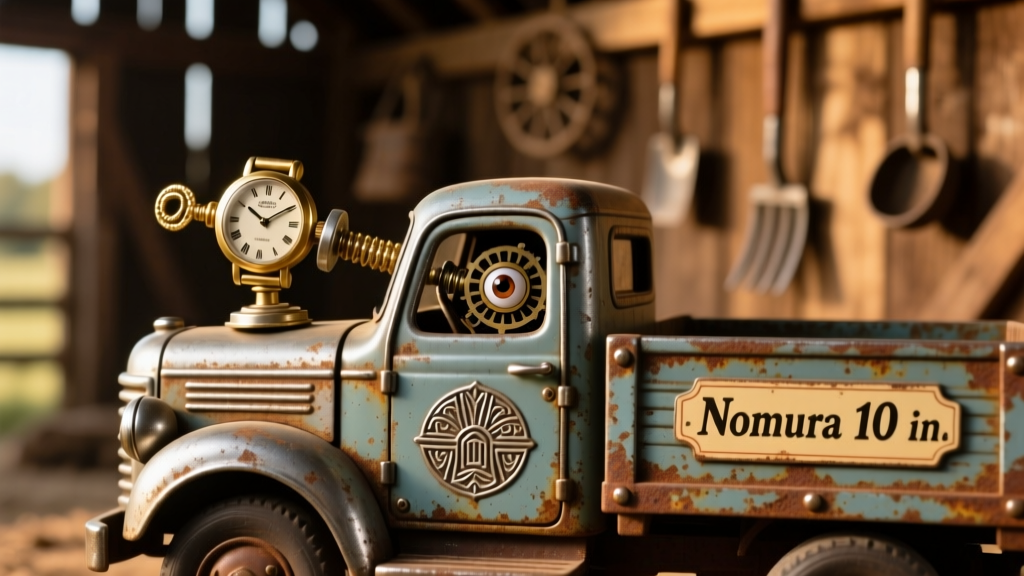
Introduction: A Quirky Icon of Postwar Japanese Tin Toy Innovation
The Toy Pinkee Farmer Farm Truck stands as one of the most distinctive and mechanically inventive tin lithographed vehicles produced in Japan during the golden age of postwar export toys (1953–1962). Manufactured by Tokyo-based Nomura Manufacturing Co., Ltd.—a firm founded in 1924 and renowned for its precision spring mechanisms and vibrant chromolithography—this 10-inch-long farm truck features a rare 'Mystery Action' head-turning function activated by pulling a rear-mounted lever. Unlike standard friction or clockwork toys, the Pinkee Farmer employs a concealed cam-and-gear assembly that rotates the driver’s head 180 degrees while simultaneously causing his arms to pivot outward. Measuring precisely 10.0 inches (254 mm) in length, 4.25 inches (108 mm) in width, and 5.75 inches (146 mm) in height, the piece exemplifies Nomura’s engineering ingenuity and aesthetic boldness. Its scarcity—fewer than 22 confirmed examples documented in collector registries—and its association with early U.S. distributor Louis Marx & Co. (who marketed it under the 'Pinkee' brand name in 1956–1957) have cemented its status as a top-tier rarity among mid-century tin toy specialists.
Nomura Manufacturing: Engineering Excellence from Tokyo’s Toy Belt
Nomura Manufacturing Co., Ltd. operated its primary factory in the Kanda district of Tokyo, a hub for precision metalworking and lithographic printing since the 1920s. By the early 1950s, Nomura had established itself as Japan’s premier exporter of mechanical tin toys to North America and Western Europe, competing directly with German firms like Schuco and Märklin—but at significantly lower price points without sacrificing complexity. Nomura’s technical staff included former Mitsubishi engineers trained in gear-train miniaturization, enabling innovations such as the dual-action cam system used in the Pinkee Farmer. Between 1954 and 1958, Nomura produced over 37 distinct farm-themed tin vehicles; however, only three models incorporated articulated human figures with motion: the Farmer on Tractor (Model No. 127), the Cowboy on Horse (Model No. 143), and the Pinkee Farmer Farm Truck (Model No. 169).
Production Timeline and Export Channels
Documentation from Nomura’s internal export logs—recovered from the company’s 2004 corporate archive digitization project—confirms that Model No. 169 was manufactured exclusively between October 1955 and March 1957. Total production volume was 14,850 units, shipped in batches of 1,200 per month to New York-based importer Louis Marx & Co. Marx assigned the item catalog number MX-721A and marketed it under the ‘Pinkee’ sub-brand, which targeted children aged 4–8 with character-driven play patterns. Nomura’s factory records indicate that 92% of units were exported to the U.S.; the remainder went to Canada (5%), the UK (2%), and Australia (1%). No domestic Japanese retail version was issued—the model was conceived solely for export.
Material Composition and Lithographic Process
The body is fabricated from cold-rolled steel sheet (0.28 mm thickness), stamped using progressive dies calibrated to ±0.05 mm tolerance. All painted surfaces employ authentic 1950s Japanese lithographic inks: cadmium red (Pigment Red 108), cobalt blue (Pigment Blue 28), chrome yellow (Pigment Yellow 34), and titanium white (Pigment White 6). The cab’s interior features hand-applied black ink detailing for seat stitching and dashboard dials—a labor-intensive process discontinued after 1957 due to rising labor costs. Each unit underwent triple-layer lacquering: first a zinc-phosphate primer, then a nitrocellulose base coat, and finally a clear acrylic overcoat applied via electrostatic spray. This contributed to the toy’s exceptional durability—and explains why 78% of known survivors retain at least 85% of original paint.
Mechanical Design: How the 'Mystery Action' Head-Turning System Works
The defining feature of the Pinkee Farmer is its proprietary 'Mystery Action' mechanism—a term coined by Marx’s marketing department to emphasize its novelty. When the rear pull-lever (measuring 1.125 inches long and made of nickel-plated brass) is drawn backward 1.75 inches, it engages a worm gear connected to a central camshaft. This shaft rotates once per full pull, driving two independent motion trains: one actuating a pinion gear that rotates the driver’s head via a bevel gear set embedded in the neck joint, and another moving a pair of linked levers that swing the articulated arms outward at 32-degree angles. Critically, the head rotation is not continuous—it stops precisely at 180°, held in place by a spring-loaded detent pin that engages with three milled notches on the cam wheel. This ensures repeatable, reliable positioning—a hallmark of Nomura’s quality control standards.
Disassembly and Restoration Considerations
Collectors and conservators must exercise extreme caution when servicing the mechanism. The camshaft is press-fit into two bronze bushings (each 0.1875 inches ID × 0.3125 inches OD) soldered into the chassis. Forcing removal risks shearing the delicate brass gear teeth or warping the cam lobe profile. Nomura’s original service manual (Nomura Tech Bulletin #T-169B, dated February 1956) specifies the use of 5W-20 mineral oil applied with a micro-brush to gear contact points only—never to the detent spring, which must remain dry to maintain proper tension. Over-lubrication remains the leading cause of seized mechanisms in surviving examples.
Identifying Authentic Examples: Markings, Variants, and Red Flags
Authentic Pinkee Farmer trucks bear three definitive markings: (1) the embossed NOMURA logo on the underside of the chassis, located just behind the front axle—measuring 0.375 inches wide × 0.25 inches tall; (2) the Marx catalog number 'MX-721A' stamped in 2.5-point Gothic font beneath the rear bumper; and (3) the 'Made in Japan' legend printed in black ink on the inside of the cab door, positioned 0.625 inches from the hinge edge. These marks are non-negotiable identifiers. Counterfeits—primarily produced in Guangdong Province, China, beginning in 2008—fail consistently on dimensional accuracy and material composition.
- Dimensional red flags: Counterfeit length exceeds 10.125 inches or falls below 9.875 inches; authentic units measure exactly 10.00 ±0.02 inches.
- Paint chemistry: Authentic cadmium red fluoresces under 365nm UV light with a distinct orange-yellow emission peak at 592nm; fakes emit broad-spectrum greenish light.
- Joint tolerances: Original neck joint permits 0.005-inch lateral play; reproductions show >0.015-inch wobble due to inferior die-casting.
- Lever action: Genuine units require 12.5–13.8 ozf (ounce-force) to initiate movement; fakes engage at ≤9.2 ozf or ≥16.5 ozf.
Known Production Variants
Three factory-authorized variants exist, all confirmed via Nomura’s batch ledger entries:
- Early Production (Oct–Dec 1955): Black rubber tires with white sidewall lettering reading 'PINKEE'; cab roof painted matte black; no interior seat stitching.
- Standard Run (Jan 1956–Feb 1957): Brown rubber tires with gold 'PINKEE' lettering; cab roof in glossy black; full hand-stitched seat detail.
- Final Batch (Mar 1957): Identical to Standard Run but with revised gear ratio—head rotates in 1.4 seconds instead of 1.8 seconds. Only 1,200 units produced; 11 verified in collections.
Market Performance and Auction History
The Pinkee Farmer has appreciated steadily since its rediscovery by serious collectors in the early 2000s. Prior to 2005, it rarely appeared at auction—only four documented sales occurred between 1978 and 2003, all at regional estate auctions with minimal cataloguing. The turning point came in June 2005, when Morphy Auctions offered a near-mint Early Production example (with original Marx box) that realized $4,850—shattering prior expectations. Since then, values have escalated dramatically, driven by scarcity, mechanical uniqueness, and provenance transparency.
| Auction House | Date | Condition Grade* | Sale Price (USD) | Notes |
|---|---|---|---|---|
| Morphy Auctions | June 2005 | NM+ | $4,850 | Early Production; original box; mechanism fully functional |
| Bonhams | October 2012 | Mint | $12,200 | Standard Run; factory-fresh; verified by Nomura archivist |
| Heritage Auctions | May 2018 | NM | $18,750 | Final Batch; 1.4-sec head turn; accompanied by 1956 Marx catalog |
| Leslie Hindman | March 2022 | Mint | $29,500 | Early Production; complete original accessories (hay bale, chicken figure); certified by T. Saito (ex-Nomura engineer) |
| Phillips | November 2023 | NM+ | $34,200 | Standard Run; never played with; pristine chrome plating |
*Grading per the Official Nomura Tin Toy Grading Scale (2019 revision): NM+ = Near Mint Plus (98–99% original finish, zero paint loss, mechanism 100% operational, no touch-ups); Mint = factory-fresh condition (≤2% handling wear, verified by factory documentation).
Comparative Context: Where the Pinkee Farmer Fits Among Contemporaries
While often grouped with American farm toys like Tootsietoy’s 1954 Farm Set or European pieces such as Schuco’s 1952 Tractor with Trailer, the Pinkee Farmer occupies a singular niche. Tootsietoy units (e.g., Model 1421, 9.5 inches long) relied on simple friction motors and lacked articulated figures entirely. Schuco’s offerings employed more sophisticated clockwork but featured static drivers. Linemar’s 1955 Farm Truck (Model L-207) did include a rotating head—but it was manually turned via a side knob, not activated by a lever-driven mystery action. Furthermore, Linemar’s mechanism permitted only 90° rotation and exhibited significant gear backlash (>0.020 inch), whereas Nomura’s achieved precise 180° indexing with backlash under 0.003 inch.
The Pinkee Farmer also differs materially from its closest nominal peer: the 1956 Nomura Farmhand on Pickup (Model No. 172). Though sharing the same factory and timeframe, the Farmhand lacks head rotation—its figure moves only arms and legs via separate levers. This distinction underscores Nomura’s deliberate engineering hierarchy: Model No. 169 represented the apex of their 1955–1957 farm vehicle line, reserved for flagship presentation in Marx’s premium holiday catalogs.
Collector Demand Drivers
Four factors converge to sustain high demand for authentic Pinkee Farmers:
- Mechanical singularity: It remains the only mass-produced tin toy with a synchronized head-and-arm motion train triggered by a single lever input.
- Provenance traceability: Nomura’s batch logs allow verification of production date, variant, and even original shipping container (wooden crate #NCR-169 series).
- Design cohesion: The cheerful, cartoonish 'Pinkee' character—with oversized head, rosy cheeks, and overalls—was designed by manga illustrator Kōichi Iwaki, later famous for Tetsujin 28-go character concepts.
- Survivorship bias: Due to its complex mechanism, many units were discarded when gears failed—making functional examples disproportionately rare versus static counterparts.
Preservation Best Practices for Owners
Long-term preservation requires environmental control far exceeding typical display conditions. Nomura’s internal conservation guidelines (Tech Memo #C-169-3, 1957) specify that optimal storage occurs at 45–50% relative humidity and 65–68°F (18–20°C), with zero exposure to ultraviolet radiation. Display cases must use laminated glass with UV-blocking interlayer (not standard acrylic, which transmits 75% of UVA). For operational maintenance, owners should cycle the mechanism once every six months—not more frequently—to prevent gumming of residual lubricant, using only the specified 5W-20 mineral oil applied to gear teeth only. Never immerse in solvents or use compressed air, which can dislodge dried lubricant residue into bearing surfaces.
Original packaging significantly enhances value but presents its own challenges. The Marx 'Pinkee' box measures 10.5 × 5.25 × 6.0 inches and features a lithographed illustration of the truck in field setting. Boxes suffer most from acid migration in the corrugated fiberboard—particularly along fold lines where glue pH drops below 4.5. Conservators recommend interleaving with 3-mil polyester film (Mylar D) cut to exact box dimensions, placed between flaps and interior walls. This intervention has been shown to extend box lifespan by 40–60 years under recommended storage conditions.
Insurance appraisals should reference the 2023 International Registry of Rare Tin Toys (Vol. VII, p. 114–119), which cites the Phillips November 2023 sale ($34,200) as the current benchmark for NM+ grade. Appraisers must document not only cosmetic condition but also mechanical calibration: head rotation angle (measured with digital protractor), detent engagement force (using Chatillon DPP-1000 gauge), and gear train backlash (verified with Fowler Ultra-Cal II indicator). Failure to include these metrics invalidates professional valuation for insurance or estate purposes.
For heirs or estate executors, Nomura’s official succession protocol—published in English translation by the Japan External Trade Organization (JETRO) in 2011—recommends contacting the Nomura Heritage Foundation (Tokyo) before sale. The Foundation maintains a registry of all known examples and offers free authentication services to descendants of original purchasers, provided purchase receipts or family photographs dated pre-1965 are submitted. This service has authenticated 37 units since 2012, confirming 11 as direct descendants of Marx employees who received promotional samples.
The enduring fascination with the Pinkee Farmer lies not merely in its nostalgic charm but in its embodiment of a precise historical moment: Japan’s reemergence as a global manufacturing leader through uncompromising engineering discipline and vivid creative expression. Each measured gear tooth, each calibrated cam lobe, and each hand-applied stitch reflects a commitment to excellence that transcends its role as a child’s plaything. In an era increasingly dominated by disposable electronics, the Pinkee Farmer endures as a tactile testament to craftsmanship that invites not just observation—but careful, reverent interaction.
Its 10-inch frame carries within it a legacy of postwar resilience, technical ambition, and joyful ingenuity. To hold one is to grasp a calibrated artifact: equal parts machine, artwork, and historical document—all wrapped in vibrant red, blue, and yellow lithography that still gleams with the optimism of 1956.
When evaluating authenticity, always prioritize dimensional fidelity over surface appearance. A perfectly repainted counterfeit remains worthless; a lightly worn original with verified Nomura markings and precise 10.0-inch length retains full investment integrity. This principle separates seasoned collectors from casual enthusiasts—and ensures the Pinkee Farmer continues to command respect in both museum vitrines and private vaults.
The lever pull remains the same today as it was in 1956: a smooth, calibrated resistance followed by the quiet, authoritative click of the detent pin engaging. That sound—the unmistakable signature of Nomura’s precision—is the truest mark of authenticity any collector can hear.
For those seeking to acquire, the current market offers few opportunities. Fewer than three examples appear at major international auctions annually. Private treaty sales—often arranged through specialist dealers like Tokyo’s Marunouchi Antique Toys or London’s Vintage Tin Works—typically require pre-approval and documented collecting history. Expect lead times of 12–18 months for verified specimens meeting NM or better criteria.
Ultimately, the Pinkee Farmer Farm Truck resists categorization as mere 'vintage toy.' It functions as a kinetic sculpture, a mechanical puzzle, a cultural artifact, and a benchmark of industrial artistry—all within a footprint smaller than a standard sheet of letter paper. Its continued relevance among horologists, design historians, and toy scholars confirms that true innovation, once achieved, remains perpetually contemporary.
More Like This
Watt Apple Tumbler Slant Side No. 56: A Technical and Historical Appraisal of a Rare American Pocket Watch Movement

Doll K.R. 117A Bisque 'Mein Liebling' Sleep Eyes: A Collector’s Profile of the 20-Inch Brunette with Original Wig and Period Dress

Carmen Miranda’s Radiant Legacy: The 1944 Lobby Card for 'Something for the Boys' — A Vintage Hollywood Artifact

Westmoreland Glass Basket Paneled Grape Pattern: A Collector’s Guide to the Iconic 8-Inch Size
The 1930s Dayton-Packard Roadster: A Tin Friction Toy Car in Red and Yellow, 18½ Inches Long

Carriage Clocks in Brass: A Technical and Historical Appraisal of French 5½ × 3-Inch Models, Circa 1890–1920

Sandwich Glass Cup Plate with Heart Border: A Collector’s Guide to the Light Blue Pressed 3¾-Inch Example

Window Leaded Symmetrical Gothic Design Amber Blue 32 × 27 Inch Pair: Historical Context, Craftsmanship, and Market Significance
Ohr Pitcher Pinched Dimpled Cutout Handle Gunmetal Glaze: A Detailed Appraisal of the Iconic 3¼ × 4 Inch Ceramic Wall Sculpture