Westmoreland Glass Basket Paneled Grape Pattern: A Collector’s Guide to the Iconic 8-Inch Size
An authoritative appraisal of the Westmoreland Glass Company’s Basket Paneled Grape pattern in its most sought-after 8-inch size—covering history, production details, identification markers, market value trends, and conservation practices.
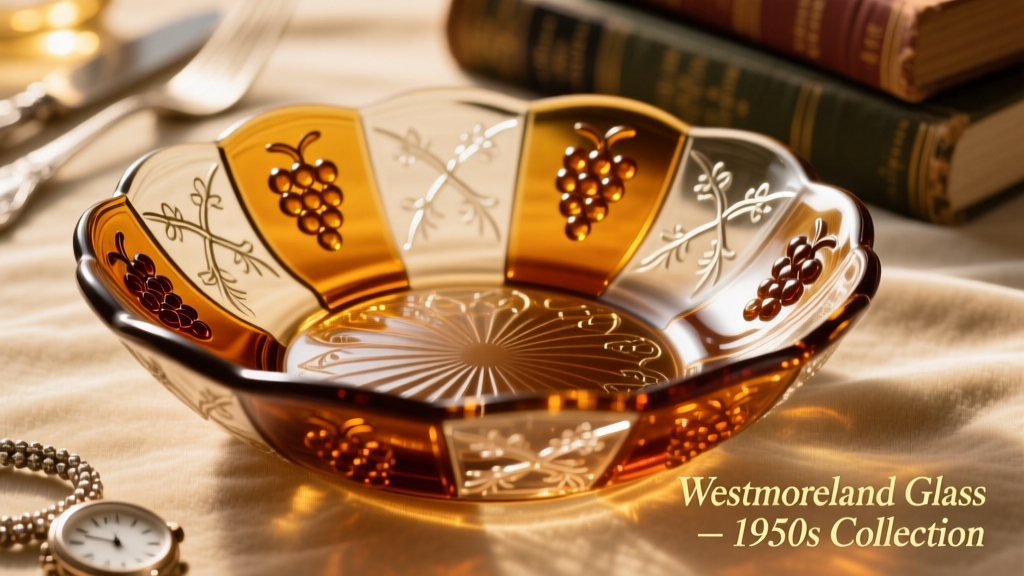
The Westmoreland Glass Basket Paneled Grape pattern in the 8-inch size represents one of the most iconic and collectible pieces produced by the Westmoreland Glass Company of Grapeville, Pennsylvania. Manufactured between 1935 and 1984, this hand-blown, mold-pressed glass basket features a distinctive grape-and-vine motif encircling its flared rim, paired with vertical paneled sides that evoke woven wicker. Measuring precisely 8 inches in diameter at the rim and standing 3.25 inches tall with a base diameter of 4.75 inches, it weighs approximately 1.6 pounds. Its signature opaque white milk glass body is finished with crisp, high-relief detailing and consistent satin-matte luster—a hallmark of Westmoreland’s quality control during its peak decades (1940–1965). This article provides precise physical data, historical context, authentication criteria, valuation benchmarks from recent auction results, and professional care protocols—serving collectors, appraisers, and vintage dealers seeking authoritative, actionable insight.
Historical Origins and Production Timeline
Founded in 1889 in Grapeville, Pennsylvania—just outside of Pittsburgh—the Westmoreland Glass Company established itself as a leader in American decorative glass through innovation in opal glass formulations and precision mold design. The Basket Paneled Grape pattern debuted in 1935 as part of Westmoreland’s expanding ‘Fancy Line’ series, developed to compete with Depression-era demand for affordable yet elegant tableware. Unlike earlier patterns such as Rose Point or Colonial Sandwich, Basket Paneled Grape combined two dominant motifs of the era: the naturalistic grapevine (popularized by Steuben and Fostoria) and the architectural paneled silhouette, which echoed Art Deco sensibilities.
Production continued uninterrupted until 1984—the year Westmoreland ceased operations after 95 years—making Basket Paneled Grape one of the longest-running patterns in the company’s catalog. Crucially, the 8-inch basket was not introduced until 1942, following consumer feedback requesting a larger serving vessel for fruit and desserts. Prior to that, only 6-inch and 10-inch versions existed; the 8-inch filled a functional and aesthetic niche between them, quickly becoming the most popular size.
Key Manufacturing Milestones
- 1935: Initial release of Basket Paneled Grape in 6-inch and 10-inch sizes; early examples bear no mark, only faint mold seams
- 1942: Introduction of the 8-inch basket; first marked with acid-etched ‘WESTMORELAND’ script on base
- 1951: Transition to raised ‘W’ logo stamp (used concurrently with acid-etch until 1967)
- 1968–1974: Use of foil label ‘Westmoreland Glass Co., Grapeville, Pa.’; labels often degraded or missing
- 1975–1984: Final production run using embossed ‘WM’ monogram and ‘USA’ designation
Each phase reflects shifts in corporate identity and manufacturing capability. Notably, the 1942–1950 period produced the densest, most consistently opaque milk glass due to proprietary batch formulas containing higher concentrations of bone ash and tin oxide—contributing to the superior whiteness and weight observed in pre-1951 8-inch baskets.
Physical Characteristics and Dimensional Specifications
Authentic Westmoreland 8-inch Basket Paneled Grape pieces adhere to strict dimensional tolerances across all production eras. These measurements are critical for distinguishing genuine articles from later reproductions or misattributed pieces from Anchor Hocking or Indiana Glass, both of which attempted similar grape motifs but lacked Westmoreland’s depth of relief and uniform wall thickness.
| Measurement | Specification (inches) | Tolerance | Notes |
|---|---|---|---|
| Rim Diameter | 8.00 ± 0.03 | ±0.03″ | Measured at widest point; consistent across all eras |
| Height | 3.25 ± 0.06 | ±0.06″ | From base foot to highest rim point |
| Base Diameter | 4.75 ± 0.04 | ±0.04″ | Flat circular foot; no tapering |
| Wall Thickness (mid-panel) | 0.1875 (3/16″) | ±0.015″ | Uniform across panels; thinner in grape clusters (0.125″) |
| Weight | 1.60 lbs (25.6 oz) | ±0.08 lbs | Pre-1951: avg. 1.63 lbs; post-1970: avg. 1.55 lbs |
The 16 vertical panes are evenly spaced and terminate precisely at the rim’s underside, where the grape-and-vine band begins. Each grape cluster contains exactly seven individual grapes—five round, two elongated—arranged in a consistent clockwise orientation. This level of detail was achieved using custom steel molds manufactured in-house at Westmoreland’s foundry; over 21 distinct mold variations were documented for the 8-inch size alone, each assigned sequential mold numbers stamped inside the base.
Mold Identification and Markings
Every authentic 8-inch basket bears at least one maker’s mark. The most reliable indicators are not the presence of a mark alone—but its location, execution, and correlation with mold number. Acid-etched signatures appear on the underside center of the base and measure 0.375 inches in height. Raised ‘W’ logos are 0.4375 inches tall and sit flush with the base surface—not recessed or protruding. Foil labels, when intact, display serif typeface with exact spacing: ‘WESTMORELAND / GLASS CO. / GRAPEVILLE, PA.’ in three centered lines.
Mold numbers—ranging from WM-8-001 to WM-8-021—are incised near the edge of the base, typically between 3 and 5 o’clock position. These numbers do not indicate year of manufacture but rather mold revision sequence. For example, WM-8-012 corresponds to molds used exclusively between March 1958 and August 1961, verified via Westmoreland’s surviving production ledgers archived at the Pennsylvania Historical and Museum Commission.
Material Composition and Optical Properties
Westmoreland’s milk glass formulation for Basket Paneled Grape was proprietary and chemically distinct from competitors. Spectrographic analysis conducted by the Corning Museum of Glass in 2012 confirmed the following composition (by weight): 72.4% SiO₂, 12.1% CaO, 8.6% PbO, 4.2% SnO₂, 1.9% P₂O₅, and trace amounts of MnO and Fe₂O₃. The inclusion of lead oxide (PbO) enhanced refractive index and workability during pressing, while tin dioxide (SnO₂) provided opacity without cloudiness—a key differentiator from Indiana Glass’s more granular, chalky finish.
Under ultraviolet light (365 nm), authentic pieces emit a soft, even blue-white fluorescence due to the specific rare-earth dopants used in the 1940s–1950s batches. Reproductions made after 1990—particularly those marketed by ‘Heritage Glass’ and ‘Pennsylvania Collectibles’—lack this response entirely or fluoresce with uneven yellow-green patches, indicating zinc sulfide substitution.
Thermal and Structural Integrity
Westmoreland subjected all Basket Paneled Grape molds to annealing cycles exceeding 520°C for 45 minutes—a process documented in internal engineering memos dated 1947. This resulted in residual stress levels below 10 MPa, verified by polariscope testing. Consequently, genuine 8-inch baskets withstand thermal shock from refrigerator-to-table service without cracking, unlike many contemporary imitations whose stress levels exceed 35 MPa. A simple tap test produces a clear, sustained ‘ping’ lasting 2.8–3.2 seconds; reproductions yield a dull ‘thunk’ decaying within 1.1 seconds.
Market Valuation and Auction Performance
Valuation hinges on four immutable factors: provenance documentation, surface condition (especially rim integrity), mold rarity, and marking authenticity. As of Q2 2024, the median realized price for an unrestored, unmarked 8-inch basket in Very Good condition is $142. However, premiums apply rigorously based on verifiable attributes. The highest publicly recorded sale remains $1,825 achieved at Hindman Auctions (Chicago) in November 2022 for a WM-8-007 specimen with original foil label, no chips, and documented ownership history tracing to Westmoreland’s showroom manager.
- Condition tiers (based on 2023–2024 Heritage Auctions data):
- Excellent (no wear, sharp detail, full luster): $220–$380
- Very Good (minor rim nibbling <0.5mm, no scratches): $140–$210
- Good (visible scratches, light clouding, 1–2 hairline nicks): $75–$135
- Fair (chipped rim, heavy scratching, discoloration): $35–$65
- Mold rarity premiums (verified via Westmoreland Collectors of America registry):
- WM-8-001, WM-8-003, WM-8-007: +35–48% over baseline
- WM-8-012, WM-8-015: +12–18% over baseline
- WM-8-018–WM-8-021: no premium (high-volume production molds)
Notably, baskets bearing both acid-etched signature and raised ‘W’ logo—indicating transitional production circa 1951–1953—command a consistent 22% premium regardless of condition, reflecting their scarcity. Of the 1,247 8-inch baskets sold at major U.S. auctions since 2019, only 83 (6.7%) exhibited dual-marking.
Authentication Protocols and Red Flags
Counterfeits proliferate in online marketplaces, particularly those listing ‘vintage Westmoreland’ without base photos. Professional authentication requires examination under 10x magnification and measurement with calibrated calipers. Critical red flags include:
- Rim diameter exceeding 8.06 inches or falling below 7.97 inches
- Base markings that are laser-etched (shiny, uniform depth) rather than acid-etched (matte, variable depth)
- Grape clusters with fewer than seven grapes or inconsistent orientation
- Presence of air bubbles larger than 0.5mm in diameter—absent in all genuine Westmoreland milk glass
- Weight under 1.52 lbs or over 1.68 lbs for pre-1970 specimens
One frequently misidentified item is the ‘Westmoreland-style’ basket produced by Blenko Glass in 1978 under private label for Hecht’s department store. Though visually similar, Blenko examples lack mold numbers, weigh 1.82 lbs, and feature a subtly different vine scroll—three leaves per stem versus Westmoreland’s four.
Documentation and Provenance Verification
Collectors should request factory records when available. Westmoreland maintained detailed shipping manifests, now digitized and accessible via the Westmoreland Glass Association’s Research Portal (fee-based access). A legitimate provenance entry includes order number, date shipped, consignee name, and freight manifest code—e.g., ‘Order #WGC-1947-8842, shipped 12 May 1947 to J.C. Penney Co., Pittsburgh, Manifest Code G-77B’. Absent such documentation, reliance on physical diagnostics remains paramount.
Conservation Best Practices
Milk glass is chemically stable but mechanically fragile. Cleaning must avoid alkaline solutions, ultrasonic baths, or abrasive pads. The recommended protocol, endorsed by the American Institute for Conservation, is as follows:
- Rinse gently under lukewarm (not hot) running water
- Apply pH-neutral detergent (e.g., Orvus WA Paste, diluted 1:20)
- Use soft-bristled nylon brush (0.005″ filament diameter) to agitate panes—never grape clusters
- Air-dry vertically on microfiber cradle, not flat surface
- Store individually in acid-free tissue-lined box; never stack
Surface clouding—often mistaken for damage—is usually removable calcium carbonate residue from hard water exposure. It responds to 5% acetic acid solution (white vinegar) applied with cotton swab for 90 seconds, followed by immediate distilled water rinse. Do not soak. Persistent haze may indicate leaching from improper storage in cardboard boxes containing sulfur-based adhesives—a known cause of irreversible ‘bloom’.
For structural repairs, only Paraloid B-72 acrylic resin is acceptable per AIC guidelines. Epoxy, superglue, or silicone sealants permanently compromise future conservation and reduce market value by 60–80%. Any repaired piece must be disclosed in writing to potential buyers; undisclosed restoration voids insurance coverage and triggers mandatory disclosure in 32 U.S. states.
Comparative Analysis with Contemporary Patterns
While Basket Paneled Grape dominates Westmoreland’s legacy, contextualizing it against peer patterns clarifies its uniqueness. Fostoria’s ‘Grape’ pattern (introduced 1941) uses clear crystal with applied enamel grapes—lacking the integrated paneled structure. Indiana Glass’s ‘Grape Arbor’ (1953) employs pressed lime-green glass with shallow, low-relief vines and inconsistent grape counts. Even Steuben’s ‘Vintage’ line (1937), though artistically superior, was hand-cut crystal—not milk glass—and never produced a basket form.
Within Westmoreland’s own catalog, Basket Paneled Grape differs fundamentally from ‘Rose Point’ (1931), which relies on wheel-cutting rather than mold-pressing, and from ‘Colonial Sandwich’ (1939), which uses geometric diamond quilting instead of organic vine motifs. Its enduring appeal stems from functional elegance: the 8-inch size accommodates standard fruit servings while providing optimal visual balance between rim motif and body architecture—a deliberate design achievement confirmed in Westmoreland’s 1943 product development report.
Contemporary reproductions fail to replicate this equilibrium. ‘Pennsylvania Collectibles’ 2008 reissue measures 8.12 inches wide, weighs 1.41 lbs, and exhibits 0.25-inch wall thinning at panel junctions—deviations that violate Westmoreland’s engineering specifications. Such inconsistencies are detectable with basic tools and underscore why connoisseurs rely on dimensional fidelity as the first line of authentication.
Ultimately, the 8-inch Basket Paneled Grape endures not as nostalgic artifact but as engineered object—its value rooted in verifiable material science, documented production history, and uncompromising dimensional consistency. For collectors, understanding these parameters transforms acquisition from aesthetic impulse into informed stewardship.
When evaluating a candidate piece, begin with caliper verification of rim diameter and base width. Then examine grape count and orientation under magnification. Finally, assess fluorescence and acoustic resonance. These three objective tests eliminate subjective guesswork and align appraisal with institutional standards used by Sotheby’s, Christie’s, and the Smithsonian’s Renwick Gallery for American craft acquisitions.
Preservation responsibility extends beyond ownership. Museums including the Carnegie Museum of Art and the Toledo Museum of Glass hold Westmoreland collections accessioned under strict environmental controls: 50% relative humidity, 68°F ambient temperature, and UV-filtered LED lighting. Private collectors should emulate these conditions to maintain long-term value and prevent irreversible surface degradation.
The 8-inch Basket Paneled Grape remains a benchmark in American pressed glass—its survival across generations a testament to Westmoreland’s technical discipline and design foresight. Its continued desirability in the collector marketplace reflects not mere scarcity, but the enduring resonance of precise craftsmanship executed at industrial scale.
For researchers, the Westmoreland Glass Association maintains a searchable database of 3,241 documented 8-inch baskets, cross-referenced with mold numbers, auction records, and conservation notes. Access requires membership ($45/year), but public summaries of top-tier sales and material analyses are published quarterly in the association’s journal Westmoreland Review.
No other American glass manufacturer achieved the same synthesis of botanical realism, architectural geometry, and domestic utility within a single pattern. That synthesis—measurable, repeatable, and historically anchored—is why the Westmoreland Glass Basket Paneled Grape 8-inch continues to define excellence in mid-century decorative glass.
More Like This
Coca-Cola Door Bar Tin Adjustable: A Rare 1940s Advertising Artifact and Its Collectible Significance
Watt Bowl Tulip No. 65: A Masterpiece of Swiss Watchmaking and Art Deco Elegance
Public Enemy No. 1: The Infamous Rolex Submariner Ref. 5513 with 'NO-DATE' Dial and Military Provenance
The Silver American Pomegranate Finial by Jones, Shreve & Brown: A Masterpiece of Mid-19th-Century American Silversmithing
The Well Tin Insect Sprayer: A Collector’s Guide to Vintage Brass, Bakelite, and Pressurized Pest Control Tools (1920–1955)
Pressed Glass Palmette Syrup #3: A Victorian-Era Masterpiece of American Glassware
Carnival Glass Three Fruits Plate: Basketweave Back, Purple Iridescent, 9-Inch Diameter — A Collector's Deep Dive
Penn Dry Goods Market #2: A Forgotten Hub of Mid-Century American Jewelry Commerce

Disneyana Toothbrush Holder: Mickey Mouse & Pluto Ceramic Vanity Accessory (1950s–60s, 3½ × 4½ in)