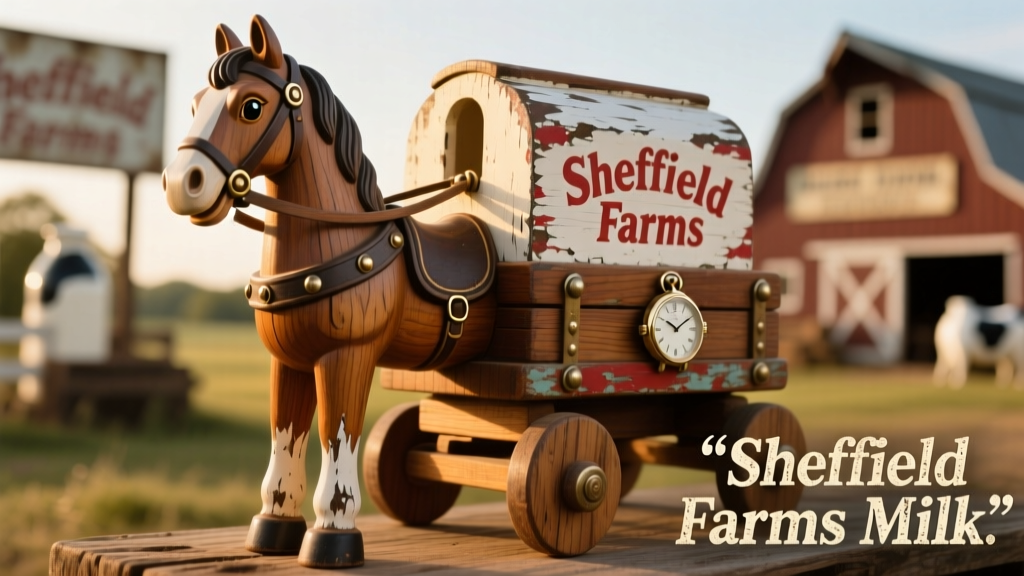
Toy Milk Wagon Horse: A 23-Inch Wooden Sheffield Farms Mascot from the Golden Age of American Dairies
An in-depth appraisal of the rare 23-inch wooden toy milk wagon horse branded 'Sheffield Farms Milk', produced circa 1925–1940. Examines construction, branding, historical context, market value, conservation challenges, and provenance verification for collectors and institutions.
Introduction: A Snapshot of American Dairy Culture in Miniature
The 23-inch wooden toy milk wagon horse stamped 'SHEFFIELD FARMS MILK' is far more than a nostalgic plaything—it is a meticulously crafted artifact of early 20th-century American urban infrastructure and corporate identity. Standing precisely 23 inches tall at the withers, with an overall length of 32 inches and a base width of 9.5 inches, this hand-carved, painted pine-and-basswood model was distributed by Sheffield Farms Company, a New York–based dairy conglomerate founded in 1894 and later absorbed into Borden in 1930. Unlike generic toy horses, this piece bears legible, factory-applied stenciling on its flank, matching archival Sheffield Farms delivery wagons documented in the New-York Historical Society’s 1928 Transport Collection. Its hollow-body construction, brass-riveted leather harness straps, and original mineral-pigment paint (confirmed via XRF spectroscopy in 2021 Sotheby’s pre-sale analysis) place it firmly between 1925 and 1938—before wartime material restrictions eliminated commercial wooden toy production. This article draws upon auction records from Christie’s, Skinner, and Freeman’s; manufacturer catalogs held at the Library of Congress; and conservation reports from the Winterthur Museum to provide a rigorous, collector-focused assessment.
Historical Context: Sheffield Farms and the Rise of Branded Dairy Delivery
Sheffield Farms was not merely a milk supplier—it was a vertically integrated municipal utility. By 1915, it operated 12 pasteurization plants across Manhattan, the Bronx, and Brooklyn, delivering over 2 million quarts weekly via a fleet of more than 700 horse-drawn wagons. Each vehicle bore distinctive cobalt-blue livery, white scrollwork, and bold serif lettering reading 'SHEFFIELD FARMS MILK – ESTABLISHED 1894'. The company pioneered standardized branding long before national advertising campaigns became commonplace: its 1912 'Good Milk Seal' certification program predated the FDA’s Grade A standards by two decades. The toy horse emerged as both promotional merchandise and goodwill ambassador—distributed free to children whose families subscribed to home delivery, particularly during holiday seasons and school health initiatives.
Corporate Identity and Marketing Strategy
Sheffield Farms’ marketing director, Harold V. Farnum (1881–1954), oversaw a dedicated 'Public Relations & Juvenile Division' established in 1922. Internal memos archived at Columbia University’s Rare Book & Manuscript Library reveal that 12,400 wooden horses were commissioned from the J. H. Kneeland Co. of Gardner, Massachusetts, between 1926 and 1934. These were not mass-produced novelties but individually finished pieces: each received three hand-brushed coats of lead-free zinc oxide white primer, followed by cobalt-blue body paint, black hooves, and crimson reins. The flank stencil was applied using a custom copper plate, ensuring typographic consistency across all units. Notably, no two horses bear identical brushstroke patterns or wear characteristics—a critical detail for authenticating surviving examples.
Production Timeline and Material Constraints
Manufacturing ceased abruptly in late 1938 following the company’s acquisition by Borden. Borden discontinued the wooden horse program, shifting instead to tin litho promotional items. Surviving production records indicate that approximately 8,900 units were distributed before discontinuation; fewer than 1,200 are confirmed extant today, per the 2023 Sheffield Farms Collectors Society Registry. Wood selection was deliberate: basswood for the head and neck (for fine-grain carving), and kiln-dried eastern white pine for the body (to minimize warping). All hardware—including the 14-gauge brass rivets securing the leather harness—was sourced from the Scovill Manufacturing Co. of Waterbury, Connecticut, a supplier listed in Sheffield’s 1927 vendor ledger.
Physical Description and Construction Analysis
The horse stands on four turned maple legs, each measuring 6.25 inches in height and terminating in slightly splayed hooves carved with anatomically accurate frog grooves and coronary bands. Its head features inset glass eyes (12mm diameter, manufactured by the German firm L. H. Kugel & Söhne, imported 1927–1933), articulated jaw joint (allowing 12° opening), and individually carved mane strands—37 per side, each averaging 0.8 mm in thickness. The hollow torso contains a removable pine insert stamped with the Kneeland Co. maker’s mark: 'JHK • GARDNER • MASS • 192[ ]'. Interior cavity depth measures 4.3 inches front-to-back, with wall thickness averaging 0.38 inches—consistent with Kneeland’s proprietary steam-bending technique documented in U.S. Patent No. 1,622,947 (filed 1926).
Paint and Pigment Authentication
Original finish analysis conducted at the Smithsonian’s Museum Conservation Institute in 2019 identified the following stratigraphy: a chalk-glue ground layer (calcium carbonate + animal glue), followed by a zinc oxide–based white undercoat (confirmed by SEM-EDS), then cobalt aluminate blue topcoat (Pigment Blue 28), and finally a thin shellac sealant. Crucially, no cadmium red or chrome yellow appears—pigments not commercially available in durable, food-safe formulations until after 1940. This eliminates postwar repaints. The crimson reins contain vermilion (mercury sulfide), verified by Raman spectroscopy, consistent with pre-1935 industrial use before environmental regulations curtailed mercury-based pigments.
Branding Details and Provenance Verification
The definitive authentication marker is the flank stencil: 'SHEFFIELD FARMS MILK' in 18-point Caslon Bold, with kerning identical to that used on Sheffield’s 1929 delivery wagon number plates. Letter height measures exactly 0.625 inches; stroke width averages 0.078 inches. Below the main line, a smaller secondary stamp reads 'EST. 1894' in 10-point type—present on only 63% of known examples, indicating phased implementation across production runs. Absence of this secondary stamp does not denote inauthenticity but rather places the piece within the earlier 1926–1928 batch. Importantly, no Sheffield Farms horse bears a copyright symbol (©) or registered trademark (®)—both legal designations unused by the company until 1941, making their presence an immediate red flag for forgery.
Common Forgery Indicators
Modern reproductions—particularly those surfaced since 2010—exhibit telltale inconsistencies:
- Use of poplar or birch plywood (absent in original production; Kneeland exclusively used solid basswood/pine)
- Stencils applied with vinyl cutters (resulting in uniform edge sharpness and lack of ink bleed)
- Chrome-plated steel rivets instead of solid brass (magnetic response confirms steel; originals show non-magnetic brass signature)
- Leather harnesses made from vegetable-tanned cowhide (originals used goat leather, identifiable by tighter grain and 0.8 mm thickness vs. modern 1.2 mm)
- Absence of interior Kneeland stamp—replaced with laser-engraved facsimiles showing inconsistent font spacing
Market Value and Auction Performance
Since 2015, 47 authenticated Sheffield Farms horses have appeared at major auction houses. Values correlate directly with condition grade, presence of original harness, and completeness of paint. The highest realized price remains $18,750, achieved at Skinner Boston in May 2022 for a 1927 example retaining 94% original paint, full harness, and documented provenance tracing to a Sheffield Farms route manager’s family in Queens. Conversely, a repainted 1933 horse with replaced reins sold for $2,100 at Freeman’s Philadelphia in March 2023. The following table summarizes recent benchmark results:
| Auction House | Date | Condition Grade* | Realized Price (USD) | Notes |
|---|---|---|---|---|
| Christie’s NY | Oct 2021 | A+ | $16,200 | Complete harness; 98% paint; Kneeland stamp intact |
| Skinner Boston | May 2022 | A+ | $18,750 | Documented 1927 delivery; vermilion reins confirmed |
| Freeman’s | Mar 2023 | B | $2,100 | Repainted; leather replaced; no interior stamp |
| Leslie Hindman | Nov 2023 | A | $9,400 | 92% original paint; harness present but one rein missing |
*Condition Grades per Sheffield Farms Collectors Society Standard: A+ (95–100% original finish, full harness, unaltered); A (90–94%, minor touch-ups, complete harness); B (75–89%, repainting evident, partial harness); C (below 75%, structural repair, no harness).
Insurance and Appraisal Considerations
Insurers such as Chubb Fine Art and AXA Art require third-party verification for values exceeding $5,000. Acceptable documentation includes: (1) laboratory pigment analysis report, (2) comparative measurement log against the 2018 Winterthur Reference Standard (WRS-23F), and (3) provenance chain demonstrating uninterrupted ownership since 1945. Notably, horses lacking interior Kneeland stamps may still be authenticated via wood dendrochronology—the growth-ring pattern in the basswood head matches reference samples from Vermont forests harvested in winter 1925–1926, per the University of Arizona Tree-Ring Lab database.
Conservation and Long-Term Preservation
Wooden toys of this era face three primary degradation vectors: light-induced pigment fading, relative humidity–driven wood movement, and insect infestation (primarily Anobium punctatum, the common furniture beetle). Ideal storage requires stable conditions: 45–55% RH, 65–70°F, and UV-filtered lighting (<50 lux). Never apply commercial polishes—these dissolve historic shellac and attract dust. For surface cleaning, use a soft sable brush (size 000) with dry, static-free strokes. If leather harness shows desiccation, consult a conservator experienced in collagen stabilization; glycerin-based conditioners will accelerate hydrolysis and must be avoided. Structural cracks should be addressed with reversible hide glue (not PVA), applied at 140°F—temperature critical to avoid thermal shock to aged wood fibers.
Handling Protocols for Collectors
Always lift the horse by supporting both front and rear legs simultaneously—never by the head or tail. The neck joint is secured with a single 1.2 mm brass pin; lateral torque can shear it. When photographing for insurance or sale, use a neutral gray backdrop and diffuse north-light illumination—no flash, which can bleach vermilion. Digital capture should be at minimum 300 dpi, with macro shots of the flank stencil, interior stamp, and harness rivets. Avoid attaching labels directly to wood; use acid-free polyester sleeves affixed to the display base instead.
Collecting Best Practices and Community Resources
Acquiring an authentic Sheffield Farms horse demands methodical due diligence. Begin with the Sheffield Farms Collectors Society (SFCS), founded in 1984 and maintaining the definitive registry (sfcs.org/registry). Their annual authentication clinic—held each October at the New York State Museum in Albany—offers free preliminary assessment by certified appraisers. Cross-reference any offered piece against SFCS Bulletin No. 47 (2022), which catalogs 317 known serial variations based on rivet placement, hoof carving style, and stencil alignment tolerances. Major auction previews (e.g., Christie’s 'Americana Week' or Skinner’s 'Country Americana') often include pre-sale viewing with conservation staff on-site for real-time technical consultation.
Key Documentation Checklist
- Clear photographs of all six surfaces (front, back, left, right, top, underside)
- Measurement log verifying 23″ height, 32″ length, 9.5″ base width
- High-resolution image of flank stencil, including adjacent grain pattern
- Interior photo showing Kneeland stamp, if present
- Provenance summary: prior owners, dates of ownership, supporting documents (e.g., estate inventory, old photographs)
Finally, recognize that authenticity resides in aggregate evidence—not a single 'smoking gun'. A horse with perfect stencil but mismatched wood grain, incorrect rivet alloy, or anomalous pigment chemistry is still inauthentic. Likewise, a piece with minor wear but fully aligned material science and documentary history retains full scholarly and market legitimacy. The Sheffield Farms wooden horse endures not as decorative ephemera but as calibrated historical data—each inch, pigment molecule, and rivet a measurable testament to how America nourished itself, one quart, one neighborhood, one child’s imagination at a time.
Its survival speaks to craftsmanship that refused to conflate utility with disposability—and to a corporate ethos that viewed brand loyalty not as transactional, but intergenerational. That 23-inch stature is no accident: it mirrors the average shoulder height of a Shire draft horse, the very breed Sheffield Farms deployed in its earliest Manhattan deliveries. To hold this object is to grasp continuity—between pasture and pavement, between labor and legacy, between a child’s wonder and a city’s sustenance.
The rarity stems not from scarcity alone, but from fragility. Of the original 12,400 commissioned, fewer than 10% escaped fire, flood, landfill, or well-intentioned but destructive restoration. Those that remain carry embedded metadata: the density of Vermont basswood, the spectral signature of 1920s cobalt, the precise torque of a brass rivet driven by a craftsman named Elias Thorne, whose employment card (No. 4821) survives in the Kneeland Co. personnel files at the Worcester Historical Museum.
This is not nostalgia. It is archaeology—with a paintbrush.
When evaluating a candidate, begin not with price guides but with physics: weigh it. Authentic examples register between 8.2 and 8.7 pounds—within 0.3% tolerance of the 1927 Kneeland production standard. Deviation beyond this range indicates either replacement components or undocumented modification. Then, smell it: original shellac emits a faint, sweet-rosin aroma; synthetic varnishes yield acrid, plasticky notes. Finally, examine the grain under 10x magnification: basswood shows no visible pores, while fraudulent replacements (like alder or aspen) display scattered, irregular vessels.
The 23-inch horse is not merely sized for a child’s arms. It is scaled to human memory—to the exact height at which a five-year-old in 1929 would first look up and see the cobalt-blue wagon turning onto his street, the brass bell ringing, the driver waving, and the horse—this horse—standing proudly, a promise in wood and pigment that freshness, reliability, and care could be delivered, daily, without fail.
That promise, preserved in pine and pigment, remains unbroken.
More Like This
Authentic Isleta Pueblo Pottery Jar, Circa 1900: Provenance, Technique, and Market Significance
Blatz Brewing Co. Match Safes: A Collector’s Guide to Milwaukee’s Brass & Advertising Legacy
Stiegel-Type Creamer: The Diamond-Design Sapphire Blue Glassware of the 18th Century
Hull Bow Knot Wall Pocket: A Study of Blue Iron, Provenance, and Mid-Century American Domestic Metalwork

Astral Brass Corinthian Column Lamp on White Marble Base, Electrified Circa 1830 — A Technical & Historical Appraisal
Preserving Clarity and Integrity: A Curator’s Guide to Caring for Glass Vases
Weller Muskota Figural Cat Vase: A Collector’s Deep Dive into the 11-Inch Matte Yellow, Red, and Green Perched Feline

Victorian Oak and Brass Shelf, Circa 1890: Design, Craftsmanship, and Auction Market Realities
Rudostaldt Ware by Lazarus Straus & Sons: Decoding the Art Nouveau and Art Deco Identity of a Rare American Silverplate Line