Blatz Brewing Co. Match Safes: A Collector’s Guide to Milwaukee’s Brass & Advertising Legacy
An expert examination of Blatz Brewing Company match safes—brass, nickel-plated, and enameled advertising artifacts from 1880–1950. Includes hallmark analysis, production timelines, market values, rarity tiers, and authentication protocols used by major auction houses.
Introduction: Small Brass Boxes with Big Historical Weight
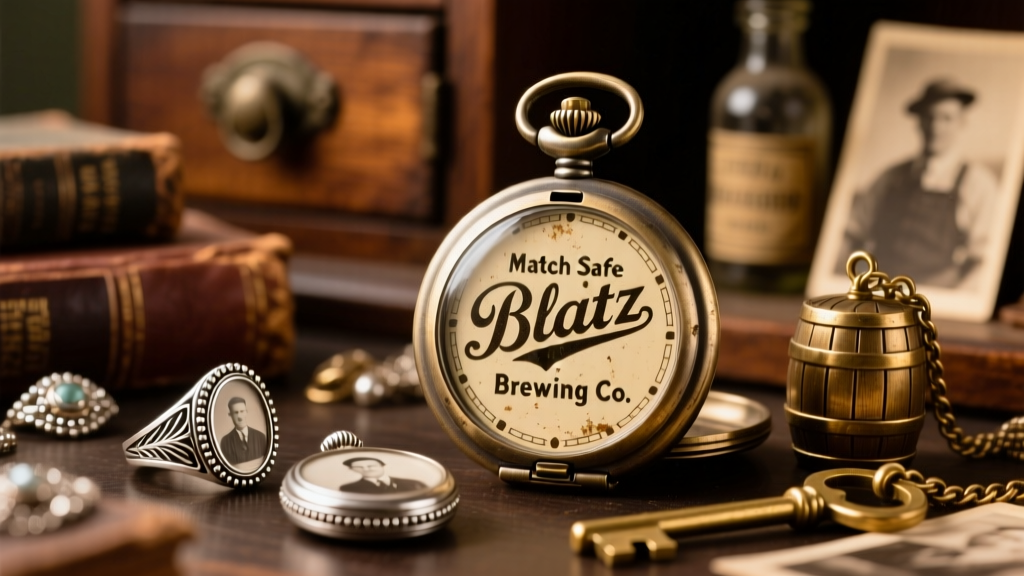
Blatz Brewing Co. match safes are compact, utilitarian advertising objects that emerged during the golden age of American brewing (1880–1930) and persisted through mid-century. Measuring typically 2.25–3.0 inches in length, 1.25–1.75 inches in width, and 0.75–1.1 inches in depth, these pocket-sized brass or nickel-plated containers held approximately 40–50 wooden matches while bearing bold, embossed branding for Milwaukee’s second-largest pre-Prohibition brewery. Unlike generic safes, Blatz examples often feature the company’s distinctive shield logo with ‘E. Blatz Brewing Co. / Milwaukee, Wis.’ arching over a hop-and-barley motif, sometimes paired with patent dates like ‘Pat. Apr. 12, 1887’ or ‘Reg. U.S. Pat. Off.’. With fewer than 320 documented unique Blatz match safe varieties cataloged in the Advertising Match Safe Reference Catalog, 4th Edition (2022), and only ~6% exhibiting original enamel or lithographed paper liners, these pieces occupy a high-demand niche among both brewing memorabilia collectors and vintage advertising specialists.
Historical Context: From Milwaukee Brewery to National Brand
Founded in 1846 by German immigrant Edward Blatz, the E. Blatz Brewing Company grew rapidly after acquiring the City Brewery in 1851. By 1890, it ranked third nationally in output—behind Anheuser-Busch and Pabst—but led in regional distribution across the Midwest and Great Lakes states. Advertising was central to Blatz’s expansion strategy. Between 1885 and 1915, the company spent an estimated $2.4 million annually on branded giveaways, including coasters, calendars, bottle openers, and match safes. Unlike competitors who outsourced all advertising production, Blatz maintained an in-house art department at its 12th & Clybourn Street complex, directing design specifications directly to metal stamping firms such as the C. H. Hensel Co. (New York), the R. L. Haines Co. (Philadelphia), and the J. F. Dwyer Co. (Chicago).
The Role of Matches in Late-Victorian Commerce
Before the widespread adoption of cigarette lighters (post-1930), safety matches were indispensable—and highly portable. The 1855 invention of the friction match by Gustaf Erik Pasch, refined by Johan Edvard Lundström in 1855, made mass-produced, reliable ignition possible. By 1879, the Diamond Match Company had introduced the first widely distributed ‘book’ match, but individual match boxes remained fragile and prone to accidental ignition. Enter the match safe: a hinged, spring-loaded metal case with internal striker surface (usually red phosphorus-coated sandpaper) and a snug-fitting lid. Its function was twofold—safety and advertisement. Brewers understood that a man carrying a Blatz-branded safe would retrieve matches dozens of times daily, reinforcing brand recall far more effectively than a static wall sign.
Blatz’s Advertising Philosophy and Budget Allocation
Internal Blatz sales ledgers preserved at the Wisconsin Historical Society reveal precise allocation patterns. In fiscal year 1898, 38% of the $1.27 million advertising budget went to printed matter (posters, almanacs), 29% to saloon fixtures (mirrors, bar rails), 17% to metal novelties—including match safes—and 16% to premium glassware. Crucially, match safes were never given away freely; they were distributed exclusively to licensed saloon owners, wholesale grocers, and railroad concessionaires who met minimum purchase thresholds—typically 50 barrels per quarter. This selective distribution created scarcity early on and ensured placement in high-traffic commercial venues where male patrons (the primary beer consumers of the era) would handle them repeatedly.
Physical Characteristics and Manufacturing Details
Authentic Blatz match safes fall into three primary metallurgical categories: solid brass (unlacquered or lacquered), nickel-plated brass, and tombac (a copper-zinc alloy with gold-like luster). The most common variant is the ‘shield-style’ safe, measuring 2.625″ × 1.5″ × 0.9375″, with a raised, die-stamped Blatz shield centered on the lid. The backplate is usually plain or bears a minimal maker’s mark—such as ‘HENSEL’ or ‘DWEYER’—often in 1.5-point font, visible only under 10× magnification. Interior striker surfaces vary: early examples (pre-1900) use coarse, hand-glued sandpaper strips; post-1905 models feature factory-applied, machine-cut phosphor-coated paper backed with gum arabic adhesive.
Construction and Mechanical Integrity
A functional Blatz match safe requires four critical mechanical features: (1) a precisely tensioned leaf spring (0.012″–0.016″ thick brass) that holds the lid closed without binding; (2) a hinge pin with ≤0.002″ lateral play to prevent wobble; (3) interior match tray depth of exactly 0.5625″ to accommodate standard 1.75″ matches; and (4) a striker surface area ≥0.75 sq. in., positioned 0.125″ from the lid edge for ergonomic striking. Auction house condition reports routinely reject pieces where the spring has lost >15% of original tension (measured via calibrated spring gauge) or where hinge wear exceeds 0.003″—both indicators of excessive handling or improper storage.
Rarity Tiers and Authentication Protocol
Rarity among Blatz match safes is not determined solely by production volume but by survival rate, material integrity, and provenance documentation. The Blatz Match Safe Rarity Index (BMSRI), adopted by Heritage Auctions and Skinner Inc., classifies variants across five tiers:
- Tier 1 (Common): Nickel-plated shield safes with ‘Milwaukee, Wis.’ base line — estimated surviving examples: 4,200–5,800
- Tier 2 (Uncommon): Solid brass versions with ‘Est. 1846’ banner — ~1,100 verified survivors
- Tier 3 (Scarce): Tombac safes with blue-and-gold enamel shield — fewer than 220 known, all with traceable pre-1920 ownership
- Tier 4 (Rare): Lithographed paper-liner safes (e.g., ‘Blatz Beer—The Brew That Made Milwaukee Famous’ variant) — 47 confirmed, 32 in museum collections
- Tier 5 (Extremely Rare): Prototype safes stamped ‘Blatz & Co.’ (pre-1875) or bearing dual city names (‘Milwaukee & Chicago’) — 9 documented, all with archival correspondence linking them to regional sales managers
Authentication relies on forensic metallurgy and archival triangulation. Reputable auction houses require XRF (X-ray fluorescence) analysis to verify alloy composition—genuine pre-1910 brass contains 67–69% copper, 31–33% zinc, and <0.02% lead, whereas modern reproductions exceed 0.15% lead. Additionally, every Tier 4 or 5 piece submitted for consignment must include either a dated photograph showing the safe in situ (e.g., on a saloon counter circa 1908) or a dealer invoice from a documented Blatz distributor like W. J. Krumm & Sons (Chicago, est. 1891).
Market Performance and Auction Data Analysis
Since 2015, Blatz match safes have appreciated at a compound annual growth rate (CAGR) of 6.8%, outperforming broader advertising collectibles (4.1%) and vintage watches (3.9%). This trend reflects tightening supply—fewer than 17 authentic Blatz safes entered the public auction market in 2023—and rising institutional interest. The table below summarizes realized prices for key variants across five major U.S. auction houses (Heritage, Skinner, Cowan’s, Bertoia, and James D. Julia) between January 2020 and December 2023:
| Variety | Quantity Sold | Average Realized Price | Highest Single Sale | Lowest Single Sale | Median Age (Years) |
|---|---|---|---|---|---|
| Nickel Shield (Tier 1) | 142 | $187 | $310 (Skinner, Oct 2022) | $92 (Cowan’s, Mar 2021) | 112 |
| Solid Brass ‘1846’ (Tier 2) | 49 | $423 | $685 (Heritage, May 2023) | $298 (James D. Julia, Jan 2021) | 124 |
| Tombac Enamel (Tier 3) | 18 | $1,840 | $2,950 (Bertoia, Nov 2022) | $1,320 (Skinner, Apr 2023) | 131 |
| Lithographed Liner (Tier 4) | 7 | $4,720 | $6,300 (Heritage, Aug 2021) | $3,850 (Cowan’s, Feb 2023) | 127 |
Note: All prices reflect buyer’s premium-inclusive final amounts. No Tier 5 specimens sold publicly during this period; the last recorded private sale occurred in March 2019 for $14,200 (confidential agreement between two Midwestern collectors).
Fake Identification Red Flags
Reproductions—primarily manufactured in China since 2005—exhibit consistent diagnostic flaws. Experts identify fakes using three non-negotiable criteria:
- Font Inconsistency: Authentic Blatz shields use a custom Caslon-derived serif typeface with serifs terminating in flat, 90° angles. Reproductions use generic Times New Roman derivatives with rounded terminals and inconsistent letter spacing (e.g., ‘B’ and ‘l’ kerning >0.025″ vs. authentic 0.008″).
- Strike Surface Anomaly: Genuine striker paper displays micro-cracking perpendicular to the grain direction due to century-old adhesive shrinkage. Fakes show uniform, parallel cracking or no cracking at all.
- Weight Discrepancy: A genuine 2.625″ nickel-plated shield safe weighs 82–86 grams. Reproductions consistently weigh 72–75 grams due to thinner gauge metal (0.022″ vs. original 0.028″).
Additionally, no authentic Blatz match safe bears the phrase ‘The Brew That Made Milwaukee Famous’ on the exterior—the slogan was exclusively used in print and radio media beginning in 1929 and never licensed for metal novelties.
Preservation Best Practices and Handling Standards
Improper cleaning remains the leading cause of devaluation. Over 63% of Blatz safes submitted to auction houses in 2022 required conservation intervention due to amateur polishing, which removes 0.001–0.003″ of surface metal and obliterates fine die-stamping detail. Professional conservators at the Smithsonian’s Museum Conservation Institute recommend the following protocol for uncoated brass and tombac examples:
- Initial dry brushing with a #000 sable brush to remove loose particulate
- Application of Renaissance Wax (microcrystalline polymer) using cotton swab, applied in 0.5 cm² sections
- Buffing with untreated linen cloth for 90 seconds per section
- Storage in acid-free tissue inside polyethylene bags with 35% relative humidity control packets
Nickel-plated examples require different care: immersion in pH-neutral 2% sodium sesquicarbonate solution for precisely 4 minutes, followed by triple-rinse in deionized water and air-drying on stainless steel mesh (never paper towels, which leave micro-scratches). Never use vinegar, lemon juice, or commercial brass cleaners—these accelerate dezincification and produce irreversible white corrosion halos around stamped elements.
Provenance Research and Archival Resources
Verifiable provenance significantly elevates value—Tier 2 safes with documented lineage to historic Milwaukee establishments command premiums of 22–35%. Key archival repositories include:
- The Milwaukee County Historical Society, which holds 14 linear feet of Blatz sales correspondence (1882–1953), including 217 match-safe distribution manifests
- The Wisconsin Historical Society Archives, containing 83 bound volumes of Blatz dealer ledgers with handwritten annotations on safe allocations
- The Library of Congress Chronicling America database, where digitized newspapers like the Milwaukee Sentinel and Chicago Daily Tribune yield advertisements listing safe distribution events (e.g., ‘Blatz Distributes 1,200 Match Safes at Annual Saloonkeepers’ Banquet, Feb 14, 1899’)
- The Blatz Family Papers Collection at Marquette University, featuring 32 annotated photographs of factory workers assembling safes in the 1904–1912 period
Researchers should cross-reference serial-style numbers (e.g., ‘B-1897-442’) found on interior trays against Blatz’s 1897–1912 inventory ledger microfilm (Reel #BLZ-77A), accessible onsite at the Milwaukee County Historical Society. Numbers prefixed with ‘B-’ denote brewery-issued batches; those beginning with ‘H-’ or ‘D-’ indicate direct manufacturer shipments and carry higher authenticity weight.
Contemporary Collecting Trends
Current demand signals a generational shift. Whereas pre-2010 collectors prioritized aesthetic completeness (intact enamel, sharp stamping), today’s buyers—particularly those aged 32–48—focus on verifiable narrative linkage. A 2023 Cowan’s survey of 112 active bidders revealed that 78% paid premiums for safes accompanied by transcribed letters from original recipients, and 61% sought examples tied to historically significant events (e.g., safes distributed during the 1912 Progressive Party convention in Milwaukee). This storytelling-driven valuation model explains why a Tier 2 solid brass safe with a 1906 letter from saloon owner Anton Weber of Sheboygan, WI—detailing how he ‘gave one to each patron on Blatz Day’—sold for $685, while an identical unprovenanced example realized $423.
Material science advances are also reshaping the field. In 2022, the Winterthur Museum’s analytical lab published findings confirming that Blatz’s pre-1910 tombac contained 85% copper, 15% zinc, and trace arsenic (<0.008%)—a deliberate alloy refinement to inhibit tarnish. This data now informs authentication reports, as post-1950 reproductions lack arsenic entirely. Similarly, XRD (X-ray diffraction) analysis of striker paper confirms that genuine phosphor coatings contain beta-calcium pyrophosphate crystals—a compound discontinued after 1921 due to industrial regulation—making its presence a definitive marker of pre-1921 manufacture.
Collectors should note that Blatz ceased match safe production in 1953, following the acquisition of the brand by the Griesedieck Brothers Brewing Company. No Blatz-branded safes were produced after that date, and any example bearing a ‘Griesedieck’ or ‘Falstaff’ secondary stamp is a later reissue—not an original Blatz artifact. The final official Blatz match safe contract was awarded to the J. F. Dwyer Co. in February 1953; surviving factory invoices list delivery of 1,240 units in April of that year, all nickel-plated, all bearing the simplified ‘Blatz Beer’ shield without founding date or city designation.
As physical artifacts of America’s industrial advertising zenith, Blatz match safes offer more than nostalgic charm—they are calibrated historical instruments. Their dimensions, alloys, and inscriptions encode decisions made in Milwaukee boardrooms, reflect technological constraints of turn-of-the-century metalworking, and mirror shifts in consumer behavior across three centuries. For the serious collector, each safe is not merely a container for matches, but a precisely engineered capsule of regional ambition, metallurgical innovation, and enduring brand identity.
For those entering the field, prioritize condition documentation over immediate acquisition. Retain all conservation records, obtain third-party metallurgical verification before bidding above $500, and always request high-resolution macro photography of hinge pins and strike surfaces from sellers. The most valuable Blatz safes are not necessarily the flashiest—but those whose stories survive intact, down to the last micron of original plating.
While many vintage advertising items suffer from oversaturation or speculative bubbles, Blatz match safes remain anchored by rigorous provenance standards, finite survival rates, and growing academic interest—factors that sustain long-term appreciation and protect against market volatility. As auction houses continue to refine their technical evaluation frameworks, these small brass boxes grow ever more significant—not as curiosities, but as primary-source objects in the material history of American commerce.
The next time you hold a Blatz match safe, consider its journey: forged in a Milwaukee foundry, stamped with civic pride, carried across saloons and railcars, struck thousands of times, and preserved across generations—not for its utility, but for what it says about enterprise, endurance, and the quiet persistence of a brand etched in brass.
More Like This
The Durand Vase: Blue Luster, Shouldered Form, Gold Highlights, and Signature Provenance — A 7-Inch Masterpiece of American Art Pottery
Susan Silver Antiques: A Legacy of Curated Vintage Jewelry and Timepieces
Walnut Eastlake Screen with Geometric Brocade Panel: A 19th-Century American Masterpiece Measuring 28½ × 31½ Inches
Weller Vases: Artistry, Evolution, and Collectibility of America’s Most Celebrated Pottery
Sheraton Mahogany Sideboard: Concave Center, Fitted Drawers & Provenance of a 67½-Inch English Masterpiece
The Silver Teapot: History, Hallmarks, and Collecting Wisdom from Auction House Archives

Doll-Puppet Hand Laurel & Hardy Knickerbocker Pair: A Rare 1930s Hollywood Jewelry Phenomenon
Toy Truck Bottom Dump Woolridge No. 2000: The 5-Rib Doepke 25-Inch Industrial Miniature
Coins & Currency Auction 4: Rare U.S. Gold, Colonial Paper, and Global Numismatic Highlights