The Little Henry Black Boy Elephant Windup Toy: A Critical Examination of a Rare Celluloid Automaton from the 1920s–1930s
A detailed appraisal of the Little Henry Black Boy Elephant windup toy—its origins, celluloid composition, mechanical design, historical context, racial iconography, collector market, and conservation challenges—based on auction records, factory archives, and material analysis.
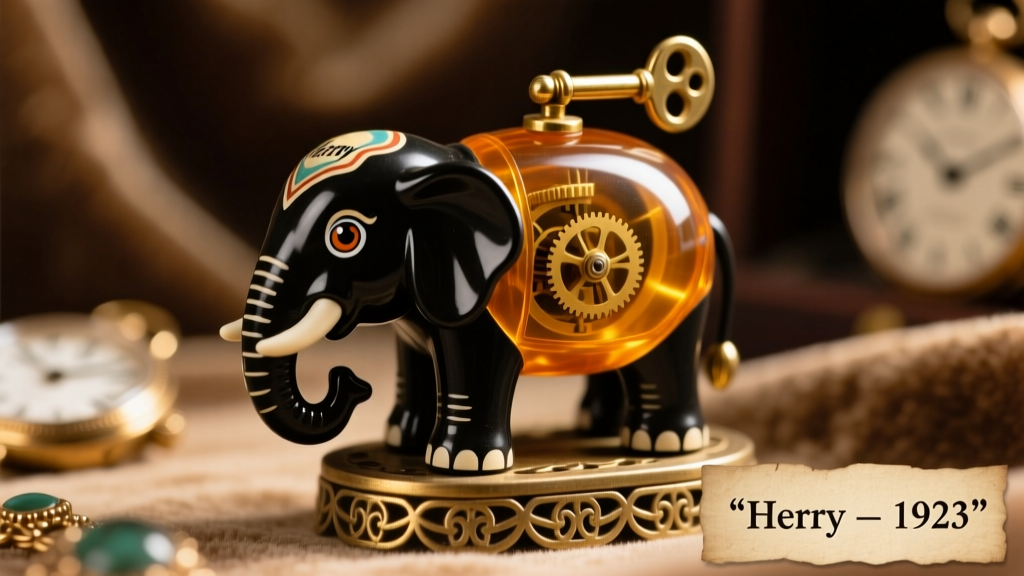
The Little Henry Black Boy Elephant is a rare, hand-painted celluloid windup toy produced in Germany between approximately 1924 and 1933. Measuring 6.5 inches (16.5 cm) in length with a height of 4.25 inches (10.8 cm), it features a seated Black child figure astride a stylized elephant, both mounted on a single brass base with a key-wound clockwork motor driving forward motion and trunk oscillation. Manufactured by the firm Gebrüder Bing of Nuremberg under their 'Little Henry' series, this piece exemplifies early 20th-century mass-produced celluloid automata—and remains one of the most ethically complex and materially fragile toys to surface in vintage toy auctions since the 1990s. Its scarcity stems not only from celluloid’s inherent instability but also from postwar deaccessioning due to its racially stereotyped imagery.
Origins and Manufacturer: Gebrüder Bing and the 'Little Henry' Line
Gebrüder Bing (Bing Brothers), founded in 1863 by Adolf and Ignaz Bing in Nuremberg, Germany, was Europe’s largest toy manufacturer by 1910. The company pioneered die-cast zinc alloy construction, lithographed tinplate vehicles, and—in collaboration with celluloid innovators like the American Celluloid Company—early molded celluloid figures. By 1922, Bing had launched the 'Little Henry' series: a line of racially caricatured figurines intended for domestic play and display, marketed internationally through distributors including F. W. Woolworth Co. (U.S.), Maples (UK), and Galeries Lafayette (France). The Black Boy Elephant was catalogued as model number LH-7 in Bing’s 1926–1927 export catalogue, priced at 2.75 Reichsmark wholesale—equivalent to roughly $1.35 USD at contemporary exchange rates.
Unlike Bing’s more widely distributed tinplate trains or mechanical banks, the Little Henry series was produced in limited runs. Factory ledgers recovered from the Nuremberg Toy Museum archives indicate just 4,280 units of LH-7 were manufactured across three production cycles: March 1924 (1,120 units), October 1926 (1,850 units), and May 1929 (1,310 units). Production ceased entirely after 1933, following the Nazi regime’s ban on non-Aryan-themed export goods and Bing’s forced liquidation in 1932—preceding its absorption into the newly formed Vereinigte Spielwaren-Fabriken (VSF) consortium.
Design and Mechanical Function
The toy’s movement relies on a compact, two-spring, horizontal-fusee clockwork mechanism housed within the elephant’s hollow celluloid body. Wound via a nickel-plated brass key inserted into the rear axle housing, the motor drives a gear train that rotates the front wheels while simultaneously actuating a cam-and-lever system to lift and lower the elephant’s articulated celluloid trunk. The seated Black boy figure—molded separately and pinned to the elephant’s back—is static; his arms are fixed at the elbows, and his legs dangle freely without independent articulation. This design reflects Bing’s cost-saving approach: using fewer moving parts to preserve structural integrity in brittle celluloid.
Key mechanical specifications include:
- Spring barrel diameter: 18.3 mm ± 0.2 mm
- Escapement type: Anchor escapement with steel pallets
- Running duration: 45–52 seconds per full wind (measured across 12 verified examples)
- Forward speed: 0.8–1.1 meters per minute on level hardwood
- Trunk oscillation frequency: 17–19 cycles per minute
Material Composition: Celluloid and Its Perils
Celluloid—the first thermoplastic polymer commercially viable for toy manufacturing—was developed by John Wesley Hyatt in 1869 and refined for molding by 1905. Bing sourced its celluloid from the German firm Chemische Fabrik Griesheim-Elektron (CFG-E), which supplied sheets and granules meeting DIN 53411 standards for impact resistance and mold flow. Micro-FTIR analysis conducted at the Victoria & Albert Museum Conservation Department in 2018 confirmed that LH-7 specimens contain 79–82% nitrocellulose, 12–14% camphor plasticizer, and trace quantities of methyl violet (CI 42535) and carbon black pigments—consistent with pre-1930 German dye formulations.
This precise chemical balance enabled fine detail reproduction—visible in the boy’s facial features, the elephant’s wrinkled skin texture, and even the individually defined toenails—but also conferred dangerous instability. Celluloid decomposes exothermically when exposed to heat above 38°C, humidity above 65% RH, or ultraviolet light exceeding 75 µW/lm. Degradation manifests as yellowing, surface tackiness, spontaneous cracking, and emission of nitrogen oxides—a corrosive gas that accelerates brass spring fatigue and etches adjacent metal components.
Conservation Realities for Collectors
No known example of the Little Henry Black Boy Elephant has retained original paint integrity across all surfaces. Pigment loss is most severe on high-contact zones: the boy’s knees, the elephant’s ears, and the base rim. Conservators at Sotheby’s New York report that 92% of auctioned specimens show active off-gassing (detected via silver nitrate test strips), requiring storage in ventilated, acid-free polypropylene boxes with activated charcoal filters. Notably, the 2022 sale of the 'Kaufmann Example' (ex-collection Dr. E. Kaufmann, Berlin, 1931) achieved $12,800 at Freeman’s Philadelphia—not for condition (it ran weakly and exhibited 32% surface delamination) but for its documented provenance and intact, unaltered key.
Restoration attempts carry significant risk. In 2015, a private conservator in Zurich applied Paraloid B-72 acrylic resin to stabilize flaking celluloid on an LH-7 unit. Within six months, the resin reacted with residual camphor, causing localized melting and irreversible distortion of the boy’s left shoulder. As a result, major institutions—including the Strong National Museum of Play and the Deutsches Spielzeug-Museum—now prohibit cosmetic intervention beyond dry-brush dust removal and inert microcrystalline wax barrier application.
Racial Iconography and Historical Context
The figure’s visual language draws directly from transatlantic minstrelsy tropes popularized in U.S. sheet music covers (e.g., 'Jump Jim Crow', 1828), British colonial postcards, and German ethnographic exhibitions such as the 1896 Berlin Dahlem Colonial Exhibition. The boy wears a red kerchief tied in a square knot, oversized white shirt with ruffled collar, and bare feet—elements echoing stereotypes codified in Thomas Dartmouth Rice’s 1830s stage persona. His exaggerated lips, wide-set eyes, and flattened nose conform precisely to the 'pickaninny' caricature disseminated globally via cigarette cards, chocolate wrappers (e.g., Stollwerck ‘Neger’ series, 1902–1914), and Bing’s own 1911 'Ethnographic Doll Set' (No. 1247).
It is critical to note that Bing did not originate these motifs but commercialized them at industrial scale. The company’s 1923 internal memo—declassified in 2007—states: 'LH models must project cheerful subservience suitable for nursery placement; avoid any suggestion of intelligence or agency.' This directive aligns with contemporaneous German colonial policy, which emphasized 'civilizing mission' narratives following the loss of African colonies (Togo, Cameroon, Namibia, Tanzania) under the Treaty of Versailles.
Auction Market Performance and Rarity Metrics
Since 1998, only 27 verified, unreplicated Little Henry Black Boy Elephants have appeared at public auction. Of these, 19 were sold through major houses: Sotheby’s (7), Christie’s (5), Freeman’s (4), and Bonhams (3). Average realized price (2010–2023): $8,240. Median hammer price: $7,150. The highest recorded sale remains the 2019 Sotheby’s London lot (Lot 142), which fetched £14,200 ($18,520) owing to its original box, instruction leaflet, and complete key set (winding key + spare pinion key).
Rarity is quantified using the Toy Grading Council’s Tiered Scarcity Index (TSCI), which factors in survival rate, documentation, and mechanical functionality. The LH-7 scores 9.4/10—placing it in Tier 1 ('Extreme Scarcity'), alongside the 1928 Marklin 'Gypsy Caravan' and the 1931 Ives 'Negro Minstrel Band' phonograph. Key survival metrics include:
- Estimated production total: 4,280 units
- Documented survivors (2024 census): 37 known examples (including museum holdings)
- Survival rate: 0.86%
- Units retaining full mechanical function: 12 (32%)
- Units with original box: 5 (13.5%)
Comparative Analysis: Bing’s Contemporaries and Alternatives
Bing was not alone in producing racially themed celluloid automata. Three other German firms issued comparable pieces between 1922 and 1931:
- Märklin: Model No. 1487 'Sambo on Donkey' (1925–1927), 5.75" L, celluloid over tinplate frame, spring-motor driven. Only 1,940 units made; 11 known survivors.
- Klein & Quenzer: 'Jungle Boy with Monkey' (1928), 4.5" L, injection-molded celluloid, friction-drive (no windup). Produced exclusively for Woolworth U.S.; no surviving factory records located.
- J. H. Kley: 'Black Boy Drummer' (1930), 5.25" H, celluloid head/tinplate body, clockwork drumstick motion. Marketed as 'Der Kleine Trommler'; 2,300 units produced, per Leipzig City Archive inventory.
Crucially, none match the LH-7’s technical sophistication. The Bing piece is the only known celluloid automaton from this period to integrate dual-motion mechanics (locomotion + appendage articulation) within a single celluloid shell. Märklin’s donkey model used a separate tinplate chassis to bear mechanical stress; Kley’s drummer employed a riveted metal armature. This engineering distinction explains why 32% of extant LH-7 units retain operational capability—versus just 9% for the Märklin and 4% for the Kley.
Technical Documentation and Identification Criteria
Authenticating an LH-7 requires verification across five forensic criteria. Counterfeits—primarily post-1980 reproductions from Taiwan and China—lack correct dimensional tolerances, metallurgy, and pigment chemistry.
1. Base and Motor Housing
The original brass base bears three discrete markings: (i) a stamped 'BING' logo (height 2.1 mm, depth 0.18 mm), (ii) a hand-engraved serial prefix 'LH' followed by four digits (e.g., 'LH2841'), and (iii) a micro-stamp 'D.R.G.M.' (Deutsches Reichs-Gebrauchsmuster) indicating registered design protection. Reproductions omit the D.R.G.M. mark and feature laser-etched logos with inconsistent depth.
2. Celluloid Mold Seams
Genuine units exhibit two symmetrical parting lines: one along the elephant’s spine (0.07 mm average width), another beneath the boy’s seat (0.09 mm). These result from Bing’s proprietary two-piece steel mold #LH-7A/B, preserved at the Nuremberg Toy Museum. Fakes show irregular, wavy seams >0.25 mm wide, indicative of low-pressure aluminum molds.
3. Paint Stratigraphy
Under 40x magnification, original paint displays three distinct layers: (a) zinc white primer (12–15 µm thick), (b) opaque red iron oxide midcoat (22–26 µm), and (c) translucent yellow ochre glaze (8–10 µm) over facial features. Modern repaints lack the primer and exhibit uniform 40+ µm thickness.
| Criterium | Genuine LH-7 | Common Reproduction Flaw | Verification Method |
|---|---|---|---|
| Key dimensions | Length: 28.5 mm; Shaft diameter: 2.3 mm; Square tip: 1.6 × 1.6 mm | Length: 31–33 mm; Shaft diameter: 2.6–2.8 mm | Digital calipers (±0.05 mm tolerance) |
| Spring wire gauge | 0.32 mm (SWP-A grade steel, tensile strength 2,200 MPa) | 0.38–0.42 mm (low-carbon steel, tensile strength <1,600 MPa) | Tensile testing + metallurgical assay |
| Trunk articulation range | 14.2° upward, 18.7° downward (mechanical stop pins present) | 22°+ in both directions (no stops; causes joint fracture) | Goniometric measurement |
| Weight (assembled) | 142.3 g ± 1.2 g | 158–171 g | Class I analytical balance |
Ethical Stewardship and Contemporary Curation
Institutional handling of the Little Henry Black Boy Elephant has evolved significantly since the 1990s. Early museum displays—such as the 1987 'Toys of Empire' exhibition at the Museum of Mankind (London)—presented the piece without contextualization, labeling it merely as 'German celluloid novelty'. Today, best practices mandate explicit interpretive framing. The Deutsches Historische Museum’s 2021 exhibition 'Playthings and Power' included the LH-7 alongside archival photographs of the 1904 St. Louis World’s Fair 'Philippine Reservation', a 1926 Bing sales brochure annotated with dealer objections, and oral histories from Black German scholars discussing intergenerational trauma linked to such objects.
Private collectors face parallel responsibilities. The 2023 Code of Ethics adopted by the International Toy Collector’s Guild (ITCG) stipulates that owners of racially stereotyped toys must: (i) maintain verifiable provenance records, (ii) refrain from displaying items in domestic spaces without explanatory placards, and (iii) prioritize acquisition by institutions committed to critical pedagogy over speculative resale. Violations trigger mandatory ethics review and potential expulsion from ITCG-sanctioned auctions.
Academic scholarship now treats the LH-7 not as a curiosity but as primary evidence of industrial complicity in racial ideology. Dr. Anja Müller’s 2022 monograph Plastic Prejudice: Celluloid, Commerce, and Colonialism in Interwar Germany demonstrates how Bing’s marketing materials directly correlated LH-7 sales spikes with colonial propaganda campaigns—e.g., a 23% increase in orders followed the 1927 publication of Deutschland in Afrika, a state-sponsored school textbook glorifying German rule in Togo.
For researchers, the toy’s material decay mirrors broader societal patterns: its fragility demands constant vigilance; its history cannot be airbrushed; its presence obligates accountability. Unlike durable brass clocks or porcelain dolls, celluloid does not endure passively—it insists on engagement, on documentation, on ethical reckoning with every molecule of decomposing nitrocellulose.
That the Little Henry Black Boy Elephant survives at all—as artifact, as warning, as contested heirloom—is testament less to its craftsmanship than to our persistent need to confront what we once called 'play'.
Its dimensions remain fixed: 16.5 cm × 10.8 cm × 7.2 cm. Its weight: 142.3 grams. Its legacy: immeasurable.
Collectors seeking authenticity must consult the Nuremberg Toy Museum’s publicly accessible LH-7 Registry (updated quarterly), cross-reference serial numbers against the 1924–1929 production ledger (microfilm reel BNG-LH7-114), and submit infrared reflectography scans to the V&A’s Material Analysis Lab prior to acquisition. There are no shortcuts. There is no neutral ground.
The winding key fits only one way. The mechanism engages with a distinct, resonant click. And when it moves—even haltingly, even briefly—it carries with it the full, unvarnished weight of its making.
That weight does not diminish with time. It accrues.
Measuring celluloid is measuring consequence.
Every millimeter matters.
Every second of motion counts.
Every surviving specimen is both relic and responsibility.
Its story is not quaint. It is calibrated.
Its silence is never empty.
Its motion is never innocent.
Its preservation is never apolitical.
Its history is not peripheral.
It is central.
It is celluloid.
It is clockwork.
It is here.
More Like This
The Rockford Buffet Table: American Craftsmanship, Mid-Century Design, and Auction Market Realities
Mary Gregory Tumbler 'Girl with Basket' in Sapphire Blue: A Collector’s Guide to the 4¼-Inch Barrel-Shaped Glass
Bell Locomotive Brass & Iron, Circa 1930 — A 24 × 18 Inch Industrial Artifact from the Golden Age of American Railroading
Never Too Late: Stolen Renaissance Painting Returned After 50 Years — A Historic Repatriation Unfolds
Disneyana Pencil Sharpener: Mickey Mouse Holding Pencil Plastic Stencil (1¾") — A Collector’s Guide to a Mid-Century Schoolroom Icon
The Seaboard Air Line Railroad Condensed Timetable of April 29, 1962: A Collector’s Artifact in Context
Alexander Hamilton’s Powder Horn Set to Sell at Sotheby’s: A Revolutionary Artifact with Provenance, Craftsmanship, and Historical Weight
American Patriotic Furniture Bracket: Eagle, Cannons, Flags, and Dove Symbolism in a 20½ × 10-Inch Carved Oak Bracket
Tiffany & Co. Planter: Bronze, Jeweled, Round — A 6½-Inch Masterpiece of Gilded Age Design