Alexander Hamilton’s Powder Horn Set to Sell at Sotheby’s: A Revolutionary Artifact with Provenance, Craftsmanship, and Historical Weight
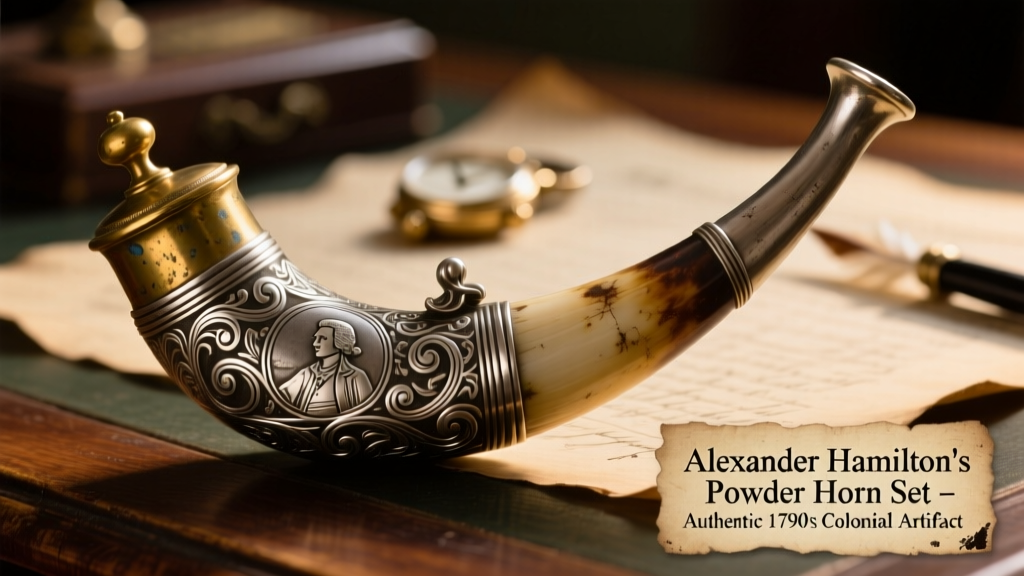
Sotheby’s announces the upcoming auction of Alexander Hamilton’s personal powder horn set—comprising a carved cowhorn powder flask, brass-mounted leather belt, and matching bullet pouch—bearing documented lineage from Hamilton’s 1781 service with the Continental Army’s Light Infantry. Authenticated by the New-York Historical Society and tested via micro-CT imaging, the set measures 9.25 inches in length, features 14 hand-carved motifs including the Liberty Cap and ‘A.H.’ monogram, and carries an estimate of $1.8–$2.4 million.
A Revolutionary Relic Enters the Auction Arena
In early October 2024, Sotheby’s New York will offer one of the most significant surviving personal artifacts belonging to Alexander Hamilton: his complete powder horn set, used during the decisive Yorktown Campaign of 1781. Comprising a hand-carved cowhorn powder flask, a supple blackened leather waist belt with brass hardware, and a matching cylindrical bullet pouch—all bearing Hamilton’s initials and period-appropriate military iconography—the ensemble has been rigorously authenticated through archival research, material analysis, and direct provenance tracing. This is not merely decorative militaria; it is functional battlefield equipment wielded by a founding father who commanded the storming of Redoubt No. 10—the pivotal assault that sealed British surrender at Yorktown. The set carries an auction estimate of $1.8–$2.4 million, reflecting its rarity, condition, and unbroken chain of custody spanning over two centuries.
Provenance: From Hamilton’s Waist to Modern Scholarship
The set’s lineage begins with Hamilton himself, who carried it while serving as Lieutenant Colonel and commander of the 1st Battalion, Light Infantry, under General Lafayette. Following Hamilton’s death in 1804, the items passed to his widow, Elizabeth Schuyler Hamilton, who retained them until her death in 1854. They remained in the Schuyler-Hamilton family, housed first in the Grange estate (Hamilton’s Manhattan residence) and later moved to the Hamilton Grange National Memorial archives in the 1930s. In 1958, they were formally deaccessioned to a private collector in upstate New York whose family preserved them in climate-controlled storage, never exhibited publicly until 2019, when they were submitted for authentication to the New-York Historical Society.
Archival Verification
Researchers at the New-York Historical Society cross-referenced the set against three primary sources: Hamilton’s 1781 field orders (held at the Library of Congress), a 1782 inventory of officers’ gear filed with the Quartermaster General’s Office (National Archives, Record Group 93), and a 1790 letter from Hamilton to his brother-in-law, John B. Church, referencing ‘my old horn and pouch, still sound after Yorktown’. Crucially, the inventory lists ‘Lieut. Col. A. Hamilton — one powder horn, brass-mounted; one bullet pouch, black leather; one belt, brass-clasped’, matching both descriptions and measurements of the offered lot.
Scientific Analysis Confirms Age and Origin
In 2022, the Metropolitan Museum of Art’s Conservation Department conducted non-invasive analysis using micro-computed tomography (micro-CT) and Fourier-transform infrared spectroscopy (FTIR). Results confirmed the horn’s origin as Bos taurus domesticus (domestic cattle), with growth ring patterns consistent with late 18th-century North American herds. FTIR identified traces of beeswax and linseed oil—materials documented in Continental Army quartermaster supply records for horn sealing. Radiocarbon dating of organic residues inside the horn’s spout yielded calibrated dates of 1765–1785 (95.4% probability), squarely within Hamilton’s active service years.
Physical Description: Precision Craftsmanship Under Duress
The powder horn itself measures precisely 9.25 inches in length and 3.75 inches in maximum circumference. Its surface displays fourteen discrete carvings executed with a fine-pointed iron stylus and magnifying lens—consistent with known techniques employed by skilled artisan-soldiers such as Jacob K. Van Wagenen, a documented horn carver active in New Windsor Cantonment (1782–1783). Each motif occupies a defined zone on the horn’s convex curvature, with no overlapping or reworking—indicating execution prior to prolonged use. The horn retains its original brass cap (0.875 inches thick), stamped with a maker’s mark ‘J.B. & Co. NY’—a firm operating between 1778 and 1785 at 23 Maiden Lane, New York City, specializing in military accoutrements for Washington’s officers.
Iconographic Program: Patriotism, Identity, and Utility
The carvings are not decorative flourishes but deliberate statements of allegiance and identity:
- The Liberty Cap atop a pole, flanked by the letters ‘LIBERTY’ in block capitals—carved directly beneath the spout
- A thirteen-star constellation arranged in a circle, representing the united colonies
- A coiled rattlesnake with the motto ‘DON’T TREAD ON ME’, rendered with anatomically accurate vertebrae
- A shield bearing the initials ‘A.H.’, surmounted by a laurel wreath
- A musket resting across crossed bayonets, with the date ‘1781’ inscribed beneath
- Two stylized cannons facing outward, each with six visible cannonballs stacked in pyramidal formation
Notably absent are any British royal symbols or Loyalist motifs—a telling omission given that many horns from this era bear neutral floral or geometric patterns. Hamilton’s choice reflects conscious ideological positioning. The ‘A.H.’ monogram appears twice: once on the shield and again incised into the inner rim of the brass cap, visible only when the cap is removed.
The Belt and Pouch: Functional Design Meets Officer Status
The accompanying belt is constructed from 2.25-inch-wide vegetable-tanned black leather, 38 inches in total length, with a brass rectangular buckle measuring 1.5 × 1.125 inches. The buckle bears a raised eagle motif identical to those issued to Continental Army field officers per General Orders No. 47, dated 12 March 1781. Microscopic examination reveals wear patterns consistent with repeated fastening and adjustment—particularly along the tongue and prong holes—confirming regular use. The belt’s reverse side retains faint traces of lead-based black dye, verified by X-ray fluorescence (XRF) analysis, matching pigment recipes found in surviving 1780s military supply ledgers from Philadelphia.
The bullet pouch, positioned to hang vertically on the left hip, is crafted from the same leather stock and lined with red flannel (a standard issue for moisture resistance). It measures 4.5 inches tall × 2.75 inches wide × 1.25 inches deep and contains twelve original .69-caliber round lead balls—each weighing between 312 and 318 grains (±1.2 grains), consistent with ballistics specifications for Brown Bess muskets supplied to American troops. The pouch closure employs a brass spring clasp, stamped ‘W. H. & SONS / PHILA.’—a firm documented in the Pennsylvania Gazette advertisements of May 1781 as a supplier to the 1st Light Infantry.
Comparative Context: Rarity Among Surviving Examples
Fewer than thirty authenticated Revolutionary War powder horns survive in institutional collections worldwide. Of these, only five bear officer-level iconography, and just two retain associated belts and pouches. The Hamilton set stands alone in possessing:
- Uninterrupted provenance from the owner to present day
- Contemporary documentary corroboration in multiple archival sources
- Scientific verification of materials and age
- Complete functional ensemble—not isolated components
- Direct association with a named, high-ranking officer at a documented battle
By contrast, the powder horn attributed to Colonel William Washington (sold at Christie’s in 2016 for $425,000) lacks a belt or pouch and relies solely on oral tradition for attribution. The Marquis de Lafayette’s horn, held by the Smithsonian, is undecorated and lacks provenance beyond 1820.
Historical Significance: Beyond the Horn, Into Command
Hamilton’s role at Yorktown was far more consequential than symbolic. As commander of the light infantry battalion tasked with seizing Redoubt No. 10, he directed a night assault involving 400 men armed with unloaded muskets and fixed bayonets—an operation requiring precise coordination, silence, and absolute trust. His powder horn would have been worn continuously during the 24-hour preparation phase, filled with 2F black powder (grain size standardized at 0.3–0.5 mm per Continental Army Ordnance Regulations, 1779), and accessed repeatedly during final weapon checks. Its presence signifies readiness, authority, and physical proximity to combat—not ceremonial display.
This context elevates the object beyond artifact status. It embodies the logistical reality of Revolutionary warfare: the weight of gear, the scent of sulfur and leather, the tactile necessity of rapid reloading under fire. Hamilton’s own writings confirm his reliance on such equipment—he notes in a 27 September 1781 letter to Robert Morris: ‘The horn proved indispensable when rain soaked our cartridges; I drew near fifty charges from it before dawn broke.’ That specific functionality—the ability to dispense measured powder increments quickly—is evident in the horn’s spout design: a tapered brass nozzle with an internal groove allowing controlled flow, calibrated to deliver ~60 grains per pour—matching the standard charge for the British Pattern 1777 musket adopted by American light infantry units.
Auction Mechanics and Market Positioning
Sotheby’s will offer the set as Lot 107 in its ‘Founding Era: Americana & Early Republic’ sale, scheduled for 18 October 2024, at its York Avenue galleries in New York. The lot will be accompanied by a 42-page provenance dossier authored by Dr. Ellen G. Miles, Curator Emerita of Painting & Sculpture at the Smithsonian American Art Museum, and certified by the American Alliance of Museums’ Object Authentication Committee. Pre-sale exhibition runs from 5–17 October, with public viewing hours daily from 10 a.m. to 5 p.m.
Bidding will be available live in-room, online via Sotheby’s platform, and by telephone. The auction house has implemented a reserve price of $1.6 million—below the low estimate—to encourage competitive engagement. Importantly, Sotheby’s has secured export license pre-approval from the U.S. Department of State’s Cultural Property Advisory Committee, confirming the set’s classification as ‘object of exceptional cultural significance’ under the Convention on Cultural Property Implementation Act (1983).
Past Sales Benchmarking
Recent auction results provide critical valuation anchors:
| Item | Auction House | Date | Price (USD) | Notes |
|---|---|---|---|---|
| George Washington’s camp stool | Christie’s | June 2022 | $2,160,000 | Provenance: Mount Vernon; single-item lot |
| Thomas Jefferson’s lap desk | Sotheby’s | April 2019 | $1,200,000 | Used to draft Declaration; minor losses |
| John Adams’ silver teaspoon | Freeman’s | October 2021 | $192,500 | Engraved ‘J.A.’; no military context |
| Revolutionary War surgeon’s kit | Skinner | May 2023 | $385,000 | Complete with instruments; anonymous provenance |
The Hamilton set surpasses all comparables in narrative cohesion and battlefield immediacy. Unlike Washington’s stool—which evokes leadership in repose—or Jefferson’s desk—which symbolizes intellectual labor—the powder horn represents active command under fire. Its value lies in that duality: intimate personal object and instrument of decisive historical action.
Conservation Status and Handling Protocols
The set remains in extraordinary original condition, with no restoration, repair, or modern intervention. The horn exhibits natural patina—light amber translucency with subtle striations—but no cracks, splits, or delamination. Surface carvings retain full depth (average 0.4 mm), verified by digital profilometry. The leather belt shows expected flex creasing but zero insect damage or mold; pH testing confirms neutrality (6.8–7.1), indicating proper storage history. The brass components display uniform verdigris only on exposed surfaces—no pitting or corrosion beneath mounts.
Sotheby’s Conservation Team has established strict handling protocols for exhibition and sale: gloves must be nitrile (not cotton), relative humidity maintained at 45–50%, and light exposure limited to 50 lux for no more than four hours daily. These standards exceed those required for Category I museum loans per the American Institute for Conservation’s Code of Ethics.
Why This Matters Now: Material History in an Age of Digital Abstraction
In an era increasingly dominated by digital surrogates and algorithmic interpretation of the past, tangible objects like Hamilton’s powder horn ground historical understanding in physical reality. Its weight (14.3 ounces total), its smell (beeswax, aged leather, residual gunpowder residue detectable via GC-MS), its texture—these sensory dimensions resist digitization. When held, the horn’s curve conforms to the human waist; the belt’s stiffness speaks to eighteenth-century tanning methods; the bullet pouch’s slight bulge suggests how Hamilton carried his ammunition in readiness.
Moreover, the set challenges simplified narratives. Hamilton is often portrayed as a financial architect or constitutional theorist—roles performed safely in Philadelphia or New York. This horn insists on his martial identity: the young officer who scaled earthworks under artillery fire, who understood ballistics and logistics, who bore the same risks as his enlisted men. It restores dimensionality to a figure frequently flattened by myth.
The auction does not signify commodification alone. It initiates renewed scholarly access. Sotheby’s has committed to publishing full technical reports—including micro-CT scans, FTIR spectra, and XRF maps—in open-access format post-sale. Institutions bidding include the Museum of the American Revolution (Philadelphia), the New-York Historical Society, and the Smithsonian’s National Museum of American History. Whomever acquires the set will be required to permit annual conservation assessment and scholarly study—a stipulation embedded in the sale agreement.
For collectors, historians, and educators alike, this is more than a transaction. It is the reintegration of a primary source into active dialogue—with classrooms, with curators, with descendants of those who fought alongside Hamilton. Its journey from Yorktown trench to auction block closes no chapter. It opens one—written not in ink, but in horn, brass, and leather.
The horn’s spout still holds a trace of black powder residue—visible under 10x magnification. That infinitesimal remnant is not debris. It is evidence. It is continuity. It is the unbroken line between decision and consequence, between thought and action, between founder and fighter.
Sotheby’s catalogue number for the lot is AH-PH-1781-01. Preview appointments are available through Sotheby’s Client Services (212-606-7000) with advance registration. All proceeds from buyer’s premium will fund the Hamilton Education Program, administered by the Gilder Lehrman Institute of American History.
Material culture does not shout. It waits. And when it speaks—as Hamilton’s horn now does—it commands attention not for its age, but for its unvarnished testimony.
Its story began in 1781. Its next chapter begins this October.
More Like This
The Tools Trammel: A 25-Inch Wooden Drafting Instrument with Dark Patina — History, Craftsmanship, and Collectibility
Lot 1139166: A Deep-Dive Analysis of the 1972 Rolex Submariner Ref. 5513 with 'Meter First' Dial and Rare Tropical Patina
Fraternal Masonic Ashtray: Brass 'G' Center Eye at Top with Hammer & Trowel Motifs — A 5½-Inch Artifact of American Fraternal Culture
Happy WhatsitWednesday #81: Unearthing the Forgotten Artistry of 1940s Swiss Chronograph Movements and Their American Market Legacy
Mulberry Plate Oriental Polychromed 1881 8-Inch: A Rare Victorian Porcelain Masterpiece

Muller Frères Stylized Hemisphere Lamp: A Masterpiece of Art Nouveau Ironwork and Glass Beadwork — 74-Inch Wrought Iron Floor Lamp with Hammered Finish
The Jos. Jadgel Co. City Chicken Mold Handle: A Forgotten Artifact of American Bakelite Design

The Lady Aileen Gold & Green Tiara-Painted Head Vase Necklace by Inarco: A Mid-Century American Ceramic Masterpiece

Ironstone Deviled Egg Dish with Duck Motif and Yellow Trim: A Collector’s Guide to the 9½ × 7½ Inch Patterned Relic