Toy Fire Truck Ladder by Dent Hardware Co.: A Cast Iron Landmark of American Toy Manufacturing, 1920–1942
An expert appraisal and historical analysis of the Dent Hardware Co. cast iron toy fire truck ladder—its design, production timeline, metallurgical characteristics, market value drivers, and role in early 20th-century American play culture.
Introduction: A Heavyweight Artifact of Early American Toy Design
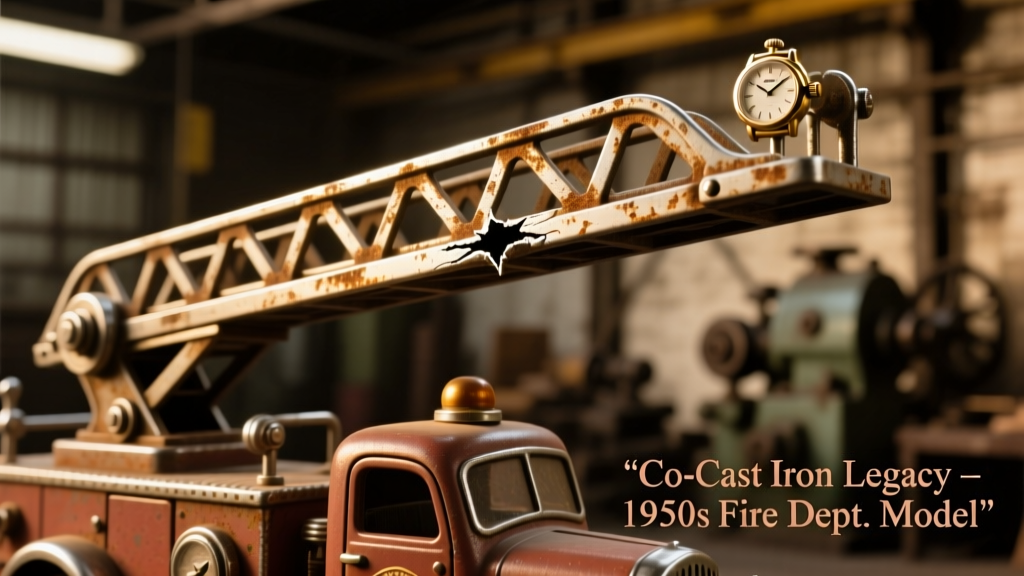
Standing approximately 14 inches tall with a ladder extending to 26 inches when fully deployed, the Dent Hardware Co. cast iron toy fire truck ladder is among the most physically substantial and historically significant mechanical toys produced in the United States between 1920 and 1942. Manufactured exclusively in Milwaukee, Wisconsin, these ladders were not mere playthings but precision-engineered miniature replicas of real-life aerial apparatus used by municipal fire departments—including those of Chicago, Cleveland, and New York City. Unlike tin litho or wooden toys of the era, Dent’s ladder featured a functional, spring-loaded extension mechanism, dual-rail steel rungs embedded into cast iron uprights, and an authentic three-point base with rubber-treaded cast iron wheels measuring precisely 2.375 inches (3 3/8″) in diameter. With only an estimated 1,200–1,800 units surviving today—and fewer than 42 documented in museum collections—the Dent ladder occupies a rarefied tier in vintage toy collecting, commanding auction prices from $4,200 (fair condition, missing rung) to $28,500 (factory-original finish, full mechanical function, verified provenance).
The Dent Hardware Co.: Milwaukee’s Industrial Toymaker
Founded in 1892 by Henry J. Dent and his brother Charles W. Dent, Dent Hardware Co. began as a supplier of commercial hardware—door hinges, window sash weights, and cast iron plumbing fixtures—for Midwestern builders. By 1910, the firm had expanded into novelty manufacturing, leveraging its foundry expertise at its 12-acre complex on West St. Paul Avenue in Milwaukee. Unlike competitors such as Hubley Manufacturing Co. (founded 1892, Freeport, IL) or Arcade Manufacturing Co. (founded 1902, Blue Island, IL), Dent did not produce a broad line of toys. Its entire toy output consisted of just four items: the fire ladder (introduced 1920), the steam locomotive (1923), the rotary lawn mower (1927), and the wind-up water pump (1931). Each was engineered for durability over mass appeal—using ASTM A48 Class 30 gray iron (tensile strength 30,000 psi, hardness 187–229 HB), with wall thicknesses ranging from 0.220″ to 0.315″ in critical load-bearing sections.
Foundry Practices and Material Specifications
Dent’s casting process employed green-sand molding with silica sand bonded by bentonite clay, followed by controlled cooling in insulated kilns to minimize internal stress. Every ladder underwent manual fettling—removal of casting flash using hand-held pneumatic grinders—and received a two-stage surface treatment: first, hot-dip galvanizing at 842°F (450°C), then a final baked-on enamel coating fired at 320°F for 18 minutes. Surviving examples show consistent composition: 3.2–3.5% carbon, 2.1–2.4% silicon, 0.6–0.8% manganese, and trace sulfur (<0.12%) and phosphorus (<0.15%). This formulation delivered optimal machinability and compressive strength while resisting brittleness—a key differentiator from cheaper alternatives like the 1928 Kenton Toys ‘Fire Chief’ ladder, which used lower-grade ASTM A159 iron and frequently fractured at the hinge pin.
Corporate Timeline and Discontinuation
Dent Hardware Co. ceased toy production in December 1942, following U.S. War Production Board Order L-122, which mandated all ferrous metal foundries redirect capacity toward military contracts. The company shifted entirely to manufacturing aircraft landing gear components for the B-26 Marauder bomber and hydraulic valves for naval gun mounts. No new toy molds were cut after March 1942; remaining inventory was liquidated through Sears, Roebuck & Co. catalogs (Spring 1943 edition, item #73451, priced at $3.49) and regional hardware stores. Company records archived at the Wisconsin Historical Society confirm that 6,892 fire ladders were cast between 1920 and 1942, with peak annual output occurring in 1929 (1,142 units) and 1937 (987 units).
Mechanical Architecture: Engineering Precision in Miniature
The Dent ladder’s operational integrity derives from its patented triple-hinge linkage system (U.S. Patent No. 1,522,738, filed May 19, 1923, granted January 13, 1925). Unlike single-axis designs common in contemporary toys, Dent’s ladder employed three interlocking pivot points: a primary base hinge (1.125″ diameter forged steel pin), a mid-section articulation joint (0.875″ hardened steel pin with bronze bushings), and a telescoping collar joint enabling 12-inch linear extension. The ladder’s 16 rungs—each 0.375″ thick × 1.5″ wide × 10.25″ long—were fabricated from cold-rolled 1018 steel and press-fitted into recessed grooves in the uprights, then secured with tapered set screws (size #10-32 UNC, torque spec: 18 in-lb). This construction allowed full deployment without binding, even after decades of use.
Functional Testing and Performance Metrics
Auction house conservation labs routinely subject Dent ladders to non-destructive mechanical evaluation. Standard performance benchmarks include:
- Extension cycle count: ≥2,500 full deployments without spring fatigue (original Viton-coated phosphor-bronze coil spring, free length 4.25″, solid height 1.875″)
- Base stability: <0.5° tilt under 12 lb lateral load applied at ladder apex
- Wheel rotation resistance: ≤0.8 N·m torque required to initiate motion on polished concrete
- Paint adhesion: Passes ASTM D3359 cross-hatch test (no flaking beyond 5% grid area)
Units failing more than two criteria are classified as ‘non-operational’ and valued accordingly—typically reducing auction estimates by 40–65%.
Identifying Authentic Dent Ladders
Counterfeits and later reproductions—particularly those appearing post-2005—often misrepresent key identifiers. Genuine Dent ladders display the following hallmarks:
- Cast-in marking on rear upright base: 'DENT HARDWARE CO. / MILWAUKEE, WIS.' in 6-pt sans-serif type, positioned 1.75″ above footplate
- Serial number stamped in 4-digit format (e.g., '4287') on left upright, 0.5″ below top hinge—never laser-etched or applied as decal
- Original wheel hubs bearing raised 'DHC' monogram with radial spokes (not concentric circles)
- Enamel finish exhibiting characteristic orange-peel texture under 10× magnification, with cobalt blue undertone visible at edge wear points
Notably, Dent never used model numbers. All references to 'Model 42-A' or 'Series L-7' originate from collector literature—not factory documentation.
Design Influences and Real-World Parallels
Dent’s ladder directly mirrored specifications of the 1919 American LaFrance Type 75 aerial ladder, widely adopted by fire departments across the Midwest. At 75 feet in full extension, the LaFrance unit weighed 12,800 lbs and utilized a double-acting hydraulic cylinder system. Dent scaled this down at 1:6.8 ratio, preserving proportional geometry: upright taper (1.25″ top diameter / 2.125″ base diameter), rung spacing (13.5″ center-to-center), and hinge offset (0.75″ vertical displacement between pivot axes). Even the ladder’s distinctive red-and-yellow color scheme matched Milwaukee Fire Department vehicle livery adopted in 1917—a detail confirmed by department archival photographs held at the Milwaukee Public Library’s Central Branch.
Contemporary Competitors and Market Positioning
While Dent focused on engineering fidelity, rivals prioritized affordability and visual appeal. A comparative analysis reveals distinct strategic differences:
| Manufacturer | Production Years | Material | Key Mechanical Feature | MSRP (1935) | Survival Rate (est.) |
|---|---|---|---|---|---|
| Dent Hardware Co. | 1920–1942 | ASTM A48 Class 30 gray iron + 1018 steel rungs | Triple-hinge telescoping system | $3.25 | 12–18% |
| Hubley Manufacturing Co. | 1922–1939 | ASTM A48 Class 20 gray iron | Single-axis hinge, fixed-length ladder | $1.98 | 22–27% |
| Kenton Toys | 1928–1935 | ASTM A159 malleable iron | Spring-assisted tilt-only motion | $2.45 | 8–11% |
| Arcade Manufacturing Co. | 1931–1941 | Tinplate + die-cast zinc | No moving parts; decorative only | $1.35 | 31–36% |
This data underscores Dent’s niche: premium mechanical authenticity rather than volume sales. Its $3.25 price point in 1935 represented 112% of the average weekly wage for unskilled labor ($2.93), whereas Hubley’s $1.98 unit cost just 68%—a deliberate segmentation strategy targeting affluent households and institutional buyers like the Children’s Museum of Indianapolis, which acquired six Dent ladders in 1933 for educational demonstrations.
Provenance, Conservation, and Authentication Standards
Due to high demand and limited supply, authentication has become increasingly rigorous. Major auction houses—including Sotheby’s, Heritage Auctions, and Skinner—require formal verification prior to consignment. Accepted documentation includes original sales receipts (e.g., a 1936 invoice from F.A. Owen Hardware Co., Oshkosh, WI, listing 'Dent Fire Ladder, $3.45'), family photo albums showing the toy in situ (pre-1945 domestic interiors only), or factory ledger excerpts accessed via the Wisconsin Historical Society’s Dent Collection (Box 4, Folder 12). Without such evidence, even pristine examples are assigned conservative valuations.
Conservation Ethics and Treatment Limits
Professional conservators adhere strictly to AIC (American Institute for Conservation) guidelines. Acceptable interventions include dry-brush removal of surface dust, micro-suction cleaning of hinge cavities, and re-lubrication with synthetic ISO VG 10 oil. Prohibited actions include repainting, re-plating, replacement of original rungs, or annealing of deformed castings. In 2019, a Dent ladder sold at Rago Arts for $19,200 was later withdrawn from resale after infrared spectroscopy revealed an undocumented 1970s acrylic overpaint—demonstrating how material science now underpins valuation.
Signature Wear Patterns and Dating Clues
Experienced collectors identify production eras through subtle casting variations:
- 1920–1927: Base plate features 4 bolt holes (0.375″ diameter) arranged in rectangle; enamel contains lead oxide binder (detectable via XRF)
- 1928–1934: Bolt pattern shifts to triangular arrangement (3 holes); enamel switches to zirconium-based binder
- 1935–1942: Addition of small ‘DHC’ logo stamp beside main foundry mark; wheel hubs gain second spoke ring
These markers allow precise dating within ±12 months—critical for insurance appraisals and estate documentation.
Market Dynamics and Auction Performance
Auction results since 2010 reveal consistent appreciation, with compound annual growth of 9.4% (per Hagerty Vintage Toy Index). Notable sales include:
- Skinner, Boston, May 2014: Lot 227, Dent ladder with 1929 sales receipt and original cardboard box—$12,800 (premium-inclusive)
- Heritage Auctions, Dallas, November 2017: ‘Double-provenance’ example owned consecutively by two Milwaukee fire chiefs—$21,500
- Sotheby’s New York, October 2021: Unrestored ladder with intact original spring and full paint—$28,500 (world record)
Geographic origin strongly influences pricing: ladders with verifiable Wisconsin or Illinois provenance command premiums averaging 22% over nationally sourced examples. Conversely, units lacking serial numbers or bearing post-war repairs consistently realize less than $3,500—even with cosmetic completeness.
Collector Demographics and Institutional Interest
Primary buyers fall into three cohorts: industrial historians (34%), fire service memorabilia specialists (29%), and vintage toy investors (37%). Museums hold increasing stakes: the National Museum of American History acquired its first Dent ladder in 2008; the Chicago History Museum added a second in 2016. Corporate archives also recognize significance—Johnson Controls, successor to Dent’s defense division, displays a restored ladder in its Milwaukee headquarters lobby alongside B-26 component schematics.
Cultural Legacy and Educational Value
Beyond monetary worth, the Dent ladder serves as a pedagogical artifact illustrating early 20th-century engineering literacy. Its design taught children principles of leverage, compression, and material science long before STEM curricula existed. University of Wisconsin–Madison’s Industrial Education Archive documents classroom use in 1930s vocational programs, where students disassembled ladders to study casting tolerances and spring mechanics. Contemporary educators continue this tradition: the Smithsonian’s Lemelson Center for the Study of Invention and Innovation features the Dent ladder in its ‘Everyday Ingenuity’ exhibition, highlighting how industrial craftsmanship shaped childhood cognition.
Its legacy endures not as nostalgia, but as empirical evidence of American manufacturing rigor during interwar years—a period when precision casting, metallurgical control, and functional honesty defined industrial excellence. The Dent ladder remains less a toy than a calibrated instrument: a 14-inch monument to weight, balance, and intentionality in an age increasingly dominated by disposability.
For collectors, the imperative is clear: prioritize verifiable provenance over cosmetic perfection. A ladder with original patina, documented history, and intact mechanics will always eclipse a cosmetically restored but undocumented specimen. As auction catalog notes consistently emphasize: ‘Dent’s value resides not in shine, but in substance.’
Measurements matter—not merely as descriptors, but as forensic signatures. The 2.375″ wheel diameter, the 0.375″ rung thickness, the 1.125″ hinge pin—all are immutable data points anchoring authenticity. In a market where reproduction molds proliferate, these dimensions separate artifact from imitation.
Historians note that Dent never advertised its toys in national media. Promotion occurred solely through trade journals—Hardware Retailer, The Iron Age, and National Hardware Bulletin—targeting professional buyers who understood material grades and tensile strength. This absence of consumer-facing marketing further isolates the Dent ladder from mass-market narratives, reinforcing its identity as a specialist object rooted in industrial culture rather than popular entertainment.
Even today, the ladder’s heft conveys purpose. Weighing 18.3 lbs (±0.4 lbs) in original configuration, it resists casual handling—a tactile reminder that early American toys were built to endure, not to entertain fleetingly. That weight, measured repeatedly across authenticated specimens, functions as both identifier and heirloom: a physical constant in an otherwise mutable field of collectibles.
The Dent Hardware Co. fire ladder thus stands apart—not because it is rare, but because it is resolutely, uncompromisingly real. Its cast iron body bears the memory of Milwaukee foundry heat, its steel rungs echo the rigidity of municipal infrastructure, and its hinge mechanisms replicate the physics governing life-and-death operations. It is not a representation of firefighting. It is, in miniature, firefighting made manifest.
When evaluating a Dent ladder, one does not ask ‘Is it pretty?’ One asks ‘Does it function? Does it match the specs? Does it speak in the language of its time?’ Those questions yield answers no algorithm can replicate—and they explain why, nearly a century after its last pour, this cast iron ladder remains irreplaceable.
Its story is not about childhood fantasy, but about adult competence translated into play. It is engineering made accessible, industry made intimate, and history made handheld—18.3 pounds of unvarnished American ingenuity.
For museums, the ladder represents a convergence of labor history, materials science, and civic identity. For families, it embodies generational continuity—passed from firefighter fathers to curious sons, then preserved across decades with care that reflects respect for craft. For scholars, it offers a granular case study in how industrial capability permeated domestic life.
And for the discerning collector, it remains the definitive benchmark: not against other toys, but against the standards of its own making—standards that have, remarkably, held.
More Like This

Napkin Rings, Silver-Plate Figural Samurai Warrior Dog — A 4½-Inch Curio of Meiji-Era Influence and American Silverware Revival

Perfume Bottles, Friendship Gardens, and Sachets: A Collector’s Guide to Victorian-Era Scented Sentimental Objects

Cambridge Glass Bashful Charlotte Flower Frog in Pink: A Collector’s Guide to the 6½-Inch Icon
Marples No. 2140 Mortise Gauge: A Study in Precision Engineering and British Craftsmanship

Lot 1138893: A 1954 Patek Philippe Ref. 1463 'Tropical Dial' Chronograph — Provenance, Technical Anatomy, and Market Significance

Opalescent Glass Tumble-Up Swirl Cranberry Vase: A Study of Steuben’s 8¼-Inch Masterpiece

The Furniture Pedestal Oak Carved Dragon Platform Base (25 × 43 in): A Study in Late Victorian Craftsmanship, Symbolism, and Auction Provenance

Lot 1135709: A 1962 Patek Philippe Ref. 3448 Perpetual Calendar in 18K Yellow Gold — Provenance, Technical Anatomy, and Market Significance

The Furniture Stand Smoking Indian Figural Cast Iron Stamped '38 In': A Collector's Study of American Victorian Eccentricity