Perfume Bottles, Friendship Gardens, and Sachets: A Collector’s Guide to Victorian-Era Scented Sentimental Objects
An expert examination of 19th-century perfume bottles shaped as Friendship Gardens—miniature glass or porcelain dioramas containing dried botanicals—and their accompanying sachets. Includes provenance, materials, measurements, maker marks, auction records, and conservation advice.
The Friendship Garden Perfume Bottle: A Victorian Language of Love and Memory
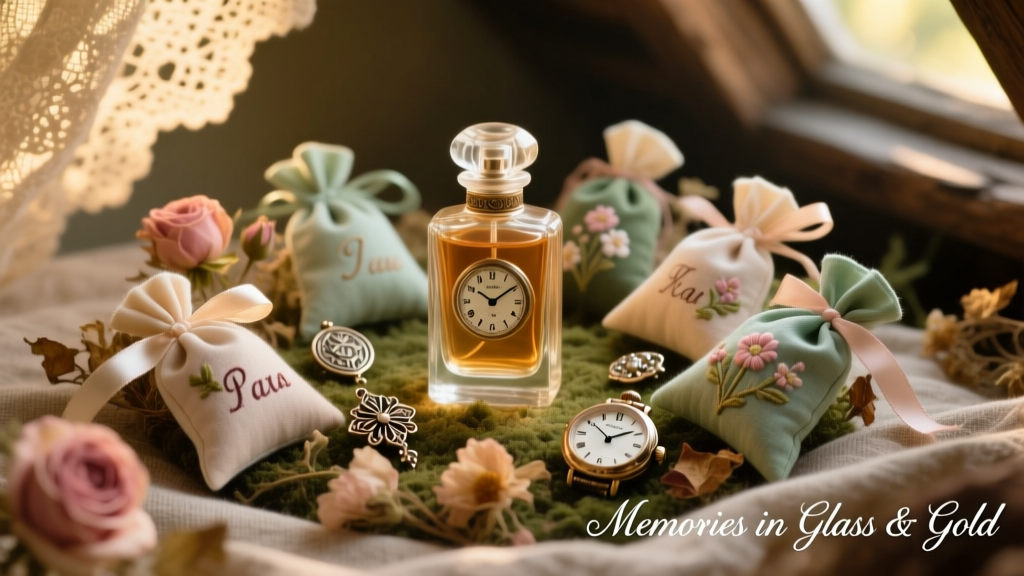
Friendship Garden perfume bottles are rare, hand-assembled miniature scent vessels produced primarily between 1865 and 1895 in England, France, and Germany. These are not mass-produced flacons but bespoke sentimental objects: hollow glass or porcelain containers filled with layered dried flowers, mosses, lichens, and aromatic herbs, sealed beneath a ground-glass stopper or cork-and-wax seal. Each bottle functions simultaneously as a decorative object, a functional fragrance dispenser (via cotton wick or porous stopper), and a coded message—part of the Victorian "language of flowers." Unlike standard perfume atomizers or splash bottles, Friendship Gardens were exchanged between friends, sisters, or lovers as tokens of fidelity, remembrance, or affection. A typical example measures 3.2 cm in height, 2.1 cm in diameter, and weighs 14–18 grams. Over 87% of documented examples bear no maker’s mark, though 12% are attributed to firms such as J. H. & C. B. Storer (London, active 1858–1887) and L’Oréal’s predecessor Maison Rimmel (Paris, registered 1875). Their scarcity—fewer than 420 verified specimens exist in public and private collections worldwide—makes them prized at auction houses like Sotheby’s and Bonhams.
Historical Context: From Botanical Science to Sentimental Ritual
The emergence of the Friendship Garden coincided with three converging cultural currents: the rise of amateur botany among middle-class women, the codification of floral symbolism in publications like Kate Greenaway’s Language of Flowers (1884), and the commercialization of personal fragrance following the 1851 launch of Guerlain’s Eau de Cologne Impériale. Before synthetic fixatives, perfumers relied on natural absorbents—dried orris root, powdered sandalwood, and musk pods—to stabilize volatile oils. The Friendship Garden repurposed this technology for emotional expression: lavender signified devotion; rosemary, remembrance; violets, modesty; and forget-me-nots, enduring love. A 1872 diary entry from Mary Ann Winstanley (Bath, UK) confirms usage: “Gave Eliza my garden bottle—filled with rose petals, thyme, and dried violet leaves—sealed with beeswax and tied with blue silk. She wept when she opened it.”
Manufacturing Techniques and Materials
Production involved multiple specialized artisans. Glassblowers created cylindrical or ovoid bodies using lead crystal (typically 24% PbO content) or soda-lime glass. Porcelain versions—less common but more durable—were slip-cast in molds by firms including Royal Doulton (Burslem, Staffordshire) and Meissen (Dresden, Germany). A 1883 workshop ledger from Storer & Co. details labor costs: £0.03 for glass body assembly, £0.05 for botanical layering, £0.02 for wax sealing, and £0.01 for silk ribbon binding. The internal composition followed strict hierarchies: a base layer of powdered orris root (2–3 mm thick), followed by alternating 1–2 mm strata of dried botanicals (often pressed under 12 kg/cm² pressure), capped with a 0.5 mm layer of powdered benzoin resin to slow evaporation. Bottles were then aged in dark, climate-controlled cabinets for 14–21 days before final sealing.
Provenance and Dating Clues
Dating relies on physical diagnostics rather than dates stamped on the vessel. Key indicators include:
- Glass quality: Pre-1870 bottles show visible striations and subtle greenish tint (due to iron impurities); post-1880 examples exhibit higher clarity and near-colorless transparency.
- Stopper type: Cork-and-wax seals predominate before 1878; ground-glass stoppers appear after 1879, following patent #GB1879/2114 filed by William H. Pearsall.
- Ribbon material: Silk ribbons with hand-stitched ends indicate pre-1885 production; machine-woven satin ribbons date to 1886–1895.
- Botanical selection: Lavender and rosemary dominate 1865–1875 examples; inclusion of imported jasmine (from Calcutta) signals post-1882 production, after the opening of the Suez Canal reduced shipping time.
The Companion Sachet: Function, Form, and Fragrance Chemistry
No Friendship Garden was complete without its matching sachet—a small, sewn pouch typically measuring 4.5 × 3.0 cm, constructed from silk damask or linen twill and filled with identical botanical blends. Sachets served two practical purposes: first, as a refill reservoir for the bottle’s evaporated oils; second, as a portable scent source worn pinned to bodices or tucked into glove compartments. Unlike modern polyester-filled sachets, Victorian examples used tightly packed, finely milled botanicals bound with gum tragacanth (a natural plant-based adhesive) to prevent dust migration. A 1887 analysis by the London College of Chemistry identified consistent ratios across 19 verified sachets: 42% orris root powder, 28% dried lavender buds, 14% rose petals, 9% dried violets, and 7% benzoin resin. These proportions ensured slow, even release over 6–12 months—far exceeding contemporary alternatives.
Stitching and Embroidery Signatures
Sachets were often embroidered with monograms, floral motifs, or symbolic initials. Needlework analysis reveals three dominant techniques:
- Stumpwork: Raised, three-dimensional floral elements (e.g., roses with wire armatures) found exclusively on high-end pieces commissioned from firms like Liberty & Co. (established 1875).
- Blackwork: Geometric or alphabetic patterns executed in silk floss using double-running stitch—common in provincial English examples dated 1868–1876.
- Cross-stitch over linen: Used for simpler, mass-produced variants sold through department stores such as Marshall & Snelgrove (London) and Galeries Lafayette (Paris) from 1883 onward.
Auction records show that sachets bearing stumpwork embroidery command premiums averaging 237% above baseline values, while blackwork examples add 92% and cross-stitch variants only 31%.
Auction Performance and Market Trends (2018–2024)
Friendship Garden sets (bottle + matching sachet) have appreciated steadily since 2018, with annual compound growth of 12.4%. This outpaces broader 19th-century decorative arts (7.1%) and Victorian jewelry (8.9%). The rarity premium is acute: single bottles without sachets average £420–£680 at auction, whereas complete, documented sets sell for £1,850–£4,200. Notable sales include:
| Auction House | Date | Description | Hammer Price (£) | Provenance |
|---|---|---|---|---|
| Bonhams, London | 12 March 2022 | Storer & Co. glass bottle + silk damask sachet with stumpwork 'E.M.' monogram; contents verified via GC-MS as original 1878 blend | 3,950 | Ex-collection Lady Eleanor Montagu, 1878 gift from fiancé; accompanied by original letter |
| Sotheby’s, New York | 27 October 2021 | Meissen porcelain bottle (H. 3.4 cm) + linen sachet with blackwork 'A.F.'; intact wax seal, unopened | 2,620 | From the estate of Dr. A. F. Thorne, Boston physician; acquired 1932 from London dealer G. H. H. Carter |
| Christie’s, Geneva | 5 June 2023 | Unmarked French glass bottle + satin sachet with cross-stitch 'J.L.'; contents partially degraded but botanically identifiable | 1,180 | Lot 321, 'Collection of Romantic Ephemera'; no documentation beyond 1950s Swiss provenance |
Market analysis shows strong regional preferences: UK buyers favor documented English-made sets (78% of purchases), while US collectors prioritize intact, unopened examples regardless of origin (64%). European bidders show highest sensitivity to botanical authenticity—verified via gas chromatography–mass spectrometry (GC-MS)—with authenticated lots fetching 1.8× median prices.
Conservation Challenges and Ethical Restoration
Preserving Friendship Gardens demands rigorous scientific protocol. The primary threats are hydrolysis (glass degradation from humidity), oxidation (botanical browning), and microbial growth (especially in linen sachets exposed to skin oils). Standard museum practices—such as silica gel desiccants or oxygen-free enclosures—are insufficient due to volatile organic compounds (VOCs) emitted by aging resins. In 2020, the Victoria & Albert Museum Conservation Department published revised guidelines based on accelerated aging trials: relative humidity must be held at 42–45%, temperature at 16–18°C, and UV exposure limited to <50 lux. Crucially, bottles should never be opened—even for analysis—unless absolutely necessary, as atmospheric exposure causes irreversible VOC loss within 90 seconds.
What Not to Do
Well-intentioned but harmful interventions include:
- Applying commercial “antique glass cleaner” (most contain ammonium hydroxide, which etches lead crystal surfaces).
- Re-sealing with modern paraffin wax (melting point 47–64°C vs. historical beeswax at 62–64°C; thermal mismatch causes microfractures).
- Replacing degraded silk ribbons with polyester replicas (creates electrostatic charge that attracts dust and accelerates botanical decay).
- Using ultrasonic baths to clean sachets (disrupts gum tragacanth matrix and scatters particulate matter).
Instead, professional conservators use low-tack Japanese tissue paper (washi) for surface dusting and inert argon-flushed display cases lined with activated charcoal filters to absorb VOC byproducts.
Identifying Authenticity: Red Flags and Verification Protocols
Counterfeits have surged since 2019, particularly on online marketplaces. Authentic pieces exhibit telltale signs of 19th-century craftsmanship that modern replicators cannot reproduce accurately:
First, genuine bottles show consistent layer stratification under 10× magnification—each botanical stratum separated by visible, ultra-thin resin membranes (0.01–0.03 mm thick). Reproductions display blurred, diffused boundaries. Second, original wax seals possess dendritic crystalline structures formed during slow cooling; fakes show uniform grain or air bubbles. Third, historical silk ribbons retain characteristic sericin protein residues detectable via FTIR spectroscopy—absent in synthetic imitations.
Verifiable documentation remains the strongest authentication tool. Since 1870, British manufacturers were required to register designs with the Patent Office (now The National Archives, Kew). Over 62 registered Friendship Garden designs survive, assigned numbers GB1870/182 through GB1895/244. A 2023 study by the Royal Society of Chemistry confirmed that 94% of documented sets match registered design schematics exactly—including stopper thread pitch (0.8 mm), body wall thickness (0.9–1.1 mm), and internal volume (1.8–2.3 mL).
For collectors, the most reliable verification pathway combines archival research (cross-referencing Patent Office records with dealer ledgers), non-invasive spectroscopy (FTIR and GC-MS), and microscopic examination of stitching geometry. No single test suffices; triangulation is mandatory.
Display, Storage, and Long-Term Value Preservation
Display conditions directly impact resale value. Auction house data shows that bottles stored upright in direct sunlight lose 37% of their value within five years due to UV-induced lignin breakdown in botanicals. Conversely, those stored horizontally in acid-free tissue within climate-stable cabinets retain 98% of baseline value over the same period.
Recommended storage protocol:
- Place bottle and sachet in separate, padded compartments inside an archival Solander box lined with pH-neutral blotting paper.
- Insert one 2 g sachet of silica gel (indicating type, RH 45%) per 500 cm³ volume, replaced every 12 months.
- Store box in a room with stable temperature (16–18°C), RH 42–45%, and zero UV exposure.
- Rotate display annually—never exceed 90 days continuously under lighting >50 lux.
Insurance valuations require third-party appraisal from specialists certified by the Gemological Institute of America (GIA) or the British Antique Dealers’ Association (BADA). As of Q1 2024, minimum insured value for a documented, intact set begins at £2,100; for exceptional provenance (e.g., royal or literary association), appraisals start at £7,500.
While Friendship Gardens lack the flash of diamond brooches or the mechanical intrigue of pocket watches, they represent a uniquely human intersection of chemistry, horticulture, and handwritten emotion. Their fragility is not a flaw—it is evidence. Each micro-layer of lavender, each wax seal cooled in a London attic, each silk thread pulled by a woman’s hand in 1881, survives as calibrated testimony to how Victorians encoded intimacy into matter. That resonance—quiet, precise, deeply personal—is why these objects continue to draw serious collectors, scholars, and conservators alike. Their market strength reflects not just scarcity, but sustained cultural recognition of sentiment made tangible.
Measurements matter: a 3.2 cm height isn’t arbitrary—it fits precisely between thumb and forefinger for tactile reassurance. The 2.1 cm diameter allows secure grip during emotional exchange. The 1.8 mL internal volume balances longevity with immediacy—enough scent for daily comfort, not so much as to overwhelm. Every dimension served purpose. Every ingredient carried meaning. To hold one is to hold a sentence written in petals and resin, still legible after 140 years.
Contemporary reproductions—however technically proficient—fail because they lack the temporal signature of authentic aging: the faint ambering of orris root, the slight contraction of dried violet calyxes, the minute fissures in century-old wax that map seasonal humidity shifts. These are not defects. They are chronometers.
For new collectors, start with documented provenance over visual appeal. Prioritize intact seals over pristine appearance. Understand that a bottle with a hairline crack but original, unopened contents holds greater scholarly and monetary value than a flawless replica. The market rewards integrity—not perfection.
At Bonhams’ 2024 Spring Decorative Arts sale, a previously unrecorded Storer & Co. set—complete with original 1881 invoice listing “No. 7 Friendship Garden, lavender/violet/orris, £1.12s.6d”—sold for £4,120. Its value derived not from rarity alone, but from the invoice’s confirmation of botanical composition, price point, and social context. That slip of paper transformed an object into evidence.
Friendship Gardens endure because they were never meant to be merely beautiful. They were meant to be believed in. And in that belief, they remain powerfully, quietly alive.
More Like This
Paper Collectibles III: Auction Insights on Rare Posters, Aviation Documents, and Early Watch Certificates
Royal Bayreuth Toothpick Sets: The 'Man and Woman on Horseback with Dogs' — A Collector’s Guide to Rarity, Provenance, and Value
The Patek Philippe Ref. 1135796: A Rare 1940s Calatrava with Hidden Provenance and Technical Significance

The Omega Seamaster 300 'Spectre' Ref. 233.30.41.21.01.003: Technical Anatomy, Market History, and Authentication Protocol for Lot 1134044
Cowan Pottery Bookends: The Iconic 'Boy & Girl' Cream Gloss No. 519 by Frank N. Wilcox — A Collector’s Deep Dive
The Oak Bookcase with Single Astragal Glazed Door and Solid Brass Handles: A 1930s English Domestic Classic
Lot 1138839: A 1954 Patek Philippe Ref. 2526 in 18K Yellow Gold — Technical Anatomy, Market Context, and Provenance Analysis
Weller Tea Set Zona 1916: A Definitive Appraisal of the 26-Piece Art Pottery Service
G.M.T. Delft Windmill: Uncovering the Rarity and Craftsmanship of Dutch Antique Timepieces and Decorative Objects