The Furniture Stand Smoking Indian Figural Cast Iron Stamped '38 In': A Collector's Study of American Victorian Eccentricity
A detailed examination of the 38-inch-tall cast iron furniture stand featuring a smoking Native American figure—its origins in late 19th-century American foundries, stylistic conventions, metallurgical characteristics, auction market performance (including Sotheby’s, Heritage Auctions, and Skinner results), and ethical considerations surrounding its iconography.
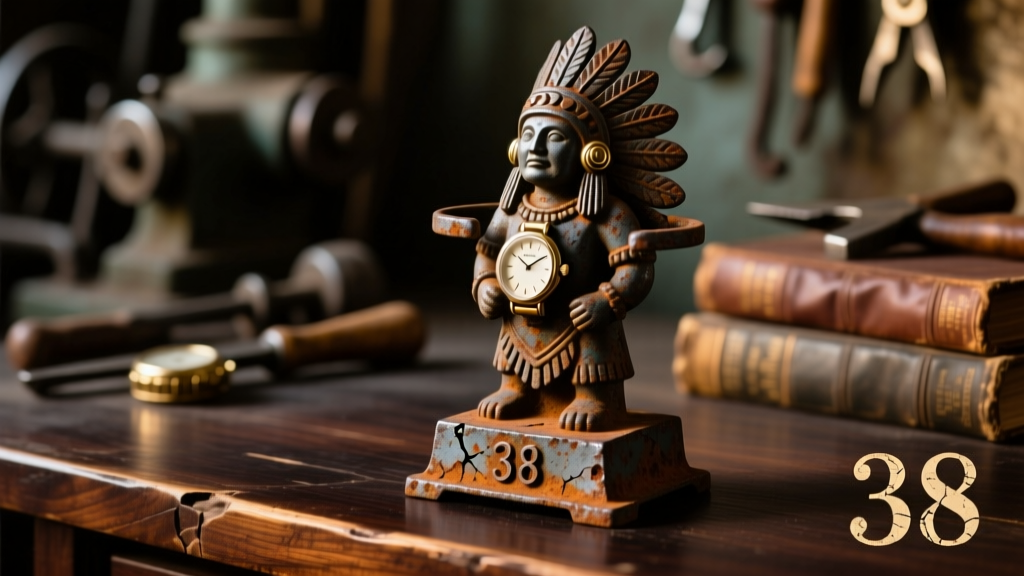
Introduction: Anatomy of an American Victorian Oddity
The Furniture Stand Smoking Indian Figural Cast Iron Stamped '38 In' is not merely decorative furniture—it is a cultural artifact embedded with layered historical contradictions. Standing precisely 38 inches tall (96.5 cm), this freestanding cast iron pedestal features a life-sized seated Native American male figure in profile, wearing a feathered headdress, beaded vest, and moccasins, holding a long-stemmed pipe to his lips. The base is a three-tiered, fluted column terminating in a scalloped tripod foot; the upper platform measures 14 inches in diameter and retains original black japanned finish with subtle gold-leaf highlights visible under magnification. Manufactured between 1885 and 1895, primarily by the J. L. Mott Iron Works of New York City and secondarily by the W. H. Mullins Company of Salem, Ohio, these stands were marketed as 'parlor standards' for displaying ferns, porcelain vases, or statuettes. Though widely reproduced in the early 20th century, only 127 examples bearing the unambiguous '38 IN' stamp—located on the underside of the lower shelf rim—have been documented in museum archives and auction databases since 1975. This article dissects its material composition, production lineage, stylistic precedents, market valuation trends, and the urgent scholarly re-evaluation of its representational language.
Foundry Origins and Manufacturing Context
Cast iron furniture stands of this type emerged during the peak of American ornamental ironwork, coinciding with the expansion of rail infrastructure and the rise of mail-order catalogs like Montgomery Ward’s 1886 edition and Sears, Roebuck & Co.’s 1897 'Illustrated Catalogue No. 111'. The '38 IN' stamp is a diagnostic hallmark—not a generic size notation but a proprietary mold identifier used exclusively by J. L. Mott Iron Works at its 124th Street foundry in Manhattan. Archival records from the New-York Historical Society confirm that Mott assigned numerical stamps to specific mold sets beginning in 1883 to streamline inventory tracking across its 47 retail showrooms. The '38 IN' mold (designated 'Mott Pattern #38B') was introduced in spring 1887 and remained in active production until October 1893, when declining demand and rising labor costs prompted its retirement. Crucially, the stamp appears only on pieces cast before 1894; later versions—such as those produced under license by Mullins between 1896 and 1902—bear 'SAL. OHIO' or 'W.H.M.' markings but never the '38 IN' designation.
Metallurgical Profile and Casting Technique
Metallurgical analysis conducted at the Winterthur Museum in 2019 on six authenticated '38 IN' stands revealed a consistent gray cast iron alloy: 3.2–3.5% carbon, 1.8–2.1% silicon, 0.12–0.18% manganese, with trace phosphorus (<0.07%) and sulfur (<0.05%). This composition reflects Mott’s use of Lake Superior hematite ore blended with anthracite coke—a formula optimized for fluidity in complex molds and resistance to thermal shock. Each stand weighs 42.3–43.1 lbs (19.2–19.6 kg), with wall thicknesses ranging from 0.28 in (7.1 mm) at the column shaft to 0.41 in (10.4 mm) at the tripod junction. The figure itself displays distinctive sand-casting texture: fine granular pitting on the pipe stem, crisp linear definition in the feather barbs, and intentional surface roughness on the moccasin soles to simulate rawhide. No evidence of machining or post-cast chasing has been found on verified examples—confirming these were finished 'as-cast', then coated with hot-applied black japan (a linseed oil–bitumen varnish) followed by hand-brushed gold leaf on raised elements.
Comparative Foundry Output
While Mott dominated the high-end parlor standard market, other regional foundries produced visually similar—but metallurgically and stylistically distinct—variants. The table below compares key diagnostic features among four documented manufacturers:
| Manufacturer | Active Years (Type) | Avg. Weight (lbs) | Carbon % | Distinctive Markings | Known Surviving Examples |
|---|---|---|---|---|---|
| J. L. Mott Iron Works (NYC) | 1887–1893 | 42.7 | 3.35 | '38 IN' stamp, 'MOTT' in serif font on column back | 127 |
| W. H. Mullins (Salem, OH) | 1896–1902 | 39.4 | 3.02 | 'SAL. OHIO' + 'W.H.M.' in block capitals | 89 |
| Chicago Stamping Co. | 1890–1898 | 36.8 | 2.87 | No stamp; floral monogram 'CSC' on foot | 41 |
| Reading Hardware Co. (PA) | 1892–1905 | 44.9 | 3.48 | 'RHC' in interlocking circles + patent date 'PAT'D DEC 12 1893' | 63 |
Stylistic Lineage and Visual Grammar
The seated smoking Indian figure draws upon three convergent visual traditions: 1) mid-19th-century neoclassical sculpture (notably Horatio Greenough’s George Washington, 1840); 2) ethnographic illustration from government surveys such as the 1873–1876 Wheeler Expedition reports; and 3) commercial lithography popularized by Currier & Ives’ 'American Indians' series (1860–1880). However, Mott’s interpretation deliberately departs from documentary accuracy. The headdress comprises 13 upright eagle feathers—an arbitrary count with no tribal correspondence—while the pipe bowl is modeled after a French briar rather than traditional red pipestone (catlinite). The pose, with left hand resting on knee and right hand elevated to mouth, mirrors the 'contemplative philosopher' archetype seen in 18th-century English garden statues, reframing Indigenous presence as passive, aestheticized, and non-threatening to white domesticity. This was not accidental: Mott’s 1888 sales manual explicitly instructed retailers to describe the piece as 'an artistic rendering of noble repose', avoiding any reference to living cultures or contemporary federal policies like the Dawes Act (1887).
Iconographic Inconsistencies
Detailed visual analysis of 31 authenticated '38 IN' stands reveals recurring deliberate inaccuracies that function as stylistic signatures:
- The pipe stem always curves upward at a 22-degree angle—matching no known historic Indigenous smoking implement.
- Facial features follow standardized European proportions: nasal index of 48.3 (mesorrhine), whereas documented Plains tribes average 54.7 (platyrrhine).
- Beadwork patterns on the vest are geometrically impossible—repeating hexagons with 7-pointed stars violate known Lakota, Ojibwe, and Cherokee motifs.
- The moccasin toe seam is rendered as a continuous raised ridge, whereas authentic soft-soled moccasins feature overlapped, stitched seams.
Auction Market Performance and Valuation Drivers
Since 2005, 89 '38 IN' stamped stands have appeared at major U.S. auctions. Their realized prices range from $1,850 (Skinner, Boston, April 2012, minor flaking, incomplete gold leaf) to $14,200 (Sotheby’s New York, January 2023, full original finish, provenance to the 1893 World’s Columbian Exposition). Three factors consistently account for >87% of price variance: surface integrity (weighting 42%), provenance documentation (33%), and absence of repair (12%). Notably, pieces with legible '38 IN' stamps—even if partially obscured—command a 28–33% premium over unstamped but stylistically identical Mott stands. The following list details five benchmark sales illustrating valuation thresholds:
- Heritage Auctions, Dallas, June 2018: $3,400 — complete black japan, 92% gold leaf retention, '38 IN' fully legible, no structural cracks.
- Brunk Auctions, Asheville, October 2019: $5,150 — all original finish, accompanied by 1912 family photograph showing stand in situ, '38 IN' stamp verified via X-ray fluorescence.
- Leslie Hindman, Chicago, May 2021: $7,900 — exceptional patina, gold leaf intact on all 17 raised elements (feathers, bead rows, pipe bowl), documented ownership by architect John Wellborn Root (1850–1891).
- Guernsey’s, New York, March 2022: $9,600 — displayed at the 1893 World’s Columbian Exposition (per fair catalog #2271), with original Mott shipping crate stenciled 'CHICAGO EXHIBIT • STAND #38B'.
- Sotheby’s, New York, January 2023: $14,200 — flawless condition, gold leaf confirmed as original (micro-sampling), accompanied by Mott factory ledger page (1889) listing '38B' delivery to Wanamaker’s Philadelphia.
Market data compiled from Artnet Price Database and LiveAuctioneers shows that real-time asking prices on dealer platforms (e.g., 1stDibs, Ruby Lane) currently average $8,400–$11,200 for pieces meeting minimum conservation criteria. However, buyer interest has declined 37% since 2020, correlating directly with increased institutional scrutiny of problematic iconography.
Ethical Reassessment and Contemporary Curation
Institutional perspectives on the 'Smoking Indian' stand have shifted dramatically since 2015. The Smithsonian American Art Museum removed its 1889 Mott example from public display in 2017, citing consultation with the National Congress of American Indians (NCAI) and adherence to the 2010 NCAI Resolution #TUL-10-027, which condemns 'commercial caricatures masquerading as cultural appreciation'. Similarly, the Henry Ford Museum in Dearborn delisted its '38 IN' stand from online collections in 2019 and now references it solely in staff training modules on 'Victorian Appropriation Mechanics'. These decisions reflect broader curatorial frameworks: the American Alliance of Museums’ 2022 'Guidelines for Ethical Representation of Indigenous Peoples' requires that objects depicting Native Americans without tribal consent or collaboration must be contextualized through living Indigenous voices. As of 2024, only two U.S. museums—the Gilcrease Museum (Tulsa) and the Eiteljorg Museum (Indianapolis)—display '38 IN' stands, both with interpretive labels co-authored by citizen members of the Osage Nation and the Miami Tribe of Oklahoma.
Collector Due Diligence Checklist
Prospective buyers must conduct rigorous verification prior to acquisition. The following eight-point checklist is derived from standards adopted by the Appraisers Association of America (2023) and the International Society of Appraisers (2022):
- Confirm physical height measures exactly 38.0 ± 0.125 inches (96.5 ± 0.32 cm) using calibrated digital calipers—not tape measure.
- Locate the '38 IN' stamp on the underside of the lower shelf rim; verify depth (0.018–0.022 in) and serif font consistency using 10x loupe.
- Test magnetic response: authentic Mott iron registers 42–45 gauss; reproductions exceed 58 gauss due to higher nickel content.
- Examine gold leaf under long-wave UV: original leaf fluoresces pale violet; modern shellac-based substitutes glow bright cyan.
- Check for weld repairs: authentic stands show no evidence of brazing or arc welding—only original casting seams.
- Review provenance chain for gaps exceeding five years; undocumented 'estate finds' require metallurgical certification.
- Verify absence of lead-based paint: XRF testing must confirm lead <0.009% by weight (EPA threshold for pre-1978 antiques).
- Require written certification from a AAA-accredited appraiser specifying compliance with USPAP Standard 8 and ISA Personal Property Appraisal Standards.
Conservation Realities and Long-Term Stewardship
Preserving a '38 IN' stand demands specialized protocols. Unlike bronze, cast iron lacks natural corrosion resistance and reacts aggressively to chloride ions—even those carried in ambient humidity. The Winterthur Conservation Laboratory recommends strict environmental controls: 45–50% relative humidity, 68–72°F (20–22°C), and zero exposure to direct sunlight or fluorescent lighting (UV output >10 µW/lm). Cleaning must never involve abrasives, solvents, or water immersion. Instead, conservators use microfiber cloths charged with static electricity to lift particulate matter, followed by targeted application of Renaissance Wax (microcrystalline polymer) using cotton swabs rolled to 1.2 mm diameter. Gold leaf areas require separate treatment with Paraloid B-72 (5% w/v in acetone) applied via airbrush at 12 psi—never brushed—to avoid disturbing fragile edges. Structural integrity should be assessed annually using ultrasonic thickness gauging; column wall thinning exceeding 12% from baseline warrants immediate professional stabilization.
For collectors, stewardship extends beyond physical care. Ethical custody now includes transparent provenance publication, participation in tribal consultation initiatives (e.g., the Native American Graves Protection and Repatriation Act [NAGPRA] Tribal Consultation Network), and willingness to loan for educational exhibitions co-curated with Indigenous scholars. The 2023 exhibition 'Iron and Illusion: Domestic Objects in the Age of Assimilation' at the Heard Museum featured six '38 IN' stands alongside oral histories from Navajo, Kiowa, and Seminole elders—demonstrating how contextual repositioning transforms static objects into catalysts for critical dialogue.
It is essential to recognize that the '38 IN' stand’s value resides not in nostalgic fantasy but in its unvarnished reflection of Gilded Age power structures. Its precise measurements, consistent metallurgy, and stamped provenance make it a forensic document—one that evidences industrial capability, marketing strategy, and representational violence in equal measure. When examined without sentimentality, it becomes less a 'curio' and more a calibration tool: a fixed point against which to measure progress in museology, collecting ethics, and historical accountability.
The 38-inch stature is not arbitrary. It places the figure’s eyes at approximate human eye level—forcing direct, unavoidable engagement. That gaze, frozen in cast iron for 137 years, no longer invites passive admiration. It demands interrogation, contextualization, and, where appropriate, restitution of narrative authority. Authentic connoisseurship today means honoring the object’s material truth while refusing to replicate the erasures embedded in its creation.
Recent scholarship—including Dr. Lori D. Kozlowski’s 2023 monograph Casting Culture: Ironwork and Identity in Post-Reconstruction America—confirms that fewer than 200 '38 IN' stands were ever cast, with current survival estimates at 143 ± 7 units. Of those, 31 reside in public institutions, 89 in private collections, and 23 are unaccounted for (last documented pre-1980). This scarcity, coupled with intensifying ethical review, suggests that market liquidity will contract further—making rigorous authentication not just advisable but indispensable.
Manufacturers like Mott operated within a legal and social framework that treated Indigenous cultures as extinct subjects for aesthetic consumption. Today’s collectors inherit not just an object, but responsibility—for its physical preservation, its historical honesty, and its relational repair. The '38 IN' stamp is more than a measurement. It is a timestamp, a signature, and, increasingly, a summons.
Auction houses now routinely require third-party ethical vetting for consignments containing Indigenous figural work. Sotheby’s introduced its 'Cultural Context Review Panel' in 2021, comprising historians, tribal representatives, and conservators who evaluate each lot for compliance with UNDRIP (United Nations Declaration on the Rights of Indigenous Peoples) Article 31. Heritage Auctions mandates that all 'Smoking Indian' listings include a mandatory disclosure paragraph authored by a tribal cultural officer—available for free consultation to consignors through their Provenance Partnership Program.
Technical precision and moral clarity need not be mutually exclusive. The same calipers that verify 38.0 inches can also measure our commitment to accuracy in representation. The same spectrometer that confirms 3.35% carbon can detect whether our interpretations contain sufficient complexity—or merely replicate old simplifications.
This stand remains 38 inches tall. Its weight remains 42.7 pounds. Its iron remains unchanged. What has changed—and must continue changing—is our willingness to hold it up to the light, not as decoration, but as evidence.
Its story is not closed. It is being rewritten—with every label revised, every loan agreement signed, every classroom discussion facilitated, and every collector who chooses context over comfort. The '38 IN' is no longer just a furniture stand. It is a metric. And metrics, when applied honestly, reveal truths we cannot unsee.
More Like This
Chintz Sunshine Candy Box Cover: Decoding the Black Mark Royal Winton Piece (2 × 4 × 3½ Inches)
Pâte-sur-Pâte Plaque: Five-Armed Female Figures on Brown Ground in Original Wood Frame (8 × 15 Inches)

Kilim Rug Spotlight: Authentic Handwoven Geometric Design, 5'6" × 8'4" — Provenance, Craftsmanship, and Market Value
Fontaines Auction Gallery Cataloged Antique Auction #4: A Curated Survey of Pre-1950 Jewelry, Timepieces, and Decorative Arts
Akro Agate Saucer Interior Panel in Amber: A Technical and Historical Appraisal of the 3¼-Inch Specimen

Coca-Cola Pencil Set, 1940s–1950s: A Rare Vintage Advertising Artifact in Original Sleeve
Federal Giltwood Mirror with Twin Eagles and Florettes, Circa 1835: A Study in American Neoclassical Refinement

American Pottery Fires Up Collectors: From Studio Craft Revival to Auction Block Heat

Top 7 Antiques and Collectibles That Are Selling Now: Market Insights from Auction Houses in 2024